The Prospect of a U.S. Military Strike
The prospect of a US military strike against Iran over its violent crackdown on protests has laid bare a shift in Middle East geopolitics—one marked by the unexpected upending of long-standing rivalries between Iran and regional powers such as Saudi Arabia and Turkey.When protests erupted in Iran on December 28, 2025, few anticipated that they would reveal deep-seated geopolitical anxieties in Riyadh and Ankara. As the demonstrations spread across the country and drew warnings from US President Donald Trump of possible military intervention in support of the protesters, Saudi Arabia and Turkey—along with Qatar and Oman—unexpectedly rallied behind the Iranian regime, primarily due to concerns about the potential consequences of a regime change in Iran.To be fair, prior to the Iranian protests, relations between Tehran and its rivals Riyadh and Ankara were not tense; in fact, they were moving toward closer engagement, with Saudi Arabia following up on the Chinese-brokered agreement with Iran and Turkey even planning a presidential visit. The protests, by highlighting the fragility of Iran’s political order, triggered new threat perceptions in Saudi Arabia and Turkey, leading both countries to lobby the Trump administration to refrain from military action against Iran.While Turkey and Saudi Arabia hold differing views on Iran, they share a rarely highlighted concern: Israel’s potential influence in a post-Islamic Republic Iran. Both initially assessed that the protests were unlikely to topple the regime, yet the emergence of Reza Pahlavi—and his January 8–11 calls that drew massive crowds to the streets—heightened their anxieties. Monarchist chants calling for the return of the Pahlavi dynasty dominated the protests.Reza Pahlavi, who has built strong relations with Israel, is far from a unifying figure in Iran’s polarized political landscape. His rise has unsettled non-Persian communities and devout segments of the population. Yet, from the perspectives of Saudi Arabia and Turkey, the surge of pro-Pahlavi chants across Iran suggested that Israel and the United States could expand their influence if the regime were to collapse. Amid the protests in Iran, Turkish Foreign Minister Hakan Fidan went so far as to accuse Israel of orchestrating the unrest, highlighting Ankara’s deep concerns about instability in Tehran. Notwithstanding, Saudi Arabia and Turkey were almost certain that Iranian protests, if left to their own devices, would not succeed in toppling the Iranian regime. US threats of a potential military strike in support of the protesters, however, radically changed risk assessments in Riyadh and Ankara.Depending on how the situation in Iran evolves, the alliance of the ‘elders’ may soon be challenged by an emerging bloc of younger Middle Eastern states—comprising the UAE, Israel, and the Republic of Azerbaijan—smaller states that share a convergence of strategic interests in Iran and beyond.So far, the US president’s decision to dial down threats of military action against Iran has contributed to preserving the status quo in the Middle East, especially after the Islamic Republic violently quelled protests. However, a significant military strike against Iran could open the door to profound geopolitical shifts across the region.Said Khanafira, (doctoral researcher, Simon Fraser University, Canada) Geopolitical Monitor
 |
| Reza Pahlavi, Geopolitical Monitor |
"Hopefully, Iran will quickly 'Come to the Table' and negotiate a fair and equitable deal -- NO NUCLEAR WEAPONS -- one that is good for all parties.""Time is running out, it is truly of the essence!""The next attack will be far worse [than that of the summer of 2025]."U.S. President Donald Trump"Iran stands ready for dialogue based on mutual respect and interests -- BUT IF PUSHED, IT WILL DEFEND ITSELF AND RESPOND LIKE NEVER BEFORE!"Iranian Embassy in Washington
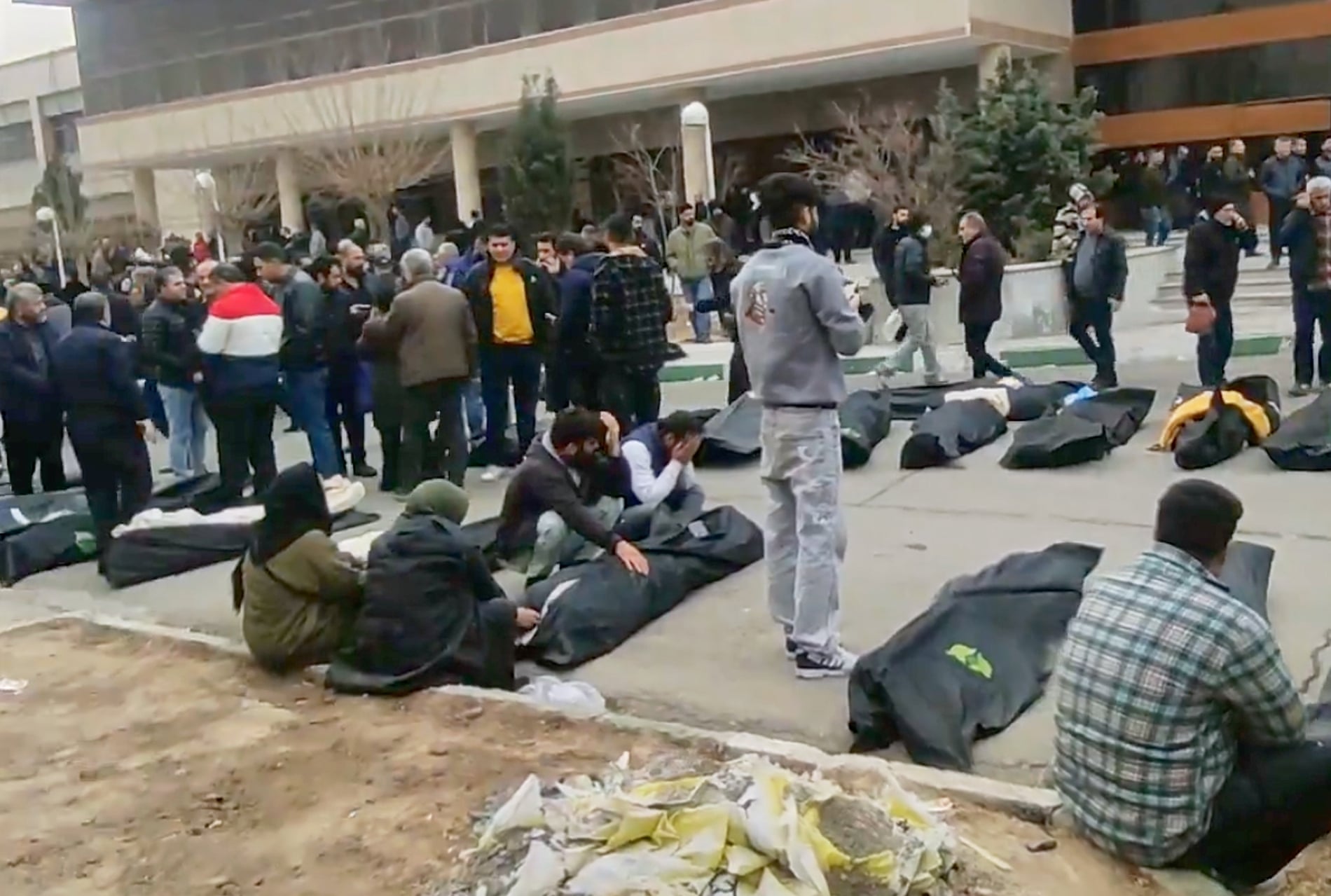 |
| A screen grab from a video taken between 9 and 11 January purportedly showing dozens of bodies outside a morgue in Kahrizak on the outskirts of Tehran, Iran's capital. Photograph: AP |
Appealing
to Muslim states in the Middle East, a desperate Iran has reached out
in a manner totally unlike its usual cloistered relations with majority
Sunni Arab states, as the sole non-Arab Muslim state in the region. The
Damocles Sword of an imminent attack by the United States on the Persian
Islamic Republic has generated panic among the mullahs of the regime.
Attacked by their own persecuted population over economic hardships that
ignited a protest against the sinking value of the rial and the rising
cost of living, the bloody crackdown by the regime drew the ire of the
Trump administration articulating a red line whose crossing would bring
the regime's downfall.
The
world has witnessed a number of widespread populist uprisings in the
Islamic Republic of Iran. All of which were met with violence committed
by the Basij and components of the Iranian Republican Guard Corps,
ideologically-driven to stifle protest by all means that could be
deployed through military-style intervention, while the Iranian Police,
committed to the welfare of their country but informed through the
metric of public order and security may have dealt less harshly with the
protesting public.
The
deaths of thousands of protesting civilians in outbursts taking place
throughout the country, in each of its cities where vulnerable courage
has met implacable denial, first with conventional crowd-control
measures and threats for people to return to their homes, then
increasingly with deadly fire, has captured the notice of the world,
with videos, photographs and personal accounts reaching the outside
world until the regime closed down the internet and peoples' modes of
communication were slammed shut.
Threats
by President Donald Trump of wartime measures his country would take to
defend the protest movement should the massive death count continue,
and hanging of protesters proceed as threatened by Iran's judiciary,
have had their impact. Fear of an invasion has shattered the level of
bombast-confidence that usually issues from the regime's elite
government circles. With an attack impending should Trump finally make
that decision, Saudi Arabia and the UAE let it be known their air or
ground or sea space would be off limits for any U.S. attack on Iran.
 |
| Photo provided by the U.S. Navy shows a Boeing F/A-18E Super Hornet landing on the Nimitz-class aircraft carrier USS Abraham Lincoln in the Indian Ocean on Jan. 22, 2026. (Mass Communication Specialist Seaman Daniel Kimmelman/U.S. Navy via AP) |
The
USS Abraham Lincoln has been moved to the region along with a number of
guided missile destroyers whose utility can be achieved though simply
launching attacks from the sea. The American armada that has moved into
position is prepared to achieve any goal commanded by the White House.
With communications cut off, it is no longer possible to receive
reliable information on killing of peaceful demonstrators and mass
execution of detainees.
Iranians
have been ordered to remain in their homes. There have been reports of
wounded being taken out of hospitals or shot in hospitals by the
regime's enforcers. People have been forced to pay a ransom to receive
the bodies of their loved ones, and not all have the wherewithal to
retrieve the bodies for a funeral to take place leaving the families in
the double grip of the desolate grief of deprivation. State media now
refer to the protesters as 'terrorists', the preferred term of the
regime.
"I feel that my generation failed to give a better lesson to younger ones.""The result of decades of teaching by my colleagues and me led to deaths of thousands, and maybe more injured and prisoners."Mohammad Heidari, Tehran teacher
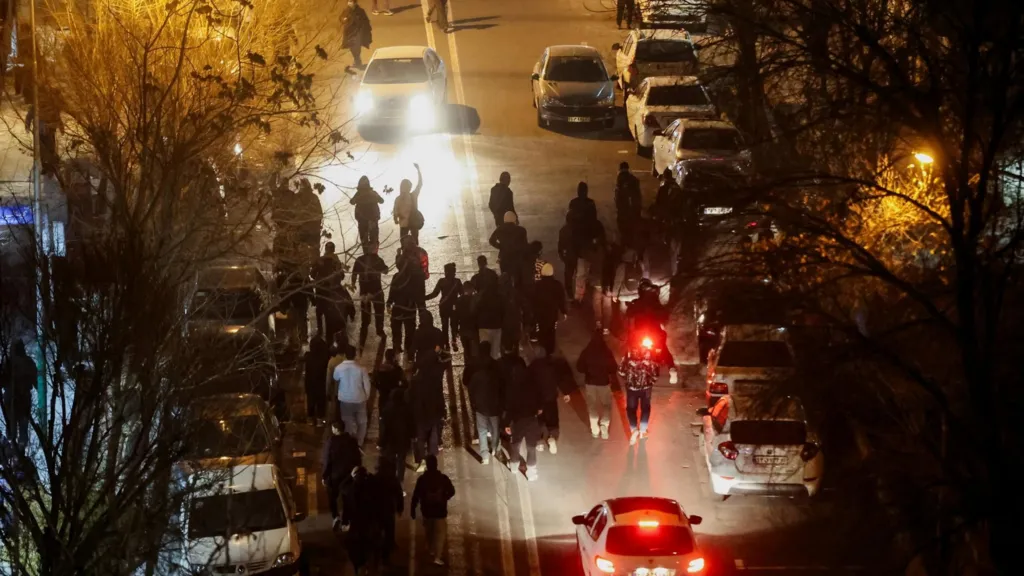 |
| Iranian authorities responded with lethal force as the protests in Tehran escalated on 8 January Wana via Reuters |
Labels: Islamic Republic of Iran, Mass Protests, Regime Crackdown, Thousands Dead/Wounded/Imprisoned, U.S. Threat
posted by Pieface @ Friday, January 30, 2026


<< Home