Honouring Those to Whom Honour is Due
"I believe that in the geopolitical circumstances I was taking office ... the threats to the North were actually quite serious."
"I think I've been borne out in that regard, I didn't anticipate that being our southern neighbour."
"I
think the reality is, the federal government manages this country
right, puts the stress on unity and not on ideological tangents, and
there's no reason why we can't pull the country together at this
moment."
Former Canadian Prime Minister Stephen Harper
"During
his tenure as prime minister, Mr. Harper emphasized the importance of
Arctic sovereignty to Canada, foreshadowing recent geopolitical
developments in that region."
"His
government oversaw the creation of Canada's first urban national park
in the Rouge Valley, protected Sable Island as a national park reserve,
expanded Nahanni National Park and created Naats'ihch'oh National Park
in the Northwest Territories."
Royal Canadian Geographic Society press release
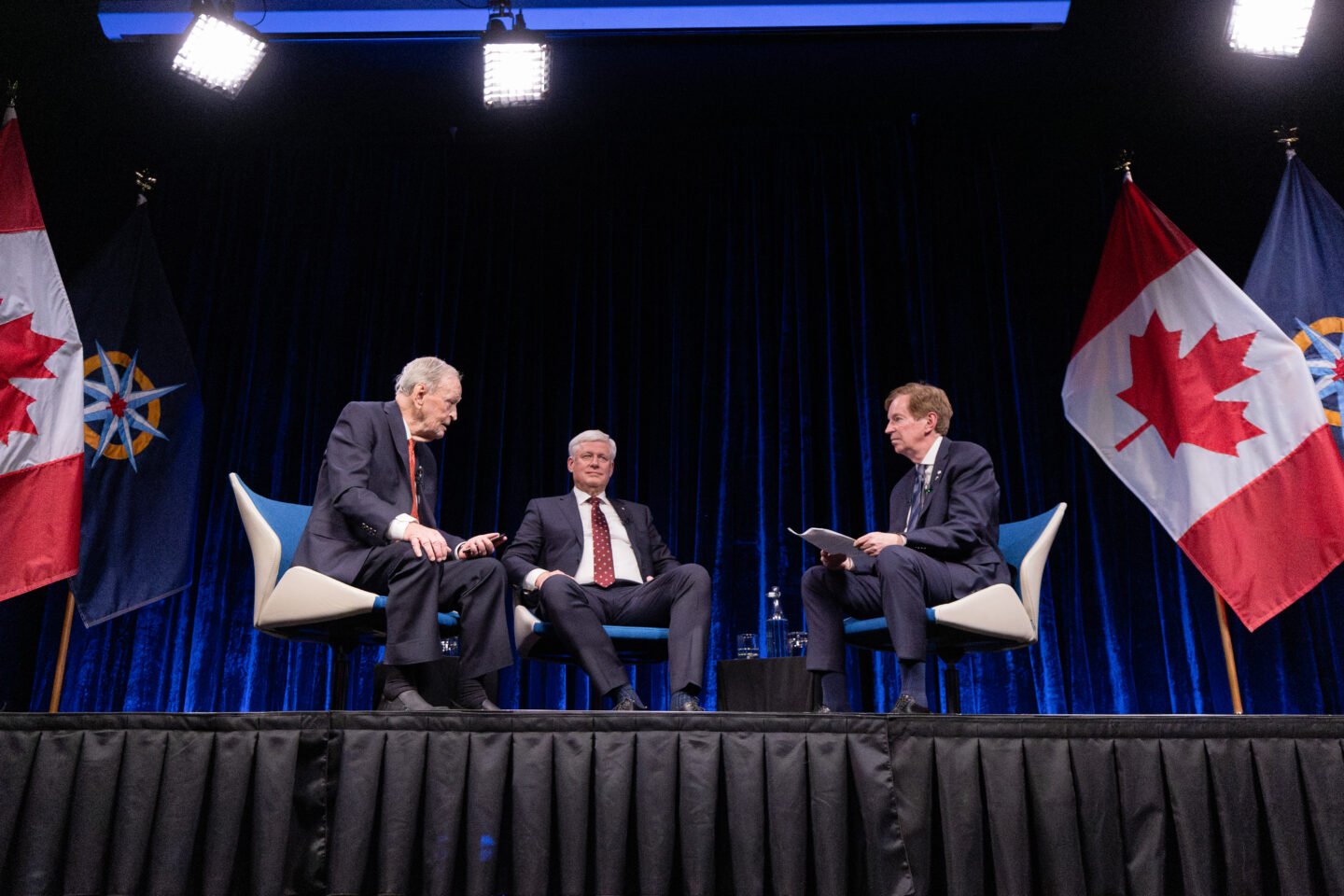 |
| Former prime ministers Jean Chrétien, left, and Stephen Harper, centre,
take part in a discussion of Canadian unity moderated by RCGS CEO John
Geiger. (Photo: Charlie Woolf/Can Geo) |
When
Stephen Harper was Canada's Conservative prime minister in three
governments; a minority and two majorities, he focused on the Canadian
Arctic and the need to protect it. At that time it was primarily Russia (and China) who
contested Canada's boundaries in the Canadian Arctic. Russia began the
militarization of the Russian Arctic, restoring old Siberian military
bases, expanding and stationing Russian military operatives there. It
claims the Lomonosov Ridge gives Russia entitlement over areas of the
seabed allocated to Canada and Denmark.
Suddenly,
it appears that although Russian claims while not diminished, have been
pushed back somewhat in light of the Trump administration's claims that
for security purposes against the malign intentions of Russia and China
make it imperative for the United States to claim Denmark's Greenland
as a protectorate of the U.S., to give it sole authority over the
island, while casting the same type of ownership claims over the
Canadian Arctic.
Mr.
Harper, speaking on a panel at the Royal Canadian Geographic Society
described his concerns over the necessity to reinforce Canada's Northern
sovereignty. At the time he could never have envisioned that a threat
to Canada's sovereignty in the North would emanate from the United
States. Yet, there it is: U.S. President Trump argues for greater U.S.
military presence in the Arctic, and where Greenland was involved, went
so far as to suggest military action to achieve his goal. That threat of
expansionism is interpreted by many, to include Canada's northern
territories.
As
sea ice recedes, routes through the North West Passage presage a new
era of shipping in routes from the Atlantic to the Pacific. Mercantile
trade worldwide will be affected, and Northern nations stand to benefit
from the potential easing of maritime routes in trade opportunities,
which is precisely what has lured China to stake its own claim as a
'near-Arctic' (laughable as it is) stakeholder. Russia is
prepared to begin mining for the natural resources known to entice
interests from natural gas to minerals.
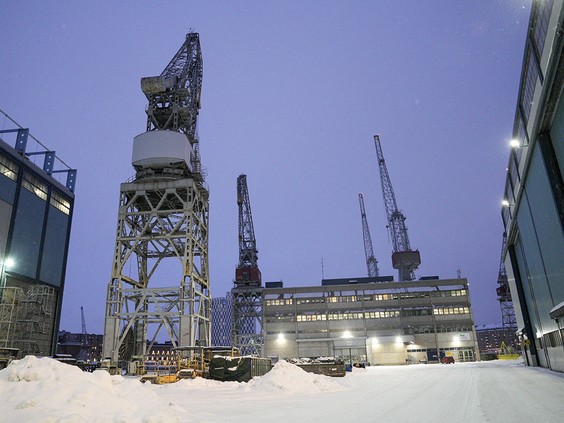 |
| A view of Canadian-owned Helsinki Shipyard in Helsinki, Finland, on Jan. 28, 2026. Photo by Alessandro Rampazzo/AFP via Getty Images |
Canada
now is alert to a changing world order, and Mr. Harper exhorted the
need to defend the nation's land, airspace and waterways, on its own, no
longer depending on its neighbour to the south to respect its
territorial integrity. He had ordered Arctic icebreakers to be built for
Canada. The occasion of Mr. Harper's speech was linked to the
Geographical Society's honouring the former prime minister with a gold
medal to celebrate his outstanding public service on the 20-year
anniversary of his first of three election wins that brought him to the
prime ministership.
A
few days later another event took place on Parliament Hill, the hanging
of the former prime minister's official portrait. At that event he
urged political parties to recognize the need for unity at this critical
time in Canada's history; to work against "external
forces that threaten our independence and against domestic policies
that threaten our unity. We must preserve Canada, this country handed
down to us by providence, preserved by our ancestors, and held in trust
for our descendants."
"He
served as prime minister of Canada for nearly a decade -- the
sixth-longest tenure in our history -- leaving an extensive record of
policy and legislative accomplishments."
"In a political climate increasingly buffeted by noise, he brought composure, intellect and decisiveness to public life."
Liberal Prime Minister Marc Carney
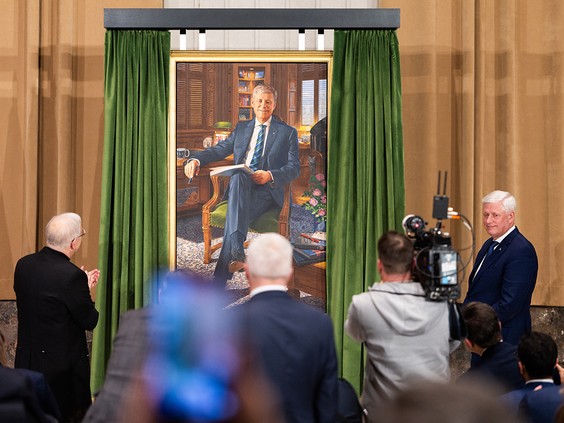 |
| Former prime minister Stephen Harper, right, at the
unveiling of his official portrait during a ceremony in Ottawa, on
Tuesday, Feb 3, 2026. Photo by HYUNGCHEOL PARK/Postmedia |
Labels: Canadian Arctic, Former Prime Minister Stephen Harper, Gold Medal, Official Portrait, Royal Canadian Geographical Society, Sovereignty
Uprising in Kazakhstan ... Control Re-Etablished in Kazakhstan
"For us it’s absolutely mandatory to make sure that Ukraine never,
never, ever becomes a member of NATO. We do not trust the
other side.”
"We need iron-clad, waterproof, bulletproof, legally binding
guarantees. Not assurances, not safeguards, guarantees with all the
words ‘shall, must’, everything that should be put in, ‘never ever
becoming a member of NATO’. It’s a matter of Russia’s national
security."
"Unfortunately we have a great disparity in our principled approaches to
this. The US and Russia in some ways have opposite views on what needs
to be done."
Russian Deputy Foreign Minister Sergei Ryabkov
"The events in Kazakhstan are not the first and not the last attempt at
interfering in the internal affairs of our states from the outside."
Russian President Vladimir Putin
"[The demonstrations were instigated by] terrorists [with foreign backing]."
"[I will reveal to the world] additional evidence [of a] terrorist aggression
[against Kazakhstan.The demands of peaceful protesters
have been] heard and met by the state [and the unrest that followed
involved] groups of armed militants [whose goal was to overthrow the
government]."
"What kind of talks can we hold with criminals and murderers?"
"We
had to deal with armed and well-prepared bandits, local as well as
foreign. More precisely, with terrorists. So we have to destroy them,
this will be done soon."
Kazakhstan President Kassym-Jomart Tokayev
"The situation has been stabilized in all regions of the country."
"A
number of strategic facilities have been transferred under the
protection of the united peacekeeping contingent of the CSTO [Collective
Security Treaty Organization] member states."
Presidential Office statement
 |
| A crane loads a military truck, which was burned during clashes onto the
platform in Almaty, Kazakhstan, Sunday, Jan. 9, 2022. (Vladimir
Tretyakov/NUR.KZ via AP) |
Russian
President Putin and Kazakhstan President Kassym-Jomart Tokayev may be
singing out of different hymnals. Both speak of 'terrorist' and foreign
influence involvement in the recent violence taking place in Kazakhstan
following peaceful protests against the government. But while Mr. Putin
considers the United States and NATO's malign influence in the region
the cause of unrest, Mr. Tokayev seems to feel otherwise pointing to the
involvement of "mostly Central Asian countries, including Afghanistan," and some from Mideast nations.
Strange
business this, apprehending an insurrection, accusing foreign elements
and 'terrorists' of invading and leading an insurrection, yet taking
draconian steps on the part of the government to arrest the nation's top
security officials for what effectively amounts to treasonous
activities. There's an echo here of Ukraine, with its still-ongoing
conflict with ethnic Russian Ukrainians in the east of the country
intent on taking possession of the Donbas as, effectively, Russian
territory.
In
essence, Russian troops invaded eastern Ukraine and fought alongside
Russian-Ukrainians leading to Moscow taking possession of Ukrainian
territory when it secured the Crimean Peninsula into Greater Russia,
violating Ukraine's sovereign territory and scheming to take Mariupol to
secure a more direct link for itself to Crimea. In this instance, the
reverse has occurred where internal strife in Kazakhstan with citizens
rising against a corrupt government turned violent and Russia intervened
to save a post-Soviet ally's sovereignty.
A
Central Asian country that, given its rich market of natural resources
of oil and uranium bringing international investment of huge proportions
basks in wealth, but little of it, unsurprisingly, given the autocratic
nature of its government, trickles down to the population. The original
protest arose when the price of fuel rose and the population smarted
with indignation. The reversal that quickly followed to appease the
anger fizzled, however, people's aggrieved state at their governance
continued and when the military used violent tactics the protesters
responded in kind.
An
estimated 8,000 people have been detained and imprisoned after the
torching of public buildings and reciprocal killings between protesters
and security forces. President Tokayev had issued shoot-to-kill orders
to end the violence caused by "bandits and terrorists". A controversial
figure of 164 killed during the riots is being contested, caused by the
clashes between protesters and security agents. President Tokayev
invited Moscow to help tamp down the insurrection.
The
Kremlin responded by calling into action the alliance of ex-Soviet
states, the Collective Security Treaty Organization. Well, isn't that
interesting, somewhat reminiscent of the North Atlantic Treaty
Organization whose creeping presence in eastern Europe which Vladimir
Putin considers Russia's 'near abroad' is a matter of such consternation
to Russia. Member states of the CSTO sent in their battalions and the
violence subsided, wearing itself out in the presence of tanks,
armaments and soldiers.
Now,
Kazakhstan's president is anxious that the CSTO and Russia in
particular vacate his country, thank you very much. Mr. Tokayev is
prepared to settle his nation's own internal conflict and consolidate
his authority, separating his rule from that of his corrupt predecessor
who has now resigned all holdover posts and whose spokesperson said: "[He]
and the head of state have always been 'on the same side of the
barricades' ... In these difficult days they have demonstrated the
monolithic nature of state power for all of us"; and that the population must rally around President Tokayev.
As
a first order of business he awarded 'prizes' for bravery to the 16
police and army officers who were killed in the violence. "The counter-terrorist operation ... will be continued until the complete elimination of the terrorists",
promised Deputy Defence Minister Sultan Gamaletdinov. According to
Russian paratrooper commander Andrey Serdyukov, the CSTO force completed
its deployment to Kazakhstan and is preparing to remain until complete
stabilization is assured.
Labels: Corruption, Kazakhstan, Russia, Sovereignty, Ukraine, Violent Protests
All The News That's Fit To Print About China
"China’s construction of nearly 250 new silos has serious implications
for international relations and China’s role in the world. The Chinese
government has for decades insisted it has a minimum deterrent and that
it is not part of any nuclear arms race. Although it remains unclear how
many silos will actually be filled with missiles, the massive silo
construction and China’s other nuclear modernization programs are on a
scale that appears to contradict these polices: the build-up is anything
but “minimum” and appears to be part of a race for more nuclear arms to
better compete with China’s adversaries."
"The silo construction will
likely further deepen military tension, fuel fear of China’s intentions,
embolden arguments that arms control and constraints are naïve, and
that US and Russian nuclear arsenals cannot be reduced further but
instead must be adjusted to take into account the Chinese nuclear
build-up.?
"The disclosure of the second Chinese silo missile field comes only
days before US and Russian negotiators meet to discuss strategic
stability and potential arms control measures. Responding to the Chinese
build-up with more nuclear weapons would be unlikely to produce
positive results and could cause China build up even more. Moreover,
even when the new silos become operational, the Chinese nuclear arsenal
will still to be significantly smaller than those of Russia and the
United States."
"The clearest path to reining in China’s nuclear arsenal is through
arms control, but this is challenging. The United States has been trying to engage China on nuclear issues
since the late-1990s, but so far with minimal success. Rather than
discuss specific limitations on weapon systems, these efforts have been
limited to increasing transparency about force structure plans and
strategy, and well as discussing nuclear doctrine and intentions."
"The Trump administration correctly sought to broaden nuclear arms
control to include China, but fumbled the effort by turning it into a public-relations pressure stunt
and insisting that China should be part of a New START treaty
extension. Beijing not surprisingly rejected the effort, and Chinese
officials have plainly stated
that “it is unrealistic to expect China to join [the United States and
Russia] in a negotiation aimed at nuclear arms reduction,” particularly
while China’s arsenal remains a fraction of the size."
Matt Korda and Hans Kristensen, Federation of American Scientists
 |
| The Hami missile silo field domes are identical to silo domes seen
at the Yumen missile silo field and the Jilantai training area. |
"[The Chinese nuclear weapons stockpile was] expected to double, if not triple or quadruple, over the next decade."
Admiral Charles Richard,commander U.S. nuclear forces
"The silo construction at Humen and Hami constitutes the most significant expansion of the Chinese nuclear arsenal ever."
Matt Korda and Hans M.Kristensen
China
has certainly not endeared itself to the freedom-loving Western
democracies of late. Its aggression over territorial rights in the
Himalaya with India, in the South China Sea with its near neighbours,
disputes over land, sea and air rights have all alerted its neighbours
to a sovereignty agenda whose fulfillment will most certainly diminish
their own disputed rights. Taiwan is in Beijing's crosshairs, and Hong
Kong has suffered a blow to its hopes for the future as a bastion of
democracy.
Life
in prison is the sentence that people in Hong Kong face for daring to
challenge the supremacy of China and this is just what a young activist,
Tong Ying-kit, 24, is now facing for hoisting a protest flag on July
1st last year reading "Liberate Hong Kong, Revolution of Our Times".
He was convicted of terrorism and inciting secession under the
controversial national security law meant to stamp out dissent that
mightily offends Beijing.
So
it is with a jaundiced eye that the United States looks in at what
intelligence agencies suspect is the latest move by China to assert
itself. As though to complement Chinese President Xi Jinping's assertion
to "bash the heads" of any foreign intrusive powers that plan to
interfere with Beijing's sovereign rights on its own territory. As, for
example, global criticism of the oppression of Tibetans and of Uyghurs
in Xinjiang.
Beijing
has had a lot on its plate recently from its Belt & Road initiative
with massive investments all over the world meant ultimately to benefit
China's status as a trade and production colossus on the world stage
where Beijing longs to be recognized as a world power at least on par
with the United States of America. United China is Beijing's goal and it
will brook no interference nor questioning of its right to act as it
will in securing 'harmony' among its many restive parts.
 |
| The Hami missile silo field covers an area of about 800 square
kilometers and is in the early phases of construction. |
Now,
according to satellite images, it appears that China has been busy,
building a second nuclear missile base able to hold dozens of
intercontinental ballistic missiles. Spread over 300 square miles in the
Xinjiang region, the vast site is theorized to hold 110 silos for
launching weapons. "The most significant expansion of the Chinese nuclear arsenal ever."
Civilian
satellite was utilized by the Federation of American Scientists to
examine the Gobi Desert close to Hami where Uyghur Muslims are believed
to be kept in "re-education camps". A series of large inflatable domes
typical of those generally made use of by construction teams on military
bases to shield from view work they are performing within, were
identified.
Only
weeks earlier another silo field had been spotted in Yumen, northeast
China. There, according to the James Martin Center for Non-proliferation
Studies, are located 120 missile silos, as well. China's version of the
issue of missile silos and their projectiles are that it maintains a
"minimum deterrent" of nuclear weapons, estimated to number some 300, by
experts. The United States and Russia both maintain strategic arsenals
easily five times that size, along with stockpiles of roughly 5,000
weapons each.
At
the same event when President Xi made his "bash the heads" threat, he
pledged to build up China's military. He also spoke of the nation's
commitment to the "reunification" of Taiwan, reiterating the importance
of social stability which would be more certain in Hong Kong under
Beijing's thumb, and at the same time enhancing Beijing's thrust toward
security and sovereignty. It is President Xi casual scorn of security
and sovereignty of other nations that is found so offensive.
"Just because you build the silo doesn't mean you have to fill them all with missiles. they can move them around."
"It's
not insane. They make the United States target a lot of silos that may
be empty. They can fill these silos slowly if they need to build up
their force. And they get leverage in arms control."
"I'm surprised they didn't do this a decade ago."
Vipin Narang, Massachusetts Institute of Technology
 |
| The Hami and Yumen missile silo fields are located deeper inside
China than any other ICBM base and beyond the reach of conventional
cruise missiles. Image: Google Earth. |
Labels: China, Foreign Interference, Missile Silos, Sovereignty
The Implacable Schism: Pakistan and India
"Through the United Nations Security Council, we are studying it now, we
will raise it in General Assembly, we will talk to heads of States at
every forum... we will raise it in the media and tell the world."
"I am afraid that [India] will now carry out ethnic cleansing in Kashmir."
"They
will try to remove the local people and bring in others and make them a
majority, so that the locals become nothing but slaves."
Pakistani Prime Minister Imran Khan
"What was a temporary and transient provision cannot be treated as permanent. It had to go."
"No dynamic nation can allow this situation to continue. A historical wrong has been undone today."
"My compliments to the Prime Minister Shri Narendra Modi ji and the Home
Minister Shri Amit Shah for correcting a historical blunder."
"J&K [Jammu and Kashmir] integration with India took place in October 1947. Article
370 came into force in 1952, Article 35A came in 1954, four and seven
years later respectively. How can Articles 370 and 35A be a condition
precedent to merger?"
"The
decision of the government will help the people of J&K the most.
More investment, more industry, more private educational institutions,
more jobs and more revenue."
Arun Jaitley, BJP Leader
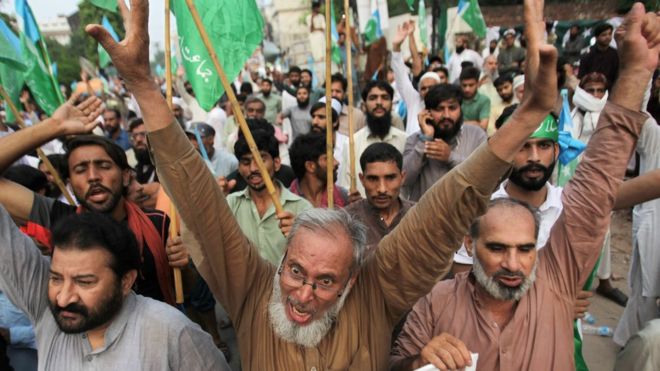 |
| Reuters, Protesters in Lahore, Pakistan chant slogans at a rally expressing solidarity with Kashmir |
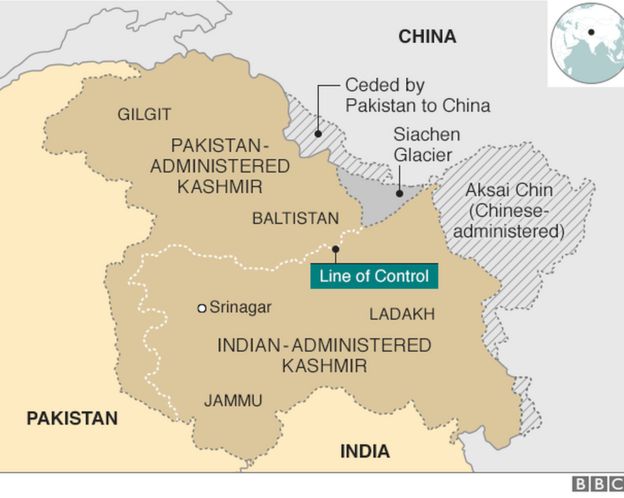
China, which has done just that, importing Han Chinese to Tibet and to Xinjiang to water down the presence of Tibetans and Uyghurs to 'formalize' and present a picture of Chinese-style legalization of majority rule in both occupied territories; the former which has independent Tibet a part of China, the latter to dampen aspirations for separation from China, exercises the classic, symbolic stance of "do as I say not as I do", in supporting Pakistan in its claims for Kashmir, as opposed to India's administering of the long-disputed territory. According to China, India's declaration of Kashmir's total administration by India is "unacceptable".
Violence flares up constantly within the disputed area of Kashmir. And it is usually Pakistan and its military and most particularly its Inter-Services Intelligence agency that has stirred up passions, grooming Kashmiri Pakistanis to launch violent attacks against the Indian-administered area. The two nuclear-armed neighbours have come close to the outbreak of war in the past over Kashmir. India originally signed Article 370 in its constitution 70 years ago to accommodate Pakistan when it broke away from India as a sovereign state.
What India has reaped for all of those years is Muslim fanatical attacks in a concentrated determination to rid Kashmir of Indian rule altogether. The new decree revoking Kashmir's shared status can be seen as a direct result of Pakistan's incitement to Kashmiri Pakistanis to view themselves as victims of Indian Hindu discrimination who must agitate against India. The violence that flares up from time to time has worn India's patience thin. Leading Narendra Modi, a nationalist, to decide the issue once and for all.
India controls Kashmir and Pakistan had a semblance of autonomy in its segment which it abused, overplaying its hand time and again. India, as the country with the third-largest Muslim population in the world, is well placed to declare itself more than able to administer Kashmir entirely without the intervention of Pakistan whose role in fomenting unrest and violence led the way toward stripping it of any authority in Kashmir. Tellingly, in view of a militant backlash to complement the fury of Pakistan, Kashmir has been overrun with Indian troops intent on keeping the peace.
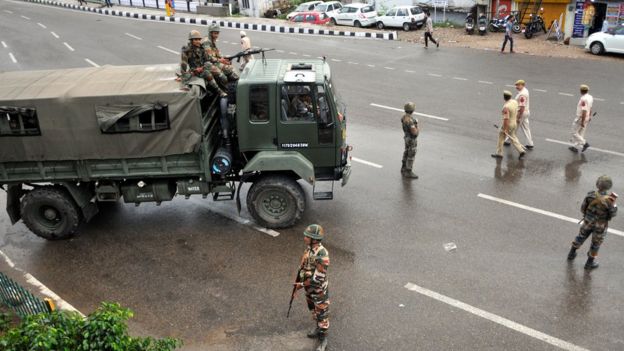 |
| Getty Images Kashmir is one of the world's most militarised zones
|
Placed under house arrest, a former chief minister of the region, spoke of the decision as the
"darkest day in Indian democracy. It will have catastrophic consequences for the subcontinent. They want to change the demography of the only Muslim majority state in India, and disempower Muslims to the extent where they become second-class citizens", she stated.
Labels: India, Kashmir, Militancy, Pakistan, Sovereignty, Violence
Russia Taking its Arctic Sovereignty Seriously
"Our task is to monitor the airspace and the northern sea route."
"We have all we need for our service and comfortable living [in Severny Klever military base, Kotelny Island, Siberia]."
Lt.Col. Vladimir Pasechnik, base commander
"In Russia, the Northern sea route has been described as a bonanza with lots of potential of economic development."
"And that's why there is a need for military capacity in the area."
"It is likely meant as defensive, but it is being interpreted by the West as offensive."
Flemming Splidshoel Hansen, Danish Institute for International Studies
"Norway is a small country, whose next-door neighbour is mighty Russia, which has placed the bulk of its military capacity right next to them."
"Norway is extraordinarily worried."
Kristian Soeby Kristensen, researcher, Copenhagen University, Denmark
 |
| The Mir-I is one of two Russian craft that dived to the Arctic floor |
Russia symbolically staked its claim to billions of dollars worth of oil
and gas reserves in the Arctic Ocean today when two mini submarines
reached the seabed more than two and a half miles beneath the North
Pole.
In a record-breaking dive, the two craft planted a one metre-high
titanium Russian flag on the underwater Lomonosov ridge, which Moscow
claims is directly connected to its continental shelf.
However, the dangerous mission prompted ridicule and scepticism among
other contenders for the Arctic's energy wealth, with Canada comparing
it to a 15th century colonial land grab.
Descending to 4,300 metres, the mini-subs Mir-1 and Mir-2 collected
water and sediment samples from the seabed. Russian scientists hope the
samples will shore up their claim that the ridge is an integral part of Russia.
If
Russia's claim is approved by the UN, the country could gain rights
over supplies of hydrocarbons that some experts put at 10bn tonnes. The
ice cap is melting, making exploration and drilling for oil and gas
easier.
The Guardian, August 2007
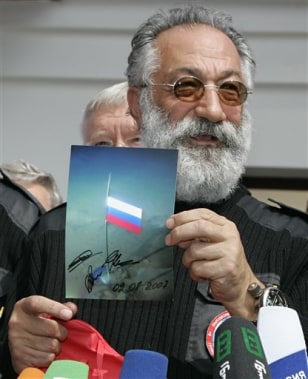 Alexander Zemlianichenko
/
AP Renowned Russian polar scientist Artur Chilingarov holds a photo of the
Russian flag on the ocean floor upon his arrival at Moscow's Vnukovo
airport on Tuesday (2007).
Alexander Zemlianichenko
/
AP Renowned Russian polar scientist Artur Chilingarov holds a photo of the
Russian flag on the ocean floor upon his arrival at Moscow's Vnukovo
airport on Tuesday (2007).
The Arctic has many contestants for jurisdiction by nations bordering that frozen sea and whose claims contest Russia's, including the United States, Canada, Denmark and Norway. And then there is China which has no physical presence in the Arctic but would like to and claims observer status. The vast mineral and energy resources stored under the ocean and thought to be technologically accessible for exploitation has all Arctic nations interested in claiming ownership of 'their' portions of the Arctic. And some, like Russia, are particularly anxious and prepared to be aggressively engaged in pursuing their claims.
Russia has invested quite a bit of funding in its Arctic claims of sovereignty, upgrading and modernizing old Soviet-era infrastructure, and installing permanent military missions on its share of the Arctic where temperatures can and do plunge to minis 50C in the winter, with the short Arctic summers giving merely temporary relief while still freezing at night. Russia's new massive investment in its base between the Laptev Sea and the East Siberian Sea on its Arctic shipping route includes permanently housing 250 military personnel.
There, with sprawling new facilities, the base maintains sufficient supplies for over a year for fully assured autonomy. The sprawling facilities can all be accessed without anyone having to venture into the icy outdoors. The military personnel are responsible for the maintenance of air and sea surveillance at the facilities, along with coastal defences such as anti-ship missiles. This is serious business for Russia; any contesting of their claims, any sign of hostile approaches will be both monitored and responded to.
For Russia, in its view of Arctic security and economic competition, the region represents a vital priority in foreign policy. No other Arctic country, including the United States has undertaken a clear presence dominating the vast area, and a bristling military menace presence as has Russia. Its intentions were clear from the time in 2007 it staged a mock but serious claim of the Arctic seabed by planting a Russian flag and celebrating its publicity coup.
In 2015 Russia submitted a revised bid claiming vast territories in the Arctic, sending it to the United Nations when it claimed 1.2 million square kilometres of the Lomontov sea shelf, all of which it claims is attached to the Russian mainland, some of which Canada disputes. Russia's claim extends over 650 kilometres from its shore. To support its claim, it has spent massively on modernizing Soviet era installations, upgrades that no other Arctic nation has committed to.
By comparison, Canada's lackadaisical efforts reflect a total lack of commitment belying the government's claims of the vital importance of its Arctic sovereignty. The amount of investment that Canada has committed to shrinks to minuscule proportions in comparison with Russia's. A road completed to the Arctic coast at Tuktoyaktuk in the Northwest Territories and work embarked upon for a port at Iqaluit in Nunavut, the extent of Canada's commitment to this date, along with the first Arctic patrol vessel being launched and satellite surveillance enhanced with a naval refueling station on Baffin Island.
Russia, on the other hand, has launched a gigantic effort since 2014 to rebuild the Kotelny Island military outpost, neglected after the 1991 collapse of the Soviet Union. Where the Russian Defence Ministry recently showed off Bastion anti-ship missile launchers positioned near the shore and Pantsyr-Si air defence systems during a drill firing shots at a practice target. A large radar dome sits on a hill overlooking the coast, stressing the main mission of monitoring the strategic area from the base.
Full radar coverage of Russia's 22,600-kilometre Arctic frontier has been achieved through the expanded infrastructure, where fighter jets can be deployed to protect Russia's Alaska airspace. And its permanently deployed military can access new base features such as spacious living quarters, a gym, and a sauna.
 |
1) North Pole: Russia leaves its flag on the seabed, 4,000m (13,100ft) beneath the surface, as part of its claims for oil and gas reserves
2) Lomonosov Ridge: Russia argues that this underwater feature is an extension of its continental territory and is looking for evidence
3) 200-nautical mile (370km) line: Shows how far countries' agreed economic area extends beyond their coastline. Often set from outlying islands
4) Russian-claimed territory: The bid to claim a vast area is being closely watched by other countries. Some could follow suit |
Labels: Arctic, Canada, Denmark, Norway, Russia, Sovereignty, United States
Kurdistan's Evolution to Nationhood
"Even as the world lines up against Kurdish aspirations for
sovereignty following Monday’s referendum, President Barzani has already
indicated a vote to secede does not imply a unilateral declaration of
independence, but will rather begin a process to afford Kurdish leaders a
democratic mandate to enter into peaceful negotiations with Baghdad. As
a practical matter, an independent Kurdistan bedecked in the full
rights and symbols of sovereign statehood is likely to still be many
years away."
"At the moment, however, we must lack no moral clarity in affirming
where our allegiances lie. The West should support the mandate the
Kurdish people are bestowing upon their leaders: to guide the peaceful
emergence of a confident Kurdistan, rather than the reinforcement of a
bad marriage destined to fail. The cause of Kurdish freedom is right and
just, and it is overdue that the West should say so."
Shuvaloy Majumdar, Munk Senior Fellow, Macdonald Laurier Institute
"Kurdistan is not ready because economically, it is a mess."
"I don't see independence happening. It's all about capability, not desire."
Joost Hiltermann, Middle East specialist, International Crisis group
 |
| Iraqi Kurds wave the Kurdish flag as they
celebrate in the streets of the northern city of Arbil on September 25,
2017 following a referendum on independence.SAFIN HAMED/AFP/Getty Images |
The Kurdish passion for nationhood lent an air of excited urgency to the call-up to the September 25 referendum to test the peoples' will to surmount anticipated difficulties to accomplishing that long-held dream of independence. A large, but not totally overwhelming proportion of those eligible to vote in Kurdistan turned out for the referendum, while others, uncertain, held back. Those who did venture to vote represented an overwhelming "yes" of 90 percent.
The wish is there, the will is there but the practical opportunity remains elusive. No one wants to contemplate the need for an armed struggle, essentially a civil war between Kurdistan and the country in whose geography is still sits, Iraq. The irony here is that socially, politically, even economically and institutionally, Kurdistan represents a model of fortitude, efficiency and tolerance, unique to the region. While Iraq represents the very opposite; without the intervention of NATO forces to support Iraq it would have dissolved entirely.
The competition between Iraq and Kurdistan to claim ownership of Kirkuk with its oil and gas resources represents an issue of huge uncertainty. That the Peshmerga forces of Kurdistan succeeded in routing Islamic State from Kirkuk is undeniable, just as it is without controversy to recognize that Iraqi forces melted in disarray when it was imperative that they stand and fight when ISIL marched its way first into Mosul then a good portion of the country to establish its Caliphate.
Only Kurdistan stood firm, opposing ISIL, rescuing the minorities, ethnic and religious that the ISIL forces threatened, persecuted and slaughtered, raped and enslaved. For their fighting courage and perseverance Kurds felt that at long last their need for total autonomy as a sovereign nation within their own heritage geography should be recognized. Kurdish political leaders anticipated the need for diplomacy and negotiations, but it is doubtful they might have predicted between them the depth of animosity their initiative aroused internationally with few exceptions.
The initial emotional euphoria after the referendum vote gave way to the reality of vociferous denials of their goals globally. Only one nation whose own struggle reflected that of the Kurds, supported their aspiration; Israel. Itself embattled in the region, surrounded by Islamist terrorist groups dedicated to the Jewish state's annihilation made it impossible for anything more than emotional, diplomatic support to be rendered.
Appealing to Baghdad, Kurdistan's President Massoud Barzani was rebuffed in his efforts for reasonable debate to come to a working agreement in recognizing a sovereign Kurdistan. Supporting Iraq's refusal to surrender a third of its territory along with oil revenues, are regional powers like Iran and Turkey, aided by Russia, which has faintly supported Kurdish ambitions, but stands in solidarity with Iraq, Iran and Turkey.
Iraq has called up the international community to help isolate Kurdistan by refusing to fly into its international airports; the closing of land crossings linking Kurdistan to the rest of Iraq is also threatened. Prime Minister Haider al-Abadi has been urged by Iraq's Parliament to send troops into the contested areas, while Turkey is threatening border crossing closings, halting the supply of goods and food.
Sudan and South Sudan present as a somewhat similar situation. One Muslim the other mostly Christian and Animist, and both riven with ethnic and tribal animosities. Arab-led Sudan has persecuted its Black Sudanese citizens; the atrocities committed by the government of Sudan against Darfurians a case in point. The world recognized South Sudan's independence as the world's newest 'nation'. One that has been beset with civil strife of a nature no less divisive and brutal than its former relations with Sudan.
Kurds have far too long suffered demeaning attacks against their right to human dignity and human rights. The violence levelled against Kurdish communities by previous Iraqi government forces, particularly under Saddam Hussein's Baathist military was horrendous, sweeping the land with fire and destruction, where chemical weapons were used to destroy countless lives. There is no humane reason why Kurds should continue to suffer assaults against their right to nationhood.
Labels: Conflict, Human Rights, Iraq, Kurdistan, Political Realities, Sovereignty
Long Overdue: Kurdish Independence
We have done our best to be partners in Iraq; it has not worked. We believe this is the right time to allow the people of Kurdistan to exercise their democratic right, a right that people across the world have, to express their self-determination."
"As a state that has its own province of Quebec that has exercised the right to hold a referendum, I think it would be difficult for Canada to deny that right to the people of Kurdistan. [Even though Iraq's situation is] a different kettle of fish."
"Ottawa would never think to cut off the medicine supply to one of its provinces, even if it was a province that was a thorn in its side. We're trying to have an amicable divorce from Iraq. But this is not the same as Quebec having an amicable divorce from Canada."
Bayan Sami Abdul Rahman, Kurdish diplomat, Washington
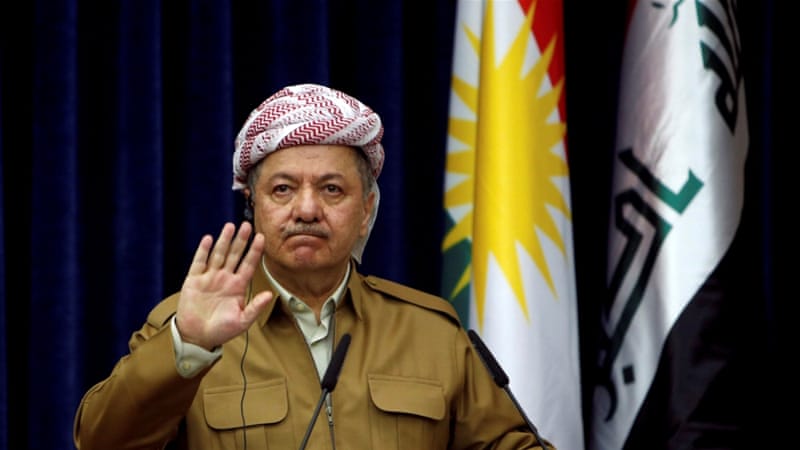 |
| KRG President Barzani announced the decision over Twitter [File: Reuters] |
There is no parallel that exists between the just right of Kurds to finally be able to establish their human right to declare a homeland of their own. What they are doing is simply on their own initiative because the international community has failed them, declaring that their ancient heritage, the geography that has always been their homeland, now be recognized formally, with secure boundaries and the expectation that their neighbours who have exploited and abused them, surrender their hold on land that is by historical right of possession, Kurdish.
Neither the British nor the French, both colonizers, were the original inhabitants of the land mass today known as Canada. Britain and France fought a war over which of the two would declare their control over Upper and Lower Canada. France, busy elsewhere, failed to concentrate on asserting its ownership, and Britain won that conflict, taking possession of the land mass that both had claimed. Britain was a generous winner, offering the French full recognition and freedom to practise their culture, their language as before, but under the aegis of British colonial possession. French Canada (Quebec) lacks the historical, legal, human rights cudgel at the core of Kurdish independence.
The Kurds have suffered dispossession, displacement, violence, humiliation and unending attacks where villages were gassed, people slaughtered, their animals and crops destroyed by the Iraqi government. Their security and human rights in Iran, Syria and Turkey were no less threatened and their persecution there too has been an intolerable humiliation for a proud and honourable people struggling to regain their Independence. It is due time. The September 25 referendum must be supported by the West, which in the first place created the problem, allotting Kurdish land elsewhere than to the Kurds.
Now, the Kurdistan Regional Government in Erbil is prepared to launch its legal right to seek a mandate from its people. Iraq's central Baghdad government seems to have no intention of making the official decision to acquiesce at long last in recognition of a just solution to an unjust situation, in agreeing to Kurdistan's full and final separation beyond autonomy to full sovereignty. Tensions, under the circumstances are taut; Kurdistan is determined and Iraq equally so.
Iraq proved itself unequal to the task any country faces of successfully defending itself against an invasion. A large swath of Iraq remains in the hands of a shrinking Islamic State caliphate. It is that part of its geography that Iraq's government should focus on entirely. And in recognition of the fact that without the Peshmerga forces meeting Islamic State militias in combat the geography still controlled by Baghdad would have shrunk even further, its government should prepare itself to admit the morality of surrendering to Kurdistan's destiny as a free and independent nation.
As for Canada, it should summon the courage of its convictions that justice should prevail, and not cower in the shadow of other Western governments like the United States, sending up cautions about destabilization should Kurdish independence be challenged by conflict. If enough deserved support were to be expressed among those nations whom Kurds should be able to rely upon, the collective support could sway Iraq in favour of agreement.
That Iran in its great malevolence, Syria, in its noxiously destructive state, and Turkey in its pathological hatred for Kurds and their desire for independence witness the proceedings with clenched teeth and an assured reaction of dissent and violence is a given. But the Kurds have proven themselves resourceful, determined and impressively worthy of any and all support by the West and NATO countries
(with the notable exception of Turkey). Rejection of Kurdish aspirations to national statehood would represent a surrender to negation of human rights.
There is more than enough of that in the United Nations where the worst human-rights abusers on the planet find their comfortable niches on various councils sitting in judgement on those nations of the world that respect human rights and just and lawful nationhood.
Labels: Conflict, Human Rights, Iraq, Justice, Kurdistan, Sovereignty