ME -- The Stage Is Set ... Will the Play Commence?
"What they're doing is setting the theatre to provide an expanded set of offensive options should the president direct military strikes.""[This time the administration does not appear to have such a] discrete objective [as was witnessed before strikes against the nuclear program in Iran last year]."Dana Stroul, former deputy assistant secretary of defence for the Middle East"[While Iran has the right to] operate professionally in international airspace and waters ... any unsafe and unprofessional behaviour near U.S. forces, regional partners or commercial vessels increases risks of collision, escalation, and destabilization."U.S. Central Command"[If the U.S. brings in more F-35s, that would suggest that it plans on] operating inside Iranian airspace in a more considerable way.""[These movements -- of the U.S. fleet in the Red Sea and eastern Mediterranean -- indicate that] both the U.S. and Israel are very concerned about an Iranian retaliation against Israel, even if Israel is not directly involved."Gregory Brew, senior Iran analyst, Eurasia Group
 |
The
Arleigh Burke-class guided-missile destroyer USS Roosevelt (DDG 80)
transits the Arabian Gulf while operating in the U.S. Central Command
(CENTCOM) area of responsibility. U.S. Navy photo by Mass Communication Specialist 1st Class Indra Beaufort |
Dozens
of aircraft have been deployed by the U.S. military to bases near Iran,
while some dozen warships have been assembled in or near the Middle
East in the past month, according to satellite imagery, tracking data
and U.S. defence officials. The stage certainly appears to be set for a
potential U.S. strike against the Islamic Republic of Iran within a few
weeks, as tensions continue to rise. Prior to strikes last year against
the Iranian nuclear program, there was an even greater buildup of
military might than on this occasion, lending an air of real uncertainty
as to the outcome of what is currently a standoff between the
abrasively defiant regime and the challenge of the powerful United
States.
Not
all experts on the Middle East and Iran are convinced that this show of
force will culminate in an actual invasion to remove the Ayatollah-led,
IRGC-fortified regime. The death toll from Iran's violent crackdown on
protests is still rising, with activists and human rights groups
claiming over 6,000 Iranians have been killed through the government
crackdown, though some insist the death toll reaches even higher -- in
the tens of thousands.
President
Trump speaks of his 'armada' whose purpose he hints, is to place
pressure on Tehran over its nuclear program. Iran, he stated, is "talking to us, and we'll see if we can do something, otherwise, we'll see what happens". For his part, Iranian Foreign Minister Abbas Araghchi has stated "Just as (Iran) is ready for negotiations, it is also ready for war." While "Structural arrangements for #negotiations are progressing", senior Iranian security official Ali Larijani stated on social media.
 |
The
USS Roosevelt (DDG-80) is armed with powerful Aegis systems, featuring
Mk 41 Vertical Launching Systems (VLS) for Standard missiles, Tomahawks,
and ASROC; a 5-inch Mk 45 gun; Phalanx CIWS/SeaRAM; 25mm machine guns;
and Mk 32 torpedo tubes for lightweight torpedoes U.S. Navy photo by Mass Communication Specialist 1st Class Indra Beaufort |
Accompanied
by three guided missile destroyers, the aircraft carrier USS Abraham
Lincoln entered Central Command's area of responsibility and is now in
the north Arabian Sea. Air defences and dozens of missiles are carried
by each destroyer, including Tomahawks, a type of munition U.S. forces
used back in June when they struck Iranian nuclear targets. While
historically the U.S. has maintained an aircraft carrier in the Middle
East there had been none in the region, when the Lincoln was redirected
from the South China Sea.
According
to defence officials, at least eight other warships are now positioned
in the area, including at least two guided-missile destroyers, the USS
McFaul and USS Mitscher, near the Strait of Hormuz. In this same area in
recent days, Iran deployed drones. Analysts identified an Iranian drone
carrier from satellite imagery, the Shahid Bagheri. Over three dozen
U.S. aircraft, among them fighter jets, drones and planes used for
refuelling reconnaissance and transport have been forwarded to U.S.
bases.
F-15
aircraft from the squadron that fought the 12-day war between Israel
and Iran in June have been deployed now, along with nine A-10C
Thunderbolt IIs, used to protect groups on the ground from enemy forces,
stationed at Muwaffaq Salti Air Base in Jordan. America's ME allies
like Jordan, the UAE and Saudi Arabia and Qatar have alerted Washington
that they will not allow the U.S. to use the bases on their soil to
attack Iran. Which is where the USS Lincoln steps into the picture since
assaults can be launched directly from its position at sea.
EA-19G
Growlers, electronic warfare aircraft that jam radars and disrupt
communications which are on board the USS Lincoln, would be useful
should the U.S. intend to enter Iranian airspace to hit targets in the
interior. The USS Delbert D. Black visited Israel and left port from
there on Sunday, moving further into the Red Sea. Additionally, two more
destroyers are in the eastern Mediterranean, the USS Bulkeley and the
USS Roosevelt, according to American defence officials.
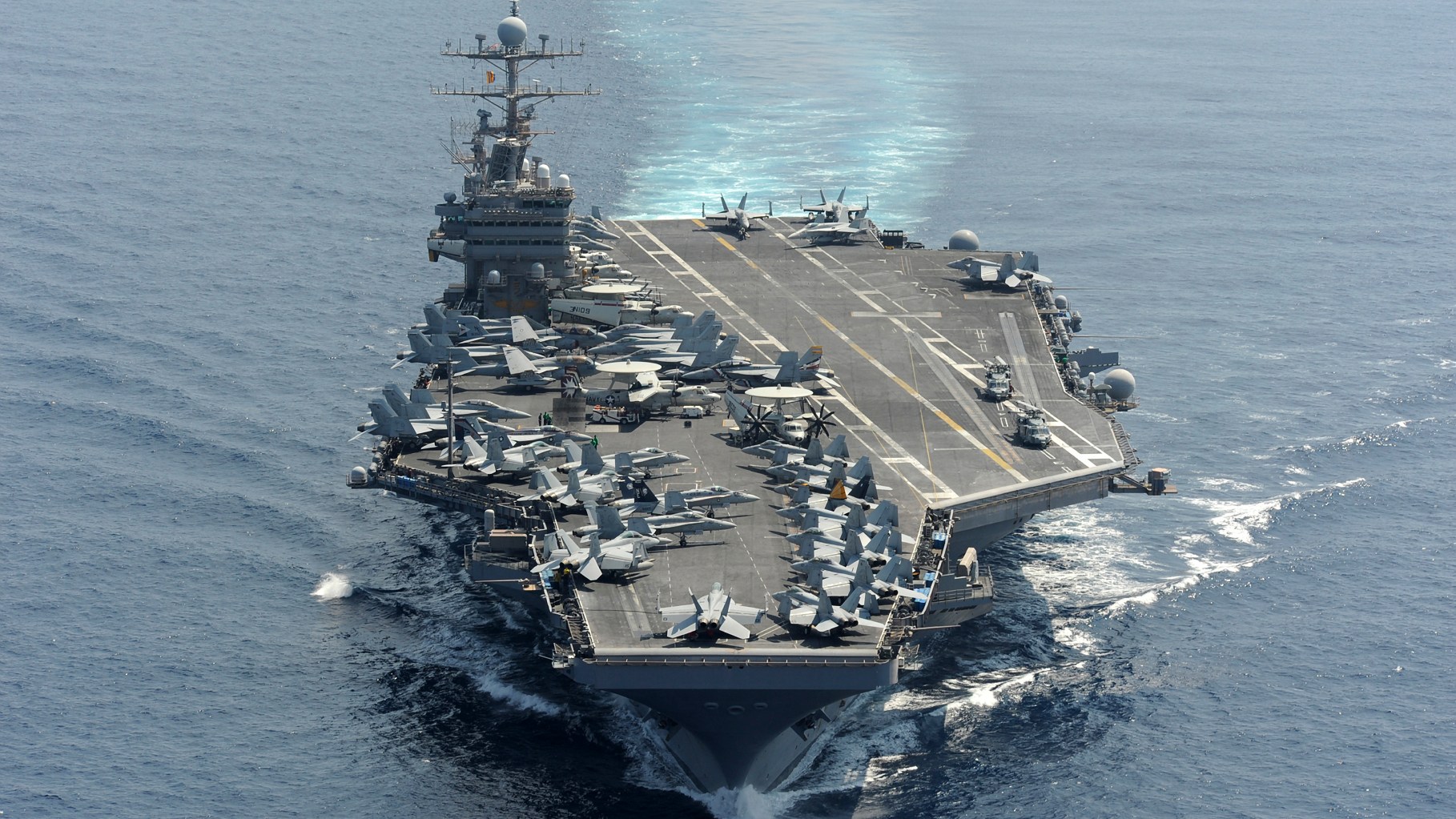 |
| USS Abraham Lincoln, The War Zone |
Labels: Iranian Protests, Nuclear Program, Regional Tensions, Standoff, Tehran's Bloody Response, United States/Islamic Republic
posted by Pieface @ Thursday, February 05, 2026


<< Home