Death to the Islamic Republic of Iran
Protesters in New York City chanted “death to America, death to Israel” in Farsi at a vigil honoring late Iranian Supreme Leader Ali Khamenei in New York City on Friday night, shortly after clashes erupted with counter-protesters, resulting in multiple arrests.The 86-year-old Iranian supreme leader was killed in Tehran on Saturday in the initial joint US-Israeli airstrikes that started the war, with his death confirmed by the Iranian government the following day.Protesters set up images of Khamenei on two tables alongside flowers and candles, with signs reading, “Solidarity with Iran.” Other pictures included US civil rights leader Malcolm X and George Floyd, and the display table also carried copies of zines with titles such as “Zionism and Racist Landlords” and “ICE & Friends.The event, held in Washington Square Park, was billed as both a memorial for Khamenei — whose death was dubbed by those present as an “assassination by US government forces” — and for “all martyrs of Amerikan [sic] imperialism.”“We must live like the ayatollah did, with his heart for his people, and we must die like he did,” a speaker told the crowd.The protesters chanted, “Death to the IDF,” and, “Al Qassam you make us proud, kill another soldier now,” a reference to Hamas’s Al Qassam Brigades. One man waved a Hezbollah flag. Both Hamas and Hezbollah are US-designated terrorist groups.The protest was endorsed by at least 18 smaller activist groups, such as the Bronx Anti-War Coalition, the far-left Workers World Party and Crown Heights Bites Back, according to a statement from organizers. The larger anti-Zionist activist groups in the city did not sign on.Some of the organizers have had contact with the Iranian mission to the United Nations.The Times of Israel
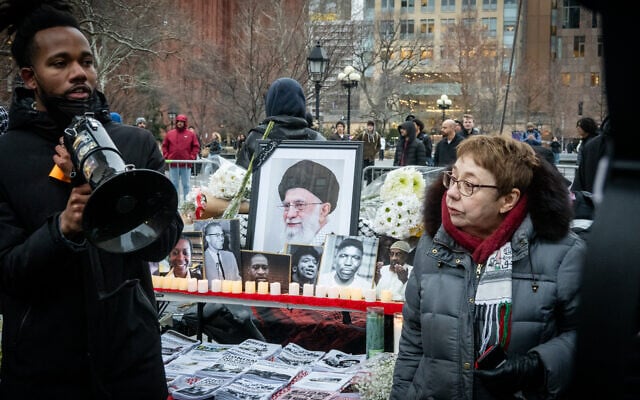 |
| Demonstrators chant during a vigil honoring Iran's late Supreme Leader Ayatollah Ali Khamenei in New York, March 6, 2026. (Luke Tress/Times of Israel) |
A think tank has identified at least 27 UK universities where student societies and affiliated groups have mourned the death of Iran’s Supreme Leader, Ayatollah Ali Khamenei.Evidence compiled by The Henry Jackson Society shows student groups - primarily Ahlul-Bayt or similarly aligned Islamic societies - have shared messages referring to Khamenei as a “martyr”, organised memorial events, or circulated content praising the Iranian regime.Universities where such activity has been recorded include University College London, Cambridge, Manchester, Edinburgh, Bristol, Southampton, Surrey, Cardiff, Glasgow, Brunel, Kingston, Westminster, King's College London and Imperial College London, among others.Some societies organised commemorative events on campus, while others posted condolence graphics, shared vigil material or cancelled events “in honour of our beloved Shuhada”.GB News
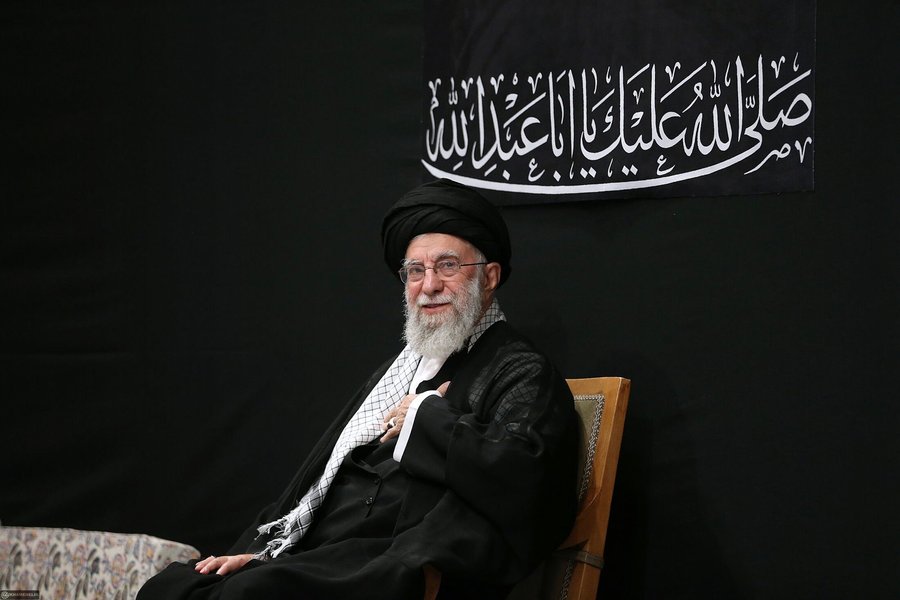 |
| Iran's Supreme Leader Ali Khamenei was killed in the first weekend of the conflict | GETTY |
"I am an individual with many faults and shortcomings" he said in his inaugural address, and "truly a minor seminarian". It was, at the time, an accurate self-assessment for a mid-ranking cleric in the hierarchical world of Shiite Islam.""Over the next four decades, this seemingly unqualified cleric who rose to the top almost by chance would become one of the world's longest-serving autocrats, confounding every American president since George H.W. Bush. He would at one point become the most powerful man in the Middle East, dominating five failing lands -- Syria, Lebanon, Iraq, Yemen and Gaza.""This ambition and hubris also led to his downfall. He came to govern with the hypervigilance and brutality of a man driven by the idea that much of his own society and the world's greatest superpower sought to unseat him -- which, in the end, it did."Karim Sadjadepour, senior fellow, Carnegie Endowment for International Peace
Born
in Mashhad, second of eight children of a cleric in 1939, Ali Khamenei
was enrolled in religious education by age five where his formative
years were spent in the Mashhad seminary. He failed to attain senior
religious credentials. A family formula repeated by his second-oldest
son Mojtaba, now elevated to the position his father vacated on his
death. Reputed to be even more averse to human rights than his father
Ali, Mojtaba, a pedestrian cleric, but an enthusiastic dabbler in pricey
real estate, has achieved a fortune, just like his father; real estate
investments in world capitals took precedence over religious matters.
In
his early 20s, Ali Ayatollah became acquainted with the politics of
Ayatollah Ruhollah Khomeni, who was considered an Islamist cleric of the
first order. He was also a harsh critic of the more secularist Shah of
Iran who exiled him in 1964. One of Ayatollah Khomeini's passionate
admirers for his defiance of royal authority, in Khomeini's exiled
absence, Ali Khamenei spouted his mentor's positions on Islamic
government for Iran. He gained distinction in this passion for negating
authority, by six arrests and solitary confinement.
When
Shah Pahlavi was deposed with the 1979 Islamic Revolution that overtook
2,500 years of Persian monarchy, Ayatollah Khomeini returned from exile
to rule over a new Islamic Republic, raising Khamenei from obscurity to
the position of president of the Islamic Republic. Following a decade
of rule, Ayatollah Khomeini died just as its brutal eight-year conflict
with Iraq came to an end. With no clear successor to his rule, Ali
Khamenei was named, and took on the title of Ayatollah, to become Iran's
Supreme Leader as Grand Ayatollah.
Khamenei,
while presenting himself as a religious leader with no pretensions to
personal wealth in fact accumulated vast wealth accessed through Iranian
private property seized by the theocratic state. While Khamenei's
decrees and authority ensured that the population of the Islamic
Republic had no access to international finance, nothing deterred him
from building immense financial wealth. He took state funds to spend
billions from energy extraction in funding his "axis of resistance" in the Middle East, while Iranians suffered the economic impact of sanctions and inflation.
The
Hamas-led invasion of southern Israel with an orgy of sadistic savagery
in the commission of mass rapes, large-scale slaughter and atrocities
on a Medieval scale of torture and mutilations of children, entire
families immolated in their homes, abductions and destruction committed
by thousands of Palestinian terrorists represented a triumph of
'resistance' to 'occupation' of Zionists in the Middle East to Khamenei
who celebrated the shattering event.
Israel's
response against Hamas in Gaza, Hezbollah in Lebanon, and Houthis in
Yemen, all terror proxies of Iran, began to destroy the Islamic
Republic's 'ring of fire' around the Jewish state, that was meant for
its destruction. The axis of resistance was wholly diminished by the
Israel's assassination of Hamas's Ismail Haniyeh in Tehran and Yahya
Sinwar in Gaza, along with the Hezbollah leader Hassan Nasrallah.
When
Israel and the United States struck Iran in June of 2025 in a 12-day
war against military installations, assassinating elite Revolutionary
Guards commanders and regime authorities, while the U.S. dropped
bunker-busting bombs on nuclear sites, Ayatollah Khamenei was
mysteriously absent, hidden away for safety before finally emerging with
the raids completed, to declare victory for Iran.
Iran
celebrated that victory months later when cities across the country
were engulfed in huge anti-regime demonstrations, with Iranian citizens
demanding the end of theocratic rule. Ayatollah Khamenei ordered the
Islamic Revolutionary Guard Corps and their Basij police offshoots to
spare no efforts in cracking down on the dissenters using all means
necessary to halt any further demonstrations against the government. The
deadly crackdown led to an estimated 30,000 citizens being killed, tens
of thousands of Iranian citizens injured and arrested.
Now
in its death throes, the Islamic Republic has devoted itself to
instituting a dynastic follow-up to the death of the Supreme Leader,
replacing him with a man cloned in his image in every conceivable way.
The IRGC will not go easily. Its command structure swiftly replaces
those that are extinguished. Their reason for existence is to continue
the strategy mapped out for them first by Khomeini, then by Khamenei, to
ensure that Shia Islam dominates the numerically superior Sunni form of
Islam by conquest. And to destroy any vestiges of the West and
democracy in the Middle East, beginning with Israel.
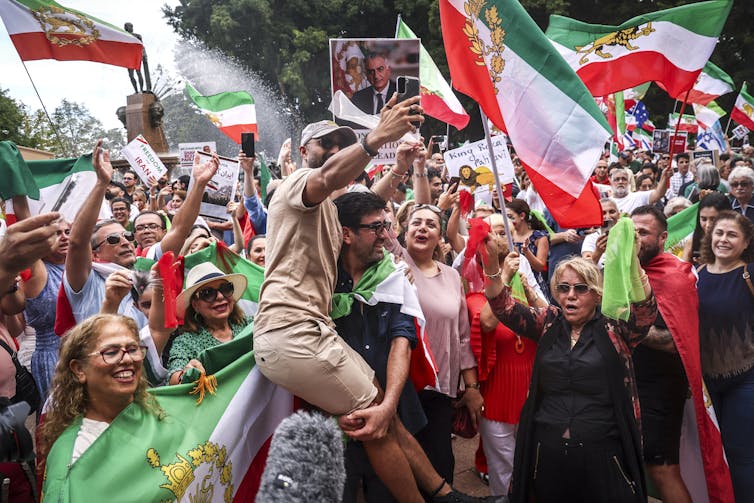 |
| Members of the Iranian community in Sydney celebrate after US-Israeli air strikes killed Ali Khamenei, March 1. David Gray/AFP via Getty Images |
Labels: Ayatollah Ali Khamenei, Islamic Republic of Iran, Islamist Conquest Denied, Israeli-U.S. Bombing of Iran
posted by Pieface @ Tuesday, March 10, 2026


<< Home