Penalizing Abraham Accord Signees
"During the past two years, Iran and Israel have traded missile and air strikes three times, and by now, war between them is old news. War between Iran and the Gulf Arab states of Saudi Arabia, Qatar, Kuwait, Bahrain, and the United Arab Emirates, however, is something new. According to reports, Iran fired missiles at all of them this morning. This video appears to show an attack on Juffair, the area of Bahrain that hosts the U.S. Navy’s Fifth Fleet. Similar attacks were reported in the other countries, all of which host American bases or other strategic interests.""All these countries, with the possible exception of the U.A.E., have been at various times torn about whether to treat Iran like a bad neighbor who must be tolerated, or a bad neighbor whose house needs to be burned down with the neighbor in it.""These countries once wondered whether Iran could be appeased and contained. Now they do not."Graeme Wood, The Atlantic"Everyone is very scared [as the situation continues to deteriorate].""There is footage of missile interceptions all over the city.""I am packing a suitcase just in case … not that we can leave, because airspace is closed.""It is the thing we have all been frightened about happening, and now it has."Dubai resident
 |
Dubai turns into a ghost town as Iranian strikes rattle the city. Nearly empty highways are seen in Dubai on Sunday. Caroline Faraj/CNN |
Iran,
as the only non-Arab Muslim state in the Middle East, has long sought
to reassert itself in the image of ancient Persia where the Shi'ite
theocracy recalls a time when Persia was once the ruling hegemon in the
Middle East during the Achaemenid Empire (c. 550–330 BC) when
its royal families oversaw a vast influential territory. Today,
Iranians still celebrate the empire of Cyrus The Great, a warrior and
statesman. In Israel he is remembered as the great king who was
instrumental in freeing Israelites from their captive state and allowed
them to return to Israel to rebuild the Temple of Solomon destroyed by
the Assyrians.
The
majority Sunni Muslim states in the Middle East have always lived
uneasily alongside Iran, since 1979's Islamic Revolution that brought
Ayatollah Ruhollah Khomeini to power in Iran with the exile of the
former Shah Pahlavi. The revolution that turned Iranians from a proud
free people to a people shackled by strictly enforced Sharia law, taking
Iranians socially back to the Medieval era, curtailing their liberties
as the regime began to export its version of Islam and formed, trained
and armed non-state terrorist militias to do its bidding on the
international stage and within the Middle East.
Tehran
had its ambitions to wrest Mecca from the control of the Saudis, a
point of extreme tension between the two countries, both competing as
well to be recognized as the ultimate power in the Middle East. Most of
the Sunni states had amicable trade linked to oil extraction with the
West and particularly the United States, as did the former Shah of Iran.
Under the theocratic regime that Tehran ruled, relations from the onset
of the revolution were antagonistic to the United States, the Iranian
mullahs characterizing the U.S. as the 'great Satan' and Israel which
they regarded as a U.S. appendage, the 'little Satan'. Its intention was
to destroy them both.
Hit-and-run
attacks against both accomplished through the medium of Iran's proxy
terrorist groups became the regime's mode of conduct toward both Israel
and the United States. But it was not until it became apparent that Iran
was diligently working on a devoted nuclear program -- all the while
promising it would destroy Israel -- that attention was fixed on its
actions. In the failure of Western nations to persuade Iran to abandon
its nuclear ambitions alongside the IRGC's development of ever
further-reaching and more powerful ballistic missiles amidst threats
they could eventually reach the U.S. seaboard, tensions continued to
grow.
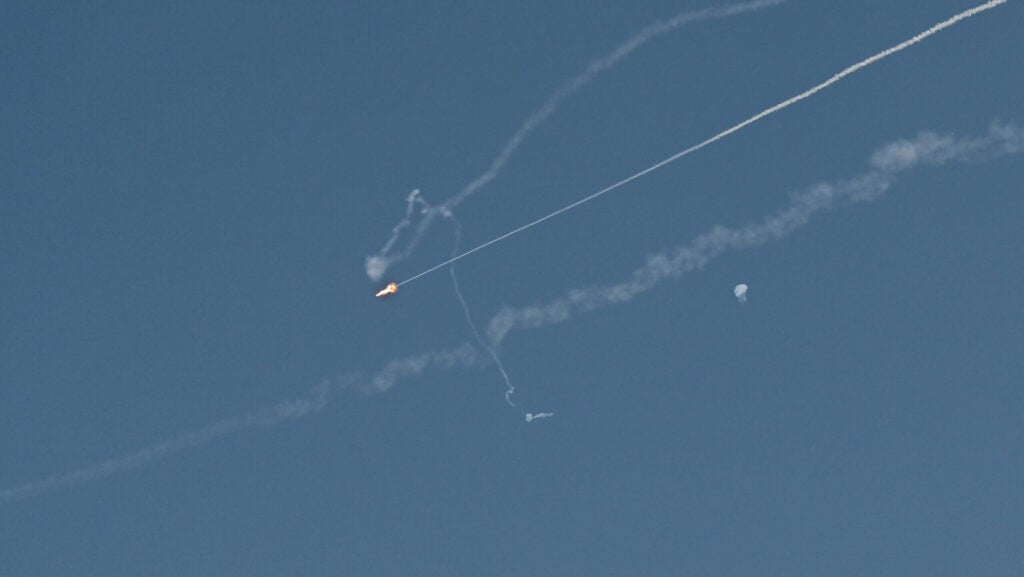 |
| Explosions from the interception of an Iranian projectile are seen in the sky over Dubai on March 1, 2026. (Photo by Giuseppe CACACE / AFP via Getty Images) |
On
the last day of February 2026 a second joint action shared by the
United States and Israel targeted Iran's nuclear and ballistic missile
sites with the intention of completely destroying them, following the
mistaken belief that their earlier June 2025 attacks had accomplished
that goal. In the wake of mass demonstrations of Iranians against their
theocratic leadership stifling life in the country for ordinary people,
and the resulting regime response that killed thousands, wounded many
more and imprisoned tens of thousands, Israel and the United States,
following a massive buildup of military might at sea and in the air,
attacked Iran.
"The regime has not capitulated in the least. At least not yet. They are fighting back and so what we’re watching is this sort of test of wills.""[The] Saudi Ministry of Foreign Affairs affirmed the Kingdom’s full solidarity with the countries concerned and its firm support for them, stating that it would mobilize all its capabilities to assist them in any measures they undertake.""[The UAE emphasized that the country’s security is] indivisible [from its Gulf neighbors] and that any infringement on the sovereignty of any state constitutes a direct threat to the security and stability of the entire region.""[It’s interesting to see the countries] banding together with the United States.""The Emiratis and the Saudis are now speaking the same language. They have been at odds with one another over the last several weeks, they are issuing statements of support for one another as Iranian missiles and drones are getting shot across the region."Jonathan Schanzer, executive director, Foundation for Defense of Democracies
The
Islamic Republican Guard Corps at the direction of Grand Ayatollah Ali
Khamenei, laid plans to attack their Sunni Arab neighbours whom they
accused of collaborating with the United States. Accordingly, even with
the death of Khamenei, along with that of the head of the IRGC and many
other military leaders, the plan was advanced into kinetic action, with
hundreds of missiles and drones attacking not only Israel, but U.S.
military assets in countries like Kuwait, Qatar, Jordan, Bahrain and
Oman.
By
the third day of the U.S.-Israel strikes on Iran, four people were
killed and 100 wounded in the United Arab Emirates, Kuwait, and Qatar.
Iran has burnt all its bridges. Arab states that would have no hand in
attacking the Islamic Republic despite their fears of its aggressive
intentions now turn their eye in a well-earned jaundiced direction
toward the real and immediate threat Iran now poses to their own
security and that of their civilian populations. A situation that could
very well end up with a coalition of Arab nations moving their own
militaries against Iran.
And
ultimately, Iranians would be freed from the theocratic restraints of a
government leadership that destroyed too many Iranian lives to be
permitted to live on without penalty itself.
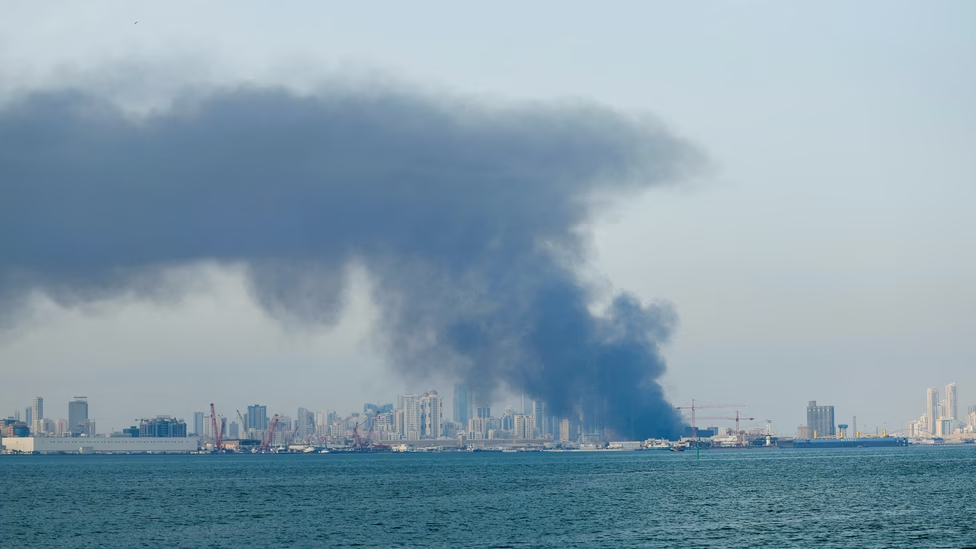 |
| Smoke rises after Iran carried out a missile strike on the U.S. Navy’s Fifth Fleet in Bahrain. (Reuters) |
"For the first time in history, all the GCC states were targeted by the same actor within 24 hours. Their long-standing nightmare scenario has happened.""Although in case of a US attack to Iran, this was an expected action from Tehran, but the scope has shocked both the Gulf political elite and public.""[By hitting civilian infrastructure, whether intentionally or not, in the Gulf Cooperation Council capitals], Iran has crossed a dangerous line. The aim may have been to raise tensions in the Gulf to pressure the US, but this calculus may also backfire. It risks pushing the GCC states closer to the US camp in this war."Sinem Cengiz, researcher, Qatar University’s Gulf Studies Center/non-resident fellow at Gulf International Forum
Labels: Islamic Republic of Iran, Joint Israel/US. Attacks, Shi'ite Iran, Sunni Arab ME
posted by Pieface @ Monday, March 02, 2026


<< Home