Saturday, July 11, 2026

The Intransigent, Defiant, Deadly Islamic Republic

"They asked for a time out [from military action]. They wanted to go to the funeral of Khamenei. And I said, ‘Give it to them.’ And they started shooting missiles. I mean, it was the craziest thing."
"I don’t want to deal with them anymore. They’re scum. You know what scum is? They’re scum. They’re sick people. They’re led by sick people and they’re vicious, violent people. And if they had a nuclear weapon, they’d use it. As far as I’m concerned, it’s over."
"They’re liars. If I make a deal with them, we have a deal. And he [the Iranian negotiator] goes out, he talks. We make a deal, everyone’s agreed: no nuclear weapon. We make a deal, they [the Iranian delegation] go outside, talk to the press, and they say, ‘We never even talked about it.’ There’s something wrong with them. They’re cuckoo. As far as I’m concerned, it’s over."
U.S. President Donald Trump
 
 
On again, off again. Decisions made spontaneously reflecting an impulsive of-the-moment thought process, leavened with emotional irritation. An incendiary situation whose outcome is vital to the well-being not only of the population of the Islamic Republic who have suffered since 1979 under the theocratic rule of a totalitarian state imposing its will, meting out imprisonment, torture and death to all who oppose it. And to the larger community inhabiting the Middle East, as the source of inciting to terrorism through sponsorship of select militias whose formation is vital to the regime's agenda of conquest where the al-Quds branch of the Islamic Republican Guard Corps recruited, trained, armed and  tasked them as proxy militias to carry out its death-cult orders.
 
From Hezbollah to Hamas to Palestinian Islamic Jihad and Iraqi Shia militias all loyal to the regime, the noose tightened not only on Israel, marked for annihilation by the Ayatollahs, but Sunni-majority countries in the region as well; not for annihilation but the conquest of domination. Its weapons' focus as a means to assert its dominance through technological means with missiles and drones, and aspirationally, a nuclear program to allow the Iranian regime to wield the most fearful of all weapons to achieve its goals.
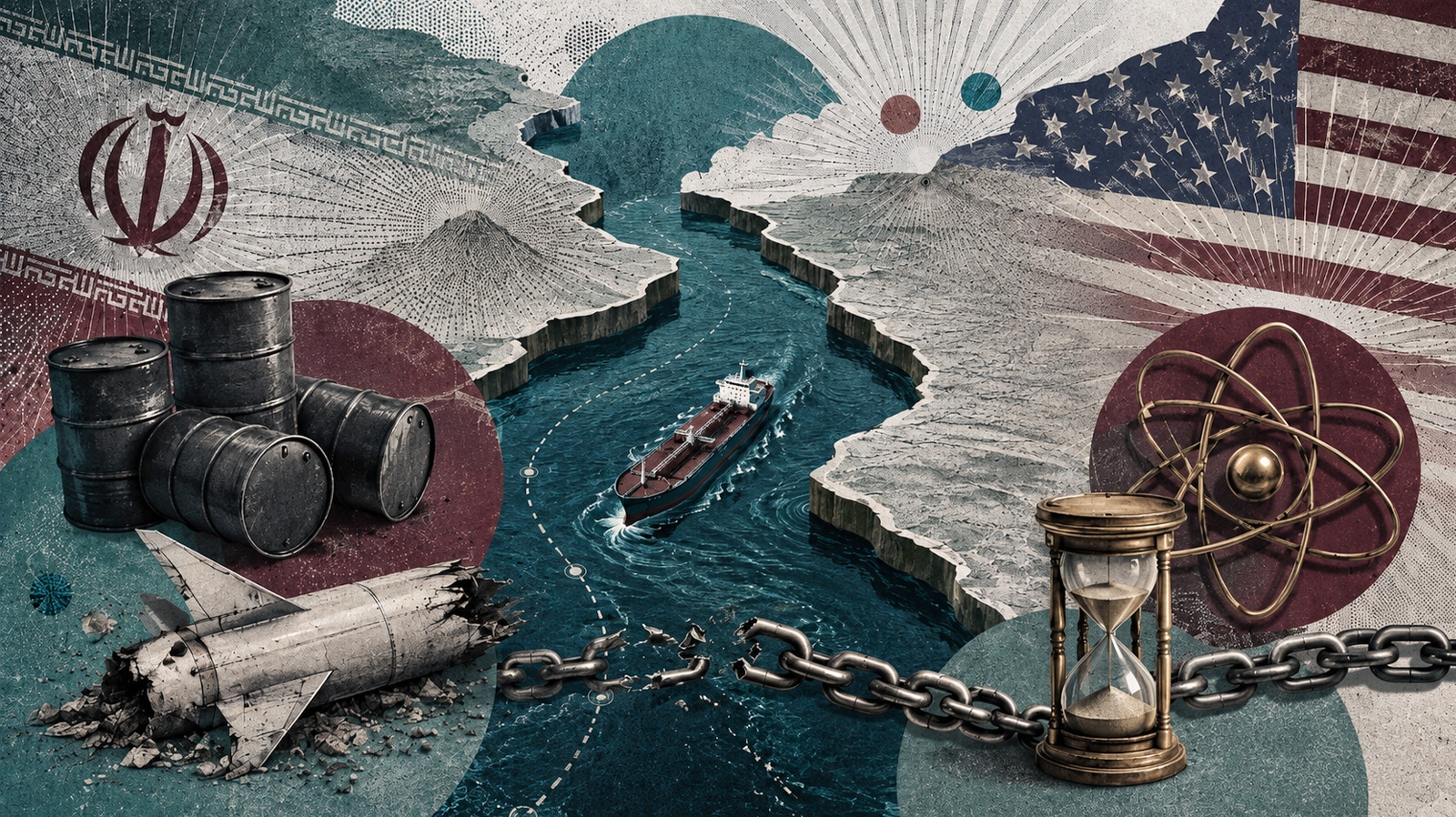
 
Iran Illustration 
 
Upended briefly and temporarily when joint aerial strikes by Israel and the United States complicated those plans by assassinating through pinpoint, intelligence-gathered strikes, military commanders, religious figures, including the most senior  cleric whose direct messaging from above moved the strings of the dread and powerful IRGC puppets to action along with nuclear scientists, and strategic strikes on nuclear sites and weapons depots. Any other country would reel from the strength of those blows, but not Iran.
 
It had only months earlier destroyed the lives of thousands of its disaffected people whose effrontery  in massing by the tens of thousands in street demonstrations throughout the country to demand an end to the regime, and the right to live as free people, enjoying liberty as a human right, refusing the straitjackets of passivity in fear of consequences. Their punishment by state police, the Basij and the  Iranian military was swift, decisive and deadly. Battling military-to-military of two well-armed attacking countries required another tack; the manipulation of circumstances and in this case cutting off global shipping to inflict pain internationally. 
"They want recognition of Iran basically having control of the Strait of Hormuz. That is their bottom line. That is their leverage with the United States and the West that has replaced earlier enriching higher and higher levels of uranium."
"Fundamentally, they think time is on their side. They can suffer more than the Americans and the Gulf and that's what they're gambling on."
Alex Vatanka, senior fellow, Middle East Institute 
The Strait of Hormuz became the winning move for Iran in this chess game of a war. Following the February 28-initiated strikes on Iran, since April 8, President Trump declared one ceasefire initiative with Iran after another as oil prices gushed skyward and Washington grappled with the dilemma of lifting itself out of a quagmire it had no stomach to pursue, in a war that proved hugely unpopular with American voters. This was a president who had given the impression that he meant what he said; no more U.S. troops involved in endless MidEast wars.
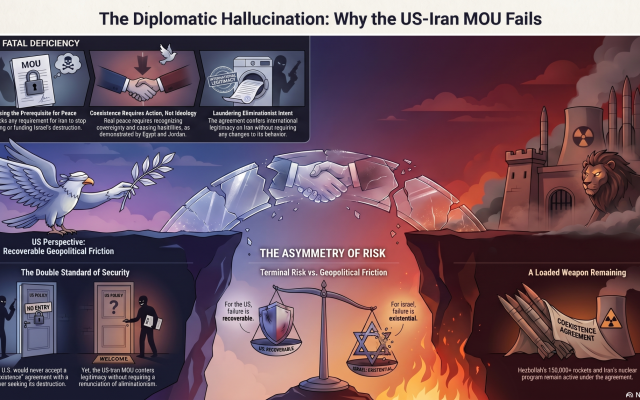
 
https://static-cdn.toi-media.com/blogs/uploads/2026/06/Why_the_US-Iran_MOU_Fails-640x400.png 
 
Instead, Mr. Trump had to focus on the measure that Iran took to disrupt world energy supplies, along with fertilizer and other critical supplies to a dependent world. Any tankers or cargo ships leaving the Gulf States for their usual destinations crossing through the Strait risked Iranian drones or missiles and before long ships one after another were stranded awaiting an opportunity that never came. Then came the system of fees inaugurated by the IRGC for safe passage. Followed by negotiations and a Memo of Understanding and the war footing went limp, all in abeyance.
 
While the U.S. administration faces the democratic anger of its population persuading it to leaven its actions accordingly, no such constraints face the Islamic Republic, for its population is forcibly mute and as much as it detests its government, the fear, anger and resentment of up to 35,000 lives destroyed only a few months ago, acts as an anchor to further action against a government that will not be dislodged. The Islamic regime has decided to wait things out. Until enough pressure from the U.S. public and the international community against a continuation of the war, forces the U.S. military to withdraw. 
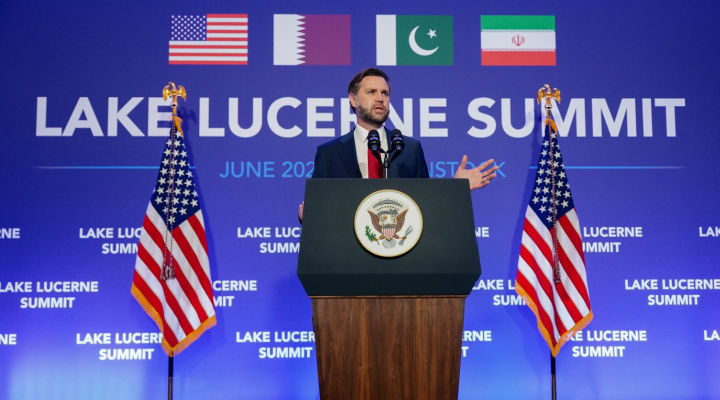
 
US Vice President JD Vance speaks to members of the media before boarding Air Force Two, after the US and Iran held high-level talks at the Lake Lucerne Summit, at Emmen Military Air Base, Emmen, Switzerland, June 22, 2026. Photo: REUTERS/Nathan Howard/Pool
 
"Iran is trying to avoid another full-scale war. But it also believes that failing to respond caries its own risks because it would project weakness and invite further pressure."
"Iran's calculation is that calibrated, limited escalation can restore deterrence without crossing the threshhold into all-out war."
Negar Nirtazavi, senior fellow, Center for International Policy 
   

Labels: , , , , , , ,

Tuesday, March 10, 2026

Death to the Islamic Republic of Iran

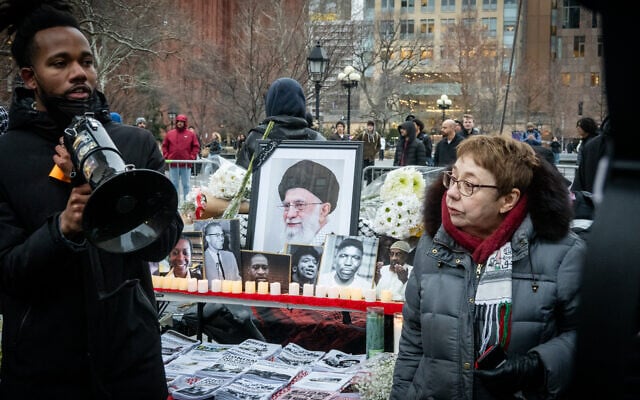
Protesters in New York City chanted “death to America, death to Israel” in Farsi at a vigil honoring late Iranian Supreme Leader Ali Khamenei in New York City on Friday night, shortly after clashes erupted with counter-protesters, resulting in multiple arrests.
The 86-year-old Iranian supreme leader was killed in Tehran on Saturday in the initial joint US-Israeli airstrikes that started the war, with his death confirmed by the Iranian government the following day.
Protesters set up images of Khamenei on two tables alongside flowers and candles, with signs reading, “Solidarity with Iran.” Other pictures included US civil rights leader Malcolm X and George Floyd, and the display table also carried copies of zines with titles such as “Zionism and Racist Landlords” and “ICE & Friends.
The event, held in Washington Square Park, was billed as both a memorial for Khamenei — whose death was dubbed by those present as an “assassination by US government forces” — and for “all martyrs of Amerikan [sic] imperialism.”
“We must live like the ayatollah did, with his heart for his people, and we must die like he did,” a speaker told the crowd.
The protesters chanted, “Death to the IDF,” and, “Al Qassam you make us proud, kill another soldier now,” a reference to Hamas’s Al Qassam Brigades. One man waved a Hezbollah flag. Both Hamas and Hezbollah are US-designated terrorist groups.
The protest was endorsed by at least 18 smaller activist groups, such as the Bronx Anti-War Coalition, the far-left Workers World Party and Crown Heights Bites Back, according to a statement from organizers. The larger anti-Zionist activist groups in the city did not sign on.
Some of the organizers have had contact with the Iranian mission to the United Nations.
The Times of Israel
Demonstrators chant during a vigil honoring Iran's late Supreme Leader Ayatollah Ali Khamenei in New York, March 6, 2026. (Luke Tress/Times of Israel)
A think tank has identified at least 27 UK universities where student societies and affiliated groups have mourned the death of Iran’s Supreme Leader, Ayatollah Ali Khamenei.
Evidence compiled by The Henry Jackson Society shows student groups - primarily Ahlul-Bayt or similarly aligned Islamic societies - have shared messages referring to Khamenei as a “martyr”, organised memorial events, or circulated content praising the Iranian regime.
Universities where such activity has been recorded include University College London, Cambridge, Manchester, Edinburgh, Bristol, Southampton, Surrey, Cardiff, Glasgow, Brunel, Kingston, Westminster, King's College London and Imperial College London, among others.
Some societies organised commemorative events on campus, while others posted condolence graphics, shared vigil material or cancelled events “in honour of our beloved Shuhada”.
GB News
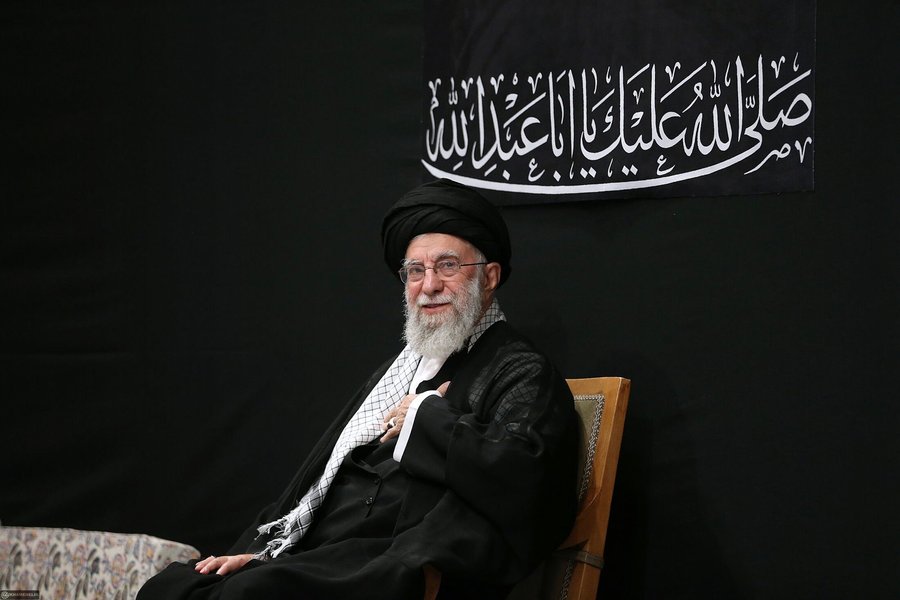
Ali Khamenei
Iran's Supreme Leader Ali Khamenei was killed in the first weekend of the conflict | GETTY
"I am an individual with many faults and shortcomings" he said in his inaugural address, and "truly a minor seminarian". It was, at the time, an accurate self-assessment for a mid-ranking cleric in the hierarchical world of Shiite Islam." 
"Over the next four decades, this seemingly unqualified cleric who rose to the top almost by chance would become one of the world's longest-serving autocrats, confounding every American president since George H.W. Bush. He would at one point become the most powerful man in the Middle East, dominating five failing lands -- Syria, Lebanon, Iraq, Yemen and Gaza."
"This ambition and hubris also led to his downfall. He came to govern with the hypervigilance and brutality of a man driven by the idea that much of his own society and the world's greatest superpower sought to unseat him -- which, in the end, it did."
Karim Sadjadepour, senior fellow, Carnegie Endowment for International Peace  
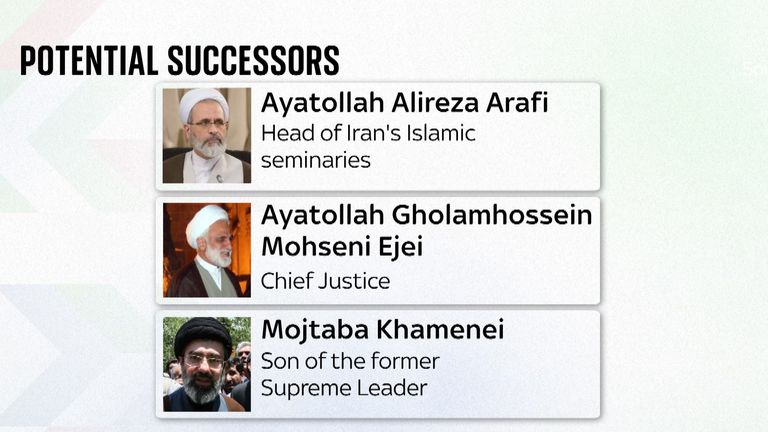
Born in Mashhad, second of eight children of a cleric in 1939, Ali Khamenei was enrolled in religious education by age five where his formative years were spent in the Mashhad seminary. He failed to attain senior religious credentials. A family formula repeated by his second-oldest son Mojtaba, now elevated to the position his father vacated on his death. Reputed to be even more averse to human rights than his father Ali, Mojtaba, a pedestrian cleric, but an enthusiastic dabbler in pricey real estate, has achieved a fortune, just like his father; real estate investments in world capitals took precedence over religious matters.
 
In his early 20s, Ali Ayatollah became acquainted with the politics of Ayatollah Ruhollah Khomeni, who was considered an Islamist cleric of the first order. He was also a harsh critic of the more secularist Shah of Iran who exiled him in 1964. One of Ayatollah Khomeini's passionate admirers for his defiance of royal authority, in Khomeini's exiled absence, Ali Khamenei spouted his mentor's positions on Islamic government for Iran. He gained distinction in this passion for negating authority, by six arrests and solitary confinement. 
 
When Shah Pahlavi was deposed with the 1979 Islamic Revolution that overtook 2,500 years of Persian monarchy, Ayatollah Khomeini returned from exile to rule over a new Islamic Republic, raising Khamenei from obscurity to the position of president of the Islamic Republic. Following a decade of rule, Ayatollah Khomeini died just as its brutal eight-year conflict with Iraq came to an end. With no clear successor to his rule, Ali Khamenei was named, and took on the title of Ayatollah, to become Iran's Supreme Leader as Grand Ayatollah.
 
Khamenei, while presenting himself as a religious leader with no pretensions to personal wealth in fact accumulated vast wealth accessed through Iranian private property seized by the theocratic state. While Khamenei's decrees and authority ensured that the population of the Islamic Republic had no access to international finance, nothing deterred him from building immense financial wealth. He took state funds to spend billions from energy extraction in funding his "axis of resistance" in the Middle East, while Iranians suffered the economic impact of sanctions and inflation.
 
The Hamas-led invasion of southern Israel with an orgy of sadistic savagery in the commission of mass rapes, large-scale slaughter and atrocities on a Medieval scale of torture and mutilations of children, entire families immolated in their homes, abductions and destruction committed by thousands of Palestinian terrorists represented a triumph of 'resistance' to 'occupation' of Zionists in the Middle East to Khamenei who celebrated the shattering event. 
 
Israel's response against Hamas in Gaza, Hezbollah in Lebanon, and Houthis in Yemen, all terror proxies of Iran, began to destroy the Islamic Republic's 'ring of fire' around the Jewish state, that was meant for its destruction. The axis of resistance was wholly diminished by the Israel's assassination of Hamas's Ismail Haniyeh in Tehran and Yahya Sinwar in Gaza, along with the Hezbollah leader Hassan Nasrallah. 
 
When Israel and the United States struck Iran in June of 2025 in a 12-day war against military installations, assassinating elite Revolutionary Guards commanders and regime authorities, while the U.S. dropped bunker-busting bombs on nuclear sites, Ayatollah Khamenei was mysteriously absent, hidden away for safety before finally emerging with the raids completed, to declare victory for Iran. 
 
Iran celebrated that victory months later when cities across the country were engulfed in huge anti-regime demonstrations, with Iranian citizens demanding the end of theocratic rule. Ayatollah Khamenei ordered the Islamic Revolutionary Guard Corps and their Basij police offshoots to spare no efforts in cracking down on the dissenters using all means necessary to halt any further demonstrations against the government. The deadly crackdown led to an estimated 30,000 citizens being killed, tens of thousands of Iranian citizens injured and arrested. 
 
Now in its death throes, the Islamic Republic has devoted itself to instituting a dynastic follow-up to the death of the Supreme Leader, replacing him with a man cloned in his image in every conceivable way. The IRGC will not go easily. Its command structure swiftly replaces those that are extinguished. Their reason for existence is to continue the strategy mapped out for them first by Khomeini, then by Khamenei, to ensure that Shia Islam dominates the numerically superior Sunni form of Islam by conquest. And to destroy any vestiges of the West and democracy in the Middle East, beginning with Israel. 
 
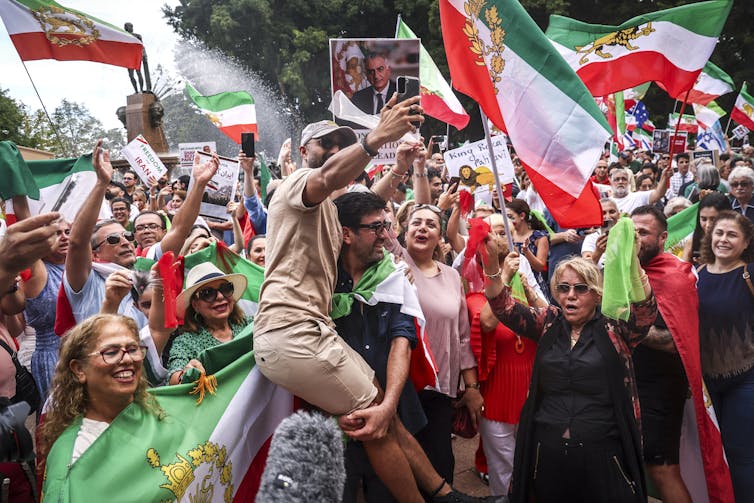
Members of the Iranian community in Sydney celebrate after US-Israeli air strikes killed Ali Khamenei, March 1. David Gray/AFP via Getty Images
 

Labels: , , ,

Tuesday, March 03, 2026

The New-Old Iranian At-War Governing Council

"We had prepared for such moments and have plans in place for all scenarios, even for the time after the martyrdom of revered Imam Khamenei."
"You'll see that after the leadership council is formed, the power and integrity of officials, defensive forces and the people will be beyond imagination."
Mohammad Bagher Galibaf, parliamentary speaker, Iran 
 
"We are ready in our country."
"We are not looking for war, and we won't start the war. But if they force it on us, we will respond."
Ali Larijani, 67, head, Iranian Supreme National Security Council 
https://smartcdn.gprod.postmedia.digital/nationalpost/wp-content/uploads/2026/02/69a3aa5484dfb4ee61ed6f42jpeg-e1772378315337.jpg?quality=90&strip=all&w=564&h=423&type=webp&sig=InL4GDx3sIw--snzKtap_w
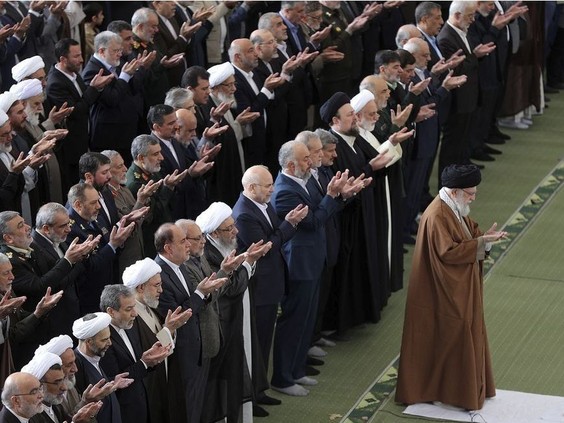
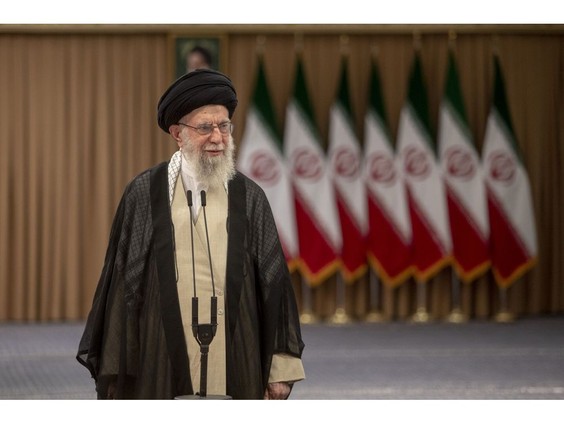
In this photo released by the official website of the office of the Iranian supreme leader, Supreme Leader Ayatollah Ali Khamenei leads an Eid al-Fitr prayer marking the end of the Muslim holy fasting month of Ramadan at the Imam Khomeini Grand Mosque in Tehran, Iran, Monday, March 31, 2025. Photo by Uncredited /AP
 
Well, 'they' did proceed to 'force it' on the Islamic Republic of Iran. The United States and Israel in a tandem of determination, after failed nuclear talks and in the wake of massive, prolonged popular protests by Iranians fed up with the economic plight they found themselves in as a result of sanctions imposed on Iran for its intransigence over international demands that it forego its nuclear programs, where the regime's brutal crackdown on protesters led to thousands killed, tens of thousands injured and arrested, the decision was finally made to attack the regime's nuclear development sites, its IRGC weapons depots, ballistic missile launchers and leading government figures.
 
Ayatollah Ali Khamenei is dead, as are many of the leading military and security figures of the Islamic Republic. Before his death, the Grand Ayatollah left instructions with trusted aids how they must proceed in a continuation of the Islamic Republic after his death. The Muslim holy month of Ramadan 2026 saw the aerial invasion of Iran by American and Israeli fighter jets targeting the regime's infrastructure, its military, its government figures, after a massive buildup of American military assets at sea and in the air. A joint, well-planned agreement between Israel, whom Iran has repeatedly threatened to destroy and the U.S., whose military assets Iran has repeatedly targeted with its proxy terrorists.
 
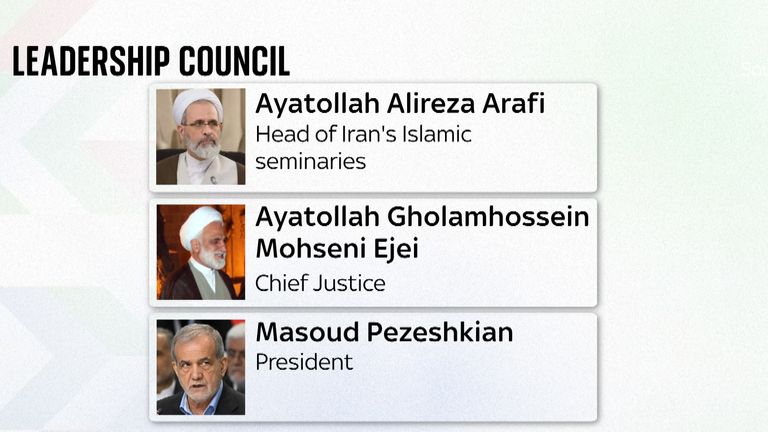
Provisional Leadership Council, Sky News
 
 Facing the threat of strikes and dealing with nationwide protests in January, Ayatollah Khamenei assigned Ali Larijani, Iran's foremost national security official, to take the reins of government. He chose Mr. Larijani, and not the current president of the country, Masoud Pezeshkian to be tasked. President Pezeshkian, a former heart surgeon turned politician and considered a moderate, would then report directly to Mr. Larijani. Larijani is a veteran politician, currently head of the Supreme National Security Council, formerly commander of the Revolutionary Guards Corps.
 
Mr. Larijani had been tasked with crushing the January protests throughout the country that demanded the ouster of the regime and the end of Islamic rule. The lethal force that was unleashed under his command was in fact a reflection of the government itself, prepared to kill as many protesters as was deemed necessary to convince Iranians that the government was unmoved by the passion of their protests other than to continue the regime's resolve to crush dissent.
 
It has been Mr. Larijani who has been front and central in liaising with Russia, Qatar and Oman while supervising the nuclear negotiations underway with Washington. He has been at the helm of planning Iran's response to the expected strike by the United States in view of the American forces being amassed in the region. Alongside Larijani, a handful of other close political and military associates of Ayatollah Khamenei were tasked to ensure that the Islamic Republic would survive any assassination attempts on the regime's leadership including that of the Ayatollah himself.
 
Four layers of succession were assigned by Ayatollah Khamenei for each of the military command and government roles of critical importance to the longevity of the regime. All those named to leadership roles were themselves in turn to name up to an additional four replacements with responsibilities delegated to a circle of confidants for decision-making, in the event that communications were disrupted or the death of the Ayatollah. All of the country's armed forces were placed on the highest state of alert in preparation for fierce resistance. 
 
Sky News
 
A three-person temporary leadership council has been formed to govern the country and temporarily assume the duties of supreme leader, in line with Islamic Republic law. Mr. Larijani tops the list to manage the country, followed by Brigadier General Mohammad Bagher Ghalibaf, a former Guards commander and current speaker of Parliament, designated as the de facto deputy to Khamenei, to command the armed forces during conflict. President Pezeshkian has been sidelined.
 
None of the men in this tight little circle of command and control would be considered with any favour by the angry people of Iran, given their accusations of financial corruption, and complicity in violations of human rights, inclusive of the recent slaughter of thousands of unarmed protesters over a three-day period in early January. 
 

Labels: , , ,

Monday, February 10, 2025

The Oppressed People of Revolutionary Iran Amidst its Nuclear Threat


"[Negotiating with the United States would be neither] wise, intelligent nor honourable. Negotiating with such a government should not be done."
"We must understand this correctly and not be misled into thinking that sitting at the negotiation table with that government will resolve certain matters. No, negotiations with the United States will not solve any problems."
"They make statements about us, express opinions and issue threats. If they threaten us, we will threaten them. If they act on those threats, we will do the same. If they undermine our nation's security, we will undoubtedly respond in kind."
Supreme Leader Ayatollah Ali Khamenei, Tehran, Iran
https://smartcdn.gprod.postmedia.digital/financialpost/wp-content/uploads/2025/02/776168586.jpg?quality=90&strip=all&w=564&h=423&type=webp&sig=Wnvx_g_2fhm559089EluIw
Ayatollah Ali Khamenei Photographer: Majid Saeedi/Getty Images
 
The Islamic Republic of Iran has for years suppressed the wishes of the Iranian people to live fruitful lives without the interference of strict medieval-era Sharia law that imposes restrictions on every aspect of people's lives. Iranians have attempted time and again to convey their wishes to the hardline Islamist government that the version of Islam they have been forced to live under has made their lives a torment. The advent of the return of former Grand Ayatollah Ruhollah Khomeini from exile in 1979 and the downfall of the Shah of Iran introduced the Iranian public to repression, subjugation and poverty of opportunities. 

The octopus arms of Revolutionary Iran that brought the dictatorship of a theocracy intolerant of any sign of its population rejecting the imposition of Islamist principles and practises under the watchful eyes of the ruling mullahs and their military arm, the Islamic Revolutionary Guard Corps, has diminished quality of life entirely for the population they command. But the aspirations of the Islamic Republic goes well beyond imposing their version of Islam on its citizenry. In forming a sectarian alliance with other Shi'ite-led and majority governments, Tehran aspires to transform the entire Middle East including Sunni-majority nations into its satellites.
 
The sole exception being the State of Israel -- whose presence on land formerly 'consecrated' to Islam, irrespective of that land being ancestrally the heritage of Judeans and current Israeli citizens --  destined, as far as the Iranian government is concerned, to be destroyed. To that end, the al Quds division of the IRGC founded, sponsored, armed, organized, trained and guided Islamist terrorist groups whose primary function would be to attack and ultimately vanquish the Israeli Defense Forces, and that done, destroy the Jewish state and its Jewish inhabitants. Its proxy militia Hezbollah was conscripted into the Republic's vision for that singular purpose. In tandem with Hamas in Gaza and the Houthis in Yemen they formed a formidable threat to Israel, fortified by Shi'ite militias in Iraq.
 
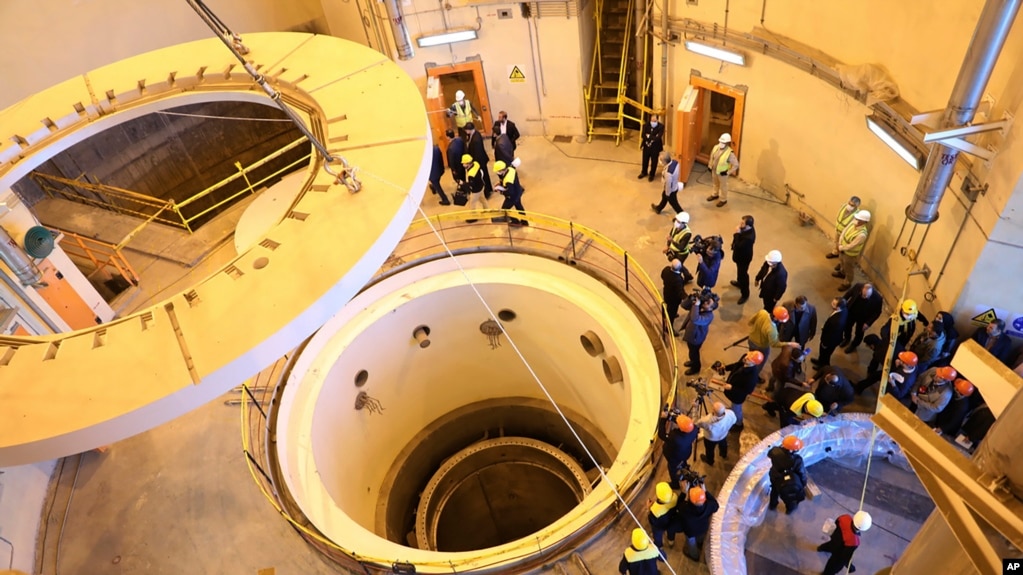
https://gdb.rferl.org/fd487141-ed28-4149-a960-7b9d94e97273_w1023_r1_s.jpg
Iran said it is ready to negotiate with the United States over its nuclear program

The IRGC nuclear program that began with ever more advanced centrifuges enriching uranium in hidden locations to the point where the creation of nuclear bombs could be created to match the technological advances of the short- and medium-range ballistic missiles that could be fitted with nuclear heads, continues to concern Western intelligence agencies, and certainly it does Israel. Iran's claims that its interest in nuclear is restricted to domestic purposes is clearly a feint that fools no one. It has made no secret of its intentions against Israel and its antipathy to the United States.
 
"With me, it's very simple: Iran cannot have a nuclear weapon", said American President Donald J. Trump. Signing an executive order on Tuesday for the reimposition of "maximum pressure" sanctions on the Islamic Republic, Mr. Trump said he felt "torn" on signing the order. "It's very tough on Iran", he said, without doubt referring to the additional economic pressure imposed on an  already flailing economy. "Hopefully we are not going to have to use it very much. I'm unhappy to do it"; not for any sympathy with the government, but empathy for the Iranian people living under economic hardships.
 
For months prior to this latest setback for Iran, the Republic has been signalling its readiness to re-engage in talks with the United States in the interests of negotiating the issue of its rapidly advancing nuclear program -- ostensibly in exchange for lifting crushing economic sanctions draining billions of dollars from the Iranian economy. With Khamenei's latest comments, the Iranian rial crashed to a record low of 872,000 rials to US$1 in aftermarket trading. 

"The Americans did not uphold their end of the deal. The very person who is in office today tore up the agreement. He said he would, and he did", complained Khamenei dolefully. Reformist President Masoud Pezeshkian on Thursday promised dialogue with the West. Several days later Khamenei contradicted that statement. While Iran's Foreign Minister stated that Iran would never engage in talks under the kind of pressure the newly imposed sanctions bear on the country.
 
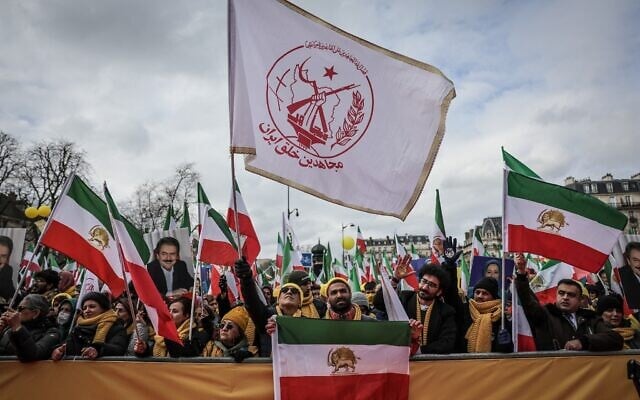
Thousands of Iranians from across Europe rallied impressively in Paris on February 8, urging world leaders to put more pressure on Iran’s ruling clerics."Instead of appeasing the mullahs, [the world] should stand side by side with the Iranian people", Maryam Rajavi, president of the National Council of Resistance of Iran (the political wing of the People's Mujahedin of Iran), told the rally. "We say your demise has arrived. With or without negotiations, with or without nuclear weapons, uprising and overthrow await you", NCRI President-elect Maryam Rajavi said.
 
https://static-cdn.toi-media.com/www/uploads/2025/02/AFP__20250208__36XF3EA__v1__HighRes__FranceIranDemonstrationRights-640x400.jpg
Supporters of the People’s Mujahedeen of Iran wave a flag of their organization (C) along with Iran’s pre-revolution flag during a demonstration in Paris, on February 8, 2025, on the occasion of the 46th anniversary of the uprising against the Shah. (Thibaud MORITZ / AFP)

Labels: , , , , , ,

Follow @rheytah Tweet