The Sting of the I.R.G.C. 'Mosquito Boats'
"The Islamic Republican Guard Corps navy works more like a guerrilla force at sea."
"It is focused on asymmetrical warfare, especially in the Persian Gulf and the Strait of Hormuz."
"So instead of relying on big warships and classic naval battles, it depends on hit-and-run attacks."
Saeid Golkar, Guards expert, political science professor, University of Tennessee, Chattanooga
"When it is very bumpy, they [armed forces onboard] cannot shoot."
"[They
are also ill-equipped to go head to head with a warship, and would
likely suffer] very heavy casualties [in any direct assault on one]."
"Even
if they tried to saturate the ship’s defences by attacking from
multiple directions, they would be extremely vulnerable to the air
support that would be called in."
"It is going to be much harder to eliminate the small boat threat than
it was to destroy Iran’s larger naval vessels, which were big targets
that were relatively easy to find and track and, at most, only had a
limited ability to defend themselves from air attack."
Jeremy Binnie, Middle East specialist, defence intelligence
company Janes
 |
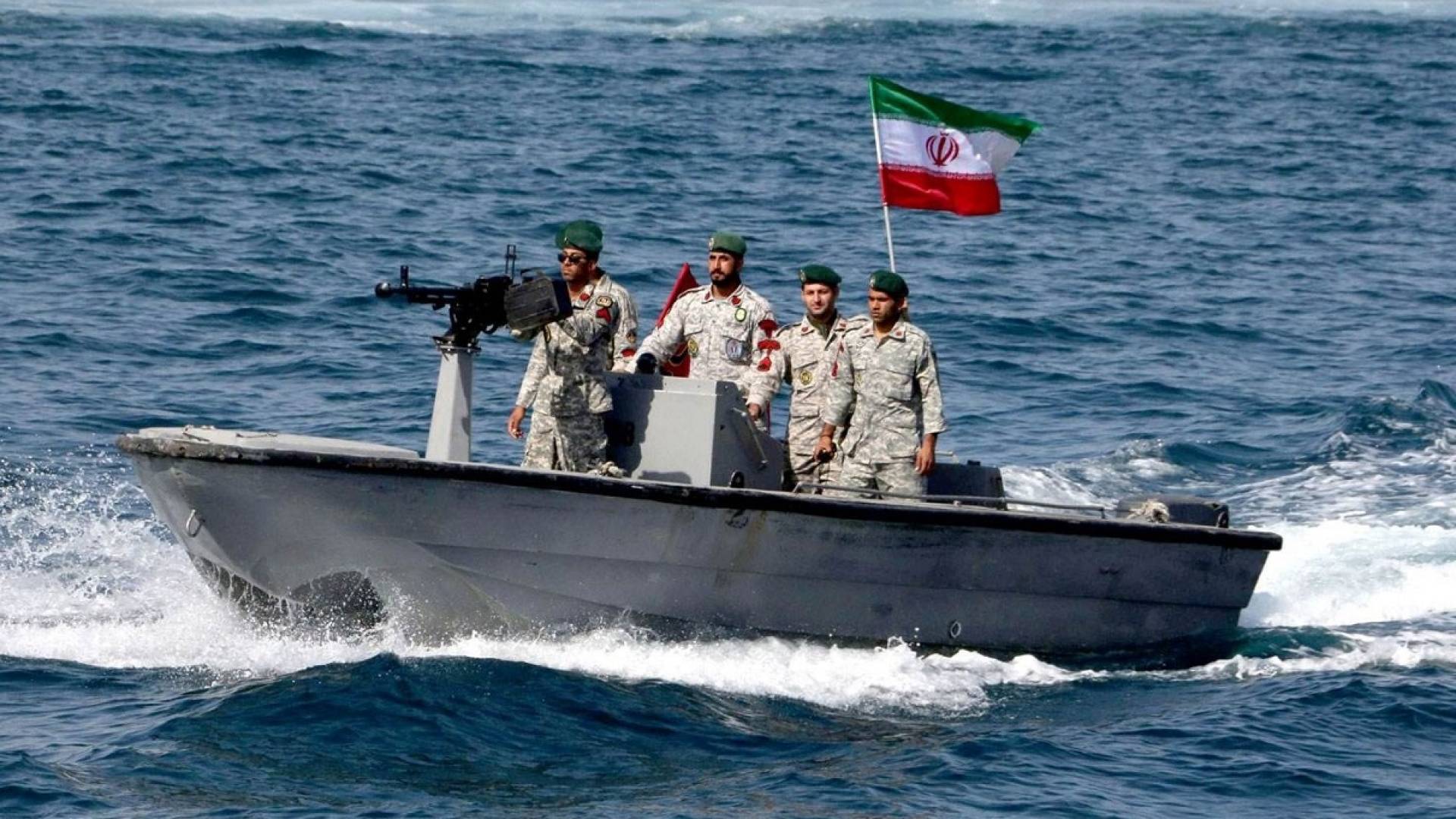
| The IRGC speed boats are fast, light, and easily replaceable. NurPhoto via Getty Images |
It
all began when recreational boats were mounted with rocket-propelled
grenades or machine guns, when Iran first began using small boats that
were fast, maneuverable, and deadly when patrolling the Strait of Hormuz
and the Persian Gulf. Those recreational craft underwent a
transformation when a range of specially designed small boats, along
with miniature submarines and marine drones were built to the IRGC
specifications, over the years. That 'mosquito fleet' of small boats has
become a real and present threat in the Strait as a consequence of the
U.S.-Israeli conflict in Iran.
The
flotilla of small, fast boats whose purpose by the IRGC has been to
harass local and international shipping through the Gulf, has turned now
to threatening and firing upon global shipping in the Strait of Hormuz
during the recent face-off between the U.S. and the Islamic Republic of
Iran -- or what's left of it, aside from the IRGC. The Islamic
Revolutionary Guard Corps is separate and apart from the regular Navy of
Iran, which had been struck a cataclysmic blow in the opening days of
the aerial bombardment.
Over
90 percent of Iran's navy's fleet was destroyed, according to U.S.
General Dan Caine, chairman of the Joint Chiefs of Staff. They all,
including the country's major warships, were sunk and sit now on the
ocean's bottom. At the same time, an estimated 50 percent of the fast
attack boats belonging to the Guards were sunk. Estimates of the total
number of these small ships prior to the U.S. sinking of the fleet
ranged from hundreds to thousands. They are still not now in short
supply.
 |
| Arrival of new shipment of IRGC fastboats. Photo via Mehdi H |
The
size of the boats make them mostly invisible on satellite images from
where they're moored alongside piers, where the excavation of deep
caves along the rocky coastline shelters them, prepared for deployment
at a moment's notice. During the current conflict, at least 20 vessels
were attacked by the 'mosquito fleet', according to the International
Maritime Agency. Analysts consider the attacks to have been by drones
fired from mobile launchers on land.
As for the small boat arsenal which poses a major threat to commercial shipping both in the Gulf and the Strait, "It remains a disruptive force. You never quite knew what they were up to and what their intentions were", commented Admiral Gary Roughead, retired chief of U.S. Naval Operations. "The IRGC navy has always believed that it is at the forefront of the confrontation with the Great Satan", added specialist on the Guards navy, Farzin Nadimi from the Washington Institute think tank.
According
to experts, these small boats can reach speeds of over 100 knots.
Larger, more sophisticated warships were also recently developed by the
Guards, and they too were targeted when the U.S. bombardments focused on
bombing Iran's naval fleet as well as its fleet of warplanes. The
largest drone carrier, the Shahid Bagheri, a converted container ship
able to launch anti-ship missiles, was also hit by U.S. air strikes.
It
is the swarms of small boats that pose an ongoing threat to commercial
vessels which have no defences against such attacks. U.S. warships, on
the other hand, can counter a potential swam of small boats with their
high-caliber cannons and additional weaponry.
 |
60 percent of IRGC fast boats still threaten shipping lanes: WSJ |
Labels: Conflict, Islamic Republican Guard Corps, Persian Gulf, Small-Boat Fleet, trait of Hormuz, U.S.-Israel Aerial Bombardment of Iran
Canadian Hypocrisy at the United Nations
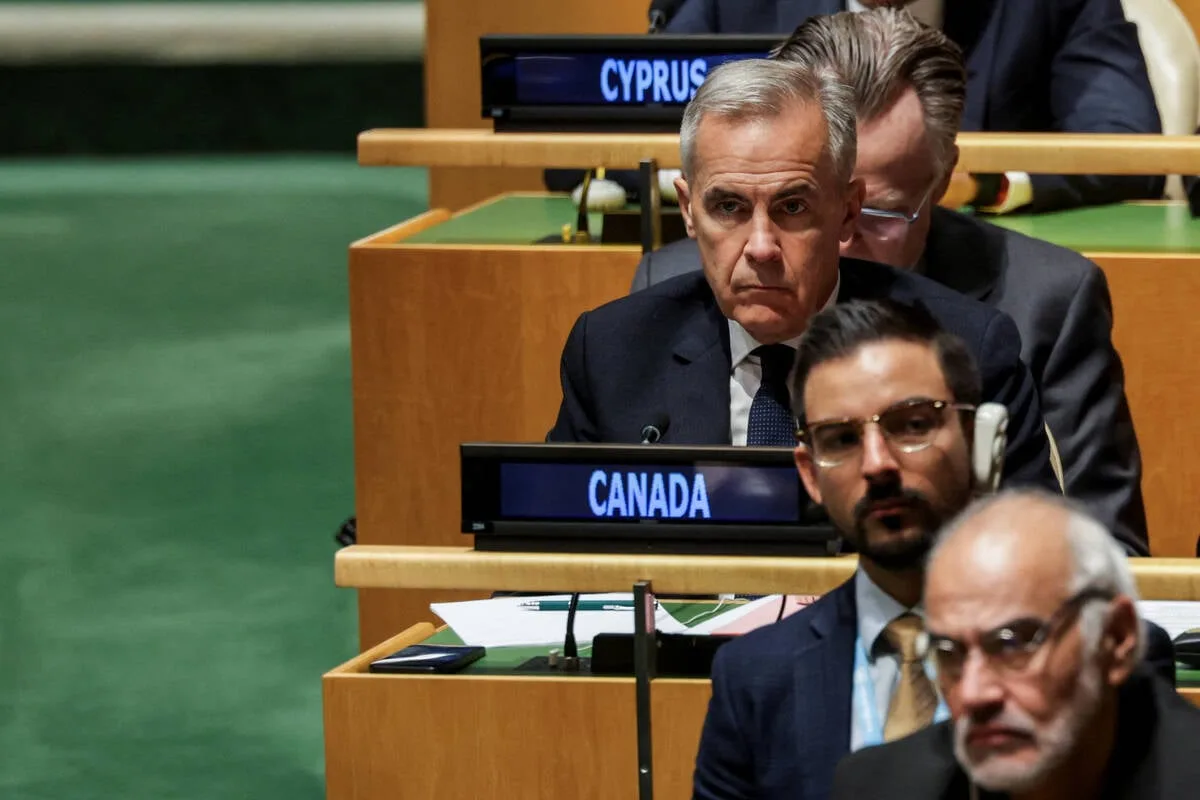 |
Canada’s misleading denial that it nominated Iran to UN body addressing women’s rights & terror prevention UN Watch |
"There
have been incorrect reports on social media about Canada’s position on
the nomination of Iran to the United Nations Economic and Social Council
Committee for Programme and Coordination – an advisory body with no
decision-making role. Iran
was nominated as part of the Asia-Pacific Group."
"Canada is not a member
of the group and did not endorse or vote for this nomination. There was
no vote, as per established procedures."
"Canada does not support Iran
for positions of influence within the United Nations. We will continue
to actively work with partners to counter Iranian candidacies."
Global Affairs, Canada
"Canada’s foreign ministry made a misleading statement
on X.com to mask the fact it allowed the nomination
of the Islamic Republic of Iran to a UN committee that addresses
critical issues including women’s rights and terrorism prevention —
failing to object as the US did, and as Canada and EU states have done in the past."
"The
fact is that Canada, as a member of the 54-nation UN Economic and
Social Council, participated in the consensus nomination of the Islamic
Republic of Iran to the UN Committee for Programme and Coordination on
April 8, 2026."
"This committee deals with budget priorities and
program coordination on critical issues, and will meet soon, May 14-21,
to address women’s rights, human rights, and terrorism prevention."
"At
a minimum, Canada should have taken the floor to object that it is
wrong to nominate a regime that only months ago massacred thousands of
protesters, and that brutally oppresses women, tortures political
prisoners, and systematically violates basic human rights."
"This
is exactly what the United States did in that meeting. It was the only
country that formally objected and disassociated itself from the
consensus decision, citing Iran’s appalling record on women’s rights.
Canada
and other Western democracies, however, remained silent and allowed the
consensus to pass in ECOSOC, a body of which Canada is a member."
UN Watch
"The United States disassociates from consensus on the nomination of Iran to the Committee on Program and Co-ordination."
"The
regime threatens its neighbours and has for decades infringed on the
Iranian people's ability to exercise their basic human rights."
"Due
to these and other concerns, we believe Iran is unfit to serve on a
body advising member states on program and budgetary matters."
U.S. Ambassador Dan Negrea
 |
| The Security Council chamber at the United Nation in New York City. Photo by Spencer Platt /Getty Images |
Canada
obligingly assisted in the approval of a motion for the Islamic
Republic of Iran -- that would be the Iranian regime that just a few
months earlier responded to nation-wide protests against the regime by
dispatching police, the IRGC and Basij to violently disband the protests
by all and any means, leading to the killing of an estimated 30,000
Iranians and the arrests and death sentences of untold numbers of
'enemies of the Islamic Republic' -- to a position on the UN's Committee
for Program and Coordination.
Iranian-Canadians
who desperately wish for the Ayatollah-led, Islamic Revolutionary Guard
Corps-enforced Republic to fall, and yearn for the freedom from
oppression that would mean for their families in Iran, would have
reacted to the news of this incredible betrayal with disbelief. While at
the same time, the infiltrated members of the regime and the IRGC that
have made a home for themselves in Canada would have beamed with
pleasure. Just as Hamas has on occasion congratulated the ruling Liberal
government for some of its decisions, now the Iranian regime was given
the same opportunity.
Officially,
for internal consumption, the Liberal government of prime minister Mark
Carney denied any such reports; that they did no such thing. The actual
facts belie that assertion. Canada gave aid and comfort to a regime
under the duress of a conflict brought by the State of Israel and the
U.S. military launching an aerial war on the regime, its military, the
IRGC, their weapons depots and rocket launchers and nuclear sites. While
the Iranian regime presents a distinct danger with its nuclear
ambitions and its sponsorship of terrorist groups to the world at large
and the Middle East in particular, Canada's government calls for a
ceasefire so the regime can survive.
Canada's
decision at the April 8 meeting of the UN Economic and Social Council
enables Iran to have an advisory and oversight role on programs as
diverse as gender equality and terrorism prevention, as well as
'peaceful uses of outer space'. Global Affairs Canada's insistence that
Canada's role in the event has been misunderstood, is an evasive and
shameful tactic in a bid to shield the government from the shame and
blame it most certainly deserves for betraying the most elemental
foundations of human rights against tyrannical rule.
Official
video from the UN Economic and Social Council, most recently chaired by
Bob Rae, Canada's ambassador to the UN, showed an official chairing a
plenary session of the council where the Islamic Republic of Iran was
included on a list of countries set to be appointed to a three-year term
on the Committee for Program and Co-ordination. With no objections from
the representatives of the assembled countries, the officiating
individual bangs a gavel and declares: "It is so decided".
And
Canada helped in that decision; not a word of doubt expressed of the
inappropriateness of a corrupt, terror-promoting, nation known for
persecuting its own people -- much less its violence visited upon
Iranian women who dare to oppose strictures placed upon their most basic
of human rights -- sitting on such a committee from Canada.
 |
| Screenshot from a UN live stream showing the
precise moment that a plenary session of the UN Economic and Social
Council approved the nomination of the Islamic Republic of Iran to a UN
oversight committee. Photo by UN |
Labels: Global Affairs Canada, Islamic Republic of Iran, Liberal Government, Terrorism, U.S.-Israel Aerial Bombardment of Iran, UN Watch, United Nations Committee for Program and Coordination, Women's Rights
The Strait of Hormuz
"[Any Iranian warships that come] anywhere close [to the U.S. blockade will be destroyed]."
"We can't let a country blackmail or extort the world because that's what they're doing."
"We [the United States] don't use this strait. We have our own oil and gas, much more than we need."
U.S. President Donald Trump
"The entirety of the Iranian coastline, including ports and energy infrastructure [are included in the restrictions]."
"[Transit through the strait] to or from non-Iranian destinations is not reported to be impeded by these measures."
"[However, ships] may encounter military presence [in the strait]."
Maritime Trade Operations agency
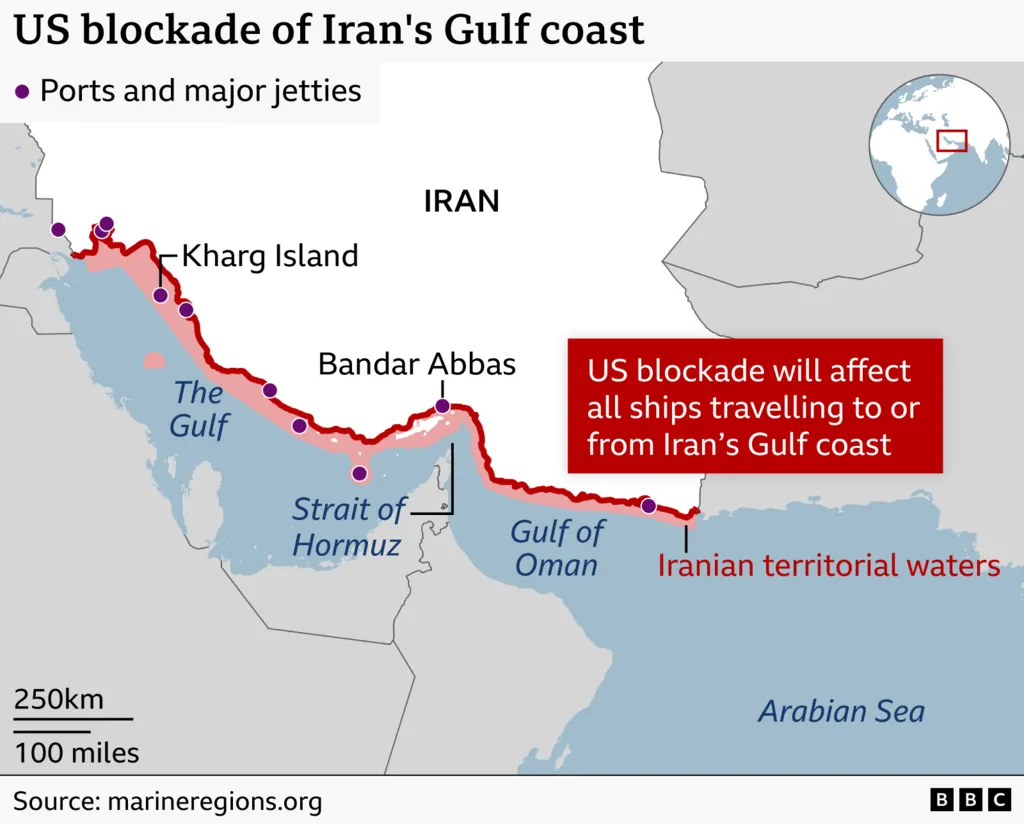
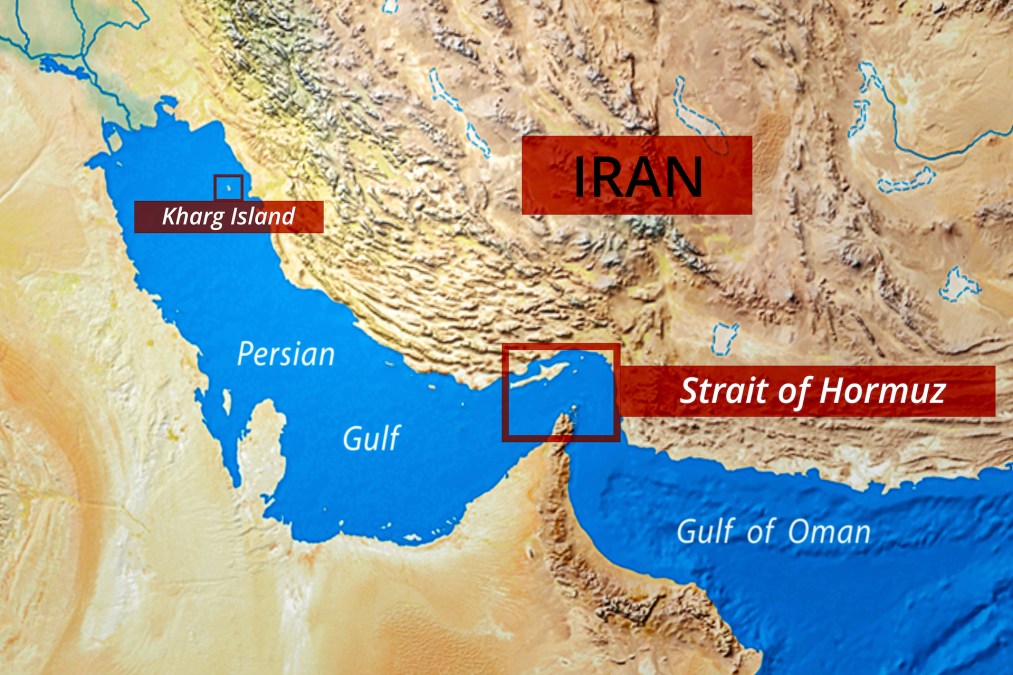
On Monday, the U.S. military began a blockade of all Iranian ports and coastal areas, a tamped-down version of President Trump's previously-expressed intention to block the strategic Strait of Hormuz entirely. Early reports are that ships had stopped crossing the waterway. Mr. Trump has emphasized that safeguarding the strait is of greater concern to Europe and other places around the globe than it is for the United States although none yet have made a move singly or in tandem with others to counter Iran's lock on the strait.
Iran has responded with threats to target ports in the Persian Gulf and the Gulf of Oman, just as it has the oil terminals and airports of Gulf countries it considers enemies, pounding them with missiles and drones to an even greater degree than it has been targeting Israel. Its goal appears to be that if enough damage can be done to Iran's neighbours, they will rise against the U.S. and Israel in their joint aerial campaign against the Islamic Republic.
Certainly not on the basis that other Muslim countries would not stand willingly by as a foreign interloper destroys military bases, launching sites, missile depots, and targets Iranian leaders and its IRGC elite for assassination. Iran's neighbours are Arab Muslims and for the most part majority Sunni. Aryan Iran is a Shitte power, its theistic regime has threatened the dominance of its Arab neighbours, none of whom with the exception of Qatar and Oman would mourn the disappearance of the regime's hold on Iran.
In its furious death throes the intransigent terrorist state structure has turned against its neighbours, both those that oppose it, and those who have in the past supported it, all of which have now sustained lasting damage to their infrastructure, both civil and oil-producing. Pakistan and Turkey, out of the IRGC's line of fire, but holding Islamist fundamentalist positions not far off from Iran's own, are actioning for a ceasefire to save what is left of the regime, when the entire point of the exercise is to excise it entirely.
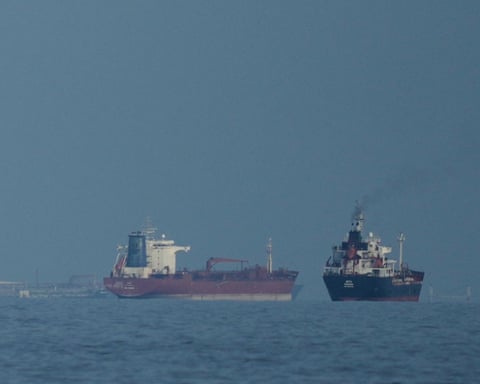 |
| Oil tankers and cargo
ships line up in the strait of Hormuz, where the US military says it
will enforce a naval blockade on all Iranian ports. Photograph: Altaf Qadri/AP |
Global markets have been shaken over the lack of movement through the Strait of Hormuz. The now-seven-week conflict has seen thousands of people killed. Tentative ceasefire talks have failed to reach an agreement; unsurprisingly, since Iran's demands are impossible to be met -- essentially insisting that all the reasons that the United States launched its attacks to begin with, from nuclear, to inciting terrorism, to slaughtering its own people, to threatening Middle East stability and beyond, be reinstated, along with an obligation by the U.S. to pay restitution for its strikes.
Even in defeat of its continuation to govern, the Islamic Republic publicly celebrates 'victory' over its opponents. The months of non-stop aerial bombing have wrought great damage to Iran's aspirations and very capacity to carry on, but what is left of any authority figures in the radical theocracy still direct the actions of the Islamic Revolutionary Guard Corps (or vice versa) and the Basij militia, as well as the Shiite militias in Iraq and Hezbollah in Lebanon.
Globally, the impact of basic goods and energy soaring in price has had its negative effect, reflecting the breakdown of traffic through the strait. Analysts are struggling to imagine how the blockage by the U.S. of the strait will work. Whether it will produce too-great economic stress on Iran, or whether if the strait still fails to allow normal traffic, global oil and other items like fertilizer will be driven high enough to force President Trump to change tactics.
According to the U.S. military's Central Command, the blockade is to be enforced "against vessels of all nations entering or departing Iranian ports and coastal areas", which would include all of Iran's ports on the Persian Gulf and Gulf of Oman. Ships travelling between non-Iranian ports would be allowed to transit the strait, on the other hand.
Trump stated that Iran's navy was "laying at the bottom of the sea, completely obliterated" though it still maintains "fast attack ships", warning that "if any of these ships come anywhere close to our BLOCKADE, they will be immediately ELIMINATED". To which Iran responded with: "Security in the Persian Gulf and the Sea of Oman is either for everyone or for NO ONE". "NO PORT in the region will be safe", another response from the IRGC warned. Hence the dire need to destroy those 'fast attack ships'.
 |
| Two police officers walk in front of an anti-U.S. billboard depicting
American aircraft being caught by Iranian armed forces in a fishing net
beneath the words in Farsi, "The Strait of Hormuz will remain closed,
The entire Persian Gulf is our hunting ground," in Tehran, Iran, Sunday,
April 5, 2026. (AP Photo/Vahid Salemi, File) |
Labels: Gulf States, Islamic Republic of Iran, Islamic Revolutionary Guard Corps, Strait of Hormuz, U.S.-Israel Aerial Bombardment of Iran
That Critical Maritime Passage
"Today, we began the process of establishing a new passage and we will share this safe pathway with the maritime industry soon."
"Additional U.S. forces, including underwater drones, will join the clearance effort in the coming days."
U.S. Central Command commander Admiral Brad Cooper
"Effective immediately, the United States Navy, the Finest in the World,
will begin the process of BLOCKADING any and all Ships trying to enter,
or leave, the Strait of Hormuz. At some point, we will reach an “ALL
BEING ALLOWED TO GO IN, ALL BEING ALLOWED TO GO OUT” basis, but Iran has
not allowed that to happen by merely saying, “There may be a mine out
there somewhere,” that nobody knows about but them. THIS IS WORLD
EXTORTION, and Leaders of Countries, especially the United States of
America, will never be extorted. I have also instructed our Navy to seek
and interdict every vessel in International Waters that has paid a toll
to Iran. No one who pays an illegal toll will have safe passage on the
high seas. We will also begin destroying the mines the Iranians laid in
the Straits. Any Iranian who fires at us, or at peaceful vessels, will
be BLOWN TO HELL!"
U.S. President Donald J. Trump
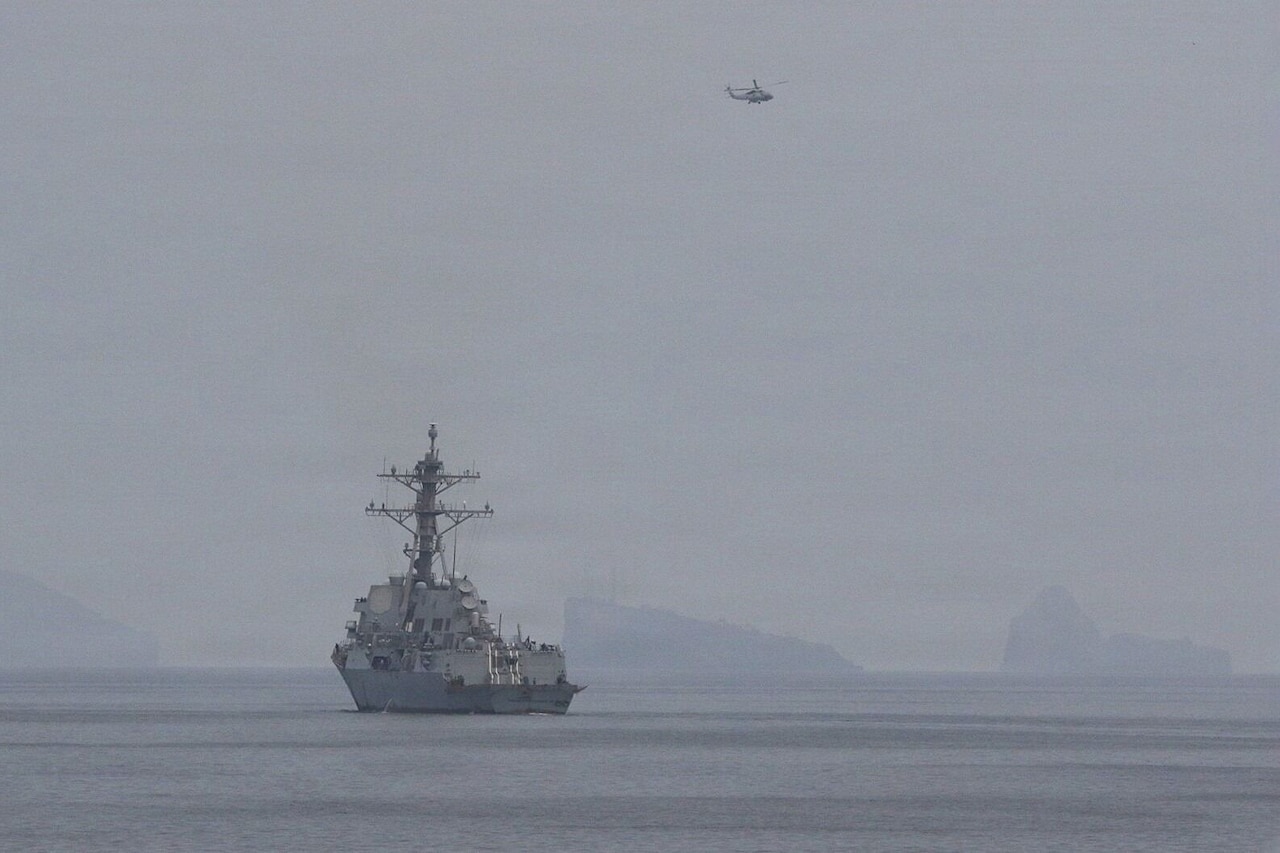 |
A Navy destroyer in the U.S. Central Command area of operations transits
the Strait of Hormuz, April 11, 2026. Photo: U.S. War Department |
"The blockade will be enforced impartially against vessels of all
nations entering or departing Iranian ports and coastal areas, including
all Iranian ports on the Arabian Gulf and Gulf of Oman. CENTCOM forces
will not impede freedom of navigation for vessels transiting the Strait
of Hormuz to and from non-Iranian ports."
"Additional information will be provided to commercial mariners
through a formal notice prior to the start of the blockade. All mariners
are advised to monitor Notice to Mariners broadcasts and contact U.S.
naval forces on bridge-to-bridge channel 16 when operating in the Gulf
of Oman and Strait of Hormuz approaches [per the release]."
Centcom press release
The
U.S. Department of War announced on its website that the USS Frank E.
Peterson and the USS Michael Murphy are operating in the Persian Gulf,
part of a broader mission to fully clear the Hormuz Strait -- an
international sea passage and essential trade corridor -- of sea mines,
laid courtesy of the Islamic Revolutionary Guard Corps. Underwater
drones, along with additional American forces, are set to join the
clearance project in coming days.
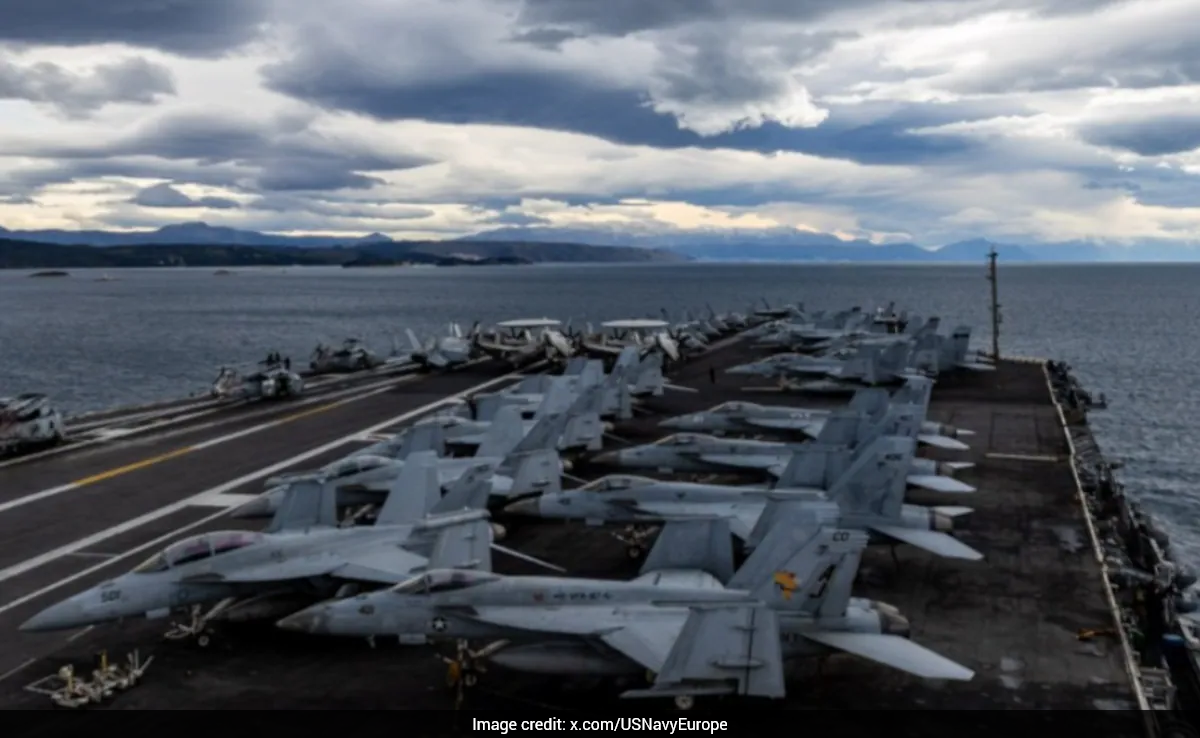 |
| US has deployed two Navy guided-missile destroyers to Hormuz (Representational Image) |
"We're sweeping the strait. Whether we make a deal or not makes no difference to me",
said President Trump, even as negotiations between U.S. and Iranian
representatives -- alongside a Pakistani mediator -- on a potential
ceasefire broke down. The Iranian preconditions were a non-starter, with
Israel intent on continuing its strikes on Hezbollah in southern
Lebanon. Iran's continued insistence on its right to continue with its
nuclear program, its demand that the U.S. withdraw from bombing Iran and
prepare to pay reparations, along with its refusal to put a stop to its
support of proxy terrorist groups ensure the talks would go nowhere.
The
Islamic Republic's 'red lines' expressed as demand for damage caused by
U.S.-Israeli strikes compensation and the release of Iran's frozen
assets, are a reflection of the supreme arrogance of a ruling elite that
refuses to acknowledge its position as a bludgeoned theistic hegemon
that threatened its neighbours and launched terror attacks by proxy
internationally whose beating is its just due for the further threat its
nuclear ambition poses to the world at large.
The country of 93
million people is deserving of relief from the tyranny of a regime that
persecutes its own population, using vast oil reserves to fund global
terrorism rather than investing in internal infrastructure of benefit to
the country's future -- not as a conquering Islamist totalitarian
state, but as a responsible government adhering to international norms
of human rights standards. That its disregard for and abuse of its
female population's right to equal treatment and respect given to their
male counterparts is ignored by the United Nations where Iran was
recently appointed to a human rights group is cynicism on steroids.
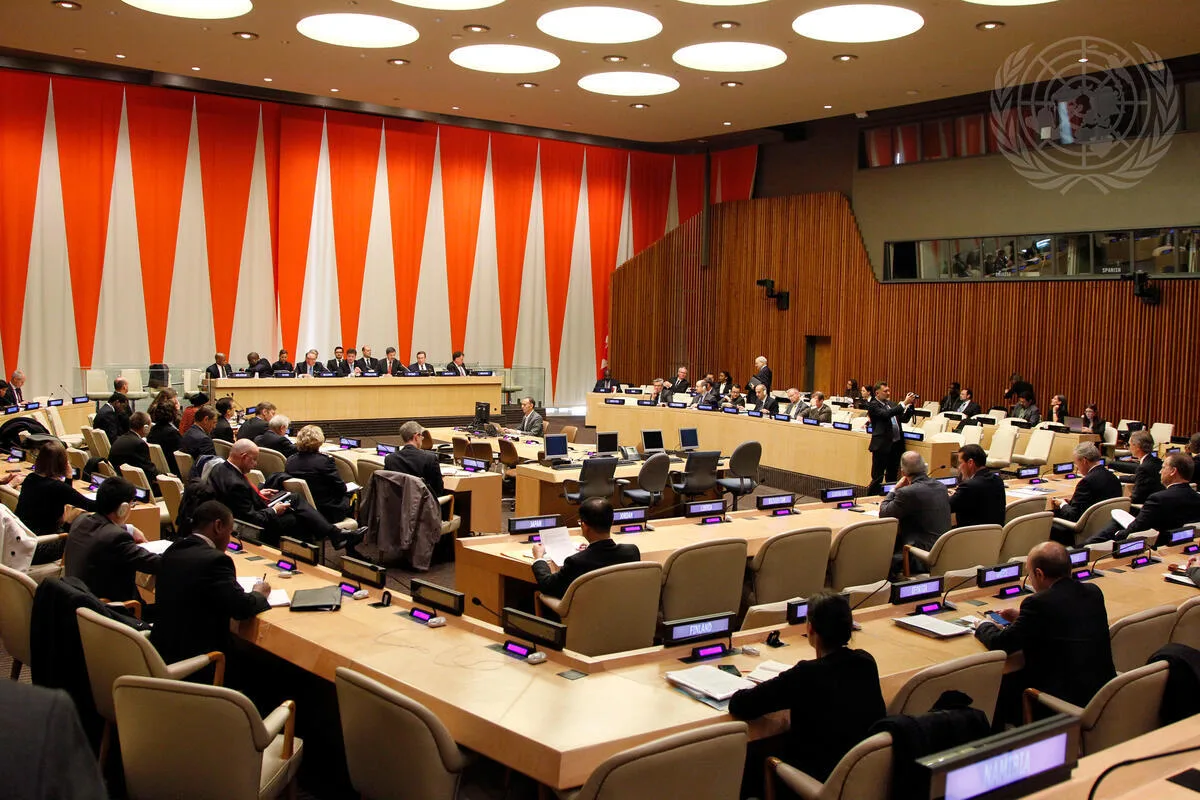 |
| United Nations General Assembly, UN Watch |
The
15-point proposal by the United States includes restrictions on Iran's
nuclear program and the reopening of the Strait of Hormuz, while Iran's
10-point proposal prior to the talks focused on a guaranteed end to the
war and control over the Strait of Hormuz, where it plans to collect a
maritime passage fee for each ship passing through, amounting to $1
million. An average of 100 to 130 ships passed through the strait daily,
prior to the U.S.-Israel joint aerial assaults.
That toll, if
permitted to proceed, despite the deep objections of the other Gulf
States that the IRGC has been bombing persistently since February 28,
would enable the Islamic Republic to amass an astronomical fortune, far
outstripping its revenues up to the conflict derived from its energy
products. And all of it would be directed toward restoring its destroyed
ballistic missile and drone stocks, along with other military assets
that it has lost during the prosecution of the war, including warplanes
and warships.
"An integrated suite of unmanned maritime systems and sensors, the MCM
MP counteracts mines in the littorals while increasing the host vessel’s
standoff distance from the threat area."
"Embarked with the MCM MP, [a
littoral combat ship] or a vessel of opportunity can conduct the full
spectrum of detect-to-engage operations (hunt, neutralize, and sweep)
against mine threats using sensors and weapons deployed from the MCM
Unmanned Surface Vehicle (USV), an MH-60S multi-mission helicopter, and
associated support equipment."
U.S. Navy, new mine countermeasures mission package
 |
| Getty Images |
Labels: Ceasefire Negotiations, Conflict, Islamic Republic of Iran, Strait of Hormuz, U.S.-Israel Aerial Bombardment of Iran


