"Drill, Baby, Drill!"
"We were running out of Tier 1 inventory; everybody's running out of Tier 1 inventory."
"The best inventory is going to be run out of Pioneer by 2028, Tier 2 by '32, so people don't talk about the fact that we're running out of inventory."
Scott Sheffield, founder, former U.S. Permian fracking giant Pioneer Natural Resources Co.
"It's a very touchy topic down here, that the [U.S.] Permian [Basin] is this infinite resource that will always keep going."
"But the Permian is no longer in its first inning."
"[U.S.] oil and gas companies have some
pretty deep pockets and they should be turning back to Canada, given
that they don't have unlimited running room here."
"We're
growing like mad in the Montney [Alberta oilsands]. The major natural
gas plays in the U.S. are actually declining versus the Montney [shale]
that is actually growing."
Mike Verney, executive vice-president, McDaniel & Associates Consultants Ltd.
"We're Texas-sized as far as gas goes; we've got some big numbers."
"Long term, we are the best place to invest in the world because as other resources dry up, Alberta is not going anywhere for a long time."
Alberta Energy Minister Brian Jean
 |
| It would cost hundreds of millions of dollars to retool U.S. refineries to handle
domestically produced oil. But stopping U.S. exports would also leave
Canadian crude with few market options. (Todd Korol/Reuters) |
U.S. President Donald Trump is on public record, sneering that Canada hasn't got anything that his country needs, including energy resources, of which America has more than sufficient for its needs and more. This, as part of his explosive trade war, which began with Canada and Mexico when he first threatened, then imposed across-the-board tariffs on all goods entering the United States from Canada and Mexico, then extended his tariff war to China, before finally lassoing the European Union, then South Korea and Japan.
So how's the United States doing in providing energy resources for itself beyond the present time? American energy executives at the CERAWeek by S&P Global conference in Houston are now agreeing there has been a slowdown in oil production in 2025, anticipating a potential peak in U.S. oil production just around the corner of the near future. This, despite his calls to "drill, baby, drill".
These types of dismal prognostics seem misplaced at the conference where peak oil predictions are fairly unpopular, given its close proximity to the most prolific oilfield in the United States, the Permian Basin -- a region spanning parts of West Texas and southwestern New Mexico -- region that is recognized as the primary driver of U.S. oil and gas production growth latterly.
 |
| American oil refiners are largely equipped to handle heavier crude imported from other countries such as Canada. (Bing Guan/Reuters) |
Permian output saw a record 6.3 million barrels daily in 2024, accounting for some half of the U.S. total production in the last year, at the same time that other shale oil plays plateaued or declined, according to the U.S. Energy Information Administration (EIA). That preceded symptoms the Permian may be entering its declining production years with well-productivity issues being experienced by producers alongside diminishing production growth.
This week, the founder of former Permian fracking giant Pioneer Natural Resources Co. said that one of the main reasons his company sold out to Exxon Mobile Corp. in 2023 was the very issue made clear -- that it was running out of top-tier drilling inventory.
Despite tremendous domestic reserves there is uncertainty about the U.S. capacity to feed a booming liquefied natural gas (LNG) sector while tending to growing domestic demands for natural gas-fired electricity generation driven by energy-voracious data centres, due in part to a shortage of pipeline capacity.
There are persistent doubts whether President Trump's willingness to make use of emergency powers in expediting, permitting and fast-tracking project reviews, to the delight of the U.S. oil and gas industry, will translate to a significant production increase required to meet the demand of an LNG export sector expected to double in size by 2028.
The issues of geological degradation and capital discipline among producers have served to alter the American oil and gas sector, and operators no longer leap with the same alacrity to drill new wells, even when oil prices are relatively high. American companies and investors searching out more accessible resources and economic opportunities are beckoned a couple of thousand kilometres north to the vast Alberta oilsands and Canada's Montney shale play.
Compared to a previous Alberta provincial estimate of 24 TCF, new data reveal that Alberta has proven natural gas reserves of 130 trillion cubic feet (TCF). The overall figure comes to 144 TCF when probable gas reserves are added, according to a study commissioned by the Alberta Energy Regulator, conducted by McDaniel & Associates Consultants. That new estimate of gas reserves over-doubles Canada's overall total, placing Canada into the global top 10 with the ninth-most reserves, up from 15th, previously.
As well, new preliminary estimates confirm that proven oil reserves in Alberta reached 167 billion barrels, an increase from the last official estimate of 159 billion; final numbers in coming weeks expected after an audit has been completed for all basins. Texas' proven reserves in 2023 by comparison, were 20 billion barrels, according to EIA estimates.
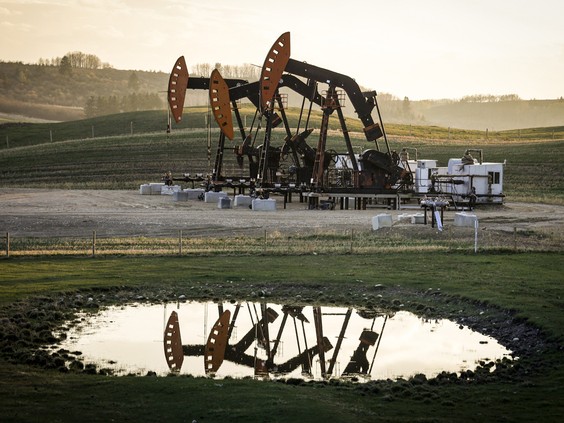 |
| Pumpjacks draw out oil and gas from well heads near Calgary, Alta. Photo by Jeff McIntosh/The Canadian Press via AP files |
Labels: Alberta Oilsands, Canada-U.S. Relations, Steep Tariffs, Texas Diminishing Energy Resources, U.S. President Trump's Trade War
Obama Redux : Hostility to Canadian Oilsands
"[Mr.
President, I urge you to reconsider the cancellation of Keystone XL
and] take into account the potential impacts of any further action to
safety, jobs and energy security."
"It
is of the utmost importance that the United States maintain energy
security through strategic relationships with our allies rather than
increasing reliance on OPEC nations and Russia. This includes the
development of infrastructure like the Keystone XL and Mountain Valley
pipelines, to get this energy to market in the safest and most
responsible way."
U.S.Senator Joe Manchin, Democrat, West Virginia, Chairman, Senate Energy and Natural Resources Committee
 |
| The Narwhal |
"Your
decision will result in devastating damage to many of our states and
local communities. Even those states outside the path of the Keystone XL
pipeline -- indeed all Americans -- will suffer serious detrimental
consequences."
"Please be aware that states are reviewing available legal options to protect our residents and sovereign interests."
"In
the meantime, we urge you to reconsider your decision to impose
crippling economic injuries on states, communities, families and workers
across the country."
Montana Attorney General Austin Knudsen/Attorneys General of 13 other states
"In
a nod to the far-left environmental wing of the Democrat Party, the
President issued a new moratorium on oil and gas leasing on Federal
lands and called a halt to the Keystone XL Pipeline, even though we are a
long way from significantly
reducing or eliminating our need for oil and natural gas."
U.S.Senator John Thune, South Dakota
"Keystone
XL was not just a policy decision to allow a pipeline to cross a
border. What came with it were a whole bunch of permits."
"The policy change had the effect of revoking those permits without due process."
Scott Miller, senior adviser, Center for Strategic and International Studies, Washington
As
Presidential Candidate Biden, no secret was made of the fact that in
deference to those members of the Democratic Party and their
environmental lobbyist supporters, much less his loyalty to the Obama
years when the same interests held influence over the administration,
the XL Pipeline carrying crude oil from Alberta to the U.S. that had
been approved by President Donald Trump, would be cancelled at the
earliest possible opportunity by presidential decree. That opportunity
arrived the day following Mr. Biden's inauguration as President of the
United States of America.
Oil
dredged from Alberta's oilsands despite having undergone
technologically advanced extraction methods to ensure minimal
environmental contamination including CO2 emissions has always been
characterized by U.S. environmental groups as injurious to the globe,
hastening climate change. No such concentrated campaigns were undertaken
on American soil by contrast, where 2.6 million miles of pipeline ferry
natural gas and liquid petroleum products to refineries to service
America's huge appetite for energy.
U.S.
environmental groups were far less disturbed about coal-fired plants
using old technologies and dirty coal that polluted the atmosphere far
more extensively and harmfully than oil extraction in Alberta. Canadian
oil was the bogeyman, symbolic of all that was wrong in the oilfields,
whereas fracking with its great unknowns relating to forcing chemicals
deep underground to pollute groundwater and the process leading to local
earth tremors seemed by comparison to the environmentalists, quite
benign.
 |
|
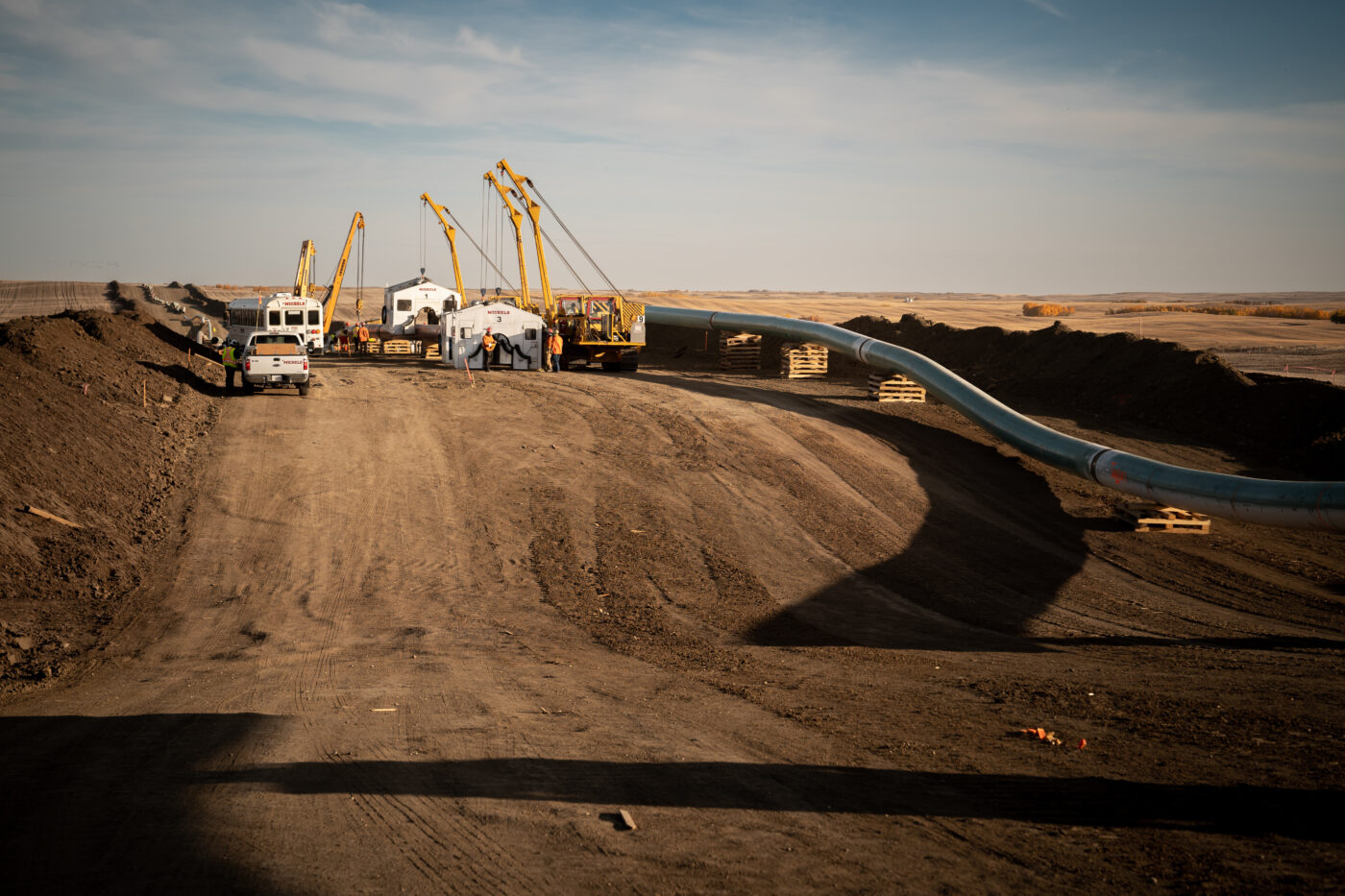
Pipeline under construction in Alberta, Canada rblood/Flickr
|
It
is now not only Canada that is being short-changed by this stoppage of
the KXL pipeline, but over a dozen U.S. states that are considering
legal action against their federal government, voicing their concern
that Americans "will suffer serious detrimental consequences"
in job losses and energy insufficiency, as a result of that
ill-considered move. President Biden's executive order revoking
cross-border permits for the $14.4-billion KXL pipeline has union
leaders, Republicans and Democratic lawmakers and state attorney
generals attempting to persuade Mr. Biden to reverse that order.
Regulatory
and legal hurdles were all overcome within the United States of the TC
Energy Corp. pipeline project over the past decade. Alberta oil carried
directly via pipeline to the U.S. Gulf Coast made good sense a decade
ago and continues to make good sense now. The oil, irrespective of the
presence of the pipeline, will still be sent, but by
riskier-to-the-environment means; shipping and by rail, both methods
vulnerable to accidents and costly clean-ups. The safer option of
pipelines is vastly more economic, faster and obviously preferential for
all those reasons.
 |
| Rocky Kistner/NRDC |
Massive
investments had already been made; construction was underway in
Alberta, Saskatchewan, Montana and South Dakota well prior to Mr.
Biden's executive order killing the project. Alberta Premier Jason
Kenney's government is reviewing its options; whether to sue the U.S.
government over the cancellation. "We
are monitoring and continuing to talk to American political players
about the importance of Canadian energy tot he United States", said the spokesperson for the province's energy minister. The province is "reviewing every legal tool at our disposal to defend our financial interests in this project".
Meanwhile shipment by rail is increasing.
"Canadian oilsands is in demand in the US. And because of that, it's
economic for companies to be taking on [extra] rail shipments, in
addition to shipping through [existing] pipe[lines]", said Ben Brunnen, vice-president of the Canadian Association of Petroleum Producers.
"Western Canada still has the ability to overproduce its pipeline
capacity ... It is reasonable to expect we will see a rise in crude by
rail."
The
U.S. oil industry wants Canadian crude shipped to its refineries. The
alternative is oil shipped from Saudi Arabia, Russia, even Venezuela.
Sending oil by pipeline is faster, safer, and would mean that Canadian
shippers would be paid the full, not the current discounted price for
their oil that comes with shipping by rail. The existing pipelines are
fully used with no more capacity. The result is more rail shipments
which are costlier and result in discounted prices for Canada;
benefiting the U.S. and penalizing Canada.
 |
| The Biden administration’s cancellation of the Keystone XL pipeline was
largely expected on both sides of the border, especially given former
President Barack Obama previously rejected the project in 2015. Photo:
Government of Alberta / Flickr |
Labels: Alberta Oilsands, Canada-U.S. Relations, Keystone XL Pipeline, President Joe Biden, U.S. Senators


