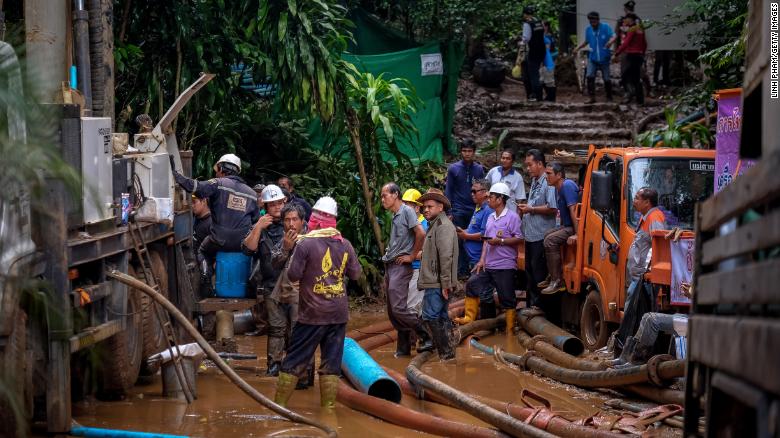
Confused and Desperate Rescue Attempts : Whistling in the Dark
"A former SEAL who volunteered to help died last night around 2am."
"His job was to deliver oxygen. He did not have enough on his way back."
Chiang Rai Deputy Governor Passakorn Boonyaluck
"We are no longer digging -- we will find a way that can give us access [without digging] direct to the area where the boys are."
"We are drawing our jungle trekking resources together. There are about 20 to 30 teams."
"Now
we are going to walk around that area to search every inch, [to see if]
there are chimneys or holes where we can climb down, and we may adjust
our plan."
"In the previous days we were fighting with time. And now we are working against water."
"We
are draining out as much as our capacity allows. But water continues to
flow in, no matter how many holes have been blocked, water still
continues to pour in."
"If we must evacuate [the boys] out before they are ready due to the
rain ... we will do so, but it will be the very last resort to do so."
"We [are] target[ing] the water in the third chamber to reduce to the
point that no diving equipment is needed, like to the waistline, so one
can wear just life jackets and walk out."
"I confirm here again that they are in good health and they are smiling and playing around."
Chiang Rai governor Narongsak Osottanakorn
 |
| Still from video; rescuers preparing to evacuate trapped boys and coach |
The threat of heavy rains continuing once again has upset original plans and forced rescuers to abandon the hope that if all else fails, the trapped boys and their coach could remain in place on their muddy, limited-space shelf above the still-surging flood waters for as long as it takes for the flooding to cease and the waters to be reduced to manageable levels. Emergency alternate preparations for extracting the twelve boys and their coach through the same cave-diving manoeuvres as the expert divers took to find them have also suffered a setback with second thought.
Plans A, B, C and D are all falling by the wayside of practical realities and the huge possibilities of matters going awry. That a chute might be found on the mountainside to provide a short route up and out seems to have gained little hope, the search fruitless. Concerns over somehow managing to guide the trapped boys taking the underwater route through the difficult and complicated tunnels amid warning that the route is dangerous not only for novices but for experts was brought to reality with the death of a former SEAL who had volunteered his services.
Like mountaineers clambering up Mount Everest, depending on supplemental oxygen to see them through the steepest, highest portion of the ascent to the summit, then finding themselves without sufficient oxygen to descend and dying from hypoxia, the volunteer diver, tasked to ferry food to the boys found himself with insufficient oxygen to see himself through the last part of his three-hour journey back out and he died in the attempt.
 |
| Some of the members of a soccer team in a section of Tham Luang cave in Khun Nam Nang Non Forest Park. Picture: GettySource:Getty Images |
The massive threat to human survival represented by this rescue operation that has captured the attention and hopes of the world community, bringing offers of assistance from international experts, professional cave divers, and technology experts, hang over the tenuous choices and the progress of temporary operations to bring the twelve boys and their coach back to health after their starvation ordeal of ten days before discovery, trapped within the ten-kilometre-long cave system.
The high-pressure pumps used to drain water from the cave have barely seemed to make any difference as water continues to pour in from other areas. Thai navy SEALs remain with the boys to render first aid and teach them swimming and diving lessons hoping to keep their spirits high while their bodies slowly mend. But the boys are emaciated and it will take time before they recover strength and energy, both of which would be required to embark on a three-hour precarious diving expedition to safety.
"The water is still too rough for the boys now. We are focusing on setting up ropes in each section of the cave to help them", said Tiraya Jaikaew, head of a team of volunteer rescue divers working with the Thai navy. According to Thai authorities the boys' lives are not to be endangered by reckless decision-making and the extraction will commence only when it is
"100 percent safe". A promise that, under the circumstances, seems as reliable as instructing nature to shut off her water faucets.
 |
| Thai soldiers and volunteers are seen at the entrance of Tham Luang cave. Source:AFP |
Labels: Caves, Floods, Rescue, Thailand
Danger? It's Not Over Until It's Over
"Diving is not easy. For people who have never done it, it will be difficult, unlike diving in a swimming pool, because the cave's features have small channels."
"If something happens midway, it could be life-threatening."
Thai Interior Minister Anupong Paojindaa
"[There were] complications and problems. They [British divers] were having to swim against the currents and pull themselves along the walls."
"The visibility wouldn't have been very good."
Bill Whitehouse, spokesman, British Cave Rescue Council
"Any attempt to dive the boys and their coach out will not be taken lightly because there are significant technical challenges and risks to consider."
"[The boys are] located in a relatively small space and this would make any potential drilling attempt as a means of rescue [as an alternate escape route] very difficult."
British Cave Rescue Council statement

Hoping to discover an alternate escape route other than the one currently being considered which would include guiding the twelve boys and their coach underwater through the cave system to safety, rescuers have been looking elsewhere for promising potentials, searching the side of the mountain to determine whether passage could be found into the caverns below. Backhoes and drilling equipment were put in place but the logistics of creating a large enough shaft to enable extracting the boys would be seriously complex and time-consuming.
Not that the alternative is much less so. The problem seems insolvable for the moment. The option of leaving the group where they are, on their dry, cramped shelf space above the flood waters and delivering food and any other supplies deemed necessary while the wait continues for the waters to subside either naturally or through pumping efforts -- or until another exit can be found is also complicated, fraught with danger, and time-wasting. Alternatives are few to offer simpler solutions.
The diving option would be the fastest solution but yet perhaps the most dangerous in hopes of extracting the group safely.
"Trying to take non-divers through the cave is one of the most dangerous situations possible, even if the dives are relatively easy", warned Anmar Mirza, national coordinator of the National Cave Rescue Commission in the United States. It took the two British divers who managed to reach the stranded boys and their coach three hours underwater. Hardly an adventurous option for novices.
 |
| None of the boys can swim. Picture: Thai Navy SEALs via Getty ImagesSource:Getty Images |
The divers, Rick Stanton and John Volanthen, first to reach the boys and their coach within the Luang Nang Non Cave on Monday came across them almost by accident, when Volanthen was placing guide lines in an effort to close the gap toward the missing group. Running out of line, he was forced to the water's surface. And there, to his amazement, sat the boys on a ledge, watching him, illuminated by his head lamp. The drama of the search and the wearying wonder whether the boys and coach remained alive was concluded.
But left was the dilemma of how they could be rescued. The ten kilometres of narrow passageways and wide, lofty chambers under the mountainside with the rocky, muddy ground and elevation alterations represent extremely difficult terrain under any conditions. Flooded and an estimated 800 metres below the surface, around 2 kilometres into the cave, the circumstances are acutely difficult. The rainy season lasts through October, and heavy rains are forecasted to continue into the weekend.
There is the potential with heavy rains due to continue through to July ten, for water to steadily rise in the cave again, further complicating the supply missions, let alone any possible extrication at this point. But the possibility of the boys requiring diving gear to swim out of their predicament is a real one with no option but to be brought out through the complicated route their rescuers entered to find them; in murky waters impairing vision, close quarters requiring hand propulsion, and a three-hour duration.
 |
| The boys may have to be tethered to rescue divers during the operation. Picture: AFP PHOTO / Ye Aung ThuSource:AFP |
Among other details being discussed is the very real possibility that alternately, the group will have to be confined where they are for weeks, even months. They've been described as healthy and well looked after, with seven members of the Thai navy SEALs present with them, including medics. In stable condition, they are being served high protein liquids. According to SEAL commander Rear Adm. Arpakorn Yookongkaew, there was no particular rush to haul them out; where they remain is safe for the time being.
"We have given the boys food, starting from easily digested and high-powered food with enough minerals", assured Mr. Arpakorn.
"They are very weak and very skinny", noted cave diver Ben Reymenants, assisting in the rescue effort. He was, he said,
"very surprised obviously that they are all alive and actually mentally also healthy". A doctor and a nurse have both offered to stay with the stranded group of boys for the duration of their ordeal, even if it does, in the end, take months. But the situation could change at any time and a decision made to proceed with a dive.
"[The boys would have to undergo] immediate and intensive training [if they were to stand any chance of exiting the cave alive]."
"Normal
cave diving requires skills that go beyond what 99 per cent of the
world’s divers have ever seen, which is why it is so very hard to become
certified to dive in caves. The diving required in this cave, however, is not normal cave diving, and the rescuers are not normal cave divers."
"The
greatest enemy to a diver is panic. Students who are accustomed to the
normal mishaps of swimming, like accidentally getting water in the mouth
or eyes, will usually have no trouble, but for people with little
swimming experience, such a minor event can lead to irrational panic."
"Most of the Thai team members are nonswimmers, and the culture there
has a common belief that swimming is extremely dangerous. That starts
any training in a serious deficit."
American cave diving expert
Labels: Caves, Floods, Rescue, Thailand, Trapped Boys
Lost And Found In Thailand
"We found them safe. But the operation isn't over."
"When the medics have evaluated the kids to see if their health is in good condition, we will care for them until they have enough strength to move by themselves, and then we will evaluate the situation on bringing them out again later."
Chiang Rai provincial Governor Narongsak Osatanakorn, Thailand
"Supplying them on site may face challenges depending on how difficult the dives are."
"Trying to take non-divers through a cave is one of the most dangerous situations possible, even if the dives are relatively easy."
Anmar Mirza, American cave rescue expert
"We believe that there is only a short break in the monsoon and all
feasible options for the rescue of the boys are being considered."
"Although water levels have dropped, the diving conditions remain
difficult and any attempt to dive the boys and their coach out will not
be taken lightly because there are significant technical challenges and
risks to consider."
British Cave Rescue Council Vice Chairman Bill Whitehouse
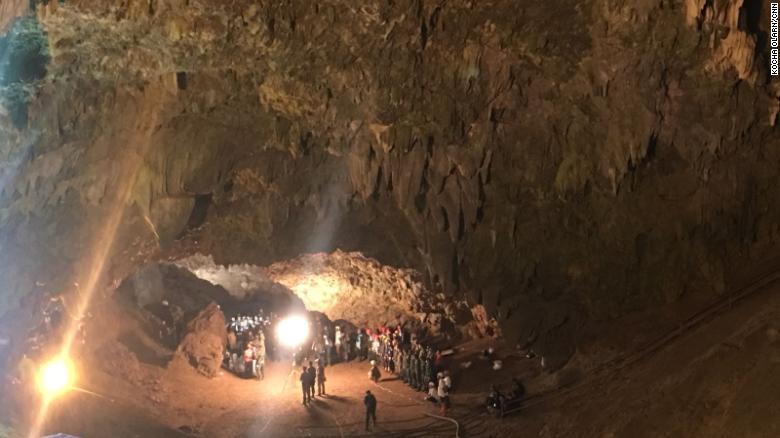 |
| Local volunteers join members of the Thai SEAL team at the entrance to the cave network. |
After a full ten days trapped in the Tham Luang Nang Non cave under a mountain located in Chiang Rai province from June 23, twelve young soccer players, aged 11 to 16 and their 25-year-old coach have now been found. Search rescuers had a fairly good idea where they expected to find the group if they were still alive. They had managed to find a perch above the flood waters that had made it impossible for them to leave the cave they had entered for a day of exploratory fun. It wasn't known whether they had met with disaster or managed to survive.
Their discovery seems miraculous. Without food or hope the thirteen managed somehow to hang on awaiting rescue. The time interval from when they found themselves unable to leave the cave complex to the time when they were located must have seemed gloomily frightening and interminable. That none came to any real harm through being inundated by the flood waters which in some chambers reached to the ceiling, represents yet another miracle. Perhaps the utmost miracle is that after ten days, despite being dispirited, forlorn and without provisions they survived the dangers before them.
 |
| Some of the boys pictured in the cave
|
The Thai navy released video footage of the soccer team seated upon a dry area within the cave complex, a spotlight illuminating their faces and the water just below them. No one had to be present outside the cave complex to imagine the relief and joy of the parents awaiting word of their children's plight. The final push into the complex in hopes of locating the lost children and their coach resulted after days of painstaking preparation. Divers had finally located the group about 300 to 400 meters in at a section of the cave located on higher ground. Precisely where the rescuers felt they might be found and sheltered from the flood waters.
"You are very strong", one of the rescuers is heard to say to the boys sitting on their haunches quietly, in the released video. When one of the boys asks what day it was, the rescuer responded:
"Monday. Monday. You have been here -- ten days". According to one of the rescuers, Anmar Mirza, the vital decision to be reached is whether an attempt is to be made to evacuate the boys and their coach, or to leave them where they are for the present, and ensure they have food and water until the time is right to take them out at a time of least harm.
"Now we have given food to the boys, starting with food that is easy to
digest and provides high energy. We have taken care of those
boys following the doctor's recommendation. So do not worry, we will
take care of them with our best. We will bring all of them with safety.
We are now planning how to do so."
"We don't have to rush. We are trying to take care of them and make them strong. Then the boys will come out to see you guys."
Thai Navy Seal Chief Rear Adm. Aphakorn Yoo-kongkaew
Labels: Caves, Crisis Management, Soccer Team, Thailand
The Suspenseful Intolerable Wait

"We went in a few kilometres and were able to enter a second chamber behind the entrance. In that chamber, there was an area where I saw shoes and bags left behind on the ground."
"We believe the students have gone further in."
Lt. Naponwath Homsai, Royal Thailand Navy
"I haven't slept and I hope that all of them can come out all safe and sound."
"My son is a strong boy. I still have hope."
Namhom Boonpiam, mother of 13-year-old missing boy
 |
| Relatives
of the boys and their coach, who are missing in a flooded cave, wait
under a tented area for any updates in the search, on Tuesday in Mae
Sai, northern Thailand. (Tassanee Vejpongsa/Associated Press) |
"[Not explorable from November to June due to flooding, the cave has an] impressive entrance chamber [leading to an easy walk along] spacious passageways [about a kilometre in length]."
"At the end of the marked path the passage enters a series of chambers, boulder collapses and boulder chokes where route finding can be difficult."
Online guidebook, The Caves of Northern Thailand
The cave narrows to a two-metre wide passage, three metres in height. Then it splits into different directions, several passages leading to other chambers, to pools, or to places with lofty "avens", shafts that reach the surface. Its mystique and geology no doubt intriguing to teen-age boys' sense of adventure. Which is how and why a dozen teen-age boys between 11 and 13 years of age, belonging to a soccer team, along with their 25-year-old coach sought to satisfy their curiosity by entering the Tham Luang Nang Non cave on Saturday afternoon.
They parked their bicycles, left their backpacks and entered the cave for an impromptu adventure. But they never emerged. The cave, as so often happens evidently at this time of year, was flooded. And three days later they still haven't emerged, and the flooding continues, the water rising in the caverns. Rescuers brought to the scene speak of five metres of water. They also believe that the missing boys and their coach are still alive.
The Royal Thai Navy has sent rescuers in the hopes of being able to search further into the cave, thought to be about six to eight kilometres in length and in which large chambers are located. But they were unable to penetrate far into the chamber and its pathways. The boys' parents seek shelter in tents close by the cave entrance, staying there overnight, rain pelting down around them. Another nearby tent contains medics. Reminders of the boys' plight are as close as the cave entrance where sit the boys' soccer cleats, backpacks and bicycles.
From time to time mothers enter the mouth of the cave to call out to their children, begging them to appear. Footprints and handprints were discovered within the cave complex. An officer of the district police station felt that the boys are young, strong athletes which should be a factor in their survival.
"We're confident that the kids should still be in good condition", said Deputy Governor Passakorn Bunyalak of Chiang Rai, at a news conference.
Special diving skills, supplemental oxygen would be required to access deeper into the flooded cave; conditions that complicate rescue efforts. Speculation is that divers would bring food in to the boys and all would wait out the flood, or be introduced to the basics of scuba diving to enable them to swim out.
Cut into a mountainside in far northern Thailand, the cave is a tourist attraction that severely floods during the rainy season, June to October. However, tourists trapped in the cave in past floods have been rescued once the water receded in a few days' time.
A geographer and expert on the Tham Luang Nang Non cave said that divers went as far as three kilometres into the complex where the cave maintains a stable temperature of about 25C. The only way to get the boys out would be for them to dive, said Anukoon Sorn-ek, the geographer.
"But they have to be found first."
 |
| Rescue workers continue the search on Tuesday, as electricians extend a power line into a flooded cave. (Tassanee Vejpongsa/Associated Press) |
Labels: Caves, Floods, Missing Children, Thailand