Our Warming El Nino-Impacted Oceans
"[This new record being set for hottest temperatures in the world's oceans is] very troubling.""An ocean this warm destabilizes weather patterns and threatens food security, economic prosperity and marine life.""A warmer ocean is not our friend."Jane Lubchenco, oceanographer, former chief of U.S. National Oceanic and Atmospheric Administration"This is yet another sign of our climate system under strain and the ocean under immense pressure.""When we have a warmer ocean such as we've had in Europe this summer, it amplifies the impact of heat waves because you don't get the cooler nighttime temperatures with the sea breeze coming off the ocean when the ocean is very warm.""Samantha Burgess, strategic climate lead, Copernicus climate service, Europe"The thing that makes my heart sink is that this starts so early and it's so out-of-normal that you know when it hits its peak it's going to be unprecedented.""The ocean is not supposed to do this. It's just that there is no normal anymore.""[With hotter water], not everybody is hit equally, obviously, but the whole system collapses.""It's like when you pull out the rug from underneath an economy. The whole thing collapses. Some sectors may do a little bit better but, overall, everybody suffers."Boris Worm, biology professor, Dalhousie University, Canada
 |
| A very strong El Niño developing in the southern Pacific Ocean will disrupt global weather patterns in the months ahead, but climate scientists say it's not something we can attribute to the heat waves and wildfires that raged across the northern hemisphere this summer, like the ones in British Columbia's interior earlier this month. (Darryl Dyck/The Canadian Press) |
This
year's El Nino has already reached the peak of other recent such
appearances, and it's continuing to grow and expected to reach
unprecedented levels when it does eventually peak. With the current El
Nino, the oceans will keep heating up, and it is expected to peak at
some time between November and January. That's abnormal since most of
the Southern Hemisphere is ocean, and the world's sea surface
temperature generally peaks around March and April as the southern
summer draws to its close. But not this year.
El
Nino is nature's temporary warming of portions of the Pacific Ocean
which warps weather, raising global temperatures. This is a weather
phenomenon recognized as being responsible for most of the heat that
develops in the world's oceans -- along with long-term warming resulting
from burning coal, oil and gas. This year, ocean waters have warmed by
0.8C, seeing the world's oceans at their hottest temperatures on record
last weekend. That's bad news, but even worse is that they're entirely
likely to keep warming.
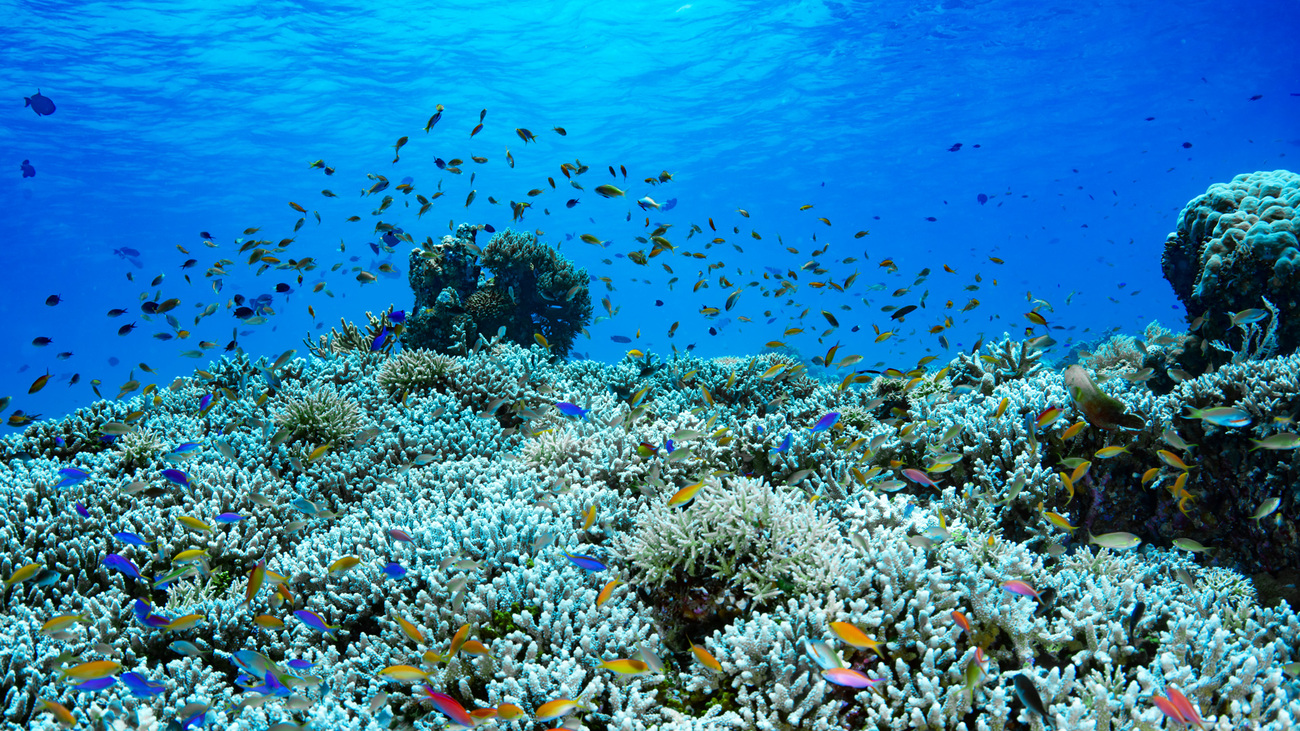 |
| Coral in Tubbatah Reef in the Philippines. Adobe |
Aquatic
lifeforms are placed under stress with warming water. The supersized El
Nino of this year is proving to be of greater concern than the record
previously set in March of 2024. A warming ocean becomes more acidic
with less oxygen, inimical to the health of its sealife. Ocean currents
become altered along with changed weather patterns. Storm systems are
enhanced by the warming oceans, becoming wetter and producing larger
storm surges.
According
to Dr. Bruno, heat-sensitive corals now are roughly one-fifth of the
levels of 1990. Some species of coral -- not the longer-lived staghorn
corals -- are adapting to the hotter water, although they're 'weedy'.
The current situation of warmer oceans and even warmer yet as time moves
on and the heating persists, is predictive of collapsed fisheries
resulting in universal food shortages.The Peruvian anchovy fishery,
considered the largest world fishery, generally collapses during El
Nino.
 |
Corals
from the Galápagos Islands contain chemical signatures that scientists
were able to use to trace a 1,000-year history of El Niño events. Greg Asner/DivePhoto.org |
The
food web becomes altered, since larger fish are able to swim off to
cooler water to escape the heat, as far as halfway across an ocean. "Anchovies can't leave so they just don't reproduce, or [they] starve",
explained Dr. Worm, affecting both the humans and the seabirds who
depend on them. The presence of more jellyfish is being observed off
Europe, stated Dr. Bruno, believing something similar will be seen on
the East Coast of the United States.
"Jellyfish are often opportunistic and they like warm waters. So yes, I would expect them to do a little bit better", added Dr. Worm. And when's the last time you saw jellyfish on the dinner menu? "As
long as we depend on a healthy ocean for our safety, prosperity and
well-being, these record-breaking sea surface temperatures portend even
greater challenges for us all", added Rick Spinrad, another former NOAA chief.
"It's frightening. We're not even in October yet.""You know, usually the Caribbean peaks at like late September, early October.""And I think next year in the Southern Ocean, the Great Barrier Reef, yeah I'm really worried about what's going to happen in the southern hemisphere in February, March."John Bruno, marine ecologist, University of North Carolina
 |
| A satellite map from the U.S. National Oceanic and Atmospheric Administration shows sea surface temperature anomalies recorded on Aug. 20, with hotter than average temperatures stretching across the El Niño region toward the west coast of South America. (NOAA) |
Labels: Caribbean, Climate Change, Corals, E Nino, Europe, Fish Stock, North America, Record-Breaking Warming Oceans, Rising Temperatures
posted by Pieface @ Monday, August 31, 2026