Thursday, March 23, 2023

The Doomed Republic of Haiti


"We believe the security and humanitarian situation in Haiti is worsening and the situation on the ground will not improve without armed assistance from international partners."
UN National Security Council 

"Kidnappings are rampant."
"The sexual violence that is taking place in Haiti is at levels never seen before -- and rarely seen in any society."
Helen La Lime, special representative, UN secretary-General for Haiti
https://www.washingtonpost.com/wp-apps/imrs.php?src=https://arc-anglerfish-washpost-prod-washpost.s3.amazonaws.com/public/UORNNZXZSEKGL34XZWT7FWD6IY.JPG&w=916
Police fire tear gas at protesters demanding the resignation of Haiti's prime minister, Ariel Henry, in Port-au-Prince on Monday. (Ralph Tedy Erol/Reuters)
 
What is it about Haiti? A completely failed state. From the time of Papa 'Doc' Duvalier to the present. The Island of Hispaniola is shared between the Republic of Haiti (west) and the Dominican Republic (east). They are as unalike in their societal values, culture and makeup, politics and orderly civilized life as it possible to be. Destabilized, rampant crime and an inability of any government to bring order to the country, it requires the intervention now and again of the international community to bring a level of stability to bear. Yet it always seems to revert in time to yet another version of dystopian disorder. 

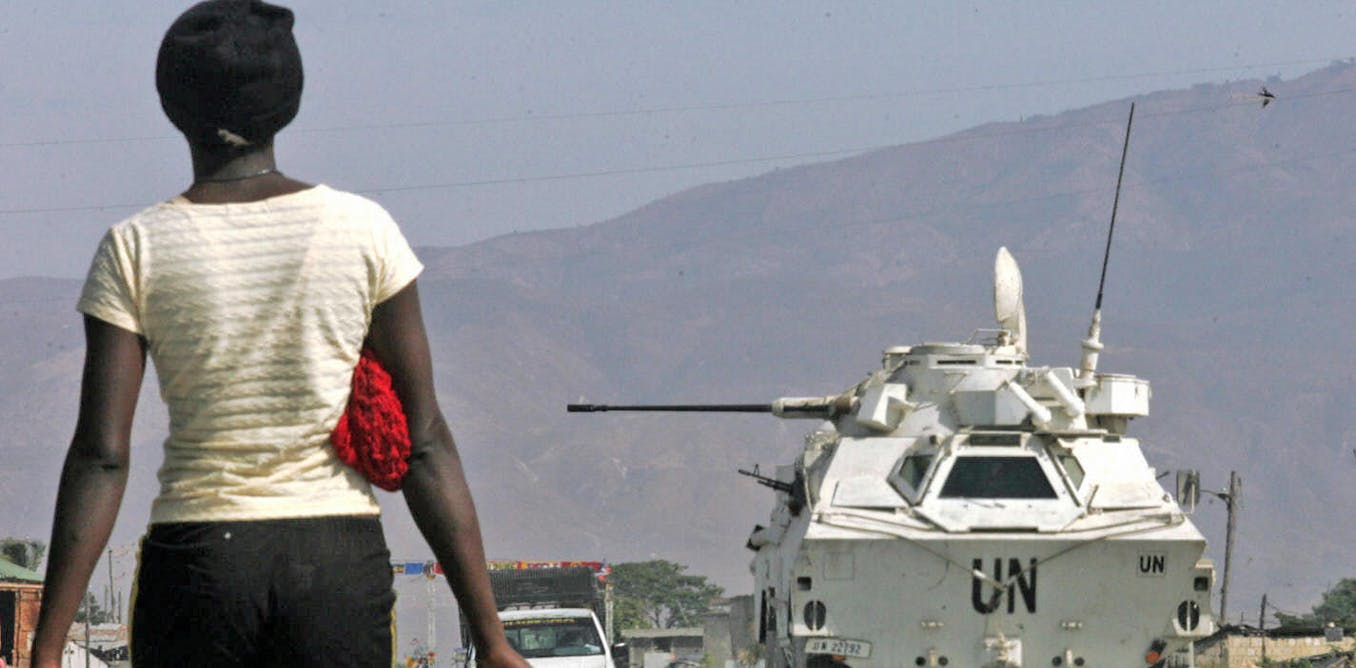
Five months ago its interim prime minister Ariel Henry pleaded for the deployment of a "specialized armed force" from outside the country to restore order in the country reeling from one crisis to another. Most Haitians want no intervention despite the critical nature of the failing state, in memory of its long history of foreign interventions. But its current struggle with gang violence, civil and political unrest and a cholera resurgence leaves it in a desperate state.

Both the United Nations and the United States support immediate rescue of the country through a brief intervention to restore calm and the authority of the government. Nothing has yet emerged, however, despite good intentions and the country is left to stagger from one misery to another with no end in sight. 2023 has seen 531 people killed, 300 wounded, 277 kidnapped in gang-related violence. In the first half of March alone 208 people died, 154 were wounded, 301 kidnapped.

Most of these unsettling violent episodes take place in the capital, Port-au--Prince. Most victims in the first half of March were killed or injured by snipers randomly shooting at people in their homes or out on the streets. According to analysts, allies of the United States remain hesitant to risk lives in a logistically complicated mission requiring an unknown but significant amount of time and resources, not to mention complexity.
 
https://images.theconversation.com/files/492238/original/file-20221028-40947-ervy7g.jpg?ixlib=rb-1.1.0&rect=0%2C4%2C1425%2C711&q=45&auto=format&w=1356&h=668&fit=crop
Many Haitians are wary of International forces. Jaime Razuri/AFP via Getty Images)
 
"You don't go there for three months or six months. You will go there for at least a couple of years", said Gilles Rivard, a former Canadian ambassador to Haiti who has advised the foreign ministry on UN-led peacekeeping missions. Haiti's presidency has been vacant since the 2021 assassination of Juvenal Moise. The national government has no democratically elected officials in the absence of elections. 

Gang violence linked to drug-running and other criminal activities as the violence has gone deeper into more neighbourhoods. Haitian police struggle with high rates of attrition, outnumbered and outgunned by the gangs. Some in Haiti fear an outside force to bring order to the country would support interim President Henry's retention of his temporary post, a deeply unpopular appointee whose claim to power is viewed as illegitimate.

Some Haitians take a dim view of the international response to date as security conditions deteriorate. When two navy ships were deployed by Canada to patrol Haitian waters in February, Le Nouvelliste, the largest newspaper in Haiti, published a front-page cartoon showing a bandit holding a gun in one hand, a man upside down in the other ... shaking him down as he shrugs off the ships.

A Haitian historian, Georges Michel, who contributed in writing the nation's 1987 constitution, remarked that some measures taken by the international community have been well-intentioned, but too late. What will save this West Indies nation from itself?

https://foreignpolicy.com/wp-content/uploads/2022/10/haiti-white-house-protest-GettyImages-1432073835.jpg?resize=1000,667&quality=90
Members of the Haitian diaspora as well as faith and human rights leaders protest outside the White House to demand the Biden administration stop supporting Haiti's government on Oct. 9 in Washington. Shannon Finney/Getty Images for Beyond Borders

Labels: , , , , ,

Monday, April 04, 2022

Lethal Arab-on-Arab Crime

Lethal Arab-on-Arab Crime

"Israel has the best security infrastructure in the world but the police can't catch some Arab teenagers with guns, inside our own country?"
"Come on. It shows exactly how much we are valued as citizens." 
Fida Sh'hade, member, Mothers for Life political lobby

"The solidarity from all these people, Muslim, Christian, Jewish, is the only thing keeping me strong right now."
"I believe in the good of people. I never expected this would happen to us ... I hope this anger will do something."
"The killing has to stop."
Aisha Hujarat, Bir al-Maksur Bedouin village, Israel

"The police don't care what happens to Palestinians so [the gangs] know they can kill children while they are playing and nothing will happen."
Imam Hujarat, Bir-alMaksur, Israel
Arab Israelis block a road as they protest against violence, organized crime and recent killings in their communities, in Tel Aviv, October 28, 2021 (Avshalom Sassoni/Flash90)

Palestinian criminal gangs in Israel have been victimizing ordinary Israeli-Palestinians increasingly over the years. Drug and loan-shark activities as well as clan and family feuds all drive criminal activity that persecute and harm those living in Palestinian-Israel communities. When violence occurs the innocent as well as those specifically targeted by gangs are murdered. And, simply put, while village heads cry out for justice and for criminals to be brought before the law, Israeli police find that cooperation from within the affected villages to aid in identifying suspects and committing arrests is often non-existent.

As well as another reality that comes into play; simply put, the priority for Israel’s security forces is the focus on Palestinian nationalistic violence in incidents of stabbing, shooting, vehicular homicide targeting Jewish Israelis. The result is that this focus is given attention above and beyond that expended on mob-linked criminality occurring within the Israeli-Palestinian community. 

Figures provided by the Aman Center, a civil society group that works to curtail violence in Israel’s Arab community, point to a record 128 Arab civilians killed in 2021 resulting from unapprehended violent crime. For 2020, 113 such homicides were recorded by the group, 96 in 2019, and in 2018 a total of 67. Clearly, a wholesale increase in violent crimes leading to deaths within the community of Arab Israelis. Most of these deaths have been among young Arab males. But children have also been killed in the cross-fire.
 
Officially, Arab crime families have been held responsible for the violence over the last few decades. Families that have acquired weapons and assumed power over their communities. It is organized crime groups that Prime Minister Naftali Bennett accuses of rampaging through the Arab communities as they run 'protection rackets' and commit murder. "A state within a state has developed" he charged; that gangs have acquired "quantities of illegal weapons ... enough for a small army".

Outside the Hujarat family home in the Bedouin village of Bir al-Maksur in Israel's north near Nazareth, three-year-old  Ammar was shot and killed in a playground, hit by a stray bullet fired during a car chase. His death was the first this year of a child losing his life to the epidemic of gun violence afflicting Israel's Arab community. Death numbers rose year over year last year when a record 127 people were killed. Illegal firearms have proliferated since 2013.

The situation has become such that gang violence is responsible for more deaths from within the Israeli Palestinian community representing twenty percent of the Israeli population, than among Palestinians living in the West Bank dying as a result of run-ins with the Israeli security forces. Among the non-Jewish Israeli citizens inclusive of Bedouin and Druze along with Muslim and Christian Palestinians, full rights of citizenship are extended.
 
In Arab and mixed-ethnic neighbourhoods gun violence grimly illustrates issues of minorities where organized crime networks are embedded; people turning to mob bosses for loans. Political corruption and extortion is commonplace and the community distrusts and fears the police, believing themselves to be victims of institutional discrimination.
 
Unemployment caused by COVID has young Arab men on the streets, well-armed foot soldiers available to commit to vendettas all of which tears at the social fabric of the communities. Feuds escalate at times simply as a result of the widespread availability of black market guns. In one neighbourhood a family lost their teenage sons when members of a rival clan opened fire after an argument had begun months earlier over a parking dispute.
 
A mere 25 percent of Arab murder cases were solved last year in comparison with about 70 percent of murders of Jewish citizens. Explained by Israeli police as a reflection that homicide investigations were "fraught with challenges", including "lack of cooperation on the part of citizens". The new coalition government promised to fight crime in the Arab community, budgeting $310 million for more police stations in Arab towns and a unit dedicated to Arab community affairs.
 
Risking, of course, accusations from within those communities that Israeli police -- among whose ranks there are representatives of the Israeli-Arab community -- would be  overstepping their authority and intruding into the lives of Palestinian-Israelis


Labels: , , , ,

Wednesday, September 01, 2021

Brazil Night Life

"I'd heard a commotion, but I thought it was fireworks. Suddenly, a man pushed me off my motorbike and told me to stop. At first, I thought it was a police checkpoint but then I saw they were assailants,"
"If they saw someone peeking from a window, they'd shoot in that direction to frighten everyone and show us they weren't playing."
Unnamed hostage, Aracatuba, Brazil  
 
"They told me to get out of the car, tore off my shirt and threw my cap on the ground,"   
"I was put onto the bonnet of a car and told: 'If you let go, if you try to throw yourself off, I'll stop the car and shoot you in the face'."
"I think I have never held on so tightly to anything as I did then."
Unnamed hostage, Aracatuba, Brazil
Pic via Yuri Macri on Twitter
People in nearby buildings captured grainy video of the shocking incident on smartphones   Twitter

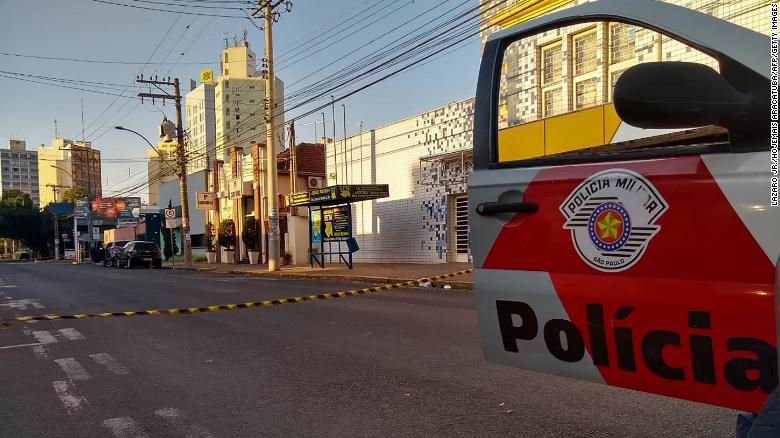
Heavily armed, military style, a group of bank robbers struck a southeastern city in Brazil on Monday hitting several banks, setting vehicles on fire and tying hostages to getaway cars to prevent police from firing at them. At least three people died in the melee. Brazil has long been resigned to random violence, but this time Brazilians responded to this event in shock and fear in reflection of the well-timed and -organized crime spree and its brutal choreography.

Aracatuba, with its 200,000 population located in Sao Paulo state was suddenly awakened about midnight when the gang struck at several banks and gunshots were heard through the otherwise-still night. Residents were advised by authorities to remain in their homes. Social media sites along with local news reports indicated up to ten people clinging to getaway cars, strapped onto the cars to ensure police would hesitate to fire.

Of the three people who died two were reported to have been local residents while the third was a part of the criminal group. Once the group had made good their escape, their hostages were reported to have been released. Mayor Dilador Borges spoke of a feeling of "helplessness" in consideration of the boldness of the action and its dread consequences.

This event appears to be yet another example of a new type of crime wave alarming Brazil; shock-and-awe bank robberies; nighttime raids intricately planned and executed by well-financed groups possessing military-style weapons and gadgets. During the raid, the group flew a drone over the city tracking movements.

Anyone still out in the city square became a hostage. Group members set vehicles on fire with the intention of blocking police from following their exit. Explosive devices were left throughout the city. "I'm in tears and desperate. Help, Lord, protect the people here. My God it looks like a movie scene what is happening here", wrote one resident.

Specialized criminal gangs have emerged, with a blueprint for action that is becoming familiar. These raids occur in the night hours in mid-sized cities, appearing toward the end or beginning of a month when banks are likely to have cash on hand to pay out to people waiting for their public welfare assistance.

Heavily armed bank robbers wreaked havoc in Aracatuba early Monday, striking three banks, setting fire to vehicles and tying hostages to their getaway cars, officials say.

In the city of Araraquara in Sao Paolo state in November another criminal group set fire to a number of vehicles in proximity to a police station with the intention of blocking a response chase, while they set about robbing a number of banks. Then the city of Criciuma in southern Santa Catarine state saw 30 heavily armed criminals in ten vehicles attack a military police station then hit Banco do Brasil in the largest robbery in state history.


Labels: , , ,

Follow @rheytah Tweet