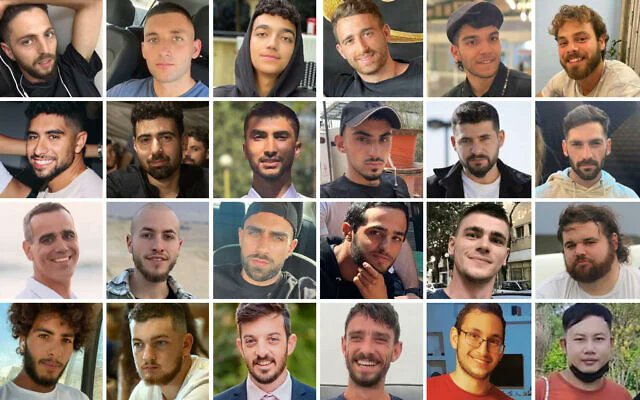
The Death Cult of Palestinian Terror
"After Hamas terrorists pulled her clothes off, they started to rape her. After one raped her, he took a knife and killed her."
"After he did it, he continued to rape the dead body. They were laughing. They always laughed."
Raz Cohen, October 7 survivor
"We fought all through the years for social justice, for peace."
"To my sorrow, we were hit by a terrible blow by those we helped on the other side."
"I stand here staggered to see the number of graves, and the terrible destruction of our community that was completely abandoned on October 7."
Yocheved Lifshitz at funeral of husband Oded
The residents of the kibbutzim that became targets when thousands of Palestinian terrorists flooded across the border from Gaza to southern Israel, were known for their activism on behalf of alleviating the lives of Palestinian civilians living in Gaza. The farming communities employed Palestinians as farm labourers, giving them jobs when employment was scarce in Gaza, and giving them wages that jobs in Gaza, if available, could not match. Relations between the kibbutz residents and the Palestinians were civil; they broke bread together in the kibbutz dining halls.

When the kibbutzim were raided by armed Hamas, PLFP and Palestinian Islamic Jihad terrorists on that dreadful day of savage infamy on October 7, among the terrorists were ordinary Palestinian, teens and men, some of whom knew those kibbutz environs intimately. People who had drawn helpful maps for the terrorists showing them where the security buildings were so those tasked to protecting the kibbutz could be dispatched first to enable the raiders to get on with their business of slaughter and rape unimpeded.
The years spent driving Gazans to medical appoints within Israel, taking children for cancer treatments, did not result in reciprocal care from the Palestinians to the Israelis who succoured them. Israelis who believed that they and the Palestinians could live in peace, trust one another, even if their leaders vowed otherwise. Israelis who passionately supported the idea of a 'two-state solution' despite the never-ending terrorist attacks; that once Palestinians had a state of their own they would accept the presence of Israel.
That dream is dead, as dead as the 1,200 Israelis who were slaughtered that day. As dead as the hostages who suffered through 500 impossibly evil incarceration days, as valuable possessions to be traded for Palestinian prisoners in Israeli jails for committing violent acts against Israelis -- those hostages who were returned to Israel in those mocking, jeering exchanges, who had died or had been killed during their brutal internment.
Age and gender made no difference. Torment and anguish was perpetrated against the helpless in the clutches of those whose fuming hatred for Jews knew no bounds. Hatred so intense that entire families died in their torched homes on that fateful day of marauding terrorism. Children abducted with their parents or separated from their fathers and taken with their terrified mothers to Gaza, as were elderly and ill men and women. An infant of ten months and his four-year-old brother strangled to death with bare hands, both bodies mutilated for the fiction of having been killed in an Israeli bombing over Gaza.
 |
|
A mourner at the grave of
hostages Shiri Bibas, Kfir Bibas and Ariel Bibas after their funeral on
February 26, 2025, in Tzohar, Israel. 2025 Amir Levy/Getty Images
|
When the hostages were released by Hamas to the Red Cross for transfer to Israel they were first surrounded by squads of masked, heavily armed Hamas terrorists, the route along which they travelled packed with cheering Palestinians. The staged events on the release of the hostages were celebratory events of victory by terrorists over the state of Israel; the death of Jews marking the superiority of a death cult over respect for human life.
Men who were released spoke of being held in the vast underground tunnel network in Gaza, legs shackled, the irons cutting into their flesh, and maddening hunger. The Bibas family had taken shelter in the safe room of their house hearing the shouts of 'Allahu akbar!' all around them. Parents Yarden and Shiri in desperate consultation decided they would fight. Yarden took his pistol and tried to protect his family. He was placed in a cage in a tunnel.
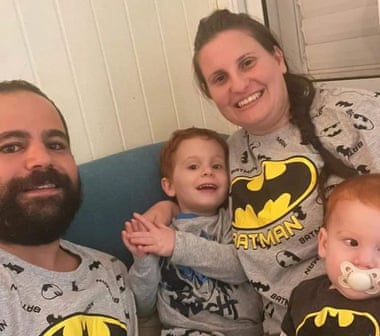 |
| Yarden, Shiri, Ariel, 4, and Kfir, 10 months |
Shiri Bibas, left with her infant boys could hear the terrorists trying break down the door of the safe room where she huddled with infant Ariel and baby Kfir. With the use of a hand drill they forced the handle open and the three were taken to Gaza. They lived for a month in captivity before being murdered. Yarden, the children's father was informed his family died in an Israeli airstrike. Finally released in an exchange, he believed his wife and children were alive and would soon join him in freedom.
There are still more hostages to be freed, both alive and dead. Hamas's mockery of the gaunt, starving hostages, in emotional upheaval, their minds traumatized, their bodies in various stages of shutting down, mark the terrorists' passionate commitment to death, revelling in the violence their savage atrocities identify their mission of destruction by. And these are the death-dealers that hordes of supporters in the West glorify.
Labels: Death Cult, Hamas Invasion of Israel, Hostages, October 7/23
Hamas's Deadly Invasion Evaluated
 |
An Israeli armored personnel carrier heads toward the Gaza border. Ohad Zwigenberg/Associated Press |
"The
dominant view in Israel, and not just at the political level, but also
within some in the security services, was that the conflict in Gaza is
manageable, that we could contain it."
"The
easy answer that you hear is that Hamas is an apocalyptic terrorist
movement that doesn't care about human life. That's true. But they're
not irrational."
"Hamas
has already said ... that it wants to exchange [the Israeli hostages]
for prisoners. One objective for Hamas in doing that is to boost up its
ranks by freeing prisoners [jailed in Israel] in large numbers."
Thomas Juneau, political scientist, University of Ottawa
"Hamas officials have been quite open about the fact that this [normalization] would be a huge event."
"Saudi
Arabia is the custodian of the two holiest sites in Islam and I think
Hamas fears that if there would be normalization with Saudi Arabia,
other Muslim nations, other Arab nations would follow suit."
"Not only is it [Fatah] secular as opposed to Islamist but it believes in a two-state solution and Hamas does not."
"Hamas
is not fighting for there to be a Palestinian state alongside Israel.
Hamas is fighting to destroy Israel ... it's against peace in general."
Matthew Levitt, professor, Georgetown University Center for Security Studies
"I
can give you a hypothesis and that is, we were in a situation where
there was no peace process. There was absolutely no movement whatsoever
on Palestinian issues. And I think that Hamas took the decision that
they had to shuffle the deck, that they had to do something or they
wanted to do something, which would make the status quo untenable."
"It's
not at all clear to me how [Hamas] thought the endgame would work out.
They would have known that this would have brought a major Israeli
military operation, that that would include ground operations."The last
Israeli ground operation [in 2014] was the biggest boost in history to
Hamas's popularity."
"Clearly
... it wasn't meant to be an incremental thing. It was meant to be a
game changing thing. And that includes the deliberate targeting of
civilians."
"Are you going to occupy all of it? You're going to fight street by street into downtown Gaza?"
"If you destroy Hamas, who will you hand [Gaza] to when you leave? Do you want to occupy it?"
Rex Brynen, Middle East expert, McGill University
 |
| Rockets fired from Gaza City are intercepted by the Israeli Iron Dome
defense missile system in the early hours of October 8, 2023.
EYAD BABA/AFP via Getty Images |
The
Palestinian Authority, commented Dr. Juneau from his perspective as an
academic with a focus on the Middle East, is highly incompetent and
corrupt. That alone has led to resentment among Palestinians which has
been responsible for growing support for radical groups like Hamas.
October 7th's incursion by Hamas into Israel, he stated, represents "the most significant escalation of the ongoing Israeli-Palestinian conflict in several decades", he said, quoting the Council on Foreign Relations.
"We just don't have great insight into Hamas's strategic judgement",
added political scientist Rex Brynen. October marks 50 years since the
Yom Kippur War when a coalition of Arab states led by Egypt and Syria
led a surprise attack on Israel, which may entirely be coincidental.
Since Hamas stated the October 7 attack had been planned out carefully
for a year before the event.
At
the same time, Israeli public opinion and support for the current
government led by Benjamin Netanyahu with the 2022 coalition government
including hard-right religious factions, and the government's intention
to change the judicial reform process that Israel's liberal-left
supports, fracturing the country, and in the opinion of onlookers from
outside the country, believing it to have been in a weakened state.
Opportunity perhaps beckoned, all the more so when the dissenting
opinions took place at all levels, including the IDF and its reservists,
some of whom refused to serve.
The
ongoing normalization process between Israel and Saudi Arabia was a red
flag to Islamists and Palestinians in general, realizing it left them
outside the loop; the reality being that the 'Palestinian refugee'
problem was being sidelined in the greater interests of achieving
regional peace that would lead to greater regional prosperity and in no
small part greater security, in the majority Arab Sunni region where
Shiite Islamist Republic of Iran presents as a threat.
An
issue that Dr. Juneau expressed his skepticism over. On the other
hand, they all acknowledged, Fatah, the leading party in the Palestinian
Authority and the PA itself are unpopular and viewed as weak by the
general Palestinian population they govern. Even among West Bank
Palestinians Hamas is admired and supported to a far greater extent than
the Palestinian Authority. Then there are relations between Fatah and
Hamas; the latter despising the former as a secular group to Hamas's
Islamism.
Dr.
Brynen expressed his opinion that the 'success' of the Hamas attack
surprised even Hamas. The much higher Israeli body count and hostage
taking surpassed its expectations. And the corollary to that was a far
greater response from Israel than Hamas might have anticipated.
One
thing all three agreed upon in their debate was that whatever the
original reasons behind the unprecedented scale of the attack -- whether
to bring international attention to focus on the Palestinians; to
eliminate Israel for replacement by an Islamist state; to free prisoners
convicted of crimes in Israel; or to help Iran -- the ultimate goal was
to effect a massive change in the region's dynamics.
To that degree, and to the dimensions of the attention given its deadly exploits in the outside world, they succeeded.
 |
| Pro-Palestinian demonstrators gather during a rally for Gaza outside the
Israeli Consulate General in New York on Oct. 9. Michael M. Santiago/Getty Images |
Labels: Abductions, Death Cult, Gaza War to Destroy Hamas, Hamas Invasion of Israel, Israel Defense Forces, Mass Slaughter, Rape Culture