Canada's Scholarship Decline
"All told ending EDI [equity, diversity and inclusion] initiatives in Canadian research should be a top priority for any responsible government.""[The quantity and quality of Canada Research Chair scholarship declined from between 20 percent to 15 percent, attributable to] non-meritorious appointment of less qualified Black, Indigenous, and female chairs.""Our analysis ... confirms that diversity is not merely neutral but can lower performance."The Equity-Excellence Tradeoff report
 |
| The Bruneau Centre for Research and Innovation at Memorial University in St. John's, Newfoundland. Since 2017, Canadian universities have been subject to strict identity-based hiring quotas as a condition of receiving federal research funding. Photo by Adobe Stock |
The Macdonald-Laurier Institute released a new report focusing on race-based hiring quotas in academia under a Liberal-government mandate. Canadian universities have been subjected to strict identity-based hiring quotas since 2017, conditional to receiving research funding from the federal government. Postings of academic jobs explicitly barring straight white men has become proforma in recent years at Canadian academic institutions, as a result of that financial stricture.
As an example, at Memorial University in Newfoundland a tranche of five new job opportunities advertised in April as being open only to "women; 2SLGBTQIA+ applicants including Indigenous peoples, racialized persons and persons with disabilities". This identity-based hiring has resulted, according to the 54-page report, in a diminishing number of Canadian research published or cited by other scholars.
The $311-million annual Canada Research Chair program came under particular attention by the study, representing the federal research fund focusing on the pressure placed on identity-based hiring. 2,285 university Canada Research Chairs are funded by the program; salaries and office expenses are entirely covered by this federal grant funding. Schools receive $200,000 yearly for a Tier 1 Canada Research Chair, and $100,000 yearly for a Tier 2 Chair. That's a substantial amount to forego for any university that might balk at the restrictions imposed.
 |
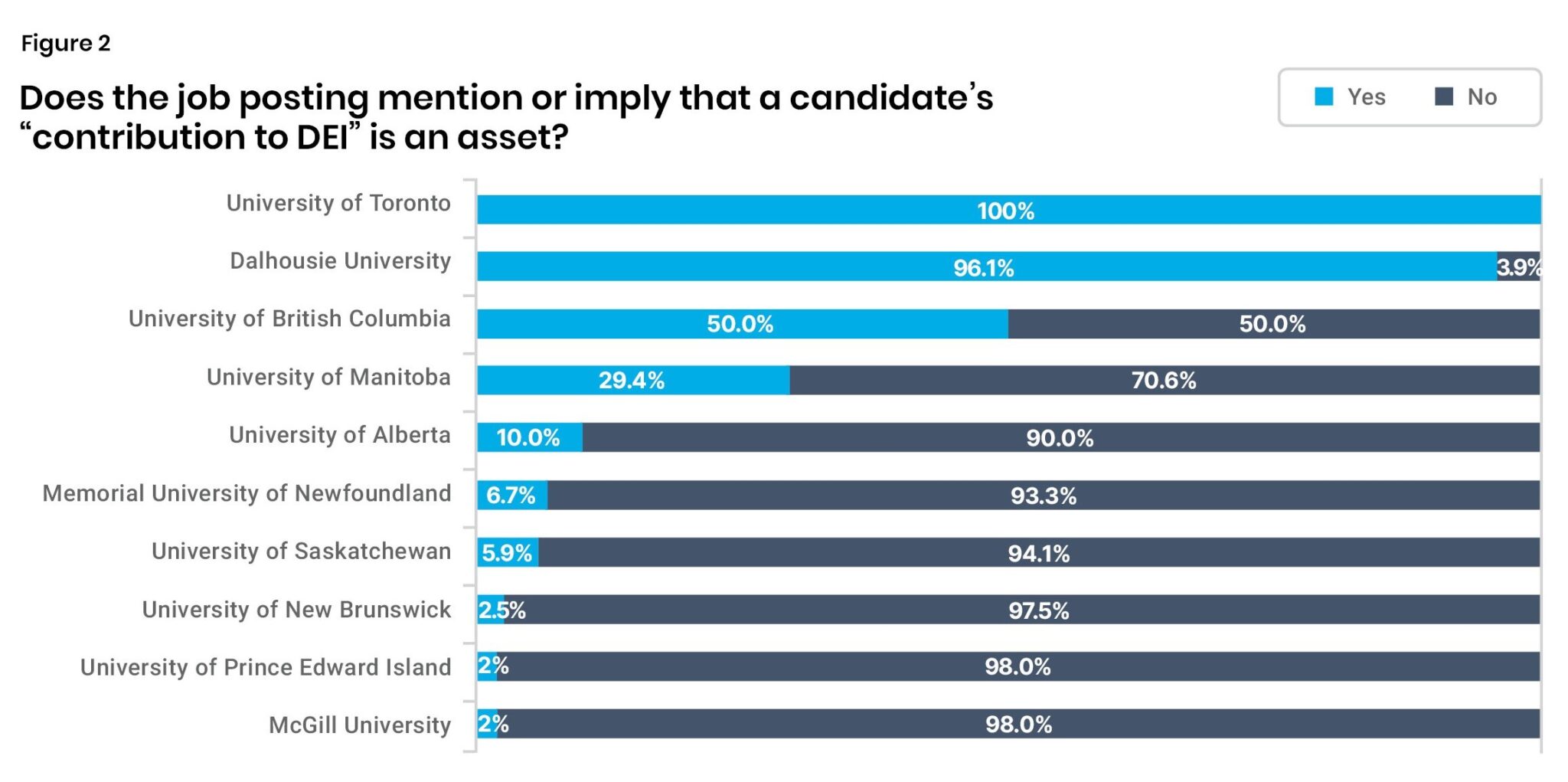
DEI and academic hiring in public universities: An index of university discrimination in Canada Aristotle Foundation for Public Policy |
Schools receiving those grants have no option but to submit to federal quotas on race, gender and sexual characteristics of any researchers they hire. Canada Research Chairs must be comprised of 22 percent 'racialized', 4.9 percent 'Indigenous' and 50.9 percent 'women and gender equity-seeking groups', according to the most recent guidelines published by the Government of Canada.
Individual universities, furthermore are informed of the precise number of Canada Research Chairs they are required to put in place in one of four 'equity-deserving' groups, targets expressed in regularly updated tables. The most recent equity quota for McGill University required the hiring of 34 'racialized' Canada Research chairs, five Indigenous Canada Research Chairs and ten 'persons with disabilities'.
Initiated in 2000, the Canada Research Chair's identity mandates began in 2017 through the oversight of Prime Minister Justin Trudeau, which fit nicely within his obsession with Critical Race Theory/DEI/Woke agendas to make Canada more equity-conscious as it approached his ideal of the 'Post-National' state that had no reason to distinguish itself through rigorous academic application to excellence. The program has taken nine years to become fully operational under the aegis of the Liberal federal government
 |
| Aristotle Foundation for Public Policy |
When the Canada Research Chair program first started, white males represented 80 percent of the chairs. By 2025, white males represented a mere 25 percent of the total. The productivity of Canada Research Chairs was ranked by Macdonald-Laurier Institute analysts before and after the imposition of the identity mandates. The performance of 1,906 Chairs was categorized by their 'h-index' -- the standard global measurement of productivity and relevance of a scholar. The number of papers where a researcher is listed as an author along with the number of instances where the papers are cited by others results in the h-index ranks; typically between one and 100.
Cohorts with the lowest research productivity were recognized as those being given priority for academic positions. Black male scholars or Indigenous had an average h-index of 25, whereas the average white or Asian male scholar held a 39 h-index. As for female scholars, their average h-index was 28. The paper concluded that the replacement of high-achieving cohorts with lower-achieving counterparts arrived at the cost of lower quality research.
"There will be many cases in which female, Black, or Indigenous scholars will not impose a cost, but on average -- under an EDI dispensation in which race and sex considerations can outweigh scholarly merit -- this will be the case.""[Example: where a university took a position previously filled by a white or Asian scholar, filling it with a Black or Indigenous hire, it likely entailed an] average loss of 3.2 h-index points."The Equity-Excellence Tradeoff report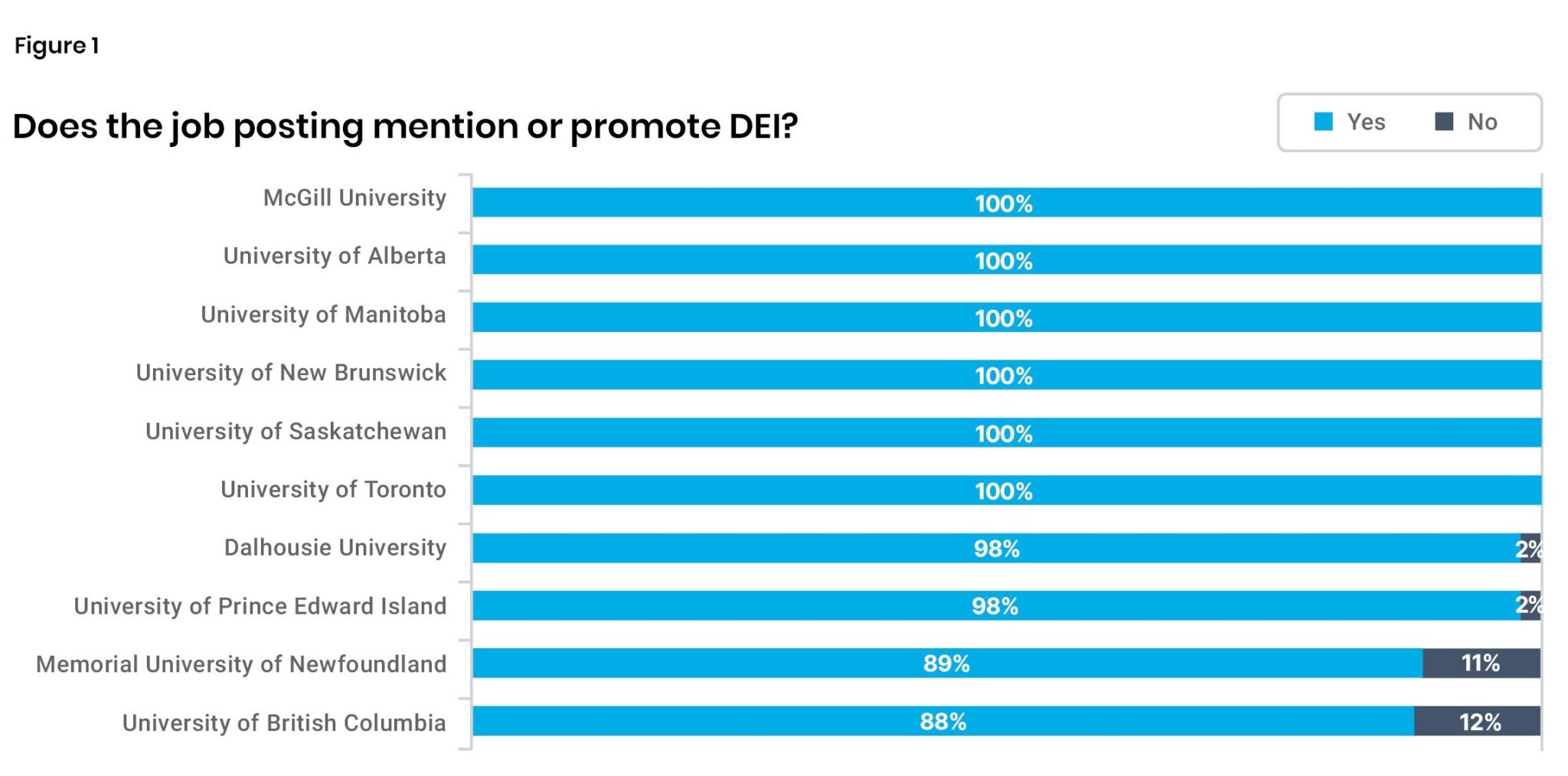
Labels: 2SLBTQIA+, Academic Hiring, Black, Canada Research Chairs, Disabled, Indigenous, Liberal Government Mandated Focus on Diversity/Equity/Inclusion, Straight White Males
posted by Pieface @ Friday, September 04, 2026


