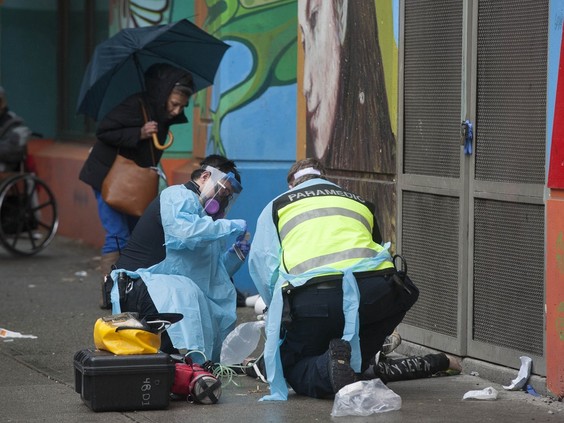
Tuesday, February 18, 2025

Pioneers in 'Safer Supply' British Columbia Benefits the Opioid Black Market


"Significant [quantities of] safer supply [opioids are being diverted to the black market with assistance of organized gangs and some unscrupulous health-care providers]."
"Taxpayer-funded 'safe supply' drugs are flooding the streets, enriching organized crime, in some cases with diversion fraudulently facilitated by pharmacies and medical professionals."
"A significant portion [of safer supply opioids are being diverted to the black market, where they are being trafficked] provincially, nationally and internationally."
Power Point presentation produced by British Columbia's Ministry of Health 
https://static01.nyt.com/images/2024/07/11/multimedia/00canada-overdose-01-vmcg/00canada-overdose-01-vmcg-superJumbo.jpg?quality=75&auto=webp
A memorial wall for people who died as a result of using drugs is featured inside the offices of the Vancouver Area Network of Drug Users, a nonprofit group. The New York Times
"The last six months of 2020 they dispensed 577,000 opioid pills. In the two years between 2022 and 2024, it was over 22 million. It's humiliating. How many people are living in British Columbia, for goodness sake?"
"We've got to stop calling things harm reduction. It's not proven."
"Is giving people giant buckets full of hydromorphone to dump into the community harm reduction? No. It's not proven to reduce harm. It's not evidence-based. It's an experiment."
"Of course we need to deal with kickbacks from pharmacies. Even if every pharmacy is on the straight and narrow, it would still be a problem. A huge problem."
"We're not talking about safe injection sites at all. You're giving dope to people who are addicted and they're not taking it. They're using it as a currency to buy street drugs and still put themselves at risk."
B.C. MLA Elenore Sturko
https://i.cbc.ca/1.5896676.1684427088!/cumulusImage/httpImage/image.jpg_gen/derivatives/16x9_1180/hydromorphone.jpg?im=Resize%3D780
Hydromorphone, a type of opioid, is pictured at a managed opioid program in 2019. The drug is among those whose prescriptions have dramatically increased in recent years. The province is investigating the diversion of a 'significant portion' of opioids. (Ashley Burke/CBC)

Part of a confidential report produced by British Columbia's Ministry of Health summarizing findings of a special investigative unit looking into the fallout of the province's initiative to react to the growing phenomenon of fentanyl overdoses leading to death that has swept Canada, and manifested hugely in British Columbia, has been leaked. Its findings discovered that the freely distributed hydromorphone that has been handed out to people addicted to opioids has flooded the streets, the result of that free hydromorphone being bartered for more potent fentanyl craved by drug addicts.
 
The cheaper and more freely available handout drugs on the streets have made their way into the hands of teenagers which has resulted in a growing use of drugs with occasionally fatal consequences for young people. Government agencies have denied that the 'safer supply' they have invested so heavily in relating to their open-minded search for a solution to the fentanyl black market, could be ending up on the streets in a black market bonanza. Yet reports from hospital personnel, police, and community investigators have all held the government to fault for a situation that really is imperilling a greater swath of the population, despite government denials.
 
Now, years after the accusations of government ineptness and malcompetence made the news, a leaked document -- that investigators have produced verifying the accusations -- has surfaced. Even before that, however, the government of B.C. came to a decision to curtail their experiment in 'harm reduction' through 'safer supply'. No longer able to deny that throughout this experiment, accidental deaths due to overdoses have increased, not diminished, and a wider net has been cast in the process, capturing a younger cohort in the drug spiral.
 
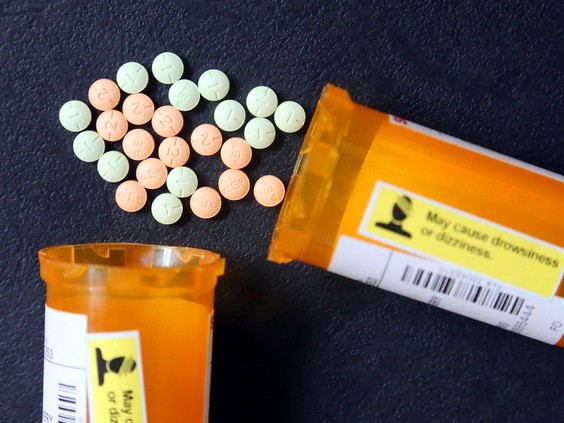
Within the presentation photos of diverted safe supply prescriptions still in their original packaging were included; evidently having been confiscated during vehicle searches by police. At least 60 British Columbia pharmacies were identified by the investigative unit as having provided prohibited paid "incentives" to clients, doctors and assisted living residences for the purpose of increasing their operating profits. 
 
https://smartcdn.gprod.postmedia.digital/vancouversun/wp-content/uploads/2025/02/0907-bi-qw-council-addictions-bi.jpg?quality=90&strip=all&w=564&h=423&type=webp&sig=WKvXF3OKFTn4nSlCv_3Fnw
 
A dispensing fee is charged for each prescription filled; in this instance billed to the provincial government. Up to three prescriptions a day can be dispensed for a single safer supply patient. Dispensing fees are around $10 each, so the potential for pharmacies to earn up to $11,000 annually for each safer supply patient served is a compelling temptation. Normal customers are worth around $120 in dispensing fees yearly. The obvious conclusion is that a single safer supply patient can result in more revenue than 90 others not related to safer supply combined, would produce.
 
According to the leaked presentation, some 'incentivized' patients may procure only one of their three daily prescriptions while diverting their extra opioids to the black market. Alternately, the pharmacy involved could fraudulently bill the province while failing to dispense the drugs, so that patients don't receive some or all of their prescriptions. Either way, extra opioids end up on the black market fueling organized crime and leading to an increase in drug use in the population. 

According to the presentation, between 2022 and 2024, some 20-million milligrams of hydromorphone (an opioid as potent as heroin) and 232,000 fentanyl patches were dispensed through safer supply, equal to 19 percent of all the hydromorphone and 13 percent of all the fentanyl patches dispensed during this period in the province.
 
https://i.cbc.ca/ais/1.7156186,1717224314156/full/max/0/default.jpg?im=Crop%2Crect%3D%280%2C0%2C1919%2C1079%29%3BResize%3D620
Some pharmacies are paying cash kickbacks to vulnerable patients in Vancouver’s Downtown Eastside to attract more business — years after crackdowns related to the practice.    CBC News
 

Labels: , , ,

Saturday, February 08, 2025

British Columbia's Experimental 'Safer Supply' Flop


"A significant portion of the opioids being freely prescribed by doctors and pharmacists are not being consumed by their intended recipients."
"[Those opioids are being trafficked]provincially, nationally and internationally."
"As long as [safer supply] gives valuable things away for free, or for far below market prices, one should expect there to also be 'profiteers' wishing to profit by obtaining supply for resale."
Leaked B.C. document
 
"You can stand in front of just about any of these pharmacies that are involved in this -- usually close to the safer supply prescribing office -- and you can sit outside for five minutes and watch all kinds of transactions going down."
Addiction outreach worker David McEvoy
 
"We have noted an alarming trend over the last year in the amount of prescription drugs located during drug trafficking investigations, noting they are being used as a form of currency to purchase more potent, illicit street drugs."
RCMP spokesperson Cpl. Jennifer Cooper 

"We have been concerned about this increasingly polarized rhetoric that is not informed by evidence, that is not paying attention to evidence, as a matter of fact, and is sharing opinion or anecdote that, in fact, is clearly not defensible if you look at the data."
"[Hydromorphone was not] present in a significant number [of the bloodstreams of the roughly 200 people per month dying of overdoses in B.C.]" 
Former B.C. Chief Coroner Lisa Lapointe
https://i.cbc.ca/ais/1.7156186,1717224314156/full/max/0/default.jpg?im=Crop%2Crect%3D%280%2C0%2C1919%2C1079%29%3BResize%3D620
Some pharmacies are paying cash kickbacks to vulnerable patients in Vancouver’s Downtown Eastside to attract more business — years after crackdowns related to the practice. Still from video
 
For years health officials in British Columbia dismissed concerns expressed relating to freely handed out opioids to drug addicts through 'safer supply' outlets, in a program designed to charitably provide a product considered safer than street opioids, in an effort to wean people off more dangerous drugs like fentanyl in response to an epidemic of deadly overdoses. Those overdoses have occurred across Canada, but British Columbia remains the poster child of drug-induced accidental overdoses. 

Which is what led the government of B.C. to develop a ground-breaking system of 'safer supply', representing, since 2020, one of the world's most comprehensive such programs. Once the program was operational, sharp eyes began to notice a proliferation in the illicit street market of diverted opioids and it wasn't difficult to conclude that the giveaway drugs were being sold on the black market in exchange for more powerful drugs like fentanyl. 
 
And while the less dangerous drugs were selling on the street at very competitive prices, they lured teenagers into venturing into the temptation of 'trying them out', creating a new generation of drug users.
 
The evidence of diversion was clear, and investigative reportage delved into the problem, publishing their damning results; the larger availability of drugs flooding the marketplace thanks to 'safer supply' initiatives, doing far more harm to society broadly; in effect enabling addicts who spurned the lesser highs of hydromorphone for the attraction of infinitely more potent (and dangerous) fentanyl-laced street drugs. These were dismissed by the province's health authorities as unsubstantiated rumours and 'false news'. 
 
This week, however, the provincial Opposition Conservatives in the province released a leaked presentation that had explored the issue without prejudice, finding that those accusations of 'safe supply' boosted opioid availability at the street level, and leading in fact to more accidental drug overdoses rather than preventing them as intended, were indeed reflecting reality. The Conservatives labelled the issue of diversion, as evidence of "taxpayer-funded drug trafficking".
 
https://smartcdn.gprod.postmedia.digital/vancouversun/wp-content/uploads/2024/09/png-0502n-overdose-037.jpg?quality=90&strip=all&w=564&h=423&type=webp&sig=SwU4R5fpM3qvebKB1TNPlg

The undeniable evidence that the government health authorities had been apprised, despite their denials, even led B.C. Health Minister Josie Osborne to confirm that the claims about diversion outlined in the report were a reflection of reality, that the report's destination was intended for the attention of law enforcement. "These allegations are here. There's absolutely no denial of it. There's no diminishing of it, and there should be no acceptance of it."
 
The very direction of distributing free recreational drugs to addicts was meant for the purpose of weaning them away from illicit drug supplies tainted by fentanyl or heroin. "Safer supply services can help prevent overdoses, save lives, and connect people who use drugs to other health and social services", an official Government of Canada policy backgrounder explained. 

In the years from 2022 to 2024, 19,751,000 mg of hydromorphone was handed out representing safer supply equivalent to 2.5 million 8-mg pills, while 1.4 million mg of oxycodone was also distributed, equating to 70,000 20-mg pills. When the program was initiated, critics gave warning that users would end up selling their rations of 'safer sup' to use the profits from their sale to acquire illicit drugs. Which led to government-supplied drugs flooding the market and addicts gaining money to buy illicit drugs.
 
"We ... know that about 50 percent of the hydromorphone pills that we come across can indeed be attributed to safe supply", the Standing Committee on Health was told by Vancouver's Deputy Chief Constable Fiona Wilson. Which did not deter drug policy advocates and government of B.C. officials from repeatedly insisting diversion was no problem; contending otherwise represented misinformation or political posturing.
 
https://i.cbc.ca/1.5896676.1684427088!/cumulusImage/httpImage/image.jpg_gen/derivatives/16x9_1180/hydromorphone.jpg?im=Resize%3D780
Hydromorphone, a type of opioid, is pictured at a managed opioid program in 2019. The drug is among those whose prescriptions have dramatically increased in recent years. The province is investigating the diversion of a 'significant portion' of opioids. (Ashley Burke/CBC)


Labels: , , , , , ,

Follow @rheytah Tweet