The Unreliable Functionality of United Nations Peacekeepers
 |
| Burundian UN peacekeepers patrol in Bangui, Central African Republic -- Photo by Jane Hahn Washington Post |
"The weakest and most vulnerable around the world rely on the United Nations to protect them, but it won't be able to fulfill their expectations if its members send protectors who are known abusers back home."
Akshaya Kumar, deputy UN director, Human Rights Watch
"[The UN] does not have dedicated resources to carry out human rights screening of individual contingent members, nor do we have the means to assess the records of individuals."
Farhan Haq, senior spokesman, UN peacekeepers
At the present time, the United Nations is engaged in managing sixteen separate peacekeeping missions with over 100,000 uniformed personnel and an annual $8-billion budget. It recruits peacekeepers from militaries around the world, many of which have notable records of military and institutionalized abuse serving repressive governments. But the United Nations lacks a system to identify conscripts with backgrounds replete with human rights abuses.
Burundi is a case in point, where the government has used its security forces as a punishing tool against political opponents. A team of human rights experts appointed by the UN warned months ago that their forces were committing
"gross violations" of human rights, recommending it
"phase out" use of Burundian peacekeepers. Consequently, the UN announced months ago it would no longer accept Burundian police as peacekeepers in the Central African Republic once the contingent has completed its tour.
The UN cited that cessation
"given the current allegations of serious and ongoing human rights violations in Burindi". Despite which the UN employs over 800 Burundian soldiers in the Central African Republic, required, according to senior officials, to maintain the peace. Another 5,400 Burundian troops are supported through the African Union's mission in Somalia. And the reason that Burundian police and military are offered to the United Nations for peacekeeping is that millions of dollars are sent to the government of Burundi as payment for supplying the troops.
The same could be said for any and all governments who offer their security personnel for deployment as UN peacekeepers; governments are lavishly recompensed for their part in offering their national police and military to the United Nations. For their part, the conscripts to the UN peacekeeping effort view the opportunity to serve as a splendid personal opportunity to enhance their livelihood. The coveted posts pay exceedingly well, about $12,000 annually as opposed to the salary of a lieutenant in Burundi who makes $500 per year.
This is used as a form of pay-off by the Burundian government which reserves the peacekeeping nominations for its loyalist contingents. Congo too sent 850 peacekeepers to the Central African Republic with an African Union mission, in 2014 taken over by the United Nations. Like Burundi, Congo's military commits human rights abuses, raping and killing civilians during civil war. Similarly, the UN announced it would be ending Congo's role in the Central African Republic after incoming troops were unable to meet UN standards for vetting, training and equipment.
Security forces that open fire on protesters, kill and injure people, crack down on suspected government enemies, arrest hundreds in defense of government orders are considered loyalists by repressive, human-rights-abusing regimes which are still viewed with a measure of favour in the United Nations. Consider Syria's regime known to be responsible for a half-million Syrian deaths in civil war conflict, and millions of displaced Syrians; half its population. It still has a respected place within UN member-bodies.
A great majority of United Nations member countries are unable to bear even cursory scrutiny of their human rights records. Countries like Saudi Arabia with its misogynistic patriarchy and its penchant for inspiring terrorism, can still sit on a council ostensibly created to support women's rights. The United Nations was meant to be a bulwark against human rights abuses in the world, as a world body to promote peace and equality. Instead it has become a club for human rights abusers to stand in judgement over the relative few of the UN's members who are exemplars of human rights protection.
Labels: Dysfunction, Human Rights, Peacekeeping, Social Justice, United Nations
The Teetering, Tottering United Nations
"Prior to Bosnia, almost half of UN peacekeepers had been from Western countries."
"When I left office, the West provided fewer than one in ten of our blue helmets."
"The leading Western countries ... wanted 'to do' something, but certainly were not prepared to deploy their own troops and did not want to pay too much."
Jean-Marie Guehenno, head of UN peacekeeping, 2000 - 2008
"Instead of protecting the people, they are abusing them. And then no one is saying anything. It's terrible."
"It was a very similar reaction [denying responsibility for UN peacekeeping errors and failings] to what I experienced. They just can't recognize that they had [done] something wrong. They expect the rest of the world to do it, but they [won't do it] themselves."
Anders Kompass, Swedish diplomat, UN employee
"They shot dead a local journalist while forcing the foreigners to watch, raped several foreign women, singled out Americans, beat and robbed people and carried out mock executions."
"For hours throughout the assault, the UN peacekeeping force stationed less than a mile away refused to respond to desperate calls for help."
Associated Press report, July 11, 2016
"The system almost lives in denial about the number of civilians who have died on its watch in Darfur, South Sudan and the Congo."
"There's a sense of incredible vulnerability across the system. And a sense that the organization has gone beyond its capabilities and some sort of reckoning is necessary."
Richard Gowan, peacekeeping expert, New York University Centre on International Cooperation
The selfless heroism of peacekeeping is not always quite what it seems. Mandated by the UN to ensure that Hezbollah would not smuggle weapons into Lebanon to begin assembling another cache with which to assault Israel, after a ceasefire in 2006 ending the 34-day war between Israel and Hezbollah in Lebanon has not stopped the terrorist Shiite group from doing just that. And since, lobbing rockets over the border into Israel, which Israel responds to, as well as stopping weapons transfers from Syria to Hezbollah.
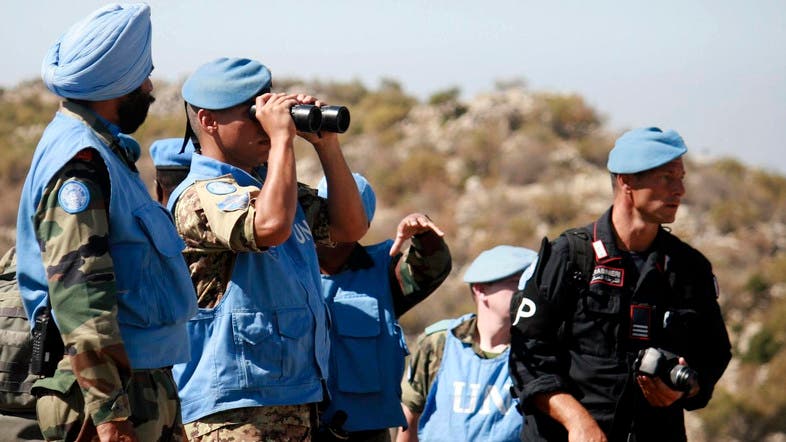
UN peacekeepers serving with the United Nations Interim Force in
Lebanon (UNIFIL) inspect areas that were targeted by shelling by the
Israeli Army in the Shebaa area, southern Lebanon. (File photo: Reuters)
Even when Western countries such as Canada deployed Canadian troops into the UN's peacekeeping missions, miserable failures occurred such as when several members of the Canadian VanDoos, a historical regiment, tortured a Somali teen to death in 1993's mission to Somalia. A year later the UN hesitated to intervene when the Rwandan genocide occurred as the blue helmets looked on helplessly while Rwanda's Hutu government targeted its Tutsi demographic, slaughtering three-quarters of a million people in short order.
Similarly, UN inability or unwillingness to respond with force where and when it was needed, led to the slaughter of Bosnian men and boys in Srebrenica, while the Dutch peacekeepers looked on helplessly, without orders to intervene, in 1995; spectacularly failing to halt the murders. It seemed from that low point on, Western countries became loathe to take part in UN peacekeeping. And while the developed world footed most of the bills, the peacekeeping soldiers came from the undeveloped world.
Over a dozen countries, including Guatemala, Burundi, Haiti, Sierra Leone, East Timor send their soldiers to UN peacekeeping missions. Around the globe, sixteen missions deploy over 100,000 uniformed UN peacekeepers, costing over $8-billion yearly. Over 30 percent of the soldiers emanate from Ethiopia, Bangladesh, India and Pakistan. In the Democratic Republic of Congo and Sudan's Darfur region
"there was little or no peace to keep". The Sudanese military and the Arab janjaweed continue to employ 'ethnic cleansing' on its Black farming community in Darfur.
A peacekeeping review panel identified, in mission following mission that a
"widening gap between what is being asked of United Nations peace operations today and what they are able to deliver", is the reality of the present day. Not only are the missions and their blue helmeted peacekeepers unable to separate opposing factions imposing violence on one another, but in some instances the peacekeepers themselves engage in inhumane violence.
In June, Anders Kompass resigned his post with the UN, pointing at allegations of child sexual abuse by UN and UN-affiliated peacekeepers in Central African Republic in 2014. His reward was to be hounded by his superiors, his resignation demanded and his reputation irremediably stained. The ingrained culture of secrecy and self-protection excusing everything and anything that goes wrong under UN auspices which leads to a refusal to recognize and correct wrongs committed by peacekeepers is now well known.
The UN steadfastly denied that its Haitian-assigned peacekeepers, in the wake of the devastating earthquake that shook the country in 2010 were responsible for creating a dreadful cholera epidemic. Where peacekeepers in a UN camp contaminated a vital water source for Haitians with the cholera virus that ended up killing ten thousand Haitians and producing 100,000 desperately ill among the population; all denied, denied, denied.
And finally the recent rampage in South Sudan by South Sudanese military where the UN peacekeepers failed to respond to desperately urgent requests for help from besieged and tormented and raped foreign aid workers, fully painted yet another United Nations global campaign to support the seemingly unattainable; world pacification; as a miserably failed enterprise. Only one of many undertaken by the United Nations.

Ambassadors
Samantha Power of the United States and Fodé Seck of Senegal,
co-leaders of the Security Council mission to South Sudan, disembark on
arrival in the capital Juba. Photo: UNMISS
Labels: Atrocities, Human Rights, Peacekeeping, United Nations


