The Wisdom of a Liberal Government
"The pace of arrivals began to exceed Canada's capacity to absorb and support newcomers in the way we are used to doing.""Canada's new government recognizes that this system is no longer sustainable, and we are determined to make it so."Canada 2025 Liberal Budget Preamble
 |
To begin to solve the problem of Canada having embarked on a mission to become 'post-national' and speed up its intake of migrants, immigrants, refugees from all over the world, including foreign students and foreign temporary workers, amounting to a million newcomers a year that nudged Canada's population from the 36 million it was a few years ago to the new total of 41 million, in the process making housing unaffordable, schools crowded with students who have no facility with the two official languages, and the nation's universal health care system close to collapse, the new government of PM Mark Carney has decided to address the issue by speeding up a universal amnesty granting permanent residency status to hundreds of thousands of 'asylum seekers'.
Canada is now embarked on a mission to undo the damage deliberately invited by the previous Liberal government under then-Prime Minister Justin Trudeau, by bringing the mass immigration imbroglio "under control". It will do this by pursuing a "one-time" program fast-tracking "eligible protected persons", many of whom entered the country illegally, toward permanent residency. To any jaded Canadian this plan looks far more like -- more of the same.
Under Canadian law, an asylum seeker who has received approval by authorities to their refugee claim is considered a 'protected person'. At the present time there are more people encompassed by the Canadian refugee system than at any other time in history. A total of 497,443 individual "asylum claimants and protected persons" reside in the country, at taxpayer expense, in every conceivable way. Many of whom take the places meant to temporarily house the Canadian homeless population. Many of them regularly visit food banks.
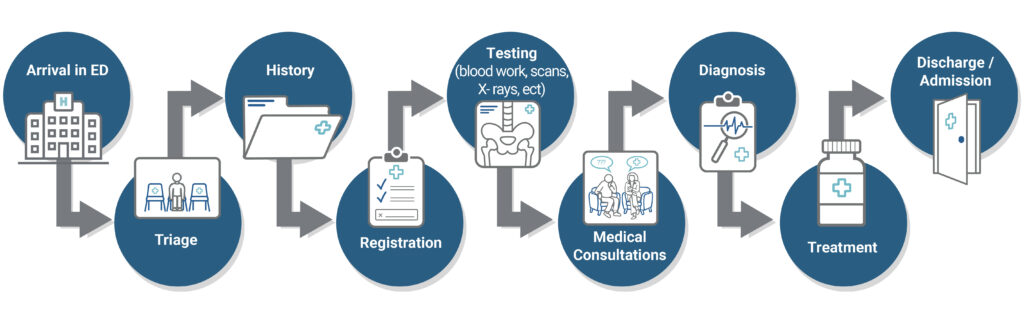 |
| Wait Times From 8 to 22 Hours...The Ottawa Hospital |
The emergency rooms of Canada's understaffed hospitals regularly hold a significant percentage of migrants requiring medical treatment which has caused the wait for treatment to go beyond 8 hours and more at any given time. But $120.4 million has been allocated in an 'austerity budget' toward bringing that 'one-time' program of fast tracking those 'eligible' into protected status as a reward to many for having illegally entered the country as economic migrants, to register as refugees.
Apart from the number that Statistics Canada registered of close to a half-million in the category of 'asylum claimants and protected persons', another 187,786 claimants for asylum wait for their case to be heard by the Immigrant and Refugee Board of Canada. In 2015, when Justin Trudeau became prime minister, asylum claimants in Canada totalled 16,058 people. In ten years exponentially greater numbers entered Canada to claim refugee status, generously invited by Mr. Trudeau.
Any foreigner passing a light security screening can claim asylum under the terms of the Immigration and Refugee Protection Act. That person is permitted to remain in the country with access to benefits and work permits until such time as their case is adjudicated, and that can take years, and even longer considering the extensive backlog. While 2015 saw 7,100 asylum claims processed, in 2024 that number ballooned to 58,050, an increase of over 800 percent.
 |
| A boundary monument marks the border between Canada and the United States at Roxham Road. The road is a well-travelled unofficial border crossing for asylum seekers crossing into Canada. (Charles Contant/CBC) |
Migrants within the refugee system include the estimated 114,373 illegal border crossers swarming Canada since 2017, illegally crossing into Canada from the United States, deliberately bypassing the legal, authorized border crossing posts. Tens of thousands of temporary migrants entering Canada as students who claimed asylum once their visas expired are included, to a record of 20,245 claims last year. In the 'protected persons' category the vast number of claimants will see acceptance.
Canada had become the fastest-growing country in the OECD after lifting pandemic lockdowns and opening all permanent and temporary migration in one fell swoop. It soon became obvious that the state of Canada's immigration system had become inefficient and dysfunctional through the impossibility of attempting to handle numbers that the system was never meant to be drowned in.
 |
| An RCMP officer looks on as asylum seekers cross the Canada-U.S. border at Roxham Road on Jan. 5, 2023. (Charles Contant/CBC) |
Labels: Amnesty, Canada's Liberal Government, Canadian Unaffordability, Illegal Migrants, Immigration and Refugee Board, Permanent Residency
posted by Pieface @ Friday, November 07, 2025