Islam and Western Academia
"Islamophobia is a fear and hatred of Islam and Muslims that translates into individual, ideological and systemic forms of oppression."
"[It is necessary to] situate these acts [Islamist terrorism] within a broader historical context ... such as the racial violence of colonialism, genocide, slavery, occupation and apartheid."
Jasmin Zine, professor of race, ethnic, gender, postcolonial studies, Wilfrid Laurier University, Waterloo, Ontario
"Well, we're been watching an intifada in Palestine, we've been watching an uprising in Iraq ... How come we don't have an intifada in this country [United States]."
"They're gonna say [I'm] being too radical. Well, you haven't seen radicalism yet!"
Hatem Bazian, founder, Students for Justice in Palestine

Mr. Bazian and his ideology is viewed with profound respect in the hallowed halls of academia. He acts as a faculty sponsor, a creator of the IRDP, (Islamophobia Research and Documentation Project), and was once a leading fundraiser and speaker for the organization KindHearts which, recognized for its links to Hamas, was shuttered by the U.S. government in 2006. He is a professor of philosophy and Islamic studies at the University of Berkeley, Dr. Bazian is as well a co-founder of Zaytuna College of California, the first Muslim Liberal Arts College in America; a very busy man.
And he is a leader in the vast academic community of ultra-leftists who view 'white privilege' as the cause of all that has gone wrong in the world. The cause, as well, of Islamophobia. The presence of which alienates vulnerable Muslims, leading them to the world of Islamist jihad and terrorism as a response to the West degrading relations with the East, deplorably and hatefully denigrating Islam, viewing Muslims as a threat to the West for some strange reason that seems to elude those brilliant academics.
As for Jasmin Zine, she has spoken at anti-Islamophobia conferences on
"Constructing the 'Enemies Within'; Muslim Youth, Islamophobia, and the Racial Politics of Canada's 'Home Grown' War on Terror". Her thesis is that the root of homegrown terrorists could not be laid at the hallowed feet of jihadist ideology, but rather it was an inevitable outcome of the oppressed retaliating to Islamophobia, the
"politics of empire" with its
"racialized security industrial complex".
Another annual conference is set to open at the Berkeley campus of the University of California, on that scourge of modern society whereby the social construct of "Islamophobia" has brought shame and infamy to the non-Muslim world which exercises the blatant racism and anti-theistic fallacies that exemplify its fall from grace. There at the conference a meeting of like minds takes place where hostility to Islam, the religion of peace, is amplified as an unforgivable disgrace of the West.
Christianity under siege in the Muslim world? Utter nonsense, since Christianity is one of the problems assailing Islam, unwilling to live in peace with Islam; the backlash that Christianity receives in the Middle East and southeast Asia represents just desserts. It will see no support from this academic crowd whose holy icons are the elevation of women, blacks, gays and aboriginals, into which grouping Islam fits in every so nicely, since they are all groups representing the vulnerable and the oppressed.
Islam, the religion of deadly conquest throughout its history, may seem to those who fail to recognize its divine purpose, to be inimical to the rights of non-Muslims, but theirs is a faulty misinterpretation. The Islam held to be sexist, homophobic and violent is nothing of the kind, and deserves its place of honour alongside blacks, native Americans, gays and transgender communities, and this is the stance of the scholars happy to promote an agenda of Islamophobia blasphemy.
Labels: Academia, Colonialism, Islam, Philosophy, Terrorism
U.S.: The Great Problem That Needs to be Solved
by Elliott Abrams
April 9, 2014 at 5:00 am
Arabs and Israelis nowadays are
both saying the same thing: "What is the matter with you people? You are
going to walk away and you think your interests are going to be
protected here?"
One of the things that has changed in this administration is that
people who are fighting for democracy in places such as Turkey, Russia
or China do not feel as if they have any moral or political support
coming from Washington in a way that they have over the years.
Is this foreign policy reversible? My answer is yes for a number of reasons.
There was recently a remarkable article in the
New York Times, based on an interview with the National Security Adviser, Susan Rice. In it, she described what the
Times called the "new, modest U.S. policy in the Middle East." Susan Rice said we have three goals in the Middle East:
- Negotiations with Iran over its nuclear weapons program.
- Negotiations with Syria over its chemical weapons program and over the war taking place in Syria.
- Negotiations between the Israelis and Palestinians over Middle East peace.
What is striking is that it really is the foreign policy of Belgium: negotiations, negotiations, negotiations.
The foreign policy of the United States is, apparently, now to be
centered in the United Nations, Brussels and Geneva, where we have talks
about Syria with the Russians and talks about Iran with Iran's
representatives.
What is missing in this formulation? In one word: power.
The president seems to regard power and the use of power pretty much
the way he regards, for example, sexism -- as if this is a problem we
had in the past; in past decades we had to deal with this phenomenon,
but we have overcome it. As if this is the great thing about the United
States: that we have gotten beyond an old‑fashioned concept such as the
use of power.
Once upon a time we would have said that the center of American
policy in the Middle East is actually not Geneva or Brussels or the
United Nations, it is the Fifth Fleet in the Gulf and the Sixth Fleet in
the Mediterranean. Once upon a time, the rules for the Middle East were
actually enforced by the United States.
I find when I talk to Arabs and Israelis nowadays, they are both
saying the same thing: "What is the matter with you people? Don't you
understand we have counted on you since the Second World War; you have
essentially kept the peace here, you have been, as the British would
say, 'the top country' in the Middle East since the Second World War, or
at least since the British withdrew from Aden. You are going to walk
away from that and you think your interests are going to be protected
here?"
Who said that? We can go down a long list of people. Was it the King
of Jordan, was it Prince Saud of Saudi Arabia? Was it Binyamin
Netanyahu? Was it the Emirates, was it the Lebanese Christians, was it
the Moroccans?
The answer is: all of the above because, in private, they are saying
the same thing. This is the only thing President Obama has actually
achieved in the Middle East: He has brought the Israelis and the Gulf
Arabs together.
In the world, and the international political system, we -- and
certainly they in the Middle East -- are faced with the Hobbesian
situation of a "war of all against all" except for one thing -- the
United States. It used to be that the United States was what prevented
that situation from exploding in ways that hurt both all of them and the
West as well.
Saddam Hussein, for example, invaded Kuwait; it was the United States
that said, No, we are not having countries swallowing each other up. So
we reversed that attempt by sending 500,000 troops -- parenthetically a
feat that we could no longer achieve because of the downsizing in the
military -- but we enforced that rule.
When the Iranians started building a nuclear weapons program, it was
the United States that said -- three presidents have said -- "You are
not permitted to do that." There was at least someone saying, "No, this
is not a Hobbesian 'war of all against all': there are certain rules
here that everyone will live by, and we, the United States, will enforce
them."
This started a long time ago -- certainly after World War II, when
the U.S. effected these rules against the Soviet Union. Obviously that
is not the way the current U.S. Administration views the Middle East or
its role there.
Is this approach more the result of incompetence on the part of the
administration, or ideology? Go back to the president's first important
speech about this: remember he went to Berlin as a candidate in 2008,
and practically every German seems to have gone to applaud that speech.
They may not be so keen on him nowadays, but that is a different
question.
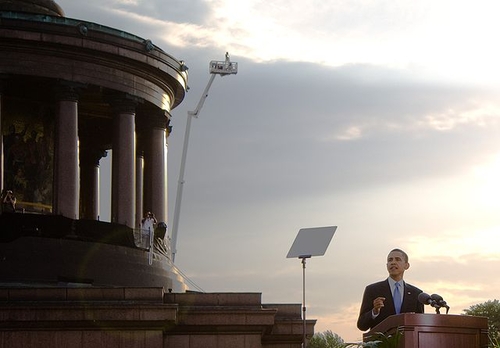
Campaigning
for the presidency in 2008, Barack Obama made a major foreign policy
speech in Berlin, in which he stated: "We are all citizens of Berlin".
(Image source: Wikimedia Commons/Matthias Winkelmann)
|
The president said in that speech -- he was talking about Iraq -- "We
have seen the consequences of a foreign policy based on a flawed
ideology. This is the conventional thinking that has turned against the
war but not against the habits that got us into the war in the first
place."
It is not enough to get out of Iraq and Afghanistan; you have to break those
habits.
What are the habits that have to be broken? This is the man who learned
foreign policy from Rashid Khalidi and William Ayers and Jeremiah
Wright. The habits, as the Administration might see them, are
"militarism," "aggression," "Cold War thinking" and an alleged effort to
dominate the world, "Imperialism" -- or what many others might call
patriotism.
In 2008 the president made one of the most amazing statements that
perhaps any president has ever made: "Tonight I speak to you not as a
candidate for president." This was the 2008 Berlin speech. "But as a
proud citizen of the United States and a fellow citizen of the world."
Later in the speech he said, "We are all citizens of Berlin."
That is not what President Kennedy said. On June 26, 1963, President
Kennedy said, "Today, in the world of freedom, the proudest boast is,
'Ich bin ein Berliner.'" He did not say, "I am a Berliner." Fast forward
to President Barack Obama: he is saying we are all Berliners.
Matt Continetti, of the
Washington Free Beacon, wrote "If we
are all citizens, then the concept of citizenship has no meaning. The
concept of citizenship which implies rootedness, partiality,
particularity has no meaning. If we are citizens of everywhere, we are
also citizens of nowhere."
You hear this from the president over and over again. "Global
citizen;" "new era of engagement." He used that line in about 10
different speeches starting with his first State of the Union "reset."
In the Administration's analysis of the world situation, there seems
to be a great problem that needs to be solved; and the problem is the
United States. It needs to break and overcome these old habits.
Some of
you might think instead that we have a great problem with Islamic
extremism. That is not the president's view. The president made this
really quite remarkable statement in his Cairo speech: "I consider it as
part of my responsibility as president of the United States is to fight
against negative stereotypes of Islam wherever they appear."
Think about that. It's really quite astonishing. I would say that if a
president made that comment about Judaism or Christianity most of us
would say, "That's really quite bizarre. It is actually not his job."
To pick out and isolate Islam as the one religion, criticisms of
which he has the responsibility to correct, is actually amazing.
You look at the Administration's policy: what is the goal here? What
is he trying to achieve? It is certainly not a human rights policy; he
seems remarkably indifferent to human rights everywhere.
Start with June 2009 in Iran: completely indifferent to the uprising
that could conceivably have overthrown the Ayatollahs. Maybe it could
not, but we shall never know. Or China: Secretary of State Hillary
Clinton's first trip there. When she was asked, "Why don't you say more
about human rights?" she said, "We know what they'll say in response."
So much for human rights in China, for human rights in Russia.
I'll refer back to the Soviets for a second because when George
Shultz was negotiating with the Soviets, he said that in every meeting
he brought up the names of Orlov, Sahkarov, and Sharansky. We saw what
Jackson‑Vanik did. Standing up to tyranny succeeded in enabling people
leave the Soviet Union.
Secretary of State Schultz always used to say that one of the ways to
do it is very simple. When you are meeting with the Soviets, he used to
say, you start the meeting with human rights because if you have a two
hour meeting and time is up and then you say, "Oh, wait a minute. I have
one more thing I need to add" while everybody is walking out the door,
it is obvious to them that that is the lowest priority item to you. So
do not do that.
One of the things that have changed in this administration is that
people who are fighting for democracy in places such as Turkey, Russia
or China, do not feel that they have any moral or political support
coming from Washington, in a way that they have over the years.
They are just not interested. On the humanitarian side, also not
interested. When the president visited Africa, there were a fairly good
number of articles in the newspapers talking about how disappointed
Africans were. After all, they had gotten a lot of attention from
President Bush. Now they had an African American president. Surely the
amount of attention would be doubled, tripled. Instead, of course, it
had largely disappeared.
The key job for humanitarian activities in Africa is the Africa desk
at USAID, the Assistant Administrator for Africa. It has been vacant for
over a year and a half. The president did not even bother to fill the
job.
What is he interested in doing? Military strength? Clearly not.
Go back to the days when the president came to office and said we
were going to create a great economic recovery plan. Remember the term
"shovel ready"? We were looking for shovel ready projects. Actually,
there were lots of shovel ready projects available in the military:
after years of war in Iraq and Afghanistan, there was much work to be
done replacing, for example, tanks and half-tracks and artillery that
had been worn out.
But none of the funds available went to that kind of military
project; apparently he did not want to have anything to do with it. In
Libya, the British and the French led. The U.S. was dragged into the
conflict, and after two weeks it walked away. In Mali, the French led.
They went in alone, with the hope that others would follow.
They asked for one thing from the United States: tankers. That was
the item they lacked to be able to refuel jets flying from French bases
in Senegal. The American reaction was to say that we could, but where do
we send the bill. After enough protest, the policy was changed, but it
has been like that, or worse.
Take Syria, where the president sent his Secretary of State out to give what could be called "war speeches."
If you go back and look at those speeches Kerry gave in that week,
they were terrific, heart‑wrenching speeches about the children being
slaughtered in Syria by the use of chemical weapons. Great stuff to get
the American people ready for military action that weekend. Until Friday
came and the president changed his mind.
It is striking, by the way, that while among them, Vice President
Biden, Secretary Hagel, and Secretary Kerry have about 80 years in the
U.S. Senate, when President Obama decided to send the issue of Syria to
the Senate and House for a vote, he did not even consult with any of
those three people, Biden, Hagel, Kerry.
I am not arguing that he should have consulted them because they
would be founts of wisdom, but I did not appoint them. He appointed
Hagel and Kerry. He chose Biden. It is a sign of the immense disrespect
in which he holds all three of them that he makes this decision without
even consulting them -- or actually consulting anyone outside of his own
White House staff.
I have been told that New York's Senator, Chuck Schumer, who is,
after all, the whip, was given about an hour's notice that this would be
announced and it would be on TV -- essentially the same notice that CNN
got.
What is the purpose here? The purpose seems to be to limit American
power. That is why I call it an ideological policy. It is really the
product of the president's view that American power is a danger to the
world and that his job as president is to restrain it, restrict it and
diminish it -- and that then the United States and everybody else in the
world will be significantly better off.
It is a William Ayers, Rashid Khalidi view; you could also call it a
Jimmy Carter view. To be fair to President Jimmy Carter: Carter, first
of all, admitted error after the Soviets invaded Afghanistan. Remember
that statement he made that he had learned more about the Soviet Union
in the past week then he had all the previous years of his life? He may
not have meant it, but he said it.
To be fair, there was a reversal with respect to American military
power, and in the final year of the Carter administration there began to
be a reinvestment in American military power. Actually, the American
military build‑up did not begin in 1981 with Reagan. It began, in an
admittedly smaller way, in 1980.
The Iranian acquisition of a nuclear weapon or an Israeli attack on
Iran to prevent the acquisition of a nuclear weapon might be the
equivalent. Certainly if Iran obtains a nuclear weapon, it is a very big
deal, and not only for all the obvious reasons about security --
because the president has made about 20 speeches saying, "I will
prevent…." He has not always used passive voice. He has said, "We will, I
will prevent...."
That turns out to be nonsense. It has a huge impact on the United
States and I think Americans hate Iran. When you have these polls
saying, "What countries do you like best? What countries do you hate?"
Iran is always way up there. People remember.
We see nothing like that with this president, who does not appear to
believe he has made any errors because, from his point of view, he has
not, if the purpose is to diminish American power in the world and the
temptation to use that power. From that point of view, the president is
experiencing great success.
Is this foreign policy reversible? My answer is yes for a number of reasons.
One of them is, because we do have friends and allies around the
world who are anxious to join us; perhaps it will take a few years
before they are able to help restore America to a greater influence.
Every country in the periphery of China including the Communist
countries, Vietnam, Laos, wants to join in that effort. Every country in
the Middle East except, of course, Syria and Iran, wants to join in
that effort.
I think that in world politics, as on Wall Street, there is such a
thing as discounting. That is, people think about the future, and what
they think will happen in the future begins to affect their conduct
right away. The example is the move President Ronald Reagan made in
foreign policy that most affected America's enemies and allies early in
his term -- and let the Russians know as well as our friends, "Whoa,
this will be different."
That act was firing the air traffic controllers. That was the moment
when I think for many Americans but also for many people around the
world people it was clear "He means what he says. He said he would do
something here that everybody said he could not do, and he did it."
That act came early. It had no real world effect on foreign affairs.
It was purely domestic, but it had an impact. If we had a new president
who, right from the start, made it clear that the current days were over
you, would not need to have five wars to prove to people the days were
over.
People would begin to adjust to the return of the United States to a position in which U.S. foreign policy
was
distinguishable from that of Belgium. Choosing Belgium may be a bit
unfair to the Belgians. Occasionally there will be a Belgian in the
audience that will come up and say, "Why are you picking on us?"
But there is more to be said about Syria. There is a lot more to be
said about the administration's policy with respect to Israel and the
Palestinians and those negotiations. To him Israel seems to be a
problem. It is not viewed as a great ally, a great asset, and a military
asset. It is just a problem -- perhaps an example of the victory of
ideology over what you see with your own eyes.
At the moment, Israel's relations with the Arabs are as good as they
have ever been. The relations with the Egyptian army are terrific.
Relations with the Moroccans are terrific. Relations with the Gulf Sunni
Arabs are better than ever because they have a common enemy, Iran.
The notion that Israel is, in fact, a problem, is probably less true
than it has ever been. The importance of Israel, for example, just to
take one example, as a bulwark protecting the Hashemite Kingdom of
Jordan, which is important for their security, but also for our position
in the Middle East, seems unappreciated. Israel's potential role with
respect to Iran is viewed as a danger, rather than as a potential asset.
At the White House the U.S. Administration still says "All options are on the table, and don't underestimate the president."
The only thing I can reply is, "I travel in the Middle East a fair
amount, and talk to Arabs as well as Israelis. I think it's fair to say
that from Morocco to Iran, there is not one single person who believes
that." I don't think he has any real allies abroad. If you asked that
question a year ago the White House used to say, "Erdogan." They don't
say, "Erdogan" any more.
There are so many intractable problems and no intimation that Hamas
is prepared to move on any of those. What do Kerry and his friends
really see that gives them any optimism in this area? I think the only
variable in his view is "me". "I'm John Kerry. I can do this," which is
ludicrous.
And there is a lot more to be said about Iran. What is clear is that
they are revving up. They are moving from the first generation to second
generation centrifuges, which are much more efficient and productive.
They are moving more materiel underground. They are attempting the
plutonium route as well as the uranium route. And presumably they are
working on a warhead. Of course, they can have a bomb without making the
announcement and they can make the announcement without having a bomb.
Reagan came on the scene and with peace through strength -- three
words, clarified and explained to Americans what American foreign policy
stands for.
Elliott Abrams is American diplomat, lawyer and political scientist, who has served in several presidential administrations.
Labels: Communications, Conflict, Human Rights, Intervention, Philosophy, United States, Values