Saturday, August 01, 2026

The Gap as Wide as the Universe Between U.S. Democrats and Republicans

"The DSA and others are saddling the Democratic party with nominees whose wildly unpopular positions will protect Republicans from having to pay the price of Donald Trump's corruption and economic incompetence."
"In November, a continued focus on defunding, decriminalizing and decolonizing will highlight cultural issues that alienate many Democrats, not to mention a huge swath of independents [who make up a record-high 45 percent of the electorate] and disenchanted Republicans." 
Rahm Emanuel 
 
"Socialism has become increasingly popular among Democrats, but it is a much tougher sell in the rest of the electorate."
"There is a reason why Republicans nationwide are licking their chops, and why there are at leas some Democrats who are a little bit worried."
"Because what is true in New York City in a Democratic primary ain't necessarily true nationwide with the general electorate."
Harry Enten, Senior Data Reporter, CNN  
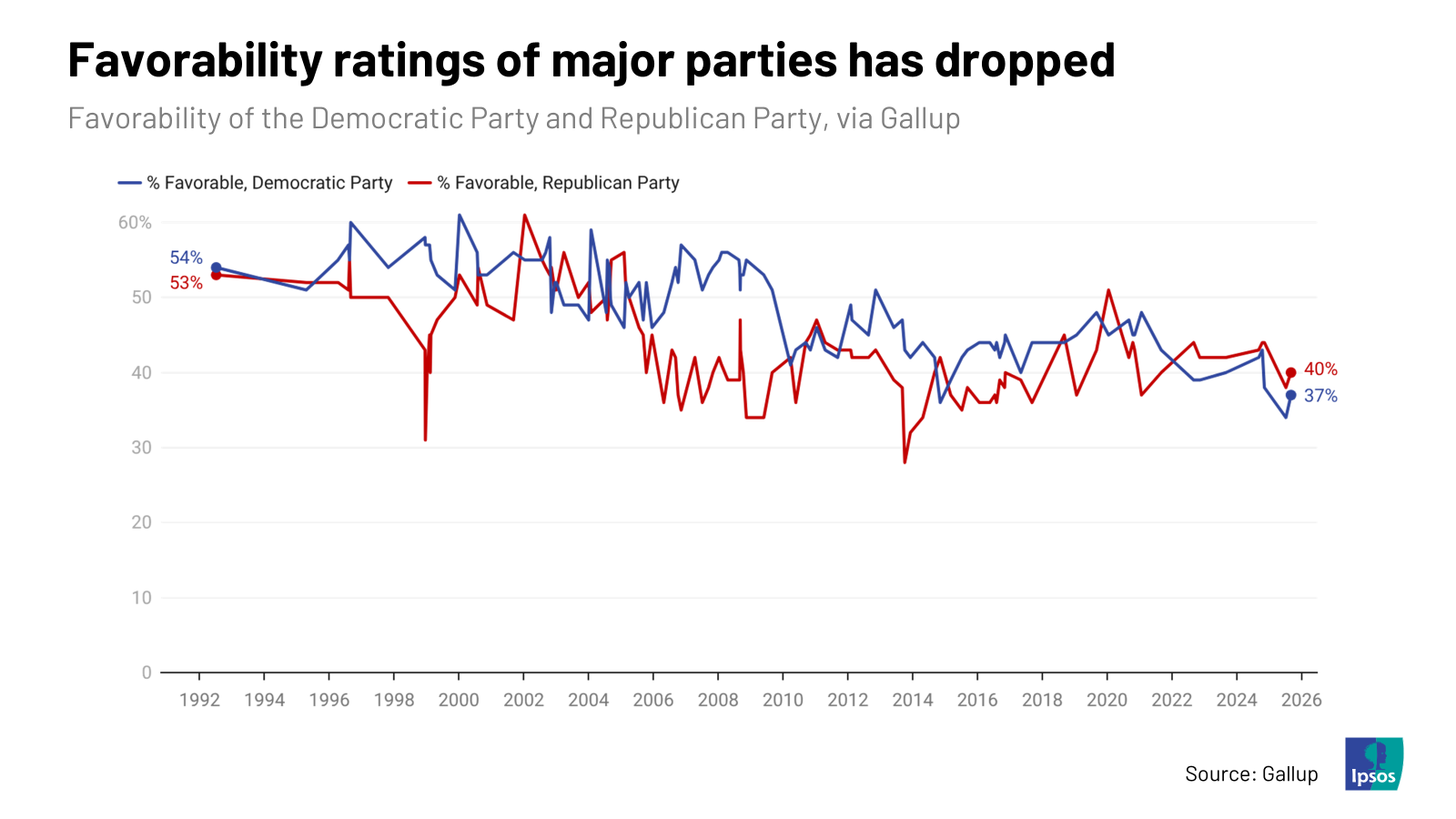
https://www.ipsos.com/sites/default/files/inline-images/image_1803.png 
"The Democratic Socialists of America [DSA] is drawing new scrutiny after more than 35 DSA-backed candidates won primaries heading into the November mid-terms, forcing what analysts call an identity crisis inside the Democratic Party."
"[The DSA calls for government expropriation of  private corporations, state-owned housing, racial reparations], universal health care at no cost to individuals, [abolution of the Senate, and] a free Palestine with Jerusalem as its capital [following the end of] all military and economic aid to Israel."
NewsNation  
According to The New York Times, these are plans requiring government officials to seize a much larger portion of Americans' wealth, so they can enforce policies and target enemies. With their "influence on the rise", DSA candidates "are eager to tax the rich and enact anti-Israel policies". 
 
Radical candidates have tapped into an ideological shift among Democratic voters, and this accounts for their wins. A June YouGov/Economist poll showed that 58 percent of Democrats have a favourable opinion of socialism, and 62 percent would vote for a "Democratic Socialist" candidate. Senator Eugene McCarthy must be twisting in agony in his grave. 
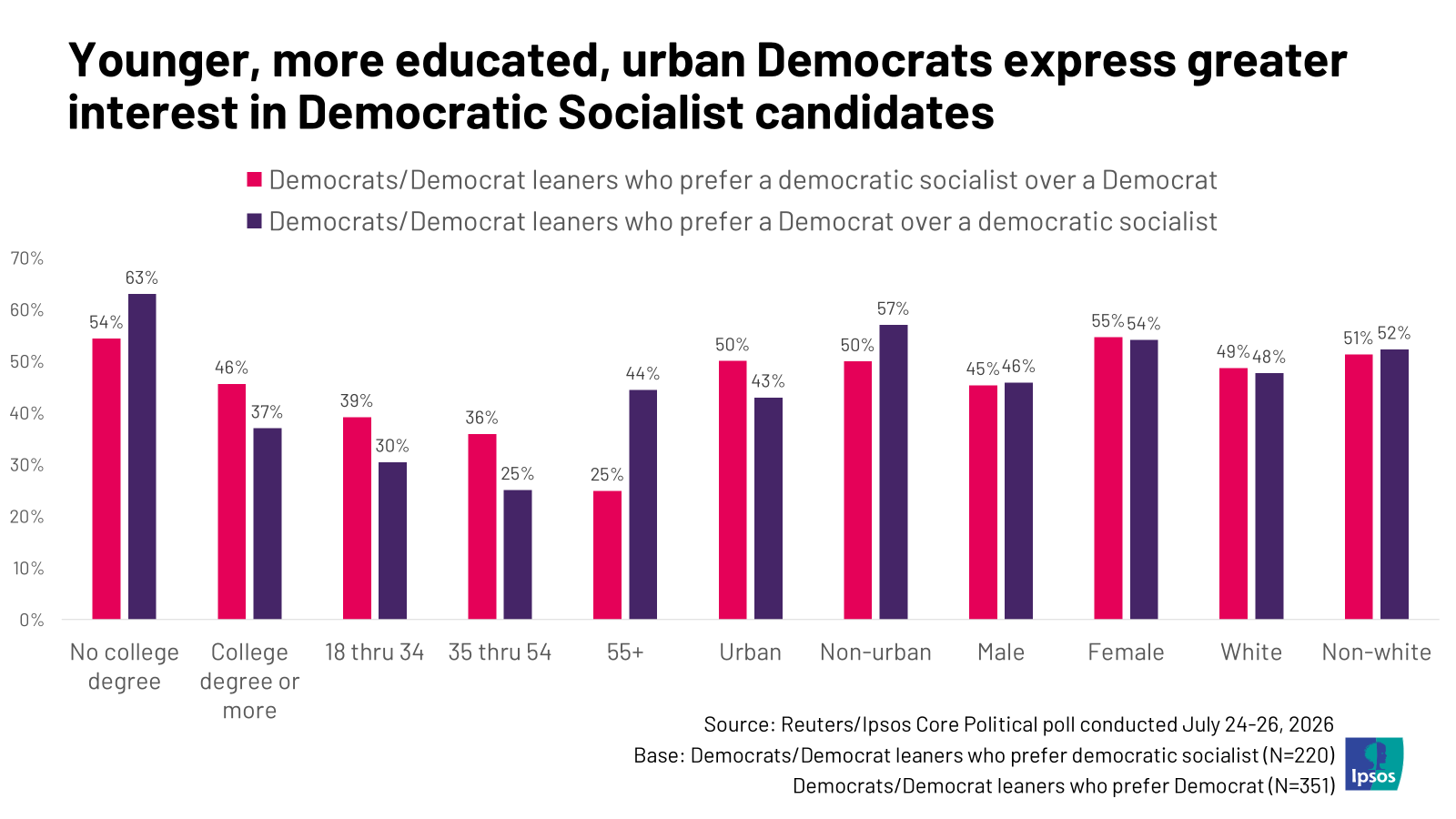
https://www.ipsos.com/sites/default/files/inline-images/image_1810.png 
In AP-NORC polling, 58 percent of Democrats feel the U.S. is "too supportive" of Israel and among them 52 percent feel that Israel committed genocide in its  defensive war against Hamas. "An ascendant faction of the left ... sees opposition to Israel as a Democratic litmus test", according to CNN. Also according to CNN, many Jewish Democrats grapple with loyalty to the extent they have crossed the line toward explicit antisemitism: "They point to references to Jewish or Israeli interests nefariously controlling politics with money or suggesting that Jews aren't fully loyal to America or to Democratic values." 
 
AP-NORC further found that "Republicans have shifted in the opposite direction, with a majority now claiming U.S. support for Israel is about right". Among GOP voters just 13 percent, and 31 percent of Americans overall accept the charge that Israel has engaged in genocide. For their part, mainstream moderates among Democrats view an opportunity slipping away while their party slithers toward hate and economic authoritarianism. 
 
https://media.cnn.com/api/v1/images/stellar/prod/c-gettyimages-2282802516.jpg?c=original&q=w_860,c_fill/f_avif
Demonstrators hold a "Democratic Socialists of America" banner ahead of a vote by the Rent Guidelines Board at el Musseo de Barrio in New York, July 25, 2006. Adam Grey, Bloomberg/Getty 
 

Democratic-aligned Americans who identify as democratic socialists:

  • Tend to be younger (59% are younger than 45, compared to 46% of non-democratic socialists aligned with the Democratic Party) and are more likely to be White (57% to 49%)
  • Are less likely to have a college degree (66% to 54%) and more likely to earn less than $100,000 a year (76% to 65%)
  • Are more likely to say they are extremely motivated to vote this year (66% of those who are registered voters say so, compared to 57% for non-democratic socialists), though both groups overwhelmingly support Democratic congressional candidates (99% of democratic socialists and 94% of non-democratic socialists)
  • Are more positive toward the Democratic Party. They are more likely to hold favorable views of the Democratic Party (68% to 60%) and its congressional leaders, and more likely to have negative views of the Republican Party and its congressional leaders 
CNN Poll 


Labels: , , , ,

Tuesday, February 11, 2025

Does Less Sex Equate To Declining Birth Numbers?

"We don't know to what extent ['aggressive' or 'rough sex'] may be driving some people to opt out, but we do know that some people are feeling frightened and don't know what to make of what's being presented to them, especially young adults."
"Solo and partnered adolescent sexual exploration are developmentally normative, offer opportunities for learning and joy, and are supportive of adult sexual development."
Tsung-chieh (Jane) Fu, (and colleagues) Paper on sexual activity
https://platform.vox.com/wp-content/uploads/sites/2/chorus/uploads/chorus_asset/file/14700341/6979684127_bfc5ff3764_o.0.1498613768.jpg?quality=90&strip=all&crop=0%2C5.4890219560878%2C100%2C89.021956087824&w=750
Joe Saunders / Flickr

In mid-January a Leger poll meant to measure the prevalence of sexual activity among various age groups asked survey participants a number of questions, all of which boiled down to the frequency of sexual activity among married, single, teens and other age groups in an effort to come to an understanding why it is that populations everywhere appear to have disengaged in frequent sexual activity. This diminished activity puzzled social scientists, some of whom have written books relating to the phenomenon.
 
The Leger poll found that a quarter (27 percent) of adult respondents said their sexual activity took place at least once weekly; 32 percent engage in sex at least once a month; one in seven people engage less than once a month (14 percent) or not at all (15 percent). Multiple studies that took place pre-pandemic documented declines in "all modes or partnered sex queried". 
 
The proportion of 18- to 49-year-olds who reported no sexual activity in the prior year rose from 24 percent in 2009, to 28 percent in 2018 in one U.S. report. Reporting neither solo nor partnered sex among 14- to 17-year-olds rose from 28.8 percent of young men and 49.5 percent of young women in 2009, to 43.3 percent of young men and 74 percent of young women in 2018.
 
Sexting and ready access to sexually explicit media "have added a new medium" for sexual experiences without physical partnered sex, wrote the authors. Teens are spending more time playing computer games, they're drinking less, and opting to engage in less risky behaviour altogether. It is felt that the issues of #MeToo along with other movements raising conversations around consent have been involved. Linked to that is the prevalence of aggressive or 'rough sex' (choking during sex) technically strangulation that can have lethal consequences despite consensuality.
 
Declining sex among adults raises concerns relating to human fertility, relationship happiness, human connection and intimacy, researchers concluded. Studies link an active sex life with lesser depression, prostate and breast cancer, and fatal coronary events. A recent study discovered that individuals having sex less frequently than 12 times yearly face a higher risk of developing cardiovascular disease. More frequent sex decreases the risk. Some 52 to 103 times per year is considered health-ideal. 

On the other hand, researchers warn that excessive sexual activity correlates with harmful effects (over 365 times yearly or higher) when "a negative correlation began to emerge" capable of triggering "sympathetic overexcitement" leading to cells lining the blood vessels being damaged, creating blood clots and allied negative outcomes. 

One University of British Columbia research study found that higher levels of COVID-related stress were associated with higher inclinations for sex with a partner. Attributed potentially to an elevated sympathetic nervous system response where stress triggers the "fight or flight" phenomenon, which "may have elicited excitation transfer, thereby increasing sexual response".
 
Over time, "COVID-19 became a chronic stressor on relationships", UBC (University of British Columbia) professor of obstetrics and gynecology Dr. Lori Brotto observed, when the study was released. COVID-related restrictions correlated with higher rates of sexual dysfunction and reduced sexual activity, other studies found -- changes that were greater in women in comparison with men. 

https://platform.vox.com/wp-content/uploads/sites/2/chorus/assets/4380137/sex_chart_2.png

Labels: , , , , ,

Follow @rheytah Tweet