The Russian Orthodox Church, Complicit in War
"We have to create conditions where no actors dependent on the
aggressor state [Russia] will have an opportunity to manipulate
Ukrainians and weaken Ukraine from within."
"We will never allow anyone to build an empire inside the Ukrainian soul."
"[Government officials are ordered to] ensure the religious examination of the
Management Statute of the Ukrainian Orthodox Church for the presence of a
church-canonical connection with the Moscow Patriarchate and, if
necessary, to take measures provided for by law."
Ukrainian President Volodymyr Zelenskyy
"[Leaders
of the Ukrainian Orthodox Church declare] full independence [from
Russia, and that its council had] approved the corresponding additions
and changes to the Statute on the
Management of the Ukrainian Orthodox Church, indicating the full
autonomy and independence of the Ukrainian Orthodox Church."
Leadership statement, May 2022
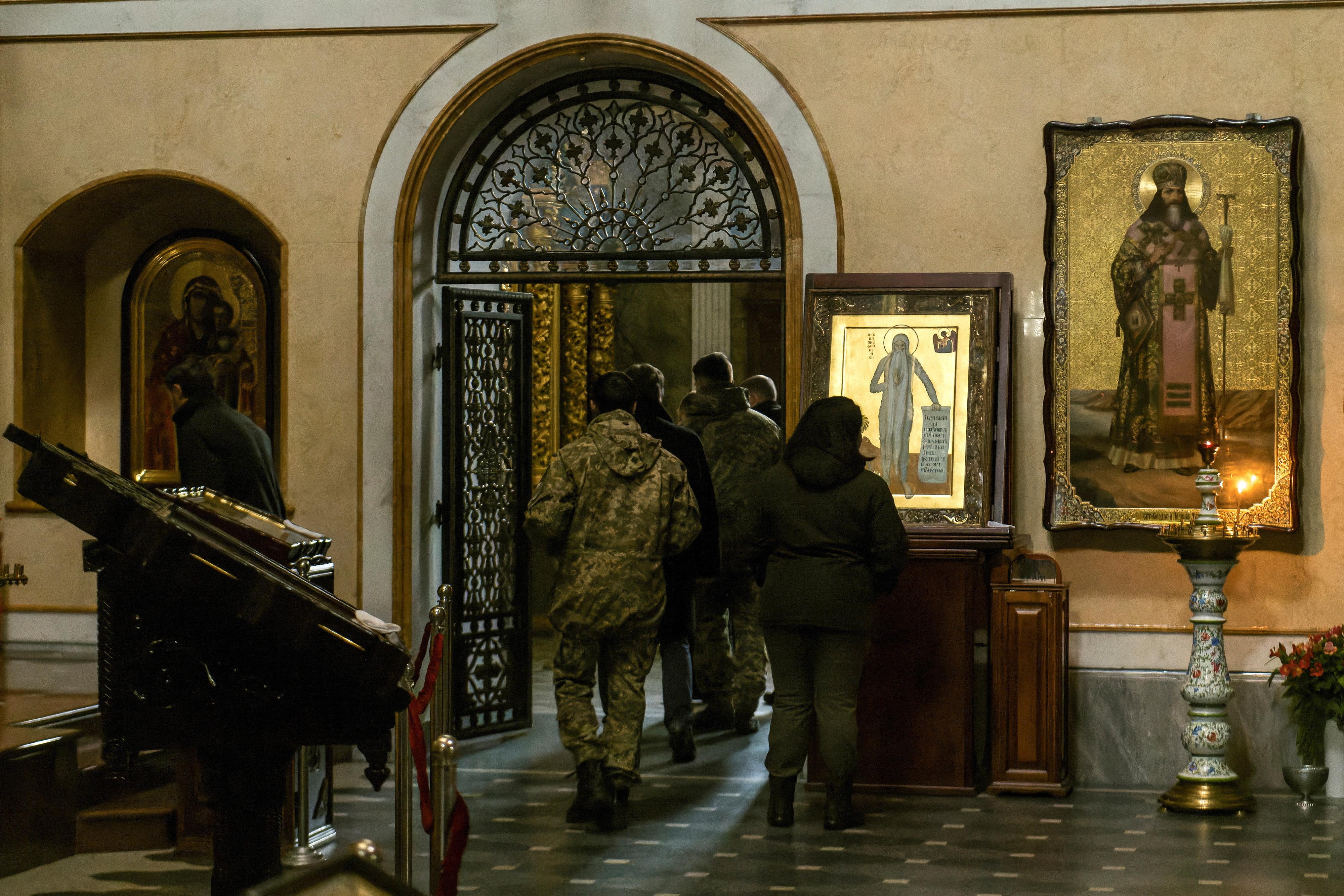 |
| Ukrainian law enforcement officers inspect one of churches of the Kyiv
Pechersk Lavra monastery, amid Russia's attack on Ukraine, in Kyiv,
Ukraine November 22, 2022. REUTERS/Vladyslav Musiienko |
Patriarch
Bartholomew of Constantinople in his role as spiritual leader of
Orthodox Christians worldwide, gave permission in 2019 to Ukraine to
form a church that would be independent of Moscow. This led to a split
in the Orthodox community within Ukraine. Those mostly in eastern
Ukraine who wanted to remain loyal to Moscow split from the larger group
throughout the country that opted to be independent of the Russian
Orthodox Church. And while the Ukrainian Orthodox Church maintained its
links to Russia, the breakaway Orthodox Church of Ukraine did not.
Early
in the 'special military operation' that Putin describes the Russian
invasion of Ukraine as, Patriarch Kirill of the Russian Orthodox Church
with whom Vladimir Putin has a close association, fully endorsed Putin's
invasion of Ukraine. He might have remained neutral, he might gently
have chastised the Russian President for waging a brutal war on a
neighbour with whom religious devotion is shared along with a common
history (of historic Russian aggression against Ukraine, including the Holodomor) but he chose to give his full support.
This
has led to suspicion against the Ukrainian Orthodox Church's role in
supporting the Russian invasion.More than that, the suspicion that the
church and some of its clerics could be playing an active role in
passing critical information along to the Kremlin about internal matters
concerning Ukraine. Ukraine's security service raided Orthodox
monasteries located in several cities in a search for Russian spies and
concealed weapons.
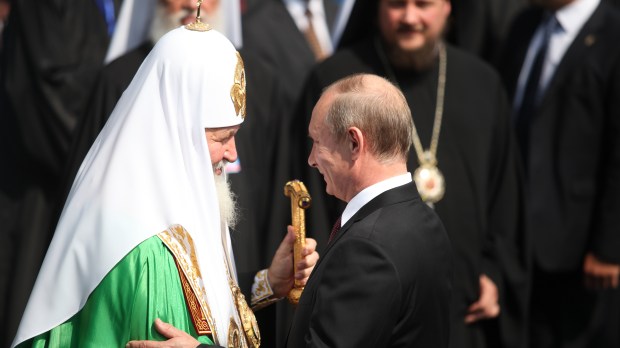 |
Kirill and Putin, in perfect accord Reuters
|
The
Pecherak Lavra in Kyiv, a thousand-year-old monastic community spoken
of as the cradle of the Russian and Ukrainian Orthodox churches was
searched by the SEU to prevent the use of the Lavra as a centre of the
'Russian world'.": The search was undertaken to "protect the population from provocations and terrorist acts" and to investigate allegations that church property was being used "to hide sabotage and intelligence groups, foreign citizens, and to store weapons".
The
Koretsky Holy Trinity monastery and the Sarny-Polissia Eparchy in
Rivne, western Ukraine, were also raided. Armed men in camouflage were
shown in footage interviewing cassocked priests. All three of these
monasteries are affiliated with the Moscow Patriarchate of the Ukrainian
Orthodox Church, a branch against which allegations of of collaboration
with Russia has been detected since the war began.
In November Basyl Malynuk, head of he SBU, spoke of the Russian Orthodox Church in Ukraine as "perfect ground for the functioning of an enemy human intelligence network",
stating that 33 priests suspected of gathering information or acting as
spotters for Russian artillery had been detained since February. This
has been construed as an "act of intimidation" by the Russian Orthodox Church.
"Like many other cases of persecution of believers in Ukraine since 2014
(when Luhansk and Donetsk ethnic-Russian Ukrainian rebels declared
those provinces detached from Ukraine and allied with Russia, and Moscow
annexed the coveted Crimean peninsula),
this act of intimidation is almost certain to go unnoticed by those who
call themselves the international human rights community", stated Vladimir Legoida, spokesman for the church.
Abbot
of the Pechersk monastery, Metropolitan Pavlo, strenuously denied
charges that he had prayed for Russia -- in the wake of footage emerging
of people within the monastery singing a pro-Moscow song.
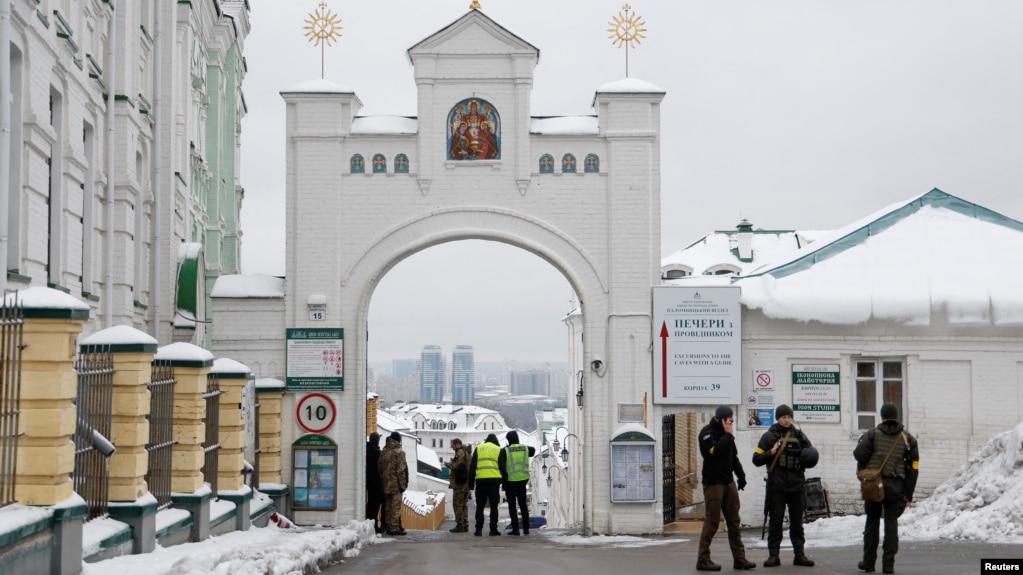 |
| Ukrainian
law enforcement officers stand next to an entrance to the Kyiv Pechersk
Lavra monastery compound, amid Russia's attack on Ukraine, in Kyiv,
Nov. 22, 2022. |
Labels: Church Support of Russian Invasion, Orthodox Church of Ukraine, Russian Inasion of Ukraine, Russian Orthodox Church, Ukrainian Intelligence Intervention
Singing From The Same Hymnal With Slight Deviations
 |
| AP Photo/Alessandra Tarantino
Pope Francis arrives to attend a ceremony at the Maronite
Cathedral of Our Lady of Graces in Nicosia, Cyprus |
"I listened and then told him: I don't understand anything about this."
"Brother,
we are not state clerics, we cannot use the language of politics but
that of Jesus. We are pastors of the same holy people of God."
"Because of this, we must seek avenues of peace, to put an end to the firing of weapons."
"The patriarch cannot transform himself into Putin's altar boy."
"[The] barking of NATO at Russia's door [may have forced Putin to
invade]. An anger that I don’t know if you can say was provoked, but
maybe facilitated."
Pope Francis
"Patriarch Kirill recalled that at the end of the Soviet era, Russia
received an assurance that NATO would not move an inch eastwards.
However, this promise was broken, even the former Soviet Baltic
republics joined NATO."
"Russia could not and cannot allow this to happen."
Russian Orthodox Church
 |
Russian Orthodox Church says Pope Francis 'chose the wrong tone' over 'Putin's altar boy' comment |
So
recently reconciled, just as recently distancing themselves from each
other's positions. The inescapable political dimensions aligned with
religious convictions has placed two elite ranking clerics, each of whom
assumes the position of shepherd over vast flocks of followers at odds
with one another. The caution of diplomacy appears to have fled the
scene when Pope Francis spoke frankly of the division between the world
of religion and that of politics.
Except
that for the fact that his further statements bridged that division.
And has left simmering resentment of his sentiments and clumsy analogy
linking Patriarch Kirill with Russian President Vladimir Putin to the
extent that the Patriarch is fully in support of Russia's brutal
invasion of Ukraine. Not the least bit reflective of a high-placed and
esteemed leader of the Eastern Orthodox Church's assumed leading
concern; that of peace and brotherhood.
Nothing
can quite lead to a justification of Mr. Putin's order to the Russian
military to launch an invasion of its neighbour. In the process
destroying entire towns and villages, civic infrastructure, bombing
hospitals, rail stations, schools, apartment buildings and even
supposedly safe corridors arranged for people to escape the confines of a
besieged city. And then there is the rape, the looting, the incidental
murders.
Pope
Francis himself failed to condemn the very leader by name when he
despaired over the conflict. Somehow finding it politically diplomatic
to abhor the war in its strident brutality but overlooking the mention
of exactly who was responsible for launching it. And now buying the
Russian president's grievance at NATO's expansion to excuse the rage a
despotic ruler succumbed to, taking his revenge over a perceived
betrayal of unity with Russia, to innocent civilian populations
suffering the onslaught.
There
is, thus, a degree of agreement between the two clerics; Pope Francis's
on a more modest scale than Patriarch Kirill's, but each sympathetic to
Russia's president's paranoia and purpose in choosing to destroy
Ukraine to teach his Slavic cousins a lesson. Pope Francis, in his media
interview in Italy described his conversation with his Orthodox
counterpart who listed off justifications for the war, in a pre-printed
agenda he read from.
The Russian Orthodox Church had its own version of the Zoom conference between the two elder Church statesmen:
"It's regrettable that a month and a half after the conversation with
Patriarch Kirill, Pope Francis chose the wrong tone to convey the
content of this conversation." It was, after all, a
confidence betrayal of a colleague, housed in language more fitting to a
flippant exchange between two low-ranking sport figures than the top
echelon of Christianity.
How
can they bring peace and harmony, in other words, to their parishioners
when they themselves bicker between their chosen positions? In setting
the record straight, the Orthodox Church added "the
Pope said, in agreement with the Patriarch, that 'the Church must not
use the language of politics, but the language of Jesus'."
A senior cleric which has over 100 million followers, as opposed to an
infinitely more senior cleric whose following numbers 1.34 billion.
Labels: Patriarch Kirill, Pope Francis, Roman Catholic Church, Russian Invasion of Ukraine, Russian Orthodox Church, Vladimir Putin, War Crimes
Labels: Patriarch Kirill, Pope Francis, Roman Catholic Church, Russian Invasion of Ukraine, Russian Orthodox Church, Vladimir Putin, War Crimes
Russian Missiles With the Blessing of the Church
"We have Christ the Saviour cathedral dedicated to the war of 1812, but unfortunately no church dedicated to the First World War, and there wasn't a church dedicated to the Great Patriotic War."
"Now Shoigu [Russian Defence Minister Sergei Shoigu] has suggested one, and the president [Vladimir Putin] and patriarch [Patriarch Kirill, primate of the Russian Orthodox Church] are in support."
Vladimir Bogatyryov, director, Patriot Park, military chaplain training school construction
"To live with the wolves you need to howl like a wolf. Each military priest without training is just like a person without warm clothing -- he's OK, but when weather changes it's like he's naked."
"I prayed and then landed [parachuted in training jump]. It was a lot of force ... if your legs aren't even, you can break them."
Fr. Mikhail Vasilyev, head, airborne forces headquarters church, Moscow
"A military priest should always be near so that soldiers don't become animals."
"He should show that any military conflict should nonetheless be humane and with a human face, so humans don't forget that God sees them always."
Fr. Sergy Privalov, head, synodal department for cooperation with the armed forces and law enforcement
 |
| Vladimir Smirnov / TASS |
During the era of the Soviet Union religion had no place in official, political, social or military life. Communism and religion have no formal ties; the latter rejected outright by the former. And although President Vladimir Putin admires many aspects of the U.S.S.R. and bemoans the loss of its former status in eastern Europe as a great unifying force -- which is to say forcing its neighbours into its direct line of influence as satellites -- he has also taken steps to officially redeem Russia's association with the Russian Orthodox Church.
Most nations, whether theistic or politically secular in the separation of church and state, still employ military chaplains to serve the troops pastorally, to give comfort with their presence. Under the banner of the U.S.S.R. the church's role was not merely superfluous but rejected. It is now, however, seeing a renaissance under Vladimir Putin's close personal ties with the Church and his vision for the Russian Federation's future as a God-fearing nation.
Not that since the dissolution of the Soviet Union chaplains have been entirely absent in the Russian military. But their presence has taken a large uptick with a new proposal to establish a school meant for military chaplains where they will be trained as well in military protocol. Once the school is fully operational plans to train an initial 269 chaplains will get underway for those in full-time military service, along with part-time priests in the military.
Fr. Mikhail had his own experience gained over twenty years accompanying Russian troops where war zones erupted in Bosnia, Kosovo, Chechnya and Syria. The idea is to collapse that two-decade experience in making Fr. Mikhail proficient in both military procedures and pastoral work into a concentrated formula introducing newly-assigned priests to both in a formal academic setting.
There are speculations that the school will train fighting priests similar to the airborne forces when exercises were held to teach thirty priests how to parachute and operate armoured personnel carriers. No, insisted Fr. Sergy, the centre would have on offer on military skills, teaching will be confined to three weeks of first aid lessons, along with the basics of army life.
Not so, grumbles Fr. Mikhail, the voice of experience as well as of moral conscience who recalls talking soldiers out of torturing prisoners during the second Chechen war. He argues that the school should go a little further and expand its program to include teaching chaplains how to drive military vehicles, disarm explosives and conduct navigation.
In Syria, clerics were visible, praying with soldiers, and blessing missiles with holy water in Crimea.
"Mobile churches" have even been airdropped where a tent and a trailer with Orthodox attributes were to be available where soldiers could attend services in the field When the monk Alexander Peresvet fought a Mongol champion in 1380 in single combat prior to the battle of Kulikovo, the history of clergy in the Russian army was launched.
Now that the Russian Orthodox Church has regained its lost influence through the traditionalist sentiments exhibited by the Russian president, the spectacle of the president and the patriarch appearing together in public has become routine. Putin took part in Epiphany this year by dunking himself in a monastery's icy lake.
A cathedral of green metal and glass to represent the main church of the armed forces will have alongside it the new chaplain school, a pairing and an enterprise characterized by the Russian defence minister as fitting to
"symbolize the spiritual values of the Russian army". Most clearly exemplified perhaps, in the blessing with holy water of missiles by a priest in purloined Crimea.
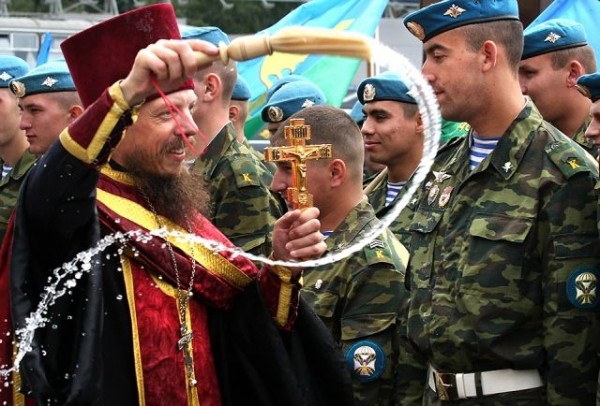 |
| During a meeting of the Higher Church Committee, Patriarch Kirill of
Moscow and All Russia pointed out the necessity of increasing the number
of military chaplains in the Russian army, the improvement of their
training and selection, and suggested making a film about their heroic
service. Source: Pravmir.ru |
Labels: Military, Russia, Russian Orthodox Church


