"A lawyer should act with integrity -- not simply honesty, but with candour and the strength of good character to take accountability when mistakes are made. They must not only act within the Rules of Professional Conduct but be mindful of the consequences of their actions."
"In my teenage years and early 20s, I was highly driven to change the world and right injustices. I was restless, wanted things to happen quickly and I felt invincible."
"My time in prison changed me forever; it gave me perspective and forced me to look at myself and evaluate my weaknesses."
"I often relive the events post-2004 and know how differently I would approach that situation now. I do not believe the ends justify the means. They do not, and I have paid a heavy price for having made that mistake once."
Suresh Sriskandarajah, Tamil-Canadian, Toronto
In 2013 Sriskandarajah pleaded guilty in a New York courtroom to conspiring to provide material support to a foreign terrorist organization. He was sentenced to two years in prison at the Metropolitan Detention Center in Brooklyn. While there he tutored dozens of inmates. He also wrote his first-semester law school exams, as a law student at University of Ottawa, Ontario. He was one of six Canadians an FBI probe charged with giving aid to the Tamil Tigers, viewed as a terrorist organization in the United States.
Three others were arrested in New York, while Sriskandarajah was eventually rendered by Canadian authorities to the U.S. to stand trial, accused of researching and acquiring communications, aviation and night-vision equipment and warship-design software for the Tamil Tigers a group fighting the Sri Lankan government for a Tamil homeland. He appealed the extradition request all the way to the Supreme Court of Canada, and it took six years for his extradition to take effect.
Sriskandarajah was born in Sri Lanka in 1980, a minority Tamil, at a time of escalating civil strife when at seven years of age he saw a relative die after swallowing a cyanide capsule, evading government soldiers. Not long after that, his father working on an oil tanker as a deckhand, declared himself a refugee when the ship arrived at the port of Montreal. It took a year before his mother and one brother were able to join his father and Sriskandarjah at age eight was left with extended family, until a year later he and another brother were able to join their parents in Canada.
He was an excellent student, studying engineering at University of Waterloo. He returned to Sri Lanka in 2004 on a student exchange program to help set up a technology training centre in the country's northeast where the Liberation Tigers of Tamil Eelam (LTTE) acted as government and where he "was pressured to abandon his humanitarian work in order to teach computer programming to members of the LTTE's technology division".
Suresh
Sriskandarajah, 2006.Glenn Lowson/National Post
"I did not appreciate the broader implications my decision to associate with the Tamil Tigers would have. However, at no point did I support any forms of violence", he wrote in a 'reflection' to a Law Society of Upper Canada Tribunal tasked to decide whether a man once convicted of a terrorist offence should be granted permission to practise law in the province. "If the [law society] were to decide a person of Suresh's character is not eligible, this would be a signal that our legal profession does not accept contrition and redemption as truly operative values", wrote supporter Craig Scott, a law professor and former member of Parliament.
He had returned to Sri Lanka a second time when 2004 was winding down, at a time a powerful earthquake took place sending tidal waves over the coastal areas of countries abutting the Indian Ocean, including Sri Lanka. When it happened, he rushed to an orphanage where he had volunteered and discovered that 150 of 170 children there had been killed in the tsunami. "I felt compelled to assist in any way I could. I became involved in relief efforts, including the burial of dead bodies speaking with foreign media in an attempt to give voice and raise awareness to the destruction I had personally witnessed." And among other things he had witnessed the Tamil Tigers alone giving aid.
Just before he was extradited to stand trial in the U.S., Sriskandarajah married, finished his first semester of law school at University of Ottawa, but was taken to New York before he was scheduled to write his exams. He took those exams while in prison. The New York judge, Raymond Dearie who presided over his trial, said: "Everything about him is positive, but for his involvement in this [Tamil Tiger] activity". Deported back to Canada in 2014 after serving his sentence he transferred to Osgoode Hall at York University to continue his law studies, where he graduated with honours.
A three-lawyer panel earlier this month came to a unanimous decision that Sriskandarajah had passed the 'good character' requirement becoming eligible to be granted a lawyer's license. It is a standard for anyone filing membership application to the Law Society of Ontario to work as a lawyer to answer a series of questions to establish 'good character'. One of the questions is whether the applicant had ever been convicted of a crime.
Suresh Sriskandarajah in 2004 in a northern Sri Lanka orphanage.Photo by Handout
"Everyone is focusing on building roads, building houses, building hospitals after war. [There is a lack of attention to] the collective trauma." "Very few people focus on the lives, on helping bring back the happiness. It is not easy." Dr. V. Jegaruban, Kilinochchi, Sri Lanka "There is a lack of reliable data to capture the true burden of the mental health, but it's probably much more than the numbers the government is putting out." "Some of the issues are probably more prevalent in the north and east. But the main disorders -- depression and anxiety -- are across the board." Nivendra Uduman, psychologist, Sri Lanka
"He always lapses into grief at this time [anniversaries of relatives' deaths in the war]." "He keeps it all bottled up and denies feeling upset or unhappy. At least we women talk to each other and cry if necessary. He won't do that, ever." Umadevi Nagendram, Kilinochchi, Sri Lanka
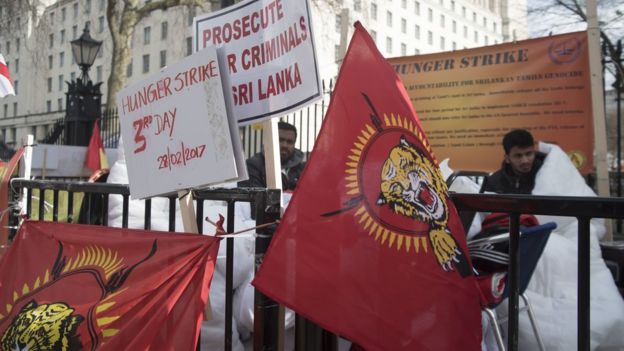
London Exiles Protest Sri Lanka's Treatment of Tamils.
George Rose / Getty Images
Villagers stream one by one with little blue books representing a personal chronicle of their history of loss dating from the Sri Lankan civil war when government forces struck against the separatist Tamil Tigers rebel militias into Dr. Jegaruban's (known as Dr. Jegan) office. The Kilinochchi district with its 130,000 residents experienced some of the worst fighting between the Tamil Tigers and the Sinhalese majority Sri Lankan Army.
The butchery carried out by both sides in their lethal conflict targeted mostly Tamil civilians, caught between the two armies and used by the Tigers as a living barrier.
According to government estimates about ten percent of Sri Lanka's 22-million population suffer some form of mental disorder; close to 800,000 are held to be suffering from depression. Research, on the other hand, suggests that the government figures represent an under-estimation, particularly in the northern areas of the country where fighting was concentrated. According to studies in the northeast the prevalence of post-traumatic stress disorder among children runs as high as 30 percent.
Among the ten highest suicide rates in the world, Sri Lanka is badly in need of some workable solution to the plight of its traumatized population. Infrastructure improvement for hospital access, restrictions on deadly pesticides convenient for people's use in committing suicide have seen some improvement. However, police continue to register about ten deaths by suicide on a daily basis, while activists estimate the number higher at 15 daily. An additional 100 to 150 people attempt suicide each day.
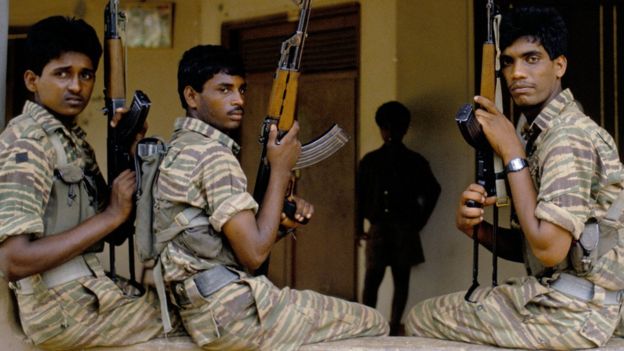
Formed in 1976, the Tamil Tigers said they were fighting for a separate state for Tamils in Sri Lanka Getty Images
Government psychiatrists like Dr. Jegan struggle to meet the demand for treatment from people suffering from this national malaise. More often, however, given the numbers involved, a burden falls upon volunteers in the population coming from all streams of society, from retired bankers, former nurses, local businessmen, trained as counselors who answer calls at suicide hotlines or render assistance with programs such as Dr. Jegan's.
Based in Kilinochchi where some of the worst fighting occurred -- since it was the Tamil Tigers' capital -- the need is greatest there. The brutal offensives against the Tamil Tigers that President Mahinda Rajapaksa embarked upon caught the rebels in Kilinochchi surrounded by the Sri Lankan Army closing the area to international observers where all hell broke loose. Accusations of war crimes by the United Nations went deliberately unnoticed by the government.
The entire population of the area became displaced, with the United Nations claiming some 40,000 civilians were killed as the war wound up. Now, Dr. Jegan goes door to door in the area villages breaking a taboo around mental health that kept many people away from seeking help, to avoid being stigmatized. He handed out little blue books and urged people to record their painful wartime histories.
Typical of such histories, he read aloud to one patient in her 60s sitting quietly before him, her entry: "Husband died of heat attack, one daughter died of war, a sister committed suicide". Committing their grief to paper, allowing the psychiatrist to know their history, hearing their story from his mouth, a communication that may begin a gradual healing process.
When 67-year-old Ulaganathan Nagendram came along with his wife, fearing her husband was in the throes of a heart attack, Dr. Jegan was unable to detect anything physically awry with the man. What was Mr. Nagendram worrying about, he asked the man's wife. The answer: Two sons killed in the war; the anniversary of one of the deaths had just passed.
"The natural disaster [2004 tsunami which killed 31,000 Sri Lankans] was a one-off catastrophic event that left a trail
of destruction and loss. But it
did not continue to exert a prolonged effect. As a result the severity
of the collective trauma was much less. In fact, having lived through a
prolonged war situation has meant that Tamil communities have learned
skills and strategies that make them better able to cope with
disasters." "Apart from attending to the immediate basic needs and other acute
problems in the rescue and relief phases after a major disaster,
rehabilitation, reconstruction and development strategies need to
include collective-level interventions. In fact, our experiences show
that many individually oriented mental health interventions appear to
fare much better when undertaken within an overall framework of a
community strategy." Clinical Associate Professor in Psychiatry Daya Somasundaram
Despite their defeat in 2009, support for the Tamil Tigers is still strong among the Tamil diaspora Getty Images
This represents a general opinion site for its author. It also offers a space for the author to record her experiences and perceptions,both personal and public. This is rendered obvious by the content contained in the blog, but the space is here inviting me to write. And so I do.


:max_bytes(150000):strip_icc()/london-exiles-protest-sri-lanka-s-treatment-of-tamils-88619226-5b282784ff1b78003727744a.jpg)