Canada ... 'Engaging' With The Islamic Republic of Iran
"Engagement is not endorsement. Having an embassy, having consular services in a country does not mean we endorse the policies of that country.""There are a series of countries with whom we have not seen eye to eye, to put it mildly, where we do not have representation. Iran, Venezuela [are] two examples. There are others.""That puts us at a disadvantage, first and foremost, to helping Canadians that are in these countries.""[In some consular cases Ottawa has leaned on countries that] aren't our natural allies [to help Canadians leave Iran]."Prime Minister Mark Carney"[The government is looking at alternative options to improve consular services for Canadians in countries like Iran].""We've taken no decisions, but we are looking at how best to serve Canadians, not only within this country, but internationally and that will be a process that occurs over the next number of months."Foreign Affairs Minister Anita Anand"Nothing about the regime has changed.""The problem that Canada has with this regime goes much deeper [than geopolitics].""This is a regime responsible for flagrant human rights violations, and this is a regime with which normalizing relations may not be possible."Masoud Zamani, lecturer in international relations, University of British Columbia"[Reopening an embassy in Tehran could be part of a broader restoration of diplomatic relations, which could allow Iran to re-establish an official diplomatic presence in Canada].""What they want is a political footprint here in Canada through an embassy. I don’t know if we gain anything by allowing them to do that. I don’t think that there is a real intention to do that.""This issue of inconsistency in the positions adopted by the prime minister is itself quite a serious matter."Kaveh Shahrooz, senior fellow, Macdonald-Laurier Institute
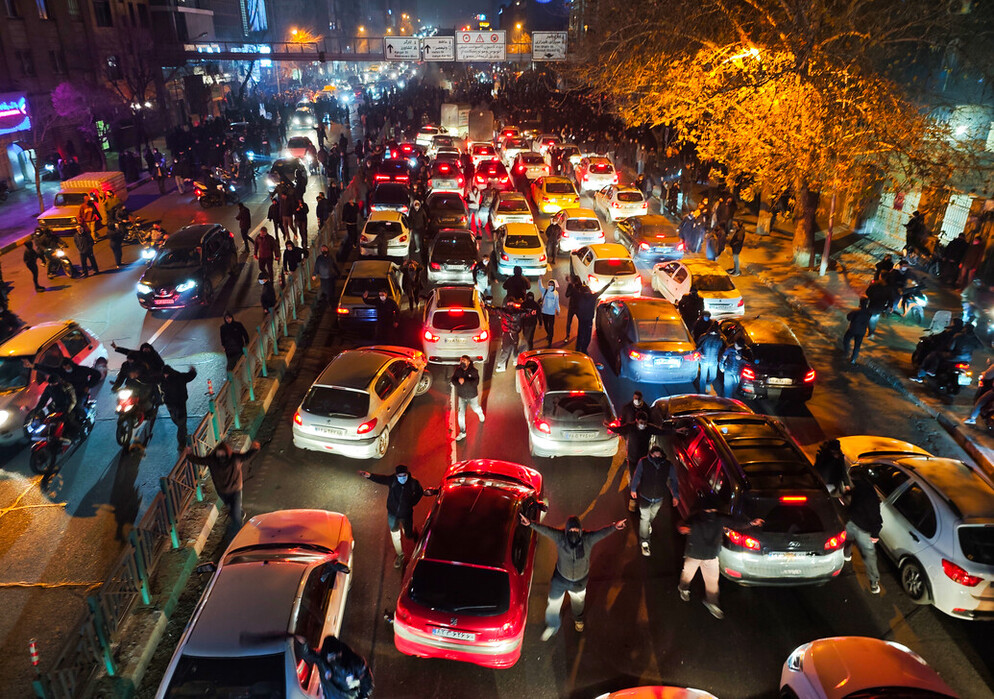 |
| Protests erupted in Iran on 28 December 2025. People across the country, outraged at decades of repression, were demanding fundamental change and a political system that respects human rights and dignity. Iranian authorities have responded with an unprecedented deadly crackdown. Security forces have used unlawful force, firearms and other prohibited weapons, against protesters, which resulted in mass killings and serious injuries. Amnesty International |
Former
Prime Minister Stephen Harper responded to the Islamic Republic's
well-known abuse of human rights in Iran, and the regime's role as the
foremost sponsor of terrorism in the Middle East by shutting down the
Iranian Embassy and Consulate in Toronto, and withdrawing Canadian
diplomats from the Canadian embassy in Tehran in 2012. Then-Foreign
Affairs Minister John Baird declared the Iranian legation
persona-non-grata in no uncertain terms. "Canada is committed to fighting global terrorism and to holding
perpetrators of terrorism — and those who provide them support —
accountable for their actions. Iran is
among the world's worst violators of human rights. It shelters and
materially supports terrorist groups."
When
Mr. Harper left office and PM Justin Trudeau became prime minister, he
mused about re-opening relations with Iran, despite that nothing had
changed in the Islamic Republic's favour; it remained the stridently
repressive government in Tehran, suppressing its public and enforcing
strict totalitarian Sharia government, while its Islamic Revolutionary
Guard Corps kept order along with its Basij branch, and its al-Quds arm
continued training, funding and arming terrorist groups such as
Hezbollah, Hamas and Palestinian Islamic Jihad.
Fast
forward to the courage displayed by mostly young Iranians who
spontaneously began to mount protests against the regime in December of
2025, demanding that it step down from office. Before long the protests
spread from the capital to other areas of the country, with greater
participation from the regime-hating population. The initial
crowd-control protocols soon gave way to violence in the IRGC and Basij
and national police responses, when live firearms were increasingly used
to 'restore order'. In the end, an estimated 30,000 Iranian protesters
were killed and many thousands arrested and tortured for their
insubordination.
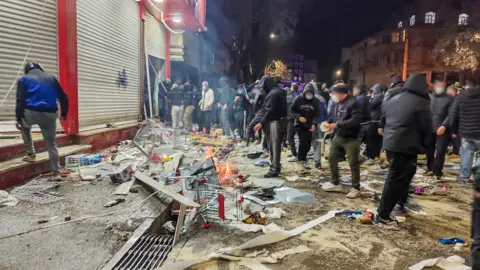 |
| Protests were also reported in several other provinces, including Kermanshah - Middle East Images / AFP via Getty Image |
More
latterly, with current prime minister Mark Carney musing publicly that
Canada should consider reopening an embassy in the Islamic Republic for
the sake of 'engagement' seems a stretch too far, even for him;
restoring relations with the largest state sponsor of terrorism in a
Canada that has become progressively less wedded to its traditional
values of democracy, rule of law, public security, equal support for all
its ethnic groups within its great ongoing experiment of
multiculturalism and prepared to jettison its respect and support for
the Jewish-Canadian community while sanctioning the viral antisemitism,
anti-Israel fulminations of the now-more-populous Muslim-Canadian
community.
The
speedy, sudden growth of the latter demographic itself a product of
Liberal-progressive permissiveness that has led to societal division,
cultural-religious antagonism and public displays of illegal threats by
one group against another which politicians and government institutions
appear not to notice is fraying the mantle of multiculturalism held so
dear by government that groups living in silos opt out of the normal
social contract in the belief that cultural-traditional mores of racist
invective are perfectly normal in a democratic society
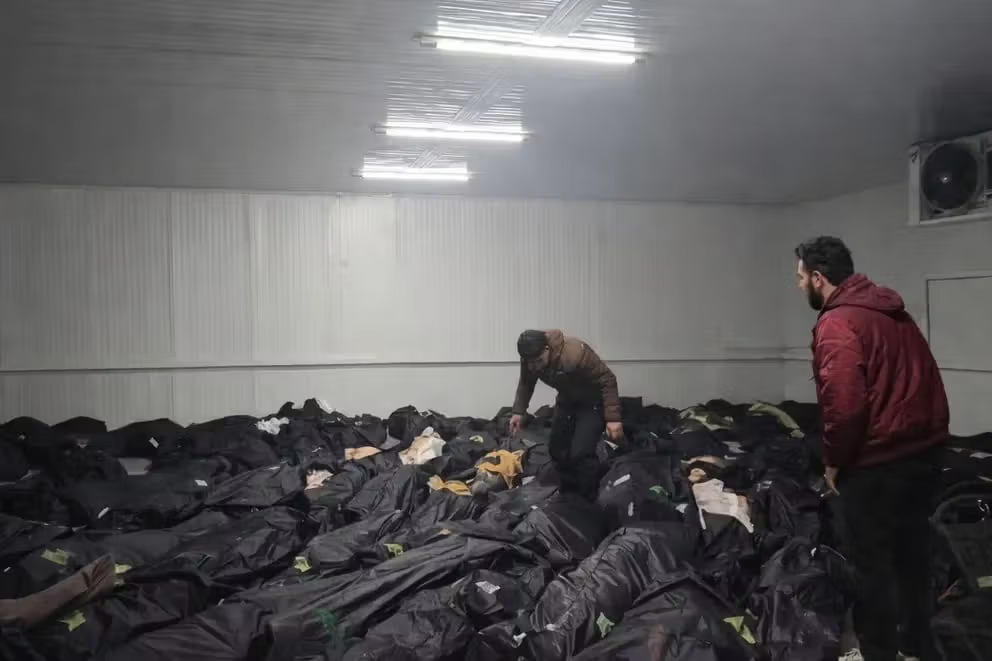 |
| Men stand amid rows of corpses in a morgue in Tehran following mass killings of protestors by security forces in this undated image obtained by Iran International |
The
Islamic Republic of Iran stands alone in financing terrorist groups
whose oft-stated raison d'etre is the destruction of the State of
Israel. This doesn't trouble the Liberal government of Canada, but
understandably it does the Jews of Canada. All the more so that they are
made victims of this new lashback of anti-Zionism/antisemitism that
appears not to trouble mainstream Canada, much less academia and unions
in Canada, all complicit with Palestinian student groups inciting hate
against other Canadians.
Among
other minorities, Canada has a substantial number of Iranian-Canadians
within the population, many of whom arrived as new immigrants to Canada
shortly after the 1979 Iranian revolution. To these Canadians of Iranian
birth, Canada has become a haven, but it is also more latterly, a
country which, although it has placed the IRGC on a terrorist list,
permits members of the IRGC and their families to enter Canada at will,
to live or vacation there, while supporting the Islamic Republic. Their
presence in Canada threatens the well-being of anti-regime
Iranian-Canadians. This government is not interested.
It
has been revealed that more than 700 IRGC members ore operatives are in
residence in Canada. How they were able to enter, and how they are
entitled to be resident in Canada is the Liberal government's little
mystery, not to be shared to the public. Who might ever have imagined
that Canada has anything in common with a country governed by
human-rights-abusing, terrorism-enabling, peaceful population protesting
slaughterers?


"Prime Minister, there’s a fine line between engaging the Iranian regime to further our interests - which you already have the tools to do under Canada’s controlled engagement policy, versus opening a mission, conferring legitimacy on a regime that brutally murdered more than 30,000 people just months ago. And a regime Canada has rightly designated a supporter of terrorism.""If the clerical military dictatorship wants more structured engagement, it should take demonstrable steps towards earning that. Like actually divesting the uranium it enriched for warheads it continues to produce, ending its terror network also operating in Canada, and ending the repression of its own people.""Having any Iranian presence in Canada would be a national security threat. Period."Shuv Majumdar, Conservative Member of Parliament for Calgary Heritage
Labels: Diplomatic Relations, Embassy Staff, Human Rights, Liberal Government of Mark Carney, Ottawa, Tehran
posted by Pieface @ Monday, July 06, 2026