"It Occurred To Me That I Was Dying"
"He hit me very hard. Initially, I thought he had punched me. I thought he was hitting me with his fist. But very soon afterwards I saw really quite a very large quantity of blood pouring out onto my clothes, and by that time he was hitting me repeatedly. Stabbing, slashing.""[I felt] a sense of great pain and shock, and aware[ness] of the fact that there was an enormous quantity of blood that I was lying in [after the attack].""It occurred to me that I was dying. That was my predominant thought.""I only saw him at the last minute. I was aware of someone wearing black clothes, or dark clothes and a black face mask. I was very struck by his eyes, which were dark and seemed very ferocious.""...I saw a large quantity of blood pouring onto my clothes. He was hitting me repeatedly. Hitting and slashing.""I was very badly injured. I couldn't stand up any more. I fell down."Salman Rushdie, 77, Indian/British author
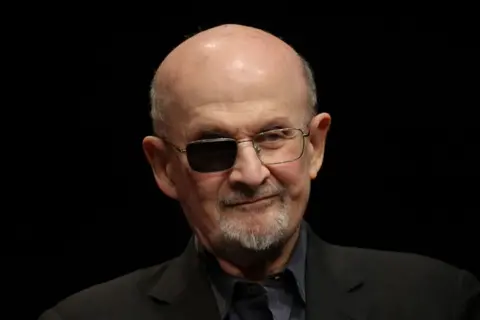 |
| Salman Rushdie in 2024. Getty Images |
Salmon Rushdie was a marked man when his controversial book The Satanic Verses was
published, drawing the ire of Muslims internationally as blasphemous in
the extreme, in 1989, the year that Ayatollah Ruhollah Khomeini, the
architect of the Iranian Revolution a decade earlier, imposed a fatwa
that called for the writer's death. That death sentence has haunted Mr.
Rushdie all his life, forcing him to live with security, unable to live a
normal life until finally the fatwa was withdrawn, but the damage had
been done. Attempts on his life would continue.
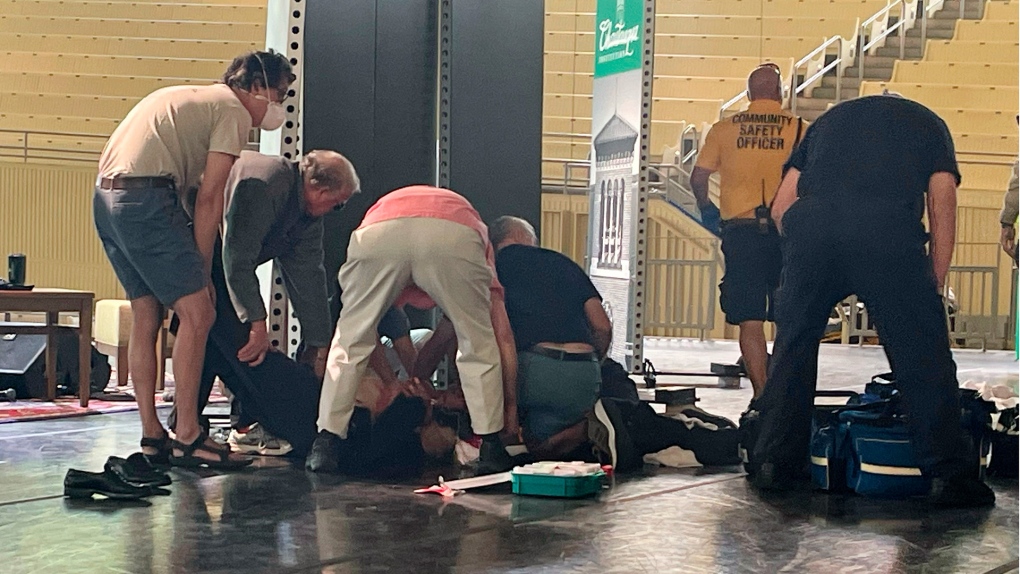
In August 2022, Mr. Rushdie was seated in an armchair on stage just about to deliver a lecture on 'keeping writers safe',
staged at the Chautauqua Institution Amphitheater in western New York,
when a masked man ran up on the stage and began stabbing the elderly
winner of the Booker Prize. The attack was swift and brutal, leaving
Rushdie in danger of his life. He was so stunned at the suddenness of
the attack that he at first was incapable of a physical response. Once
his attacker had been subdued, his life was saved, though his injuries
were serious, and one of the wounds left him blind in one eye.
The
attacker, Hadi Matar, bounded up the staircase leading to the stage,
closed the 30 feet between himself and his victim in a swift advance
and began stabbing the acclaimed author. Neither Mr. Rushdie nor
another scheduled speaker seated beside him made an initial move in
response to the attack, said District Attorney Jason Schmidt in
addressing the jurors at the trial of the attacker.
"Without hesitation this man holding his knife ... forcefully and efficiently in its speed, plunged the knife into Mr. Rushdie over and over and over and over again, stabbing, swinging, slicing into Mr. Rushdie's head, his throat, his abdomen, his thigh [as well as a hand that was raised in self-protection].""It all happened so fast that even the person under attack, Mr. Rushdie, and the person sitting next to him, Mr. [Henry] Reese didn't register what was happening."District Attorney Jason Schmidt
 |
| Matar, centre, stands at the defence table with his lawyers before the start of the second day of his trial at the Chautauqua County Courthouse, in Mayville, N.Y., on Tuesday. (Gene J. Puskar/The Associated Press) |
Unable
to fend off the attack, Mr. Rushdie finally stood and ran in an attempt
to escape the merciless knife-plunging, while his attacker pursued him.
Other people in the audience managed to subdue the attacker. Mr. Reese,
who sat beside Mr. Rushdie sustained a gash above his eye. The
27-year-old Matar of Fairview, New Jersey was charged with attempted
murder and assault. He saw fit to plead not guilty. Once this trial
concludes, Matar will face another trial, this second one over charges
of terrorism, to take place in a Buffalo U.S. District Court.
As
he entered the court for the first time, Matar stated 'Free
Palestine!' Matar was born in the United States, his parents emigrated
from Hezbollah-dominated southern Lebanon close to the Israeli border,
in Yaroun. His mother believes her son had been radicalized in 2018
after spending time with his father back in Yaroun. Following a
jailhouse interview after the stabbing Matar passed on divulging whether
he was responding to a fatwa, only speaking of Rushdie as "someone who attacked Islam".
In
the courtroom, Matar was seated some 6 metres from Rushdie. His public
defender, Lynn Schafter, in representing Matar initiated
cross-examination enquiring of Rushdie to search his memory as to how
many times he had been struck by Matar's knife. "I
wasn't counting at the time. I was otherwise occupied. But afterward I
could see them on my body. I didn't need to be told by anybody", he responded.
Rushdie, author of many books, wrote another describing the attack and his long recovery. "I'm not as energetic as I used to be. I'm not as physically strong as I used to be," he said. The book titled Knife: Meditations After an Attempted Murder, was released last year.
 |
| Rushdie, shown at the 75th National Book Awards ceremony in New York on Nov. 20, 2024, told the court that he saw his attacker only at the last minute and was struck by his eyes, which 'seemed very ferocious.' (Andy Kropa/Invision/The Associated Press) |
Labels: Attacker: 'Not guilty', Attempted Murder Trial, Blasphemy Against Islam, Islamic Republic of Iran Fatwa, New York Court, Salman Rushdie, The Satanic Verses
posted by Pieface @ Wednesday, February 12, 2025