Saturday, August 15, 2020

The Abraham Accord: United Arab Emirates/Israel

"Opening direct ties between two of the Middle East's most dynamic societies and advanced economies will transform the region by spurring economic growth, enhancing technological innovation, and forging closer people-to-people relations." "As a result of this diplomatic breakthrough and at the request of President Trump with the support of the United Arab Emirates, Israel will suspend declaring sovereignty [over areas of the West Bank as envisioned in a U.S. plan announced in January]."                                                                                                         "This historic diplomatic breakthrough will advance peace in the Middle East region and is a testament to the bold diplomacy and vision of the three leaders and the courage of the United Arab Emirates and Israel to chart a new path that will unlock the great potential in the region."                                                                                 Joint statement of Israel/UAE accord

"[The] full and official peace [with the U.A.E. will lead to co-operation in many spheres between the countries and a] wonderful future [for citizens of both nations]."                                                                                                            "There is no change in my plan to apply our sovereignty to Judea and Samaria [West Bank] in full co-ordination with the U.S. I'm committed to it. That hasn't changed."                                                                                                                   "I remind you that I was the one who put the issue of sovereignty over Judea and Samaria on the table. This issue remains on the table."                                         Israeli President Benjamin Netanyahu 

"Is it perfect? Nothing is perfect in a very difficult region. But I think we used our political chips right."                                                                                            Anwar Gargash, top Emirati official   

"I don't think anything was written in stone. We are opening a door. We are hoping the Israelis will see the benefits to this step."                                                            "I would assume that this is political manoeuvring within a very complex political society."                                                                                                                               Omar Ghobash, U.A.E. assistant minister for culture and public diplomacy
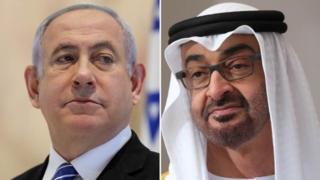
Composite image of Benjamin Netanyahu and Abu Dhabi Crown Prince Mohammed bin Zayed Al Nahyan
Benjamin Netanyahu and Prince Mohammed Al Nahyan brokered the agreement with US help  Reuters, Getty Images

According to the historical accord for full diplomacy between the United Arab Emirates and Israel, normalization will now proceed with a broad new relationship ensuing to reshape Middle East politics. The focus will no longer be fixed on the 'Palestinian' issue, and it has not been for quite some time now. That focus is now turned fully on the Arab states and Israel managing the threat posed by the Islamic Republic of Iran, a non-Arab, Shiite nation amongst the Sunni majority of the Middle East. Iran's plan to command and control the Middle East has alarmed its Arab neighbours, creating a gradual shift toward and recognition of, the Jewish state whose presence is finally acknowledged as permanent.

Israel's planned annexation of areas of Biblical Judea and Samaria, which the international community speaks of as the 'occupied West Bank' where Jewish settlements are housed is to be placed in abeyance. The politics of the Middle East are slow to change, but change they will, with three Arab states now formally at peace with Israel; Egypt, Jordan and the U.A.E.. With, presumably, more to follow. The new accord is indeed historic, a breakthrough to achieve peace, all too long in arriving. An accord, unsurprisingly, which finds no favour with the Palestinian Authority, nor obviously, with Hamas.

The Israeli settlement of Maale Adumim, Israel's largest, with a view of the Jerusalem skyline in the background. Under the deal, Israel has agreed to temporarily suspend applying sovereignty to areas of the West Bank that it has been discussing annexing. (Menahem Kahana/AFP/Getty Images)

Both Fatah, with and of the Palestinian Authority, and the terrorist group Hamas in Gaza, speak to their charters which aim for the destruction of Israel from its heritage endowments. The Palestinian Authority speaks of this monumental move closer to universal peace, as a "stab in the back" to their cause. Their cause being, to reject the very 'normalization' that the U.A.E. has just signed on to. U.S. President Trump, whose envoys helped to broker the agreement, Abu Dhabi's Crown Prince Sheikh Mohammed bin Zayed and Israeli Prime Minister Benjamin Netanyahu had "agreed to the full normalization of relations between Israel and the United Arab Emirates".

An exchange of ambassadors and embassies is anticipated shortly. The Abraham Accord unites, in the words of President Trump : "Two of America's closest and most capable partners in the region", representing "a significant step towards building a more peaceful, secure and prosperous Middle East". The U.A.E. stated it remains committed to helping the Palestinians realize their independent state, with the accord maintaining the viability of a two-state solution.

The Palestinians? The accord represents a "betrayal of Jerusalem, Al-Aqsa [mosque] and the Palestinian cause", according to spokesman Abu Rudeineh, outside President Mahmoud Abbas's Ramallah headquarters. "We were blindsided ... It is a complete sell-out", stated Palestinian negotiator Hanan Ashrawi. "Normalization is a stab in the back of the Palestinian cause and it serves only the Israeli occupation", added Fawz Barhoum, a Hamas spokesman in Gaza.

Israel and the United Arab Emirates reached a deal on Thursday that will lead to a full normalization of diplomatic relations. (Ahmed Jadallah/Reuters, Jonathan Hayward/The Canadian Press)

Labels: , , , ,

Monday, April 22, 2019

Nothing Succeeds Like Success

"I am a staunch supporter of my country establishing diplomatic ties with Israel. I know many people who are in favor of this move. Like myself they wonder why it has taken this long." 
"[Israel has0 immense influence in the region and throughout the world. I am convinced that forging ties with Israel will be in our [Somalia's] mutual interest. One of the reasons we need to establish ties with Israel sooner rather than later is to bring an end to the war of the extremists that is being waged against our people on a daily basis. The bloodletting of our people must end sooner rather than later and we will need all the help we can get to achieve this goal."
"I believe Israel can help us swing the pendulum of violence in our country’s favor. Israel can also open doors for Somalia because of its sheer influence. They say time and tide wait for no man and I believe ties with Israel should have been established a long time ago. But this is now something I have taken on as a mission that must be accomplished."
"The Palestinians are their worst enemies. They never miss an opportunity to miss a chance. They are idiots and losers in Gaza. They should be condemned each time they attack civilians. It is in our interest to welcome Israel.:
"As you know, our country is dependent on the international community for support and solidarity, and the practice of anti-Semitism in our government is unacceptable if not unthinkable. Bigotry in our government is against everything we stand for as a nation."
"There are over 20 Muslim countries that have diplomatic ties with Israel… There is absolutely no reason why Somalia too should not establish diplomatic ties with Israel."
"You are making it like coming out of a closet. I don’t see it that way. To the contrary, I think forging ties with Israel is in the national interest of my country. We can only ignore regional and global trends at [our own] peril."
Abdullahi Dool, senior Somali diplomat, fired for publicly advocating the establishment of formal relations with Israel


Hostility to Israel and the threats and violence that have characterized its neighbours' reaction to Israel's presence in the Middle East have undergone a sea change. Israel is located in a tough neighbourhood. Where tribal, clan and sectarian loyalties represent collaberative alliances and irrepressible flare-ups of antagonistic fervour. The nations of the Middle East, with its ethnic and tribal histories of warfare simmer beneath the facade of civilized demeanor, but none is too far from flare-ups reflecting a history of challenging one another for existential resources.

Even at a time when the oil sheikdoms, kingdoms and tyrannies have found themselves a source of wealth through the simple extraction of petroleum resources naturally endowed in the region, jealousies and power manoeuvring, along with sectarian hostilities ensures that suspicion rules. The people of Muslim-majority countries, tiring of the constant state of manipulated indebtedness to their rulers at a time when mass communication invites them to see how free people in democratic nations live in more equitably-shared wealth and personal freedoms, agitate for change.

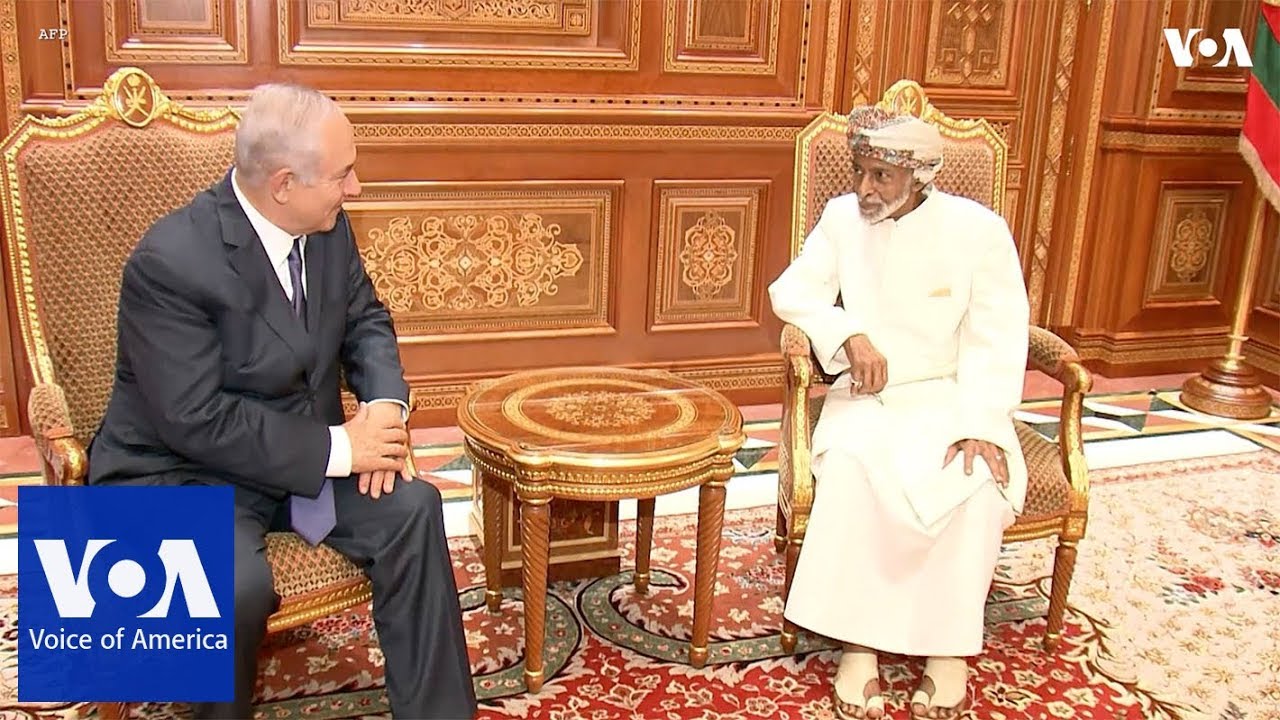
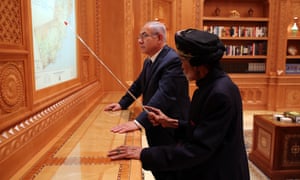
Benjamin Netanyahu and Qaboos Al-Said (VOA)

Current-day challenges and distractions along with ongoing divisions between more fundamentalist sharia-observing nations and less restrictive administrations opening themselves to European and Western types of governance and cultural refinements have tempered Sunni-led resistance to Israel's presence, moving from violent military attacks to isolating Israel, to finally relaxing relations toward toleration however grudging in character and critical outwardly, while discreetly opening diplomatic relations.

The rise of Iran's revolutionary Shi'ism and its stealth plans to dominate the region, first by making itself indispensable to the incitement of hatred against Israel through its dedicated aspirations of destroying its presence on 'consecrated' Islamic ground, carefully nurturing terrorist groups cradling a like agenda for themselves while orchestrating attacks against Jewish targets outside the Middle East has ensured that Israel's attention turned from its erstwhile adversaries' threats, now muted, to that of the Islamic Republic of Iran's.

Iran has succeeded in establishing a critical mass in a pincer movement pushing Arab Muslim countries into defensive mode in recognition of its threat inherent in a Shi'ite crescent including Lebanon, Syria, (nominally Qatar and Iraq) and Yemen, minorities though they may be in comparison to the majority Sunni states. Its insistence on establishing itself as a regional power and its unstoppable aspiration to acquire nuclear weapons concern the majority Sunnis. That they and Israel recognize a common enemy has aided their rapprochement.

Arab Inter-Parliamentary Union Flags

AE, Saudi Arabia, Egypt Reject Text Opposing Normalization with Israel at Inter-Arab Forum


Arabs respect power and might. They have no use for half-measures, for reassurances of accommodation in a civilized mode of conciliation. Military prowess as a show of strength and purpose is what gains their respect as opposed to appeasement in the interests of accommodation which is viewed as a sign of weakness. Israel has fought every step of the way to attain its statehood and to protect it from superior military numbers to its own; each of the conflicts forced upon the Jewish state was forcefully dealt with in Israel's favour.

The Arab powers might be angry and resentful but they also admire the determination and strength that achieved that outcome and with that came respect and the self-admission that their own stability in the region might be better achieved with cooperation with Israel against a common enemy. The Arab states became wealthy not because of entrepreneurial skills, scientific achievement, intellectual capability, but because they could rely on the riches of natural resources.

Israel became a power house of technical advances in water desalinzation and purification, agricultural expertise -- but also in advanced science, medicine and technology.

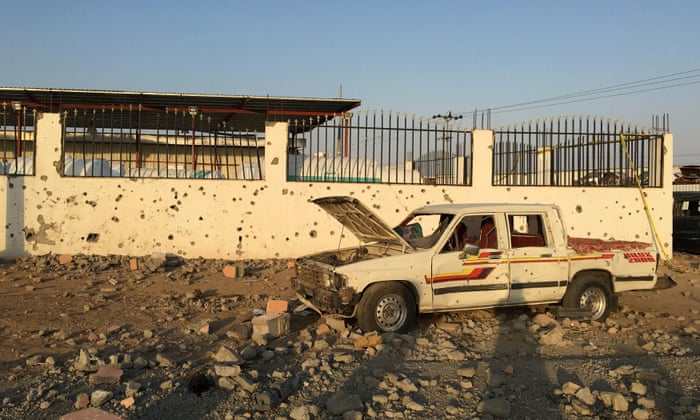
Buildings hit by Houthi rockets in Najran, Saudi Arabia, August 2016. Photograph: Reuters

Recognizing the need for diversification and to achieve skills in entrepreneurship to augment reliance on oil shipments abroad, and tourism, along with the need to protect themselves from the malignant plans of Persian Shi'ite Iran, it's little wonder the grudging admission that peace with Israel became an option, where any manner of 'normalcy' with the Jewish state up to now was anathema. The Palestinians are livid with this state of affairs, which they stigmatize as abandonment of their cause; it was those Arab states to begin with, that assured Palestinians in 1948 that Israel would be destroyed and Palestinians could return to 'their' land.

Alexander Shatilov shown on the screen singing along with Israel’s national anthem “HaTikvah” after winning a gold medal at the Gymnastics World Cup in Doha, Qatar. Photo: Screenshot.

Now, the United Arab Emirates has opened civil diplomatic relations with Israel. Prime Minister Netanyahu visited Oman with mutual compliments exchanged and interest expressed in forging closer alliances. A number of African nations have declared themselves interested in opening closer relations with Israel, thanks to Israel's active and deliberate outreach program. Qatar's Artistic Gymnastics World Cup featured an Israeli winning gold, with the Israeli national anthem and flag played and flown for the first time in an Arab state.

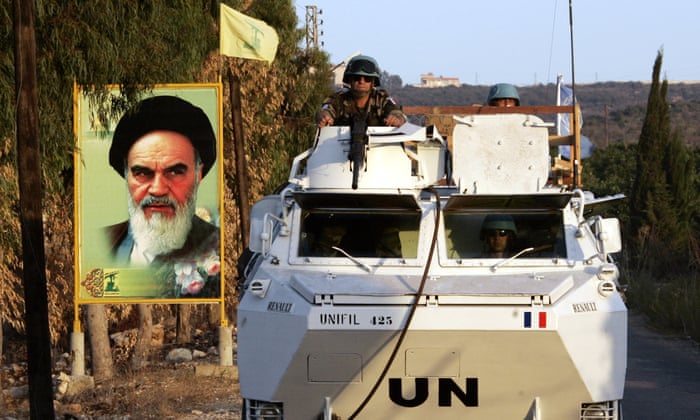
UN peacekeepers with a billboard showing Iran’s late leader Ayatollah Khomeini after the Israel-Hezbollah war, southern Lebanon, September 2006. Photograph: Francois Mori/AP

There was a time when Iran, under Shah Mohammad Rezi Pahlavi, before the 1979 Iranian Revolution, had good, stable relations with Israel. Turkey, until the ascension of Recep Tayyip Erdogan's Islamist Justice and Development Party had close collaborative relations with Israel, since deteriorated beyond repair. The Middle East and Muslim nations are nothing if not changeable and occasionally beyond fissionable.

Which brings us to Israel's relations with the Palestinians, Fatah and Hamas, the former a covert terrorist group, the latter overt, but both sharing a like goal; the elimination of Israel.

They have become lifelong enemies of Israel, aspirants to possession of the heritage Judaic land on which Israel sits. Both have inspired hatred and vengeance in their young through tutoring hate in school curricula, youth camps, television programs, to ensure the next generation of Palestinians willing and able to engage in violent assaults against Jews will not be terminated. Those who die in the attempt to extract life from Jews become celebrated martyrs whom schools, squares, public centers and soccer fields are named after, as heroes.

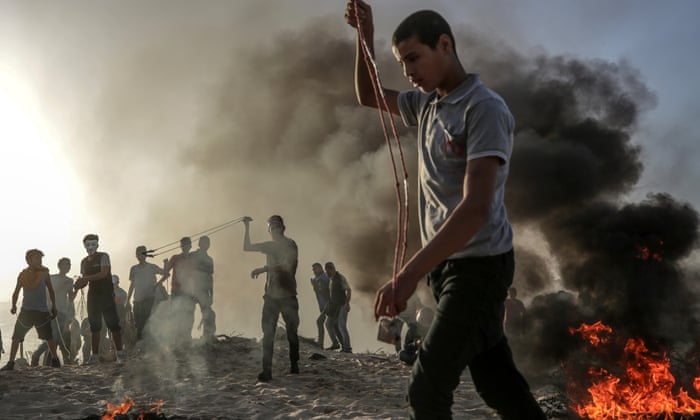
Palestinian 'protesters' on the border between Israel and the Gaza Strip, October 2018. Photograph: Mohammed Saber/EPA

Palestinian terrorists who plot violence against Israel, who are imprisoned for murdering Jews, are paid salaries by the Palestinian Authority. They view it as their sacred obligation to themselves to make certain that their population hates, fears and pledges to violence against Jews. The Palestinians, had they agreed to reconciliation, cooperation and a peace agreement, could at many junctures over the years have had a state of their own, and with that state as neighbours of Israel they would have benefited hugely, industrially, economically.

They chose, time and again, not to. The allure was vengeance.

Now, Arab states in their aggregate have come around to deciding otherwise, seeking economic benefits from connecting with Israel; seeing benefits that can accrue to them in many spheres of an improved economic, technological, scientific collaborative future with a capitalistic, democratic, liberal nation next to their own. But then, this being the Middle East, the lesson of Iran's and Turkey's once-close relationship with Israel expresses its own cautionary tale for the future.

Israeli prime minister Benjamin Netanyahu with the Sultan of Oman, Qaboos bin Said Al Said, in Muscat in October 2018. Photograph: Anadolu Agency/Getty Images

Labels: , , , , ,

Follow @rheytah Tweet