Biotechnology, Science, Responding to COVID-19
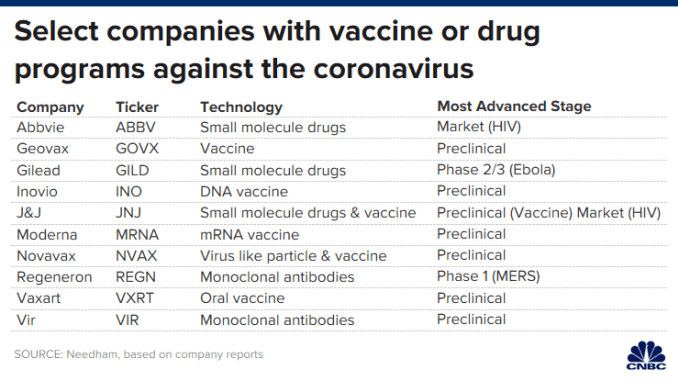
"On Monday, Moderna began clinical trials in Seattle with its mRN A-based vaccine for the coronavirus on 45 people. What's unusual is that, because the virus has been deemed a pandemic, the requirement to first test the substance on primates has been waived. But since the therapy doesn't contain the disease, there's no danger that the humans who are injected with it will get COVID-19. A similar vaccine was successfully tested on lab mice recently."
"The Americans, with a research war chest of tens of billions of dollars, have brought in the cavalry and will hopefully help save the day. Stay tuned for more breakthroughs from the world's scientific community."
Diane Francis, Financial Post
There are -- all too suddenly -- desperate times. And desperate times call out feverishly for desperate measures aiming at a solution -- however temporary -- in a bid to rescue the world from the deadly talons of a viral chimera, alike some of the types of viruses that have arisen in the past to decimate humankind, but unalike them in many ways that scientists are desperately working to decode to be enabled to create an antiviral vaccination. In a bid to temporarily create a life-saving interim solution until a final one can be successfully researched, created and manufactured, the U.S. has called on its military scientific community.
Who, aside from the scientific community at large, might be aware of the presence of the Pandemic Prevention Platform (P3), associated with the Pentagon, that mighty military institution that defends U.S. interests on a battlefield of scientific invention and new medical protocols? But there it is, the Defense Advanced Research Projects Agency (DARPA) and it has been tasked with the creation of a temporary therapy known as a "firebreak". A word familiar to anyone who has read about advanced and dangerous techniques in stemming wildfires.
 |
| Moderna, Inc. |
The wildfire the world is now facing is the steady, swift and horribly injurious onslaught of a newly-emerged viral agent, identified as SARS-CoV2, a zoonotic that arose in Wuhan, China, emerging from a wildlife 'wet' market where live animals are sold for human consumption, animals known to harbour deadly viruses; specifically bats that transmit them to civet cats, both of which rate high on Asian culinary customs as particular delicacies.
In the case of the novel coronavirus, the "firebreak" is envisioned as buying time until a permanent solution succeeds in response to the colossal infectious rate's advance. It is estimated that a permanent vaccine would take 12 to 18 months to be in readiness for mass inoculation against COVID-19. DARPA's "firebreak" therapy, on the other hand, is already in the initial testing stage and should it be successful it could be viable on a mass scale in possibly three months' time.
The therapy convinces the human body to arm its immune system to guard against the virus for an estimated period of six months. Universities, scientists and private companies work together under DARPA through technology and science, which has benefited from breakthroughs of various types resulting from technical advances in weapononry and the U.S. space program. The early Internet was created by the forerunner of DARPA. P3 has "one shot on goal ... we're really hoping it works", stated DARPA program manager, Amy Jenkins.
Through drawing a blood sample from a novel coronavirus survivor, screening it to assess all antibodies produced by the person's body to fight the virus, selecting the most effective, then mapping its genetic code and manufacuring it, this month's human trial was able to proceed. While vaccines are in development, the "firebreak" is visualized as an interim measure to last a given period, after which the substance degrades, along with the antibodies created in response to its presence, and the individual once again becomes susceptible to transmission. But by that time a permanent vaccine will be available.
The Pentagon has been invested in pandemic strategies reflecting its role as a protector of national security and public safety, toward drug development to protect front-line personnel -- soldiers, medical personnel, first responders, scientists and associated vulnerable caregivers. While the eventual vaccine will be formulated out of the coronavirus genetic code, it will contain a safe form of the pathogen. The "firebreak" on the other hand, carries 'instructions' for antibody production.
 |
| Moderna Inc. |
Moderna Technology, a bioengineering company in the United States, bills itself as a leader in the technology of mRNA medical science. "Messenger RNA, or mRNA, plays a fundamental role in human biology, transferring the instructions stored in DNA to make the proteins required in every living cell. Our approach is to use mRNA medicines to instruct a patient’s own cells to produce proteins that could prevent, treat, or cure disease." It began clinical trials in Seattle with its mRNA-based vaccine in response to the coronavirus.
Labels: Biotechnology, Novel Coronavirus, Transmssion, United States
posted by Pieface @ Thursday, March 26, 2020


/cdn.vox-cdn.com/uploads/chorus_image/image/66504221/GettyImages_1212367903.0.jpg)
