Chile: Mass Protests -- Massive Human Rights Violations
"We never thought we would have to come back to Chile under these circumstances to record massive human rights violations."
"We thought this was history."
Jose Miguel Vivanco, Human Rights Watch
"Carabineros is a militarized police force, with a military structure and logic, not a civil police force."
"All attempts to reform it after dictatorship have been very slow, with very little capacity for civilian control."
Claudio Fuentes, professor, Diego Portales University
"The march was very peaceful, but when we approached a mall some
soldiers appeared. Some protesters began to insult them and
they suddenly knelt and aimed their guns at us."
"After the first shots rang out people started throwing stones. More
gunfire followed – and that’s when Romario was hit. We must have been
more than 100 metres away, so we couldn’t have hurt or threatened them."
Ulises Cortés, 19-year-old student, Coquimbo, Chile
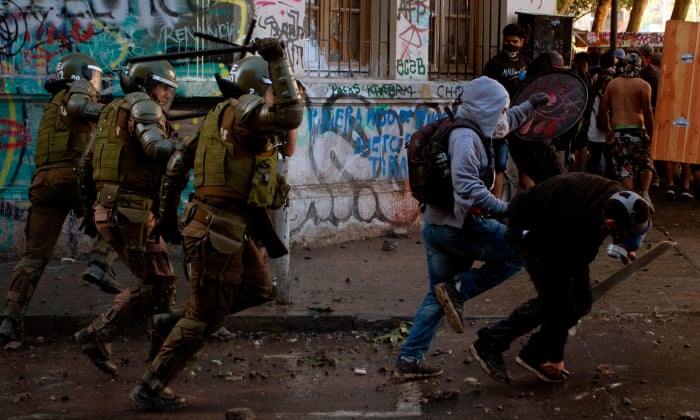 |
Riot police chases demonstrators during a protest against the government in Santiago on 19 November 2019.
Photograph: Claudio Reyes/AFP via Getty Images
|
Two months ago the Chilean protests were inaugurated when a proposed subway fare increase brought people to the streets and then inequality was identified as a greater issue in the peaceful gatherings which swiftly turned to violence in confrontations with police whose abuse of the protesters was starkly reminiscent of Chile's years under dictatorship. Chile's National Institute for Human Rights, an agency of the state, categorized thousands of instances of abuse.
The National Institute for Human Rights looked at 400 of the incidents they documented as torture and cruel treatment, while another 194 involved sexual violence, along with four rapes. Excessive use of force by police was charged in over 800 incidents, among them at least six killings by security forces. Chile's national police force, the Carabineros, has reacted to the street unrest precisely as they did under the rule of General Augusto Pinochet, when it finally ended back in 1990.
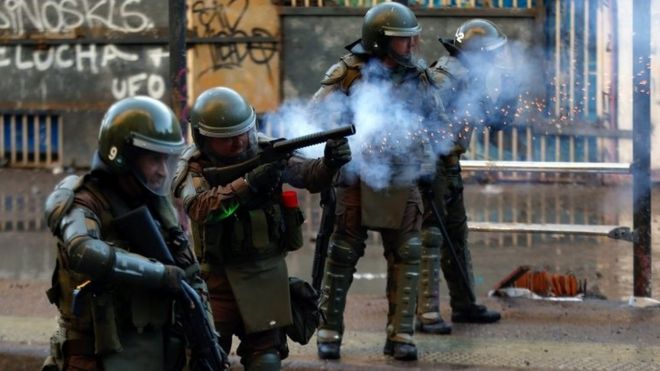 |
| Police accused of aiming at peoples' eyes EPA |
At that time, the kind of human rights violations notched up by the Carabineros resulted in the deaths and disappearances of over three thousand Chileans, with some 38,000 people having undergone systemic torture while in incarceration. General Mario Rozas, who heads the Carabineros spoke of 856 internal investigations in response to the reports, and announced institutional changes to the Carabineros' organization.
Chile's President Sebastian Pinera has opened welcoming arms to four human rights organizations; the Organization of American States and the United Nations among them, claiming that all accusations will be investigated. A task force led by the interior minister is prepared to propose reforms. The use of pellets has been suspended by police, but as the human rights groups point out, the Carabineros continue to fire tear gas cartridges at demonstrators.
Eye injuries suffered at the hands of police have left hundreds of demonstrators maimed, caused by the indiscriminate use of riot guns. Two protesters were blinded. Altogether, over 12,700 people were wounded across Chile since mid-October. In the past two years, 35 generals in the Carabineros were involved in a series of scandals, and ousted, including the former police chief who stepped down last year after an anti-terrorist squad killed an indigenous man, then covered it up.
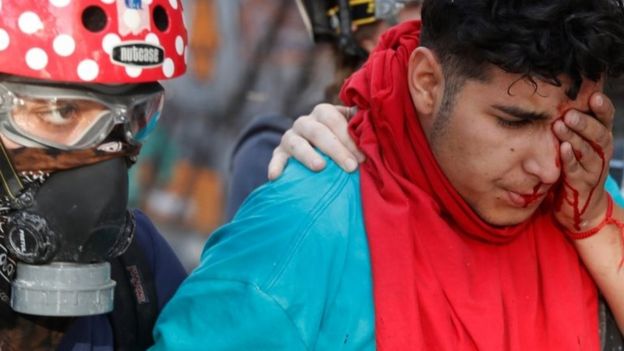 |
| More than 200 protesters have sustained eye injuries Reuters |
One of the largest, most far-reaching embezzlement scandals in the history of the country involved senior officers of the Carabineros, involving some $35-million, which led to the conviction of close to 100 police officers and civilians. For the past ten years, large protests demanded education and pension reform, an end to corruption, and respect for the land rights of indigenous people.
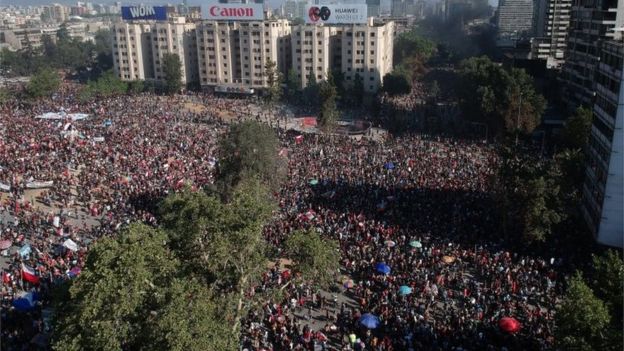 |
| Huge rallies and demonstrations have ramped up the pressure on the government Getty Images |
Labels: Chile, Human Rights, Police, Protests, Violence
Reforming a Deleterious Food Culture : Then Reversing It
"It was a hard-fought guerrilla war. People have a right to know what these food companies are putting in this trash and with this legislation, I think Chile has made a huge contribution to humanity."
"Sugar kills more people than terrorism and car accidents combined. It's the poison of our time."
Senator Guido Girardi, vice-president, Chilean Senate
"I never really paid attention to labels."
"But now they kind of force you to pay attention. And if I don't notice, my kids do."
Patricia Sanchez, 32, accountant
"Originally we didn't believe the logos would make much of a difference, but in focus groups, we've discovered that kids really do look at them."
"They'll say, 'Mom, this has so many logos I can't bring them to school. My teacher won't allow it'."
Dr. Camila Corvalan, University of Chile
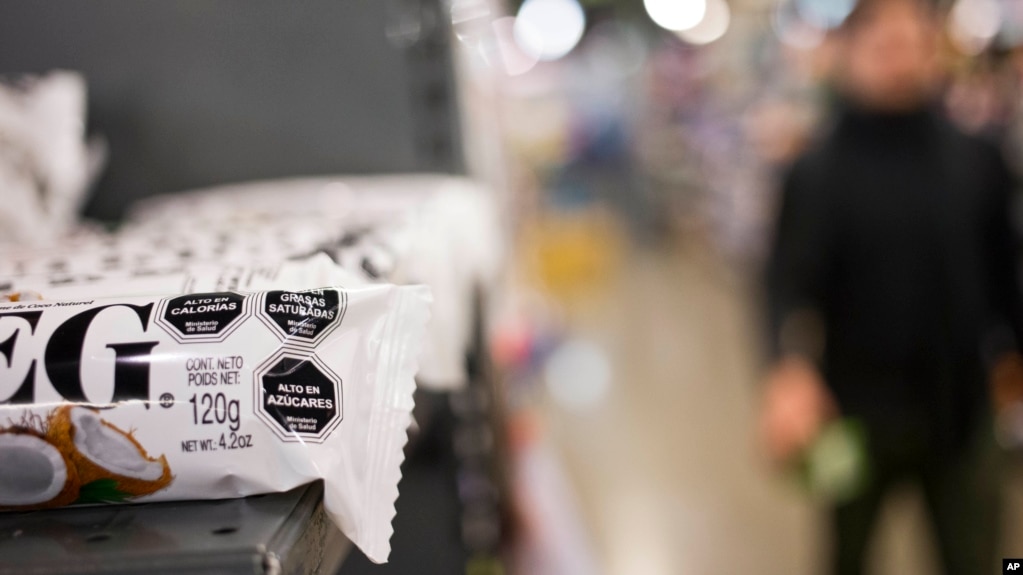 |
| This product sold in a
supermarket carries the labels required by law to show the levels of
calories, sugars and fats, in Santiago, Chile, June 27, 2016 Associated Press |
Across the globe, countries rich and poor have been struggling with the reality of rising rates of obesity in their populations, and lock-step with a hugely overweight population comes strains on any health care system alongside an increasingly troublesome mortality rate as diseases such as diabetes, heart and stroke take their toll in association with a public so accustomed to fast food outlets proliferating with cheap, non-nutritious food heavy in fat, sugar and salt that they imperil themselves.
And as governments begin to realize that processed food manufacturers have lured consumers with their public relations ploys and clever advertising marketed to grasp the attention of the most vulnerable, their efforts at persuading giant food corporations to diminish the assault on consumers' appetites has had minimum success. Chile prepared itself to take a more aggressive approach rather than rely on compliance on the part of processed food manufacturers.
Its soaring obesity rates have sounded a panic bell. Up to the late 1980s Chile faced a different kind of problem, where widespread malnutrition among poor Chileans, children in particular, was their nightmare. At the present time in Chile, an estimated three-quarters of adults are considered to be overweight or obese, according to the nation's ministry of health statistics. Childhood obesity in particular shows rates that rival the world's highest. Over fifty percent of six-year-old children are overweight or obese in Chile.
The strains on the health system are acute, with the medical costs of obesity reaching $800-million in 2016, representing 2.4 percent of all spending on the nation's health care file. This is a figure projected by analysts to reach close to four percent by 2030. These statistics and the fact that they will only increase finally spurred the Chilean government to unleash marketing restrictions, mandatory packing redesigns and labelling rules in hopes of achieving a social transformation.
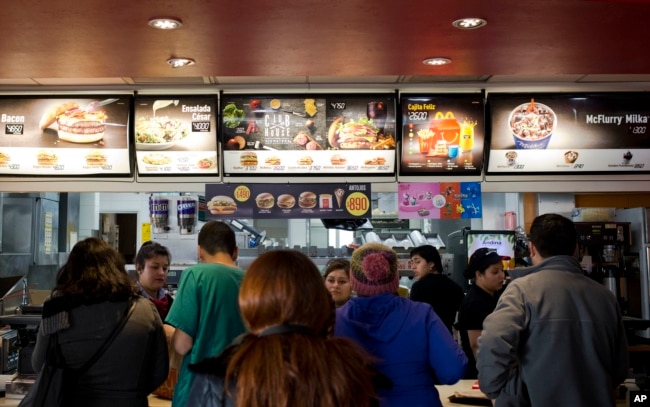 |
| Customers stand in line at a fast food restaurant in Santiago, Chile, June 22, 2016. |
Experts in nutrition recognize the measures as the world's most ambitious effort to refurbish an entire nation's food culture to save the population from itself. Should it succeed, it could represent a model for other countries with similar problems to turn around their obesity epidemic contributing to four million premature deaths annually resulting from the global emergency of obesity.
"It's hard to overstate how significant chile's actions are -- or how hard it has been to get there in the face of the usual pressures", commented Stephen Simpson, director of the Charles Perkins Centre, representing scholars focused on nutrition and obesity science and policy.
Chile's food law was put into motion two years ago, forcing multinationals like Kellogg to abandon their iconic cartoon characters so attractive to children. Cereal boxes loaded with sugar are now absent those child-centric cartoons. Kinder Surprise candies have been banned from using trinkets to attract children. Chilean schools are now prohibited from selling junk food like perennial favourites, ice cream, chocolate and potato chips. Television programs aimed at children may no longer advertise these products.
In an effort to persuade Chilean mothers that breastfeeding is the best option for healthy babies, a ban on marketing infant formula will be initiated this coming spring. Chile has mounted an 18 percent tax on beverages high in sugar. A new labelling system has been instituted requiring packaged food companies to include black warning logos prominently in the shape of a stop sign on any packaged foods high in sugar, salt, calories or saturated fat.
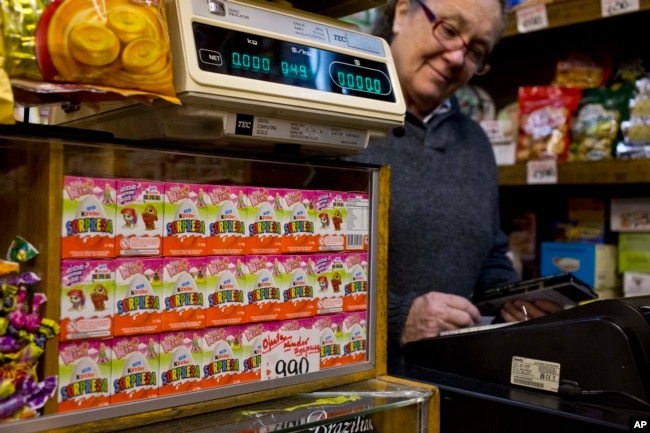 |
| Candy store owner Sofia Rumpf attends a customer in Santiago, Chile, June 24, 2016 photo. |
Chilealimentos, an industry association, is fighting back. Its director states the new nutrition labels are confusing and "invasive", the marketing restrictions based on a scientifically flawed correlation between consumers' weight gains and the promotion of unhealthy foods.
"We believe that the best way to approach the problem of obesity is through consumer education that changes people's habits", he stated rather piously, given that the advertisements used by his industry have already achieved that end.
Over 1,400 food items representing 20 percent of all food products sold in Chile have been reformulated since the law was enacted, according to AB Chile, a food industry association. Coca-Cola initiated an advertising campaign for new Sprite and Fanta versions with the tag line
"Free of Logos, Equally Rich" reflecting that those drinks no longer contain warning labels since half the sugar has been replaced by artificial sweetener. Raising other alarm flags.
A Kinder Surprise company executive from Italy and the Italian ambassador to Chile accused Dr. Jaime Burrows Oyarzun, the vice-minister of public health, of waging
"food terrorism", during a trip to his office. Managing director at Ferrero, Mauro Russo, claimed Chile's law had been erroneously applied to Kinder Surprise, since the toy is an intrinsic part of the treat and certainly not to be mistaken for a "promotional gadget", as the law would have it.
"Kinder Surprise's impact on obesity is very marginal", he insisted.
Chile's current president who lent himself to the new consumer-protective food laws is due to step down from the presidency. His successor is the former president, recently re-elected to the office, a conservative businessman who during his first term in office, vetoed the food bill in 2011. His incoming administration had formerly backed a nutrition initiative financed by multinational food companies emphasizing healthy recipes, exercise and moderation related to junk food.
The incoming president's intention, noted a spokesperson, would be to take a second look at the law, to explore ways
"to improve it", once he takes office. His wife had led the campaign financed by the multinational food companies.
"We don't need more taxes", she said recently.
Labels: Chile, Health, Nutrition, Obesity, Processed Food
The Cranky Pope
Hard on the heels of the explosive and exploding incidences of women
revealing for the first time the identities of their sexual abusers, a
phenomenon of unveiling a dark hidden secret of many men in positions of
power and influence using their positions to prey on women whose
careers they are capable of advancing or retarding, a public figure of
immense authority has stepped into the fray, and in all likelihood not
by intention but through a momentary irascible backlash flash of
irritation.
"The day they bring me proof against Bishop Barros, I'll speak."
"There is not one shred of proof against him. It's all calumny. Is that clear?"
Pope Francis, Santiago, Chile
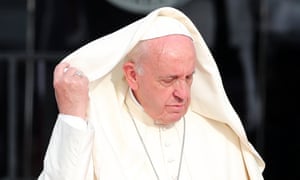 |
| Pope Francis
has accused victims of Chile’s most notorious paedophile of slander, in
an astonishing end to a visit meant to help heal the wounds of a sex
abuse scandal that has cost the Catholic church its credibility in the
country. The Guardian |
"As if I could have taken a selfie or a photo while Karadima abused me and others and Juan Barros stood by watching it all."
"These
people are truly crazy, and the pontiff talks about atonement to the
victims. Nothing has changed, and his plea for forgiveness is empty."
Juan Carlos Cruz, accuser
"[It
is] sad and wrong [for the Pope to discredit the victims since] the
burden of proof here rests with the church, not the victims -- and
especially not with victims whose veracity has already been affirmed."
"He
has just turned back the clock to the darkest days of this crisis. Who
knows how many victims now will decide to stay hidden, for fear they
will not be believed?"
Anne Barrett Doyle, online database BishopAccountability.org
Pope Francis, pressed for a comment by a Chilean journalist with respect
to the status of Bishop Juan Barros whom he had named bishop of the
southern diocese of Osorno in Chile at a time when victims of Barros's
superior, the Rev.Fernando Karadima were accusing him of rampant sexual
crimes, snapped back with the response that made it quite clear he
failed to believe the accusations of the victims that Bishop Barros
knew, and had even witnessed that abuse.
In one fell swoop not only turning asunder his main thrust of address in
travelling to Chile with the purpose of apologizing for the horrendous
misdeeds of the Catholic Church when its priests pledged to celibacy
chose to pursue other avenues of satisfying their sexual desires by
targeting children and parishioners for abuse. It was always widely
recognized that these events took place, and that superiors within the
Church sought to keep the scandal within the church, never admitting it
took place, simply transferring the offending priest to another parish
to repeat his sins anew.
In effect, this is what the Pontiff himself has done, irrespective of
his sincere apology on behalf of the Catholic Church. Loyal Catholics
who had been abused had attempted for years to apprise the church
hierarchy of what was occurring only to hit a blank wall of indifference
and disbelief. Sexual abuse and the cover up of the church is
legendary. The Archbishop of Santiago eventually apologized for refusing
to believe victims once they spread their stories at large and they
became news of shocking importance.
Yet knowing that the victims' stories had been substantiated, Pope
Francis still chose to believe that the man he named as Bishop, a former
Karadima protege, could honourable and in good faith be accepted by the
Osorno community as their church authority, in so doing repeating the
very routine the church always engaged in when confronted by such abuse.
As far as the Osorno controversy was concerned where people refused to
consider Bishop Barros as their bishop, Pope Francis spoke of the
controversy as "stupid".
This, from a man claiming himself to be dedicated to serving the people, not the classical indulgences of the church hierarchy.
"Isn't the pastoral problem that we're living (in Osorno) enough to get rid of him?"
asked Juan Carlos Claret, spokesman for a group of Osorno lay Catholics
whose three-year campaign against Barros no doubt added to the Pope's
rejection of the claims by parishioners that they could not respect an
insider who had stood by and done nothing to help stop the abuse.
This is the church establishment which has vowed to do penance for the
past, for having accused victims of slandering and attacking the church
with unsubstantiated claims. And which Pope Francis set out to reverse,
assuring Catholics that the church had much to apologize for and he was
the man to assuage the wounds. Instead, he has chosen to open a new
wound by the expedience of reverting to the former stance of the church,
accusing the accusers.
A
"tremendous error"
in judgement by the Pope, according to to German Silva, political
scientist at Universidad Mayor in Santiago, that will reverberate in
Chile and beyond.
Labels: Catholic Church, Chile, Controversy, Pope Francis, Sexual Predation


