Saturday, October 26, 2019

Health and Development for Colombia?

"When you mention Colombia, unfortunately, some people relate that name with illegal drugs."
"We have an opportunity here to take a controlled substance and change that reputation, to bring health to people and development to our country."
"I feel great about doing this [producing cannabis for the medical cannabis company Clever Leaves he co-founded in 2016]." 
"This is the right way to use controlled substances."
"Pharmaceuticals always come from the global north to South America to Africa to Asia."
"This is something that is changing that model. This is from Colombia to the world."
Julian Wilches, formerly director of drug policy, Justice Ministry, Colombia

"The cannabis industry in the last three months has faced a reduction in investment, but the interest in Colombia is still very promising."
"Colombia in the near future will become a centre for development and research for the industry."

Juan Diego Alvarez, vice-president regulatory affairs, Khiron Life Sciences Corp.
Workers prune marijuana plants at a Clever Leaves greenhouse in Pesca, Colombia. The company employs over 450 people.
Courtesy of Clever Leaves

Colombia has had a lot of experience with narcotics production, all illegal, all leading to human tragedy, violence, laying waste whole communities, while marking the country as a narco-trafficking distribution centre. Suddenly all that has changed, the country has become respectable after its struggle to cope with cocaine marketing, violence, and just incidentally its battles with FARC, the anti-government guerrilla group.

Now the country has adopted the medical cannabis industry as a legitimate, money-making scheme in a world where there are never enough recreational drugs to make everyone happy. In Bogota, the word is that Colombia's time has come, as marijuana has been embraced around the world as a drug that can be usefully harnessed for medical uses. Even as various governments have legalized recreational cannabis, and more are following.

Investment from growers in Canada and the United States among others have placed a half-billion dollars into the country to buy up farmland, build greenhouses and produce oils, creams and associated products containing cannabidiol (CBD) in new operating laboratories, to treat chronic pain, insomnia and everything in between. None of these operations are purportedly interested in growing THC-infused cannabis for smokers' highs.

The narco state of Pablo Escobar is no more, in lock step with the growing, glowing cannabis market with an estimated value of over $50 billion by 2025. Colombia sees itself as the centre of production, exporting product worldwide where cannabis use is being legalized. Oddly, Colombia itself has not yet seen fit to legalize cannabis beyond modest quantities for personal use.

An aerial view of the Clever Leaves plantation in Pesca. It currently covers 37 acres and plans to expand cultivation to over 200 acres of marijuana plants by 2021.Courtesy of Clever Leaves

Clever Leaves' greenhouses located on a huge farm in a valley in the Andes some eight thousand feet above sea level, is producing roughly25 tonnes of dried cannabis annually. An expansion will see production rise to around 324 tonnes by 2020, when it will become one of the world's largest growers. Cannabis cultivation is legal under permit since 2016. The country, close to the equator, has a guaranteed 12 hours of sunlight all year. No artificial light required.

A grab-bag of Canadian, publicly traded companies have been attracted to Colombia, names such as Canopy Growth Corp., PharmaCielo Ltd., Khiron Life Sciences Corp., Aurora Cannabis Inc., and Aphria Inc., among the largest in the global industry. This, despite emerging concerns over lung illnesses and deaths related to vaping in the United States. Profit for the industry's largest concerns has not yet materialized; they're gambling on future stakes.
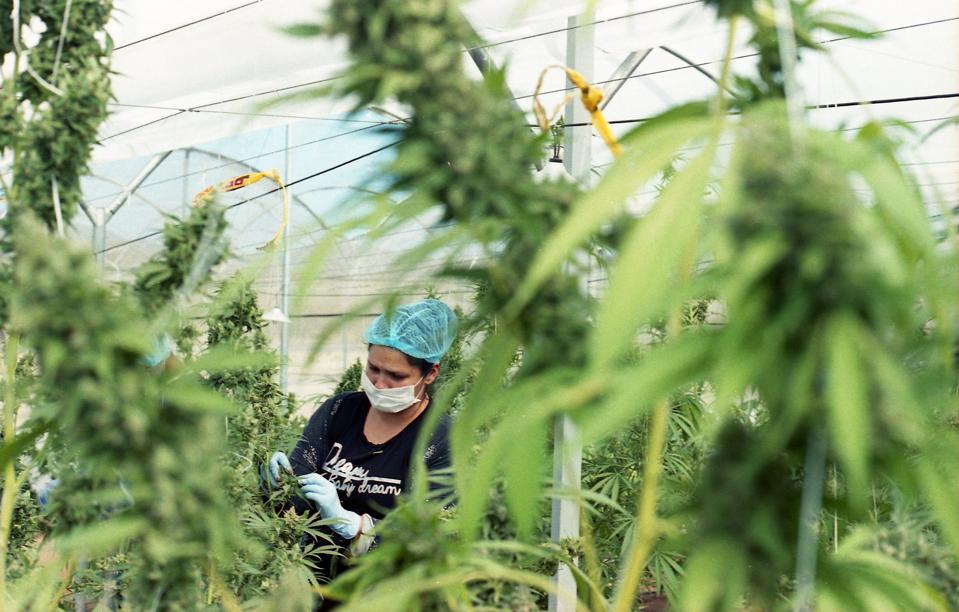
A legal cannabis grow operation in Colombia
Revenue from the cannabis sector in Colombia is forecast to swell to $791 million by 2025 from its current $99 million, with researchers estimating the U.S. market alone for CBD to the value of close to $23 billion by 2023. Colombia's President Ivan Duque has promised to cut bureaucracy and that his government is prepared to give its full support to the industry.

Even as Colombia anticipates increasing exports to the U.K., Poland and Germany once EU approval is given, other Latin American countries from Mexico to Argentina are putting laws in place enabling industries to develop there.

The evolving tapestry of cannabis regulation in Colombia
 Colombia Cannabis Farming    © iStock/Ernesto Tereñes

Labels: , , ,

Friday, December 02, 2016

Dame Fortune Frowned

"We request priority to proceed to the runway, we request priority to proceed to the locator."
"We have fuel problems."
"Now we have a total electric failure, we have a total electric failure."
"Help -- we need vectors to approach the runway."
LaMia flight crew

"The research now being carried out by national and international aviation experts, based on the aircraft’s black boxes, as well as technical examinations, will seek in the shortest possible time the results that will allow us to establish the causes of this unfortunate tragedy."
"[A lack of fuel was] most probably what caused this tragedy [but nothing had been confirmed]."
Alfredo Bocanegra, director of Aerocivil

"Many passengers got up from their seats and started yelling."
"I put the bag between my legs and went into the foetal position as recommended."
Erwin Tumiri, Bolivian flight technician, crash survivor

Rescue teams work in the recovery the bodies of victims of the LAMIA airlines charter that crashed in the mountains of Cerro Gordo, municipality of La Union, Colombia, on November 29, 2016
Rescue teams work in the recovery the bodies of victims of the LAMIA airlines charter that crashed in the mountains of Cerro Gordo, municipality of La Union, Colombia, on November 29, 2016    
Raul Arboled / AFP / Getty Images
Another stunning tragedy, with yet another Latin American sport team losing their lives in a flight to a game. An ill-conceived decision to fly with an airliner using short-distance planes capable of going so far and no further. The time allotted from departure to arrival would have worked, with sufficient fuel for the trip as long as the flight encountered no problems, there would be no need to deviate from the direct route contemplated, and that, in gambling parlance is taking a chance that fate would not intervene.

It did, predictably enough, when bad weather set in, delaying the flight and causing it to run out of fuel.

A short-haul plane operated by a charter airline was not the wisest course. But the team had flown previously with the same LaMia charter and thought highly of its services. On that previous occasion they had scored an important game victory, and hoped for similar results this time around on the Brazilian soccer team's Chapecoense plan to play in the Copa Sudamerica final in Medellin against Atletico Nacional.

Of the 77 souls aboard the ill-fated flight, 71 died in the crash, with six survivors left to detail what they had experienced. Just moments before the flight crew of the doomed plane contacted traffic control to advise of their plight, another aircraft had experienced cabin problems and had arranged with air traffic control at the Jose Maria Cordova International airport for an emergency landing.

The Viva Colombia flight was already in descent mode when the LaMia plane made their plea and was refused.


Luis Benavides / Associated Press
Luis Benavides / Associated Press  Rescue workers arrange the bodies of victims of the airplane crash.
 
The LaMia plane soon afterward crashed in La Union, a mountainous area in the Andes, outside Medellin, Colombia. Three members of the Chapecoense team survived the crash, along with three other passengers.But before the flight crashed, a co-pilot from airline Avianca, in flight at the same time as the LaMia aircraft, overheard the desperate discourse between the the captain and the air traffic control. It too was awaiting permission to land.

The cockpit crew of the Avianca heard the exchanges and waited with bated breath for the outcome, hoping for the best. LaMia pilot Miguel Quiroga begged the control tower for permission to land, according to Juan Sebastian Upegui, a co-pilot from Avianca. The charter plane had descended to 9,000 feet, and pilot Quiroga was pleading for their assistance at the control tower. 

As he sat in the cockpit of the Avianca plane, pilot Upegui strained his will to somehow, miraculously convince the fates that the other pilot's jet could make it. "I was saying, 'do it, do it -- land'." And then, finally, there was one last plea and everything fell silent on the radio; the outcome well known to the crew listening, tears streaming down their faces.


Raul Arboled / AFP / Getty Images
Raul Arboled / AFP / Getty Images    Rescue and forensic teams recover the bodies of victims of the LAMIA airlines charter that crashed in the mountains of Cerro Gord

Labels: , , ,

Follow @rheytah Tweet