Russia's Passenger Jet Safety Record
"The stewardesses saved me."
"The girls were standing near us. In the area where there was fuel, where it was dark, where the temperature was the highest, they brought people out and helped them get down the slide."
Dmitry Khlebnikov, 10th row passenger, Moscow flight disaster, Sukhoi Superjet 100
"We took off and flew into a cloud. It was hailing heavily."
"At that moment there was a bang, this kind of flash, like electricity."
"It all happened very quickly."
Tatyana Kasatkina, Aeroflot flight attendant
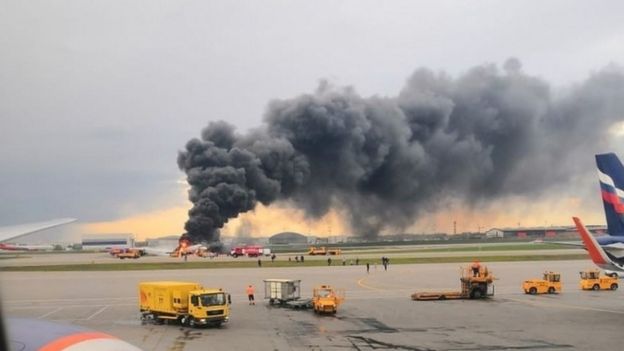 |
| Black smoke billows from the burning plane on the tarmac at Sheremetyevo airport AFP |
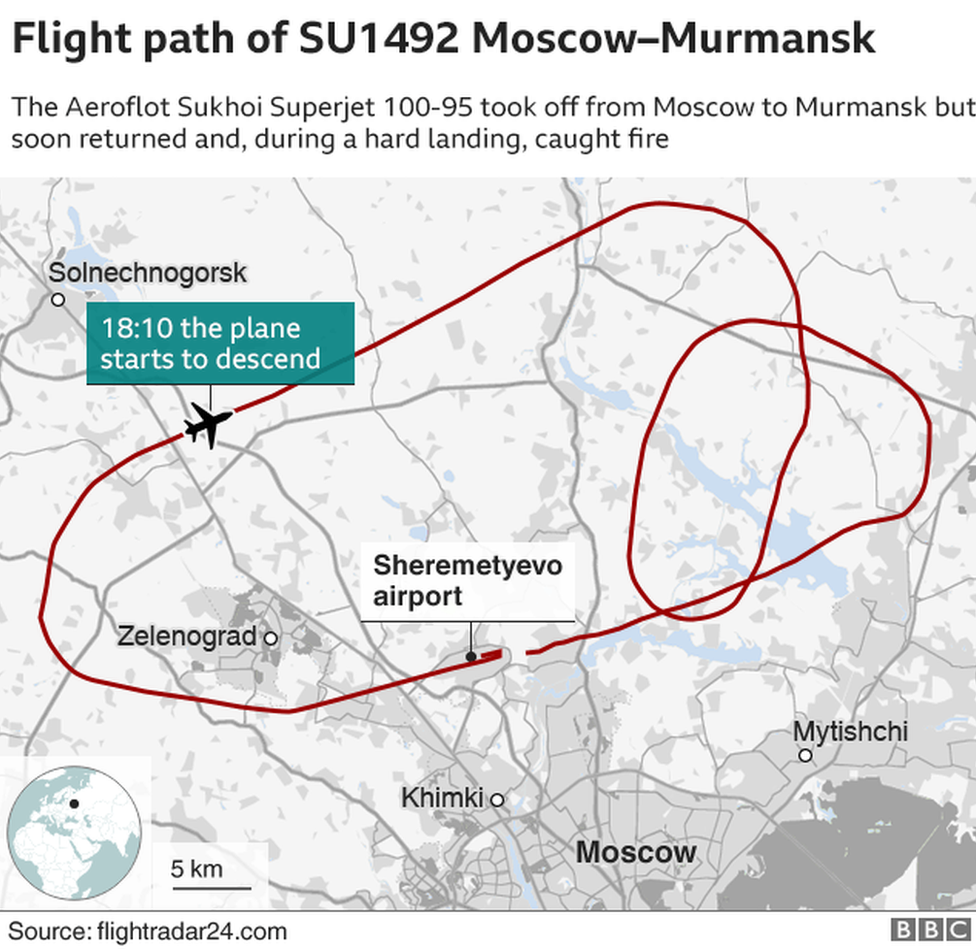
It had, said the plane's commander, Denis Yevdokimov, all started when lightning knocked out their radio and electronic guidance systems. The pilots, as a result, were forced to fly manually. The flight had left Moscow on Sunday en route to Murmansk, in northern Russia, a regular and popular flight. Shortly after takeoff the Sukhoi Superjet's pilots signalled distress, and circled back to return to Moscow for an emergency landing.
Under most such circumstances, a returning aircraft is instructed to rid itself of fuel. With communication down and instructions not forthcoming and time short, the plane arrived to the airport its fuel intact. As the plane bounced on landing, the tail struck ground causing it to burst into flames and that fuel fed the flames as the plane sped its course along the runway of Sheremetyevo International airport.
That the fuel was leaking and burning was the reality seen as flames spread on the tarmac. Even while passengers were descending via the inflatable emergency slides, attempting to flee from the blazing wreck. Of the 78 people on board the plane, 41 died, among them two children. A 22-year-old flight attendant, Maxim Moiseyev, stationed himself with the intention of assisting passengers toward the front doors.
He refused to leave himself -- as long as passengers remained on board. He had worked as a flight attendant for 14 months after passing a correspondence course in civil aviation which followed his completion of a military academy course and service in the Russian army. He died in the fire, one of the 41 victims.
Kommersant FM radio station reported that among the passengers, some insisted on retrieving their hand luggage from overhead compartments. Which served to slow down the evacuation. People behind were clamouring to exit the plane as it burned. But a handful of the passengers groped for their baggage, creating a lethal bottleneck in the single aisle.
Most of those who died had been seated at the rear of the plane. An investigative committee is considering three possible causes of the tragedy; inadequate crew and ground personnel training, technical malfunction, or bad weather. And it is conceivable that all three issues contributed to this disaster. The fuel tanks remained full because the pilots were unable to contact the tower.
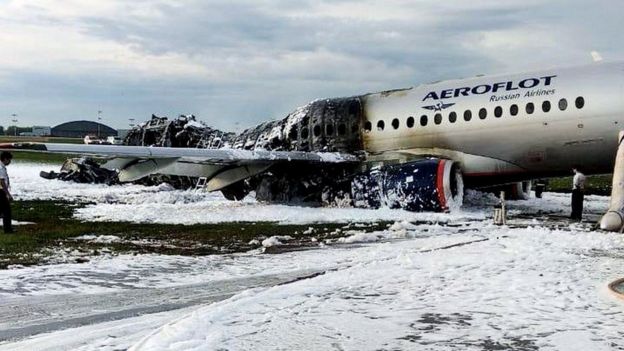 |
| The rear of the Aeroflot plane was completely burnt out Reuters |
Otherwise they might have been given the option to dump the fuel, or to circle over the airport in an effort to burn through the fuel. Coded signals were sent via transponder indicating the radio had failed. And four minutes before the disastrous landing, it was communicated that the pilots were facing an on-board emergency.
Over four thousand people signed an online petition for Russia to halt the flight of Superjets in the wake of eight safety incidents occurring in the past year in the face of denials by the transport minister that there might be any reason to ground the passenger airliner, the main domestically- produced plane.
It is a plane representing the nation's first newly designed, post-Soviet passenger plane introduced in 2008. At the plant in Siberia where the plane is manufactured, dozens of its employees were discovered to have false university engineering diplomas. A Superjet crashed into a mountain in Indonesia in 2012 during a sales demonstration flight, with all 50 people aboard killed. Attributed to pilot error.
The plane has been sold to a few other countries, among them Mexico. In Mexico 15 of its 22 Superjets were grounded this year by Interjet with complaints the plane's engine, a joint venture between French and Russian manufacturers, required too-frequent remediation work. Russia's air industry has a history of crashes, often attributed to pilot fatigue or error.
Statistically four times more dangerous than the global average for safety.
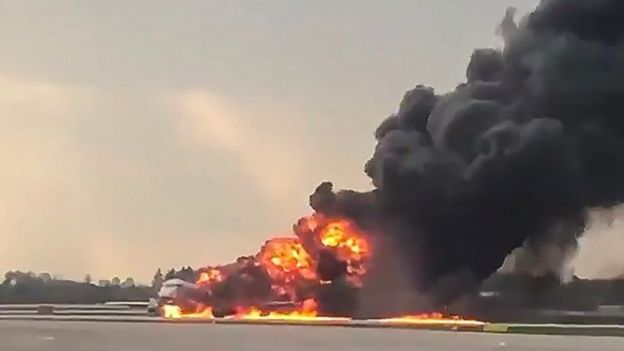 |
| The plane had just taken off from Sheremetyevo airport when it caught fire Getty Images |
Labels: Air Disaster, Flight Catastrophe, Investigation, Russia
Dame Fortune Frowned
"We request priority to proceed to the runway, we request priority to proceed to the locator."
"We have fuel problems."
"Now we have a total electric failure, we have a total electric failure."
"Help -- we need vectors to approach the runway."
LaMia flight crew
"The research now being carried out by national and international
aviation experts, based on the aircraft’s black boxes, as well as
technical examinations, will seek in the shortest possible time the
results that will allow us to establish the causes of this unfortunate
tragedy."
"[A lack of fuel was] most probably what caused this tragedy [but nothing had been
confirmed]."
Alfredo Bocanegra, director of Aerocivil
"Many passengers got up from their seats and started yelling."
"I put the bag between my legs and went
into the foetal position as recommended."
Erwin Tumiri, Bolivian flight technician, crash survivor
 |
Rescue teams work in the recovery the
bodies of victims of the LAMIA airlines charter that crashed in the
mountains of Cerro Gordo, municipality of La Union, Colombia, on
November 29, 2016
Raul Arboled / AFP / Getty Images |
Another stunning tragedy, with yet another Latin American sport team losing their lives in a flight to a game. An ill-conceived decision to fly with an airliner using short-distance planes capable of going so far and no further. The time allotted from departure to arrival would have worked, with sufficient fuel for the trip as long as the flight encountered no problems, there would be no need to deviate from the direct route contemplated, and that, in gambling parlance is taking a chance that fate would not intervene.
It did, predictably enough, when bad weather set in, delaying the flight and causing it to run out of fuel.
A short-haul plane operated by a charter airline was not the wisest course. But the team had flown previously with the same LaMia charter and thought highly of its services. On that previous occasion they had scored an important game victory, and hoped for similar results this time around on the Brazilian soccer team's Chapecoense plan to play in the Copa Sudamerica final in Medellin against Atletico Nacional.
Of the 77 souls aboard the ill-fated flight, 71 died in the crash, with six survivors left to detail what they had experienced. Just moments before the flight crew of the doomed plane contacted traffic control to advise of their plight, another aircraft had experienced cabin problems and had arranged with air traffic control at the Jose Maria Cordova International airport for an emergency landing.
The Viva Colombia flight was already in descent mode when the LaMia plane made their plea and was refused.

Luis Benavides / Associated Press Rescue
workers arrange the bodies of victims of the airplane crash.
The LaMia plane soon afterward crashed in La
Union, a mountainous area in the Andes, outside Medellin, Colombia. Three members of the Chapecoense team survived the crash, along with three other passengers.But before the flight crashed, a co-pilot from airline Avianca, in flight at the same time as the LaMia aircraft, overheard the desperate discourse between the the captain and the air traffic control. It too was awaiting permission to land.
The cockpit crew of the Avianca heard the exchanges and waited with bated breath for the outcome, hoping for the best. LaMia pilot Miguel Quiroga begged the control tower for permission to land, according to Juan Sebastian Upegui, a co-pilot from Avianca. The charter plane had descended to 9,000 feet, and pilot Quiroga was pleading for their assistance at the control tower.
As he sat in the cockpit of the Avianca plane, pilot Upegui strained his will to somehow, miraculously convince the fates that the other pilot's jet could make it. "I was saying, 'do it, do it -- land'." And then, finally, there was one last plea and everything fell silent on the radio; the outcome well known to the crew listening, tears streaming down their faces.

Raul Arboled / AFP / Getty Images Rescue
and forensic teams recover the bodies of victims of the LAMIA airlines
charter that crashed in the mountains of Cerro Gord
Labels: Brazil, Colombia, Flight Catastrophe, Soccer
Oops! Did We Say That? Well....
"Lufthansa will continue to provide the investigating authorities with
its full and unlimited support. [But
would not provide additional comment on the matter] because we do not
wish to anticipate the ongoing investigation by the Düsseldorf Public
Prosecutor."
Lufthansa statement
"I would warn against making the crew into completely transparent
people. That would just mean that someone would not go to a doctor."
Christoph Drescher, representative, Independent Flight Attendants Organization
One never knows what one may find when one goes looking. But now Lufthansa knows of a certainty what can be discovered in a search of its records. Goodness gracious, an email tucked away that someone overlooked. Andreas Lubitz -- despite Lufthansa iterating and reiterating that it had no idea because it hadn't been informed by the co-pilot that he was suffering psychological health problems -- had, after all, informed the airlines of his condition.
So despite his mental affliction somewhere deep down in his psyche he had an idea that someone with his problems might not be viewed as an ideal candidate to take charge of a cockpit in the opinion of those who do the hiring of airline pilots. He had wanted to rejoin Lufthansa's pilot training program after a hiatus of a month or so while having his mental state mentored by health professionals.
Honourably enough, under those earlier circumstances, the young man had forwarded on to the flight training school the explanatory email inclusive of medical documents setting out a
"previous episode of severe depression".
So the damning question of whether Lufthansa and its economy Germanwings operation had knowledge of Mr. Lubitz's fragile mental equilibrium has been answered, finally. Which leaves the question that has been iterated and reiterated why would they entrust the lives of passengers to someone whose background indicated such a degree of mental instability?
German investigating prosecutors indicated that Mr. Lubitz had in addition been treated for suicidal tendencies. No red flags, no warning light blipping into any flight authority's consciousness? Lufthansa's statement is not entirely forthcoming, having made no mention of when the depression had occurred, what treatment they knew of, or whether the airline had taken the responsive initiative to further investigate before declaring this candidate for flight captaincy 100% fit.
After all, Lufthansa's chief executive, Carsten Sphor, himself a former pilot, declared that Mr. Lubitz, a fine young man with a burning ambition to fly, was
"100 percent flightworthy without any limitations." Candidates for flight school, Mr. Spohr elaborated last week, were chosen not merely by demonstrating excellent technical ability, but also with an eye to their psychological fitness.
And Lufthansa's screening process was second to none.
Lufthansa's decision to readmit the young man to pilot training after a grave depressive bout now appears even more irresponsible and oblivious to passenger safety than ever, considering Mr. Spohr's statement regarding Lufthansa's screening to be state of the art
"and we're proud of it".
There are a lot of grieving families out there, and many of them are German families. Proud as they are of Germany's premier airline and its international reputation, they were prouder still of their family members.
Sixteen high school students from a town north of Dusseldorf where the plane was scheduled to land with 150 aboard, safe and sound, were killed in that deliberate crash. About half of that 150 death toll were German citizens.
Not only has Germany's reputation suffered as a result of many international passengers having met their death through seeming official disinterest in public safety, trumped by concern over one individual's right to achieve his aspirations against all logical indications otherwise, but German loss of life has also been wrenching.
Lufthansa, in revealing its utter and quite inexplicable lack of due diligence in such a vital matter, must have resigned itself to the certain knowledge that it will pay for its unforgivable lapse in operational judgement. Whether in the fallacy of the greater public interest in upholding the 'human rights' of individuals whom biology has fated not to hold such power in their mentally fragile hands, or gambling that nothing untoward would ever occur because who in their right mind would effect such a disaster?
Very few, in their right mind.
Lawsuits by grieving family members hoping to assuage their grief by any means possible? Entirely likely.
A search and rescue worker at the crash site of the Germanwings Airbus A320 in
the French Alps
Picture: AFP/Getty Images
Labels: Flight Catastrophe, France, Germany


