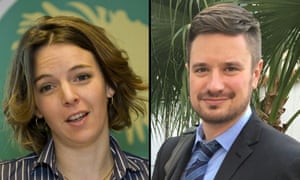
"I couldn't hear her voice [on released cellphone]." "I just heard lots of men talking in the background, not just a few but many, a group of men talking." Elizabeth Catalan, Swedish-Chilean, sister of Zaida Catalan
"What we hope for now is an independent international criminal investigation." "We can't depend on the Congolese government to do it." John Sharp, American citizen, father of Michael Sharp
Zaida Catalan and Michael Sharp were kidnapped with their interpreter
Betu Tshintela on 12 March. The bodies of all three were found two weeks
later.
Photograph: TT News Agency/AFP/Getty Images and Human Rights Watch
"Our colleagues in the DRC [Democratic Republic of Congo] have seen the
video and we are utterly horrified at what appears to be the killing of
Michael Sharp and Zaida Catalán." UN human rights spokeswoman
Ravina Shamdasani
"Our police and soldiers are accused of being implicated in the
assassination of the two UN experts. That is not the case. " "The images speak for themselves. It is not our soldiers that we see in
the video executing the two UN workers but the terrorists of the Kamuina
Nsapu militia." Government spokesman Lambert Mende
People are inspired to become cogs in the wheel of human rights justice.
And the United Nations appears only too pleased to take on these people
eager to do their part to make the world a better place by holding
corrupt governments accountable and hoping to be able to protect
vulnerable civilians through their actions and the revelations they
alert the world to. People like American Michael Sharp and
Swedish-Chilean Zaida Catalan, both contract investigators in their
mid-30s, neither of whom had received adequate training.
They travelled with interpreter Betu Tshintela, driver Isaac Kabuayi and
two motorbike
drivers into a remote area of Democratic Republic of Congo on March 12,
close to a remote village south of Kananga to investigate violence and
human rights violations attributed to the Congolese army and local
militias. They were determined to find who was responsible for a
massacre in the DRC. And Zaida Catalan was one determined person "Exciting development. I can maybe nail this bastard. Damn!", she wrote in her diary.
Which was not quite what happened. A cellphone video was made available
through the auspices of the Congolese government and shared with
authorities at the United Nations. It showed the two UN investigators
barefoot among a circle of armed men; the two forced onto the ground
with Mr. Sharp arguing. Shots are fired and Mr. Sharp is the first to be
hit. A screaming Ms. Catalan attempts to run away, and she is then
twice shot. At some point she is beheaded. When their bodies are finally
discovered in a shallow grave she is headless.
They have become two more UN-dedicated figures working for humanitarian
reasons and losing their lives because they were untrained, unprepared
and in the wrong place at the right time, investigating local corrupt
authorities who had no wish to be investigated. Two months after their
deaths the United Nations put together a panel to investigate why two of
their investigators were placed in such a compromised situation, and
paid the ultimate price for it in their innocent zeal.
As for the Security Council, it seemed content to leave the
investigation of the deaths in the capable hands of the very nation
where corruption and violence has swallowed billions in a failed UN plan
to usher in stability. Ms. Catalan and Mr. Sharp were focusing on the
role of the Congolese government in the chaos and deaths she was
investigating. Debate has arisen once again over the responsibility of
the United Nations to protect people it hires for the investigation of
wrongdoing; people they have a moral obligation to prepare for the job
they're undertaking.
The two investigators were part of a panel of six experts whom the
Security Council authorized to investigate rapes, massacres and the
exploitation of vast natural resources in the Congo. In pursuit of
answers to the questions consuming them, they travelled to places
considered no-go zones for United Nations employees. Little training was
given the independent contractors as investigators, and nor did they
have health insurance, or guidance on best practices in operating in
such hostile environments.
According to the Congolese government, their release of the video had a
distinct purpose; to prove that it was militia fighters, not its
soldiers, who were responsible for the murders. Ms. Catalan had been
scrutinizing a government official for his possible role in inciting
violence last year in the Congolese region of Kasai. Clement Kanku,
minister of development, more latterly dismissed, held close connections
with the area militia fighters and Ms. Catalan was in possession of a
recorded conversation linking Mr. Kanku to mayhem in the region.
The fact that she had this evidence against him was known to Mr. Kanku.
When it became known that something horrible had happened to the two
investigators it took four days for the United Nations to deploy its
forces from other areas of the country to begin a search.
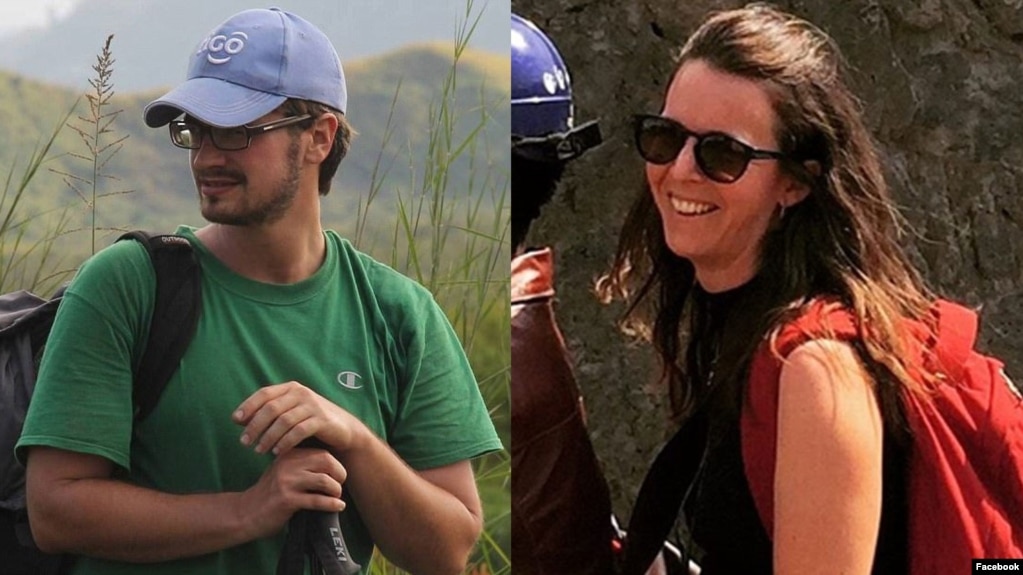
This composite image made from
photos on their respective Facebook pages shows UN workers Michael
Sharp, left, and Zaida Catalan. The two are among six people missing
from Congo's Kasai region since March 12, 2017.
Death -- of natural causes. His time had come. And some might add; none too soon. He had outlived his opportunities to make a meaningful difference to the people he claimed to have represented, in any event. Whenever the chance came, with great fanfare, to sign onto peace and relinquish his love affair with victimhood and vengeance, he chose, in the end, to reject that and clung instead to the refugee status that became so beloved of Palestinians.
Refugee status earned them something unique, something no other group of refugees in the world had ever achieved. The world, through the United Nations, felt obligated to respect their wish to be refugees forever. Other Arab nations were complacent with their decision not to embrace their fellow Arabs, inviting them to settle in parts of the Middle East where they might have made a new life for themselves. Their 'cause' was to be celebrated and pursued, but their absorption to be avoided.
But it wasn't a new life they wanted, they yearned for the old life they had left behind. Most leaving with the assurances given them by the very Arab states that now withheld citizenship from them, that they could leave briefly, allowing the combined armies of Israel's Arab enemies to wipe out the nascent state, returning the land sacred to Islam to those who worshipped the Prophet and treasured their Muslim status.
On the very cusp of a peace that earned Yasser Arafat one-third of a Nobel Peace Prize, he chose instead to instigate a return to violence and the Intifada was his designated choice to show the world that Palestinian anguish could not be bought off so easily as to surrender their animus to the intruders they claimed Jews to be, foreigners in a country never their own.
When Suha Arafat, living off the rich fat of draining off funding meant to support Palestinians by her corrupt husband and his corrupt colleagues, reinvested herself in the ongoing search for the "truth" of her husband's death, she no doubt was pleased no end that the French, the Swiss and the Russians were tasked with conducting scientific searches for the answer that would implicate demonic Israel in her husband's death.
The Swiss were obliging enough; the French less so, and the Russians, whose support for the Palestinian cause could not be questioned, announced their finding: "It was a natural death; there was no impact of radiation", according to Vladimir Uiba, head of the Federal Medical and Biological Agency. Yasser Arafat died of natural causes; no further investigation required.
The French probe found that traces of radioactive isotope polonium was present but their expert opinion was that it was "of natural environmental origin". As for the Swiss; the time frame of his illness and death, as far as they were concerned, appeared consistent with the causative of polonium poisoning.
So take your pick, one in the affirmative, two in the negative. Life killed Yasser Arafat.
"The intelligence agency gave us an unexpected briefing, saying that they had something urgent to report about a development of great import in North Korea. They said they believed that Jang Song Thaek had fallen from power." Jeong Cheong-Rae, lawmaker, Democratic Party, South Korea
North Korea's party daily Rodong Sinmun performed its propaganda obligations, exhorting North Koreans to embrace the "monolithic leadership of Kim Jong-un" and to be prepared to adoringly "follow him to the end of the world." His will be done.
All those who may feel within Seoul's government administration that their presence and their work on behalf of the new Great Leader is indispensable should take care to adjust their reality lens. No one is guaranteed to be viewed as of vital importance to Kim Jong-un and his continued reign of terror. To believe otherwise is to err -- dangerously.
This is a reality that appears to have been newly discovered by an uncle-by-marriage of North Korean leader Kim Jong-un. Married to his father's sister, Mr. Jang doubtless considered himself of huge importance in the executive scheme of his nephew's pomp and ceremony. After all, the 67-year-old Mr. Jang has been a valuable mentor to his nephew, a vital part of the North Korean power elite under Kim-Jong-il.
He and his wife Kim Kyong Hee, the sister of Kim Jong-il, the current leader's aunt, groomed the young man as designated heir after his father had a stroke in 2008. And with Kim Jong-il's death in 2011, they did their duty aiding their nephew to take power, assisting in a number of purges that resulted in the replacement of 44% of top party, military and cabinet officials.
It doesn't do, however, to exercise too much influence, inviting the critical, conniving eye of someone jealous of their own importance and any conceivable competition. Palace intrigues are sinister and devoid of compassion. Bit by bit the network that Mr. Jang had carefully constructed during the transition phase of government has been dismantled by his nephew.
Two of his deputies at the ruling Workers' Party of Korea were charged with "corruption and anti-party activities", and summarily executed. It's called the writing on the wall. There were, of late, fewer and fewer occasions when Jang Song Thaek was privileged by being given permission to appear in public with Kim Jong-un.
Now, Uncle Jang Song Thaek is nowhere to be seen. A guardian no more. Uncles propose, nephews dispose.
In this Saturday, July 27, 2013 file photo, North
Korean leader Kim Jong Un, second left, flanked by Yang Hyong Sop,
second right, vice president of the Presidium of North Korea's
parliament, his uncle Jang Song Thaek, right, and Choe Ryong Hae, vice
Marshal, left, as he tours the newly opened Fatherland Liberation War
Museum, as part of celebrations for the 60th anniversary of the Korean
War armistice in Pyongyang, North Korea. Two South Korean lawmakers say
they were told by intelligence officials that two associates of North
Korean leader Kim Jong Un's powerful uncle Jang were executed last
month. They say the uncle has not been seen in public since then and may
have been dismissed. There was no way to independently confirm the
report about Jang. (AP Photo/Wong Maye-E)
Starting Sunday in Cairo, U.S. Secretary of State John Kerry (C)
begins his 11-day tour aimed at shoring up ties with Arab nations that
have frayed in part over the Syrian conflict. (Reuters)
Al Arabiya
The Syrian foreign ministry on Sunday denounced statements by U.S.
Secretary of State John Kerry on Syria saying they could cause proposed
peace talks on the 32-month conflict to fail, Agence France-Presse
reported.
The repeated comments by Kerry “threaten to cause the
failure of the Geneva conference, are a flagrant violation of Syrian
affairs and an aggression against the Syrian people's right to decide
their future,” the ministry said.
Kerry, who is pressing a peace conference in Geneva, said in Cairo
on Sunday that Washington and its allies may differ over “tactics” on
the Syrian conflict but they shared the goal of a handover of power
“There
are some countries ... that wanted the United States to do one thing in
respect to Syria and we have done something else,” Kerry said during
his Cairo visit, which is the start of an 11-day tour aimed at shoring
up ties with Arab nations that have frayed in part over the war in
Syria.
But he insisted: “Those differences on individual
tactics on policy do not mean a difference on (the) fundamental goal of
the policy.
“We all share the same goal ... that is the
salvation of the state of Syria and a transition government put in
place...that can give the people of Syria the opportunity to choose
their future.”
Kerry also said that President Assad has lost his “moral authority,” and there needs to be a transitional government in Syria.
“We
also believe that Assad by virtue of his loss of moral authority cannot
be part of that ... Nobody can answer how you can actually end the war
as long as Assad is there,” he stressed.
Kerry is working with
his Russian counterpart Sergei Lavrov and U.N. special envoy Lakhdar
Brahimi to convene peace talks in Geneva. Geneva II is expected to
fulfill what has been agreed upon in last year’s conference, and that is
for a transitional government in Syria.
The U.S. is working
to unify the opposition, and it is hoping that the so-called Geneva II
talks can be held in late November. The opposition has insisted that
President Assad must cede power.
Kerry, meanwhile, is going to head later Sunday for Saudi Arabia, Riyadh, one of the main backers of the Syrian opposition. (With AFP)
This represents a general opinion site for its author. It also offers a space for the author to record her experiences and perceptions,both personal and public. This is rendered obvious by the content contained in the blog, but the space is here inviting me to write. And so I do.