The Ottoman Empire Still Lives in Cyprus
"Eide [Espen Barth Eid, UN envoy] should understand that statements or threats will produce results contrary to the goal of reunifying Cyprus ... the less is said, especially on his part, the better."
Greek Cyprus President Nicos Anastasiades
"The peacekeeping operation in Cyprus, from 1964 to today, is one of
Canada's longest and best-known overseas military commitments. A large
Canadian contingent served on the island from 1964 to 1993, and a small
Canadian Armed Forces presence remains there today as United Nations
(UN) peace efforts continue."
"In total, more than 25,000 Canadian Armed Forces members have served
in Cyprus over the decades. Many of them served in Cyprus more than
once, participating in several rotations."
Veterans Affairs Canada

Turkey languishes in misery at the constant memory of what it lost in prestige and territory when the Ottoman Empire fell. It cannot restore what it lost in its entirety for obvious reasons, but there is an island geography that Turkey feels should, at the very least, be returned to its guiding influence and tender care. On Cyprus Turks and Greeks faced off on one another with murderous intent when Turkey decided to invade. To this day, Turkey maintains 35,000 of its troops on the island. Essentially, Turkey 'occupies' the northern third of Cyprus and has, since 1974.
This is the Turkey whom its President, Recep Tayyip Erdogan, ascribes nobility to, as a force for peace and stability throughout its region. This is the man who sneers at the indefensibility of the Israeli occupation of 'Palestine'. The man who regards the terrorist group Hamas, as the very epogee of responsible government. This same man decries the installation of the wall separating Israel from the Palestinians who without the presence of the wall, committed countless murderous assaults on Jewish civilians in Israel. Erdogan bemoaned the fascist Jews committing a holocaust on Arabs.
There were 'disappearances' and mass graves, and thousands of deaths on Cyprus because of the Turkish invasion. Now Turks and Greeks live separated lives for fear of violence restoring the period of aggression and counter-aggression on the island, a place divided against itself for the past 43 years. There were hopes the island could be reunified. Mustafa Akinci, the Turkish Cypriot leader, and Nicos Anastasiades, his Greek counterpart, appeared to get on well together.
The future of Cyprus, at the time of the UN and the EU dismantling obstacles toward reunification, was envisioned as a democratic federated republic. Its Christian and Muslim communities viewing one another as equals, finally. But then, at the turn of the year in Istanbul, Recep Tayyip Erdogan said:
"Turkey will be in Cyprus forever", when he was asked of the disposition of the illegal presence of the 35,000 Turkish troops on Cyprus.
That bald statement began a descent in Cyrprus' fortunes once again when following the declaration of a state of emergency post-coup attempt, Erdogan was led to dispatch naval frigates to conduct 'military exercises' in Cypriot waters. In the process harassing Cypriot ships busy with seismic research off the Cypriot coast, they being within the Cyprus Exclusive Economic Zone. UN Secretary-General Antonio Guterres was informed by the Cypriot government that Erdogan's behaviour was sabotaging reunification talks.
Even before that, Greek Foreign Minister Nikos Kotzias complained that the UN envoy Espen Barth Eide was demonstrating biased behaviour favouring the Turks. So now Cypriot opposition politicians demand he be removed from his post. A thousand UN troops remain on Cyprus, patrolling the 1974 green line demarcating the territory controlled by the Republic of Cyprus, the internationally-recognized portion of the island, and the northern third, illegally invaded and occupied by Turkish troops.
Four-fifths of the population of Cyprus is comprised of Greek Cypriots. One-fifth of the population represents Turkish Cypriots. Before the Turkish invasion of Cyprus, Greeks and Turks were neighbours and behaved civilly toward one another. Erdogan is busy stirring the black pot of poisonous malice as only he knows how to do. Where are UN peacekeeping troops deployed all over the world? Where Islamist threats are rife.
Labels: Conflict, Cyprus, Greece, Turkey, United Nations

Will Egypt's Zohr Gas Field Sink Israel's Leviathan?
Originally published under the title "Will ENI's Discovery in Egypt Sink Israel's Leviathan?"
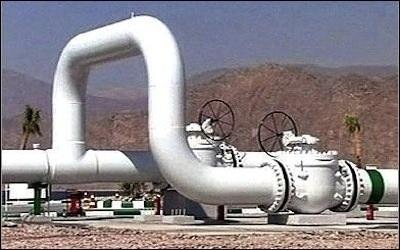
Egypt's gas pipeline to Israel
|
The discovery of the Italian energy company ENI of a giant gas field
off the coast of Egypt has transformed the East Mediterranean energy
play overnight. The newly discovered field called Zohr could hold a
potential of 30 trillion cubic feet of gas – the largest discovery in
the region, thirty percent larger than the Israeli Leviathan field,
which held the title until today.
Zohr's entry into the scene is a true game changer. It delivers a
painful blow to both the Israeli and Cypriot economies, and more
specifically to the gas partners, Delek Drilling and Noble Energy, which
until now have held the only discoveries in the region: Tamar,
Leviathan, Karish, and Tanin in Israel and Aphrodite in Cyprus. The
finding will essentially annul the MOUs Israel and Cyprus recently
signed with Egypt to supply gas to the domestic Egyptian market.
Egypt's Zohr gas field is 30% larger than Israel's Leviathan and easier to develop.
|
It will also kill any near-term hope for Israeli and Cypriot gas to
feed the two idle LNG terminals in Egypt, which are craving for gas
supply. Much shallower than Leviathan, Zohr would be easier to develop,
and ENI, which has been operating in Egypt for decades, is not likely to
face any of the regulatory obstacles Noble and Delek have faced in
Israel. ENI believes it can begin to develop the field as early as next
year whereas the current timing for the development of Leviathan is
still unknown.
Other than being a major shot in the arm to the struggling Egyptian
economy the discovery raises again the prospect of LNG export to those
countries in Europe that own regasification terminals, most importantly
Italy, and - with the recent expansion of the Suez Canal - even to the
Asian market. For Delek and Noble this fruit is hanging too high.
Those two companies are facing a do or die moment, at least when it
comes to their East Med operations. Just two weeks ago the Israeli
cabinet approved the regulatory scheme to allow the consortium partners
to develop Leviathan - more than five years after its discovery.
However, the plan needs approval from Israel's Parliament, the Knesset,
where even pre-Zohr it faced fierce opposition from many lawmakers on
the ground that it does not do enough to ensure low prices and introduce
competition. The new discovery is likely to give fodder to the
naysayers who will refuse to surrender to Noble and Delek's price
demands, reducing the chance of a Knesset approval of the deal.
Lack of LNG infrastructure in the region and huge cost of undersea pipeline construction require an alternative delivery system.
|
There seems to be no end to the
Via Dolorosa that Delek and
Noble have had to endure.
Facing the likely loss of their largest
customer – even the Jordanian market is far from secure as Jordan
intends to build an LNG terminal in Aqaba and could then absorb Egyptian
gas – as well as the inevitable downward pressure on the price of East
Med gas, the two companies will have to go back to the drawing board and
rethink their entire strategy The only hope for the consortium is to
focus on developing those parts of the European market where they could
still have competitive advantage: Greece, Cyprus, perhaps Turkey. But
the lack of LNG infrastructure in this part of the Mediterranean and the
huge cost associated with construction of undersea pipelines require an
alternative gas delivery system.
This is the time to take a hard look at the option of marine CNG
(Compressed Natural Gas), the cheapest, simplest and safest way to
transport stranded offshore gas to regional markets within the range of
2,000 kilometers. Unlike LNG, CNG does not require liquefaction of the
gas and therefore it avoids the need for costly LNG facilities.
There are many other reasons why it makes more sense to squeeze the
gas than to freeze it: superior energy balance, no boil off, no need for
cryogenic materials and simpler gas reprocessing. More, it enables
island countries like Greece and Cyprus that are either too small or too
poor to enter the LNG play to switch their electricity sector from
costly liquid fuels to low cost natural gas. The technology to deliver
gas as CNG already exists and it is certified for maritime
transportation by the American Bureau of Shipping. The problem is that
to date it has never been implemented in any market. There are many
customers who want to be second in line to adopt it, but no one wants to
be the first. But desperate times call for desperate measures and the
economic distress of the Greek and Cypriot governments coupled with the
distress of the consortium members can bring about a revolution in the
way natural gas is transported globally. Roughly half the offshore gas
of the world is stranded in fields that are too small for LNG
development. With CNG this gas can reach its markets, where it can
replace oil in both power generation and as transportation fuel.
Government foot-dragging in developing Israel's gas sector is proving costly.
|
The discovery of Zohr reaffirms two realities. The first is that the
East Mediterranean is the new frontier in oil and gas production and we
can expect much more product to come online with further exploration and
hence more competition to the incumbents.
The second, and this lesson is for Delek, Noble and the Israeli
government, is that the energy world is not sitting idly by. The
foot-dragging of the Israeli government in developing the gas sector may
now cost the consortium members their hegemony in the regional gas
market – if not their entire future. Only innovation can be their
rescue.
Gal Luft is
co-director of the Washington-based Institute for the Analysis of Global
Security and a fellow at the Middle East Forum.
Related Topics: Egypt, Israel & Zionism, Oil | Gal Luft
Labels: Cyprus, Economy, Egypt, Energy Resources, Israel
 The Turkish invasion of Cyprus in 1974 led to the island's partition
Turkey
must pay 90m euros (£73m; $123m) in damages over its 1974 invasion of
Cyprus, according to a decision by the European Court of Human Rights.
The judgement is one of the largest ever ordered by the court.
It said the damages were compensation for losses endured during the invasion and in the subsequent partition.
Cyprus has been divided since 1974 when Turkey invaded the
north in response to a military coup on the island which was backed by
the government of Greece.
Since then, the northern third has been mainly inhabited by Turkish Cypriots and the southern two-thirds by Greek Cypriots.
In Monday's ruling, the European Court of Human Rights found
that Turkey was still liable for damages, despite the passage of time.
The court ruled that Turkey should pay 30m euros for the
suffering endured by relatives of people who had gone missing during the
invasion.
It ordered Turkey to pay a further 60m euros for the
suffering of Greek Cypriots who live in the Karpas peninsula - an
enclave within northern Cyprus.
Turkey has not always complied with previous rulings by the body, Europe's top court of human rights.
Turkey still has around 30,000 troops stationed on the
island, and it is the only country that recognises northern Cyprus as a
separate entity.
UN peacekeeping forces estimate that 165,000 Greek Cypriots
fled or were expelled from the north, and 45,000 Turkish Cypriots from
the south, although the parties to the conflict say the figures are
higher.
Greek and Turkish Cypriot leaders are engaged in a new round of talks aimed at reconciling differences and reuniting the island
Labels: Aggression, Cyprus, Greece, Turkey
Turkish Cypriots seek EU help on peace process
Turkish Cypriots seek EU help on peace process
27.07.13 @ 11:54
BRUSSELS - Turkish Cypriot leader
Dervis Eroglu is urging the EU to give his people a greater role in
upcoming talks on the 45-year-old Cypriot conflict.
Eroglu met with European Commission President Jose Manuel Barroso, EU
enlargement commissioner Stefan Fuele and a handful of ambassadors from
some of the larger EU member states in Brussels on Thursday (25 July).
His spokesman, and the Turkish Cypriots' head negotiator in the
talks, Osman Ertug, told EUobserver that Greek Cypriots are using EU
structures to pass on their own solutions on the conflict directly to
Ankara.
“They are trying to use the European Union as a vehicle to send some
proposals to Turkey, not to us … It is the Turkish Cypriots that they
should address," he said.
“It is condescending - that is the wrong message,” he added.
The island has been divided between the Turkish Cypriot north and the
Greek Cypriot south since 1974, when Turkish troops invaded amid a
Greek coup, in events with roots in 19th century British colonialism.
Both sides suffered heavy death tolls at the time.
Some 180,000 Cypriots, or a third of the Greek population, were also
expelled from their homes and driven across the line to the south.
With the UN-mediated talks due to restart later this year, possibly
in October, Ertug voiced frustration with lack of progress over the past
four and a half decades.
He said the status quo has forced the north into isolation, due to
trade embargoes and lack of access to an international airport.
But he has little faith the Greek Cypriots are willing to share wealth or power with his side.
“That is based not just on historic reasons but also on the present
approach of the current leadership, which has so far been proven to be
no different from the previous,” he said.
He accused the Greek Cypriots of raising tensions in the run-up to
October by using US and Italian firms to drill for gas in disputed
maritime territory.
He said they plan to buy two Israeli warships to guard the operations.
He noted that recent Greek Cypriot legislation which bans the use of Turkish names in official documents has not helped.
Amid the mistrust, he also floated the idea of a two-state solution instead of the EU-and-UN-backed idea of reunification.
“We are at a point where the Greek Cypriot side has to decide whether
they will start the negotiations with us in a result-oriented manner as
soon as possible with the intention to resolve the Cyprus issue once
and for all,” he said.
"It is time to bury the hatchet,” he added.
A Cypriot source close to the issue, who did not want to be named,
told this website that the Greek side wants dialogue with Ankara because
Turkey makes all the decisions.
“Sixty percent of the budget of the Cypriot Turkish is covered directly by Ankara,” he noted.
With 40,000 Turkish troops and a large Turkish minority in the
territory, the contact said establishing a foothold with Ankara via the
EU is part of a broader effort to help broker a practical solution.
“We have no problems with the Turkish Cypriots, we have the same way
of living, of thinking, we have only problems with Turkey’s policy,” he
said.
The contact denied that Nicosia is planning to buy Israeli warships.
But he said any future gas platforms, which are to be shared with Israel, off the Cypriot coast may need military protection.
“We are working very closely with Israel. Our co-operation is based
on common interest in hydrocarbons, of course the Turkish Cypriots have a
right to these hydrocarbons and they can exercise that right after a
solution has been found,” he noted.
Meanwhile, another bone of contention is Varosha.
Part of the divided city of Famagusta, the Varosha strip was once a favoured party spot for the rich and famous.
It is now part of Turkish Cyprus, but it is also a ghost town, with crumbling beachside hotels.
Ertug says Varosha can only be part of a comprehensive settlement,
and that its fate cannot be decided in separate negotiations.
“Varosha is a very valuable piece of territory, it’s like our trump card, in a way,” he told this website.
For his part, the Cypriot contact says Greek Cypriots plan to put forward a "win-win" proposal in the new peace talks.
They want Varosha to be run by the UN in order to expedite its reconstruction.
In return, they will open trade with the port in Famagusta and allow
the Cypriot Turkish side to export directly to the EU market.
The port is currently under Turkish military guard and is being used
by the Turkish Cypriots, but it is not internationally recognised.
They also want Turkey itself to open its airports and ports to Greek
Cypriots - if Ankara agrees, then Cyprus will lift its 2009 veto against
Turkey’s accession to the EU.
“We want a reunified Cyprus and we need a game changer and a step towards a solution,” the contact said.
Labels: Conflict, Cyprus, Turkey


