There are International Rules of War ... and There are International Rules of Israeli War
"Once a city of 270,000 at the southernmost area of the [Gaza] Strip, Rafah has been the focus of intense combat at various times since October 7, 2023.""Today, the city lies in ruins. Driving on a newly paved road -- in a convoy of military vehicles with heavy protection -- we passed through piles of twisted rebar, demolished buildings and rubble.""The intact shell of one building stood, in stark contrast to the desolation.""After about 15 minutes we arrived at our destination -- a massive humanitarian aid complex that was near completion. The Israel Defense Forces' international spokesman, Lt.-Col. Nadav Shoshani explained that the Gaza Humanitarian Foundation, a U.S.-based not-for profit, will operate the centre which will have the capacity to provide millions of meals daily to displaced civilians."Vivian Bercovici, Israeli journalist
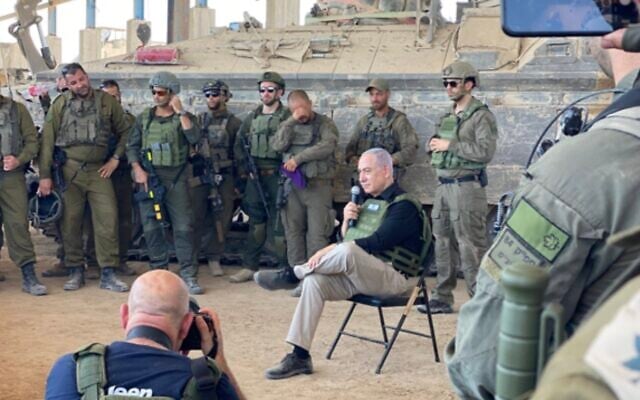 |
| Prime Minister Benjamin Netanyahu speaks to IDF troops in Rafah on the Gaza-Egypt border, July 18, 2024. (Avi Ohayon/GPO |
The
location of which she writes is not far from the Egyptian border.
Egypt, it should be noted, has recently accused Israel of committing
'genocide'. Egypt, it should also be noted, has steadfastly refused to
open its border with Gaza to permit Palestinians fleeing the conflict in
Gaza to enter the Sinai. Should that be interpreted as Egypt placing
itself deliberately in a position of complicity in genocide? After all,
Egypt, until it marched on Israel in 1967, occupied Gaza, and many
Gazans of today trace their ancestry to Egypt.
Israel
is now, once again, fighting for its existence. This time, not against
the massed armies of its neighbours, but the terrorist groups that some
of its neighbours in the Middle East have supported. Could an
existential situation be more complex than that of Israel, when it has
finally been able to sign peace treaties with some of its Arab
neighbours, while the terrorist groups in Yemen, Lebanon and Gaza along
with those in Iraq, all loyal to the Islamic Republic of Iran, and by
extension Qatar, seek to demolish the Jewish state?
In
responding to the violently lethal threats of Iran's proxy militias and
Iran itself, Israel risks alienating its Arab neighbours with whom it
has signed those peace agreements. Egypt, a case in point, has assembled
its military in large numbers along its border with Israel, as though
it is preparing to launch a war against a neighbour it has long since
pledged peace with. And nor is Israel's plight one restrained to the
Middle East. Its Western allies in Europe and elsewhere now accuse it of
disproportional force against its enemies.
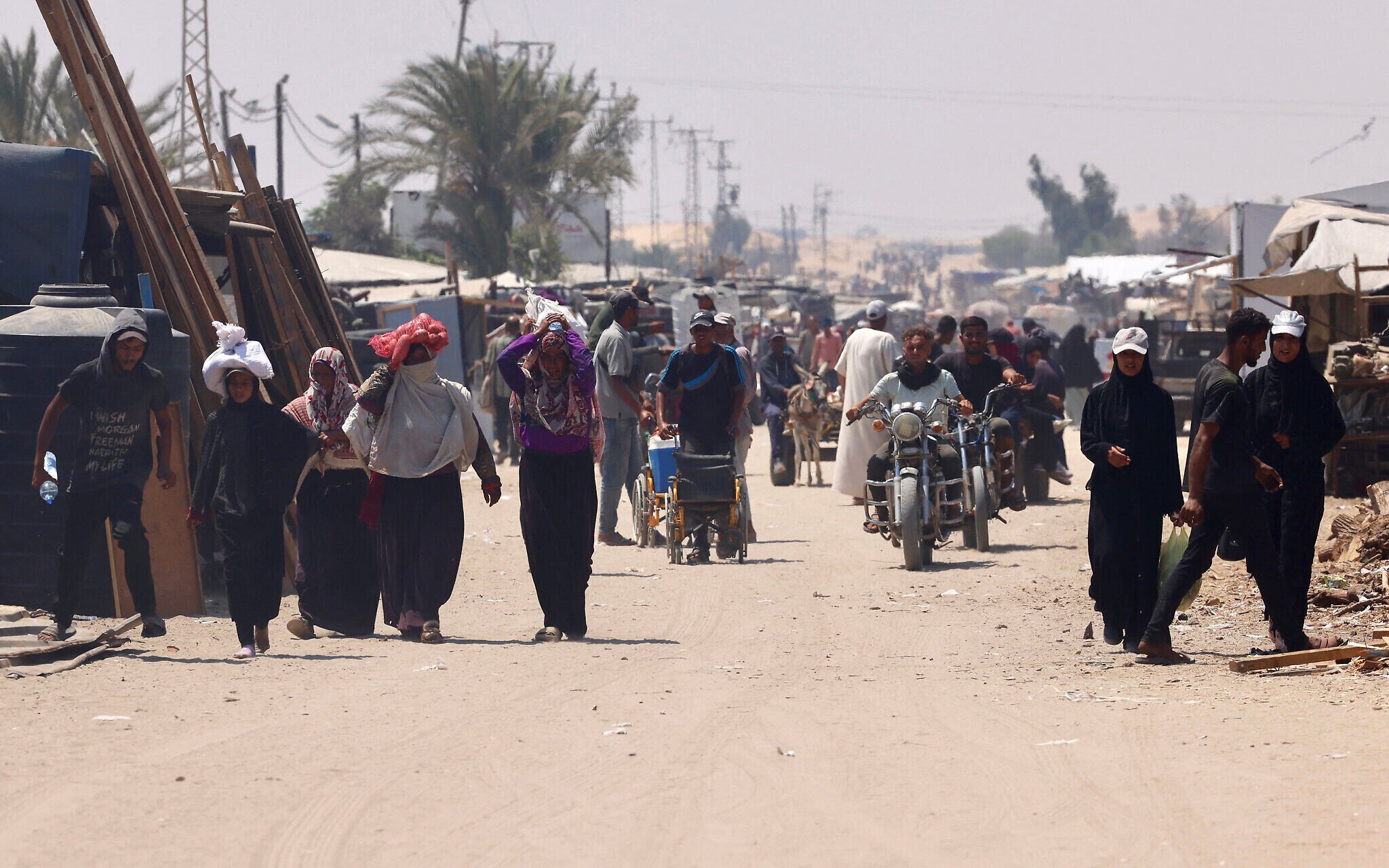 |
| Palestinians carry humanitarian aid that they gathered after an aid drop, as they walk in the al-Mawasi area of Rafah in the southern Gaza Strip on August 18, 2025. (AFP) |
These
are death-cult Islamists whose charters declare their purpose is to
destroy Israel and to kill Jews. In responding to the deadly attack of
October 7, 2023, where thousands of terrorists crossed into southern
Israel to rape and to maim, to plunder and to murder, Israel had little
choice but to invade Gaza to hunt down Hamas's leaders and its
operatives. In doing so, its northern border with Lebanon saw another
terror group, Hezbollah, rain missiles down onto the Golan Heights at
Israeli communities.
And
before long, the Houthi terrorists in Yemen responded as well,
attacking shipping in the Red Sea, asserting that any vessels with any
connection to Israel would be targeted; in the process upsetting marine
traffic internationally. Yet Israel's traditional allies, in the full
knowledge that Hamas and Hezbollah, the Houthis and the Iranian Republic
use their own civilian populations as shields to protect the
'mujahadeen' from Israel's military responses to their attacks, focus on
the plight of the civilian population in Gaza where a 'moral' military
prewarns citizens of attacks and does its utmost to minimize civilian
casualties.
 |
| Egypt's Foreign Minister Badr Abdelatty attends an Arab officials’ meeting in Riyadh on January 12, 2025. (Fayez Nureldine / AFP) |
During
an all-out conflict when a nation is forced to commit itself to a war
against those who relentlessly and continually attack its citizens, the
internationally acknowledged rules of war affirm that such a nation has
the right to defend itself and its population and to counter-attack the
offender out for its blood. By concealing themselves among the
population for cover, and by using civilian infrastructure for command
bases and by firing off missiles from launch sites deliberately placed
in crowded civilian areas, Hamas has with intention, placed its civilian
population in direct line of danger.
It
uses the statistics it gathers on casualties among the civilian
population, to convince the international community of Israel's
intention to commit 'genocide', a charge that is not only a risible
slander, but one that reality itself denies. What other country at war
in the annals of international conflict through the ages has ever been
expected to defend itself and obliterate an enemy sworn to its
destruction, while also protecting a civilian population and to feed it,
while its enemies are known to hijack humanitarian aid meant to avoid
starvation among Gaza's civilians?
Hamas
has in its possession, the remnants of 250 hostages it originally
kidnapped from Israel and took to Gaza to torture and starve and even
slaughter, because Jewish bodies, alive or dead are bargaining chips of
great value to the Hamas terror machinery knowing full well that Israel
attempts to move heaven and earth to rescue its people imprisoned in the
underground hellscape of Gaza, including those held for ransom by
Palestinian civilians in Gaza, who support the sadistic cruelty of their
leaders in savaging Jewish lives.
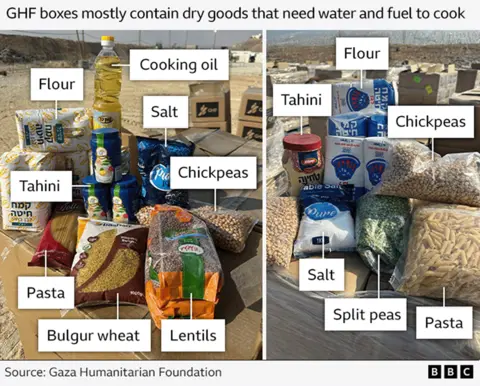
"The Muwasi-adjacent site will be operated by GHF and offer ready access to food and other life essentials in a safe, controlled environment.""Civilians will walk a 500-metre path, flat and secure, far from Hamas fighters or criminal gangs.""Once inside the complex they will receive food aid to last several days and within minutes return to their temporary shelters in Muwasi.""To avoid panics and crowd surges the centre would be operational 24/7 if necessary and supplies will be delivered by truck using the same road we took. At a minimum, basic life necessities will be available."Vivian Bercovici, Israeli journalist
Labels: Egypt, Hamas, Hezbollah, Houthis, Islamic Republic of Iran, Israel, Israel's Western Allies, October 7/23
posted by Pieface @ Sunday, September 07, 2025


