Russian Barbarism
"We went into the yard. People were injured.""Then the cars caught fire. We tried to extinguish them with car fire extinguishers.""And I got a little burned."Viktor Bukhta, resident, Sviatoshynski district, Kyiv, Ukraine"[I was] astonished by the complacency] of members of the organization [he leads, the International Atomic Energy Agency, relating to the dangers faced by the Zaporizhzhia nuclear plant].""What are we doing to prevent this happening? We are the IAEA, we are meant to care about nuclear safety.""Each time we are rolling a dice. And if we allow this to continue time after time, then one day our luck will run out.""Today's loss of all external power once again demonstrated how fragile and dangerous the situation is for the Zaporizhzhya Nuclear Power Plant."IAEA Director-General Rafael Mariano Grossi
 |
| UN nuclear chief sounds alarm as Zaporizhzhia plant reconnected – video |
“The occupiers can only terrorize civilians. That’s all they can do.""But it won’t help them. They won’t avoid responsibility for everything they have done."Ukrainian President Volodymyr Zelenskyy
A
massive missile and drone barrage was unleashed on Thursday by the
Russian military, smashing into residential buildings and critical
infrastructure across Ukraine. The large, wide-ranging attack placed the
largest nuclear plant in Europe at risk, knocking off the power grid
used by such plants for the constant power required to operate their
cooling systems in avoidance of a meltdown. This represents the latest
threat to the Zaporizhzhia Nuclear Power Plant, raising the spectre of a
catastrophic nuclear event.
All
throughout Thursday night, air raid sirens blared, while the attacks
were geared to target a wide swath of the vast country. Western Ukraine,
far from the front lines, was not immune to this attack. The assault,
according to President Volodymyr Zelenskyy, arrived while people slept;
an attempt by Moscow "to intimidate Ukrainians again".
The
strikes, according to the Russian Defence Ministry, were justifiable as
retaliation for the recent incursion into the Bryansk region of western
Russia by Ukrainian 'saboteurs'. The Russian accusation was denied by
Ukraine, warning that these allegations would be used by Moscow to
justify an increase in its assaults against Ukraine. That the incursion
over the border was carried out by Ukrainian servicemen to show Russians
that they aren't immune to the same kind of treatment their country is
imposing on Ukraine, is another matter altogether.
The
battlefield has been quiescent over the winter months despite that
Kremlin forces mounted a strategy to target the Ukrainian power supply
in late fall; a strategy to demoralize and strike apprehension into the
Ukrainian population, facing the winter without heating, water and any
comfort from the cold. The plan went awry when the Ukrainian population
remained defiant and trusted their government to employ all means to
repeatedly restore energy.
When
the attacks became sporadic and less frequent, it led to speculation by
military analysts that Russia might be running low on ammunition.
Mid-February saw the last major bombardment. But on Thursday, Russia
launched 81 missiles and eight exploding Iranian-manufactured Shahed
drones, according to Valerii Zaluzhnyl, Ukraine's chief commander of the
armed forces. Of the total strikes, 34 missiles were intercepted,
along with four drones.
Air
defences found it difficult to cope with the onslaught, given the
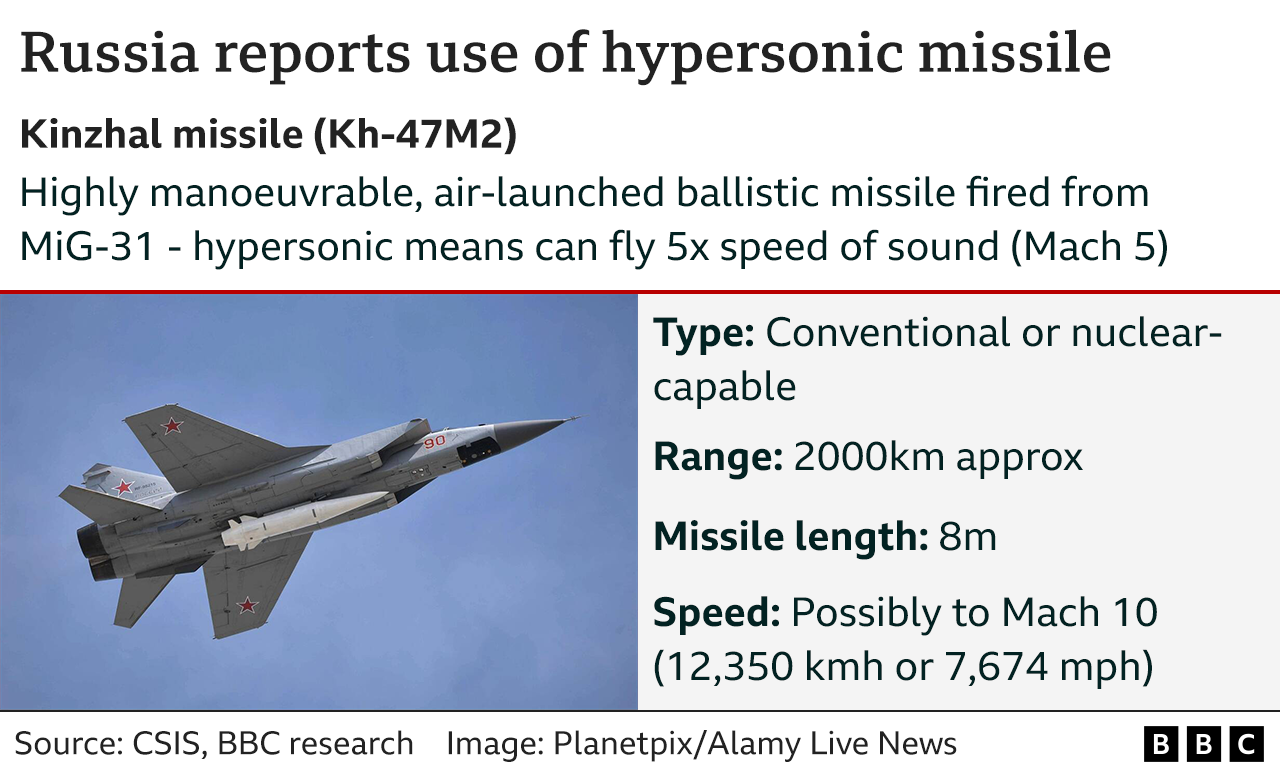
mixture of munitions. Six hypersonic Kinzhal cruise missiles were among
the weapons striking Ukraine. These missiles represent the most
sophisticated weapons in the Russian arsenal; Ukraine has no air
defences capable of intercepting them. The Russian Defence Ministry
boasted that the barrage hit military and industrial targets "as well as the energy facilities that supply them".
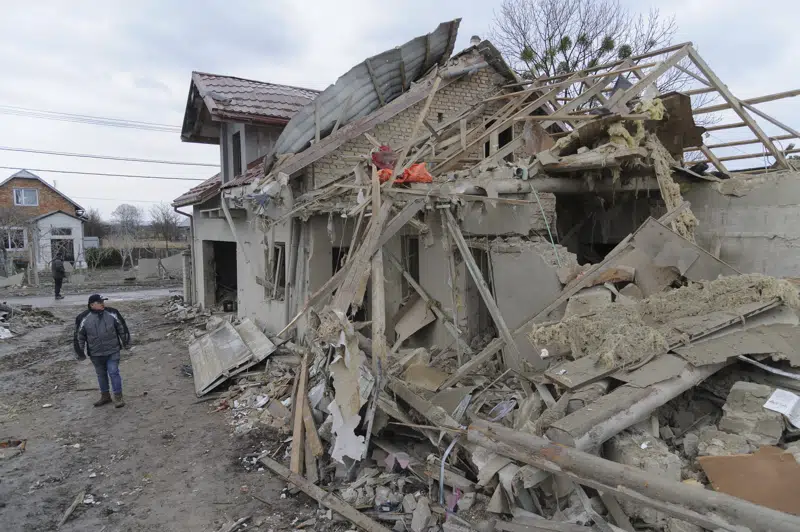 |
| A villager passes by debris of private houses ruined in Russia's night rocket attack in a village, in Zolochevsky district in the Lviv region, Ukraine, Thursday, March 9, 2023. (AP Photo/Mykola Tys) |
The
truth is, Russia doesn't really care what it hits; targeting civilian
infrastructure along with military emplacements. And once again, as has
happened repeatedly, with disastrous results, civilian areas were
struck, homes and apartment blocks hit with predictable results, the
buildings destroyed. Fortunately, loss of life was minimal, but then
those that die had no intention of abandoning life. There was no damage
to the army's combat capability as a result of the missile strikes,
It
is, however, an assured tactic that in sending the barrage right across
the country far from the front lines, it is the population that is
being targeted with intimidating tactics; kept on edge, never knowing
where the next missile will strike, and whether they will be deprived of
home, and possibly their very lives and those of their loved ones.
Escape to bomb shelters in the middle of the night is not a particularly
comforting prospect; it saves lives, but cannot preserve a sense of
equanimity.
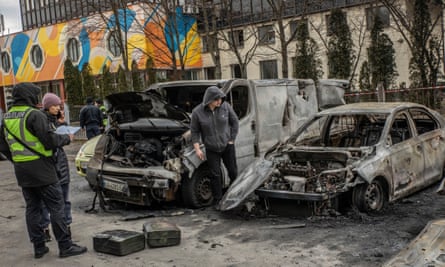 |
| Forensic police survey the fragments of missiles that fell near a residential building in Kyiv’s Sviatoshynskyi district. Photograph: Alessio Mamo/The Guardian |
An
estimated fifty percent of households in the capital, Kyiv, were
without heat. The same situation prevailed in Ukraine's second largest
city, Kharkiv, where water was also cut. The temperature hovers around
the freezing mark, deprivation of heat and of water is a miserable
experience. And this is precisely what Moscow envisions in store for the
population of Ukraine, to apply pressure to its government to agree to a
cessation of hostilities, completely on Moscow's terms. Primarily for
Kyiv to accept the loss of a third of its territory -- for starters.
In
the northwestern Zhytomyr region, hundreds of thousands of households
were without power. In Odessa, emergency blackouts resulted from damaged
power lines. The IAEA has teams of experts at all four of Ukraine's
nuclear power plants, with the intention of reducing the risk of severe
accidents.
"No military objective, just Russian barbarism",
tweeted Ukrainian Foreign Minister Dmytro Kuleba, scathingly. According
to Kyiv's city administration, the capital was attacked both with
missiles and exploding drones, many of which were intercepted, despite
which the city's energy infrastructure was hit and damaged.
 |
Labels: Bombardment of Missiles, Civilian Enclaves, Death and Destruction, Drones, Energy Infrastructure, Russian Invasion of Ukraine
posted by Pieface @ Saturday, March 11, 2023


