Desperate Migrants, Desperately Unwilling Havens
"The Taliban have real leverage, and the European Union is quite powerless.""European countries are under so much pressure that they are ready to do almost any deal to remove criminal refugees."Conrad Schetter, director, Bonn International Center for Conflict Studies, Germany"The question is if it is indeed safe to return anyone to Afghanistan under the Taliban rule.""No-one should be deported to Afghanistan given the dire human rights and living situation there.""This is a fundamental principle of international refugee law, the non-refoulement principle."Law professor Lena Riemer, Central European University, Vienna"This was a historic visit as first time ever that delegation from Islamic Emirate visited the EU and held talks with member states in Brussels.""[They spoke about] restarting broad-range consular services for Afghans in EU zone, including need for trust-building measures, consular presence and dignified return process."Abdul Qahar Balkhi, spokesperson, Taliban Ministry of Foreign Affairs
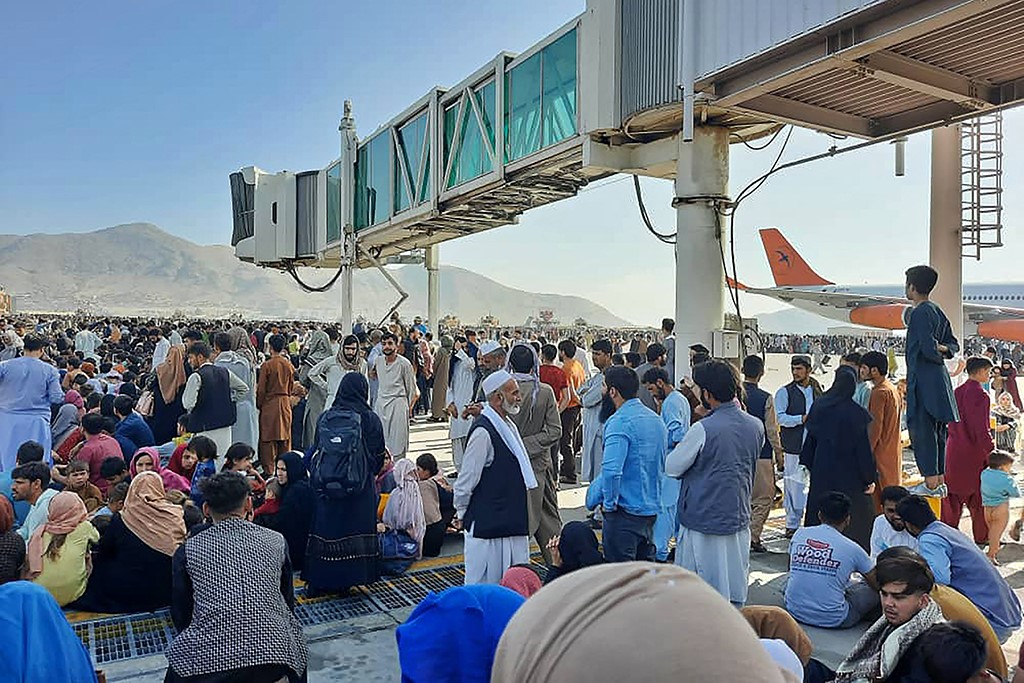 |
| Kabul airport after the Taliban takeover of power in Afghanistan on 15 August 2021, credit: Belga |
"Any engagement with the Taliban needs to prioritize protecting human rights and accountability — not deporting people to danger there.""EU countries are undermining their credibility by condemning Taliban abuses and pursuing accountability on one hand, while cooperating with the Taliban to forcibly return Afghans on the other."Fereshta Abbasi, researcher, Human Rights Watch"Belgium cannot confer legitimacy on a regime accused of serious human rights violations.""Making a meeting possible in the framework of our host-state policy does not amount to recognition, does not amount to legitimacy, and does not constitute an invitation by the Belgian government [but it is prepared to comply with EU requests for visas for Afghans]."Belgian Foreign Minister Maxime Prévot
 |
| Germany leads European push to expand Afghan deportations through Taliban deals / CC: VOA |
Europe's governments, in condemnation of the Taliban restrictions on women and girls have long shunned the Taliban regime in Afghanistan. Under pressure, with the migration epidemic flooding the continent, those same governments have been deporting refugees back to Afghanistan, in the process negotiating with the Taliban government. Over 20 European officials met in Brussels with five Taliban representatives in late June to discuss deportations.
According to three participants in the talks, the European side made no mention of human rights abuses. The focus was strictly on an agreement to be reached with Afghanistan accepting the return of their nationals. One of the major sources of migrants -- leaving Afghanistan for refuge in Europe -- the talks were meant to be viewed as technical, limited to expulsions, but have led to condemnation by human rights groups warning that the deportations risk the lives of those forced to return to their country of origin.
"The European Union cannot credibly condemn the Taliban's systematic repression while engaging with them to deport Afghans into the very abuses they claim to oppose", charged Fereshta Abbasi, Afghanistan researcher at Human Rights Watch. Russia remains the sole country in the world that formally recognizes the Taliban as a legitimate government.
From the Taliban's perspective the view is that engaging positively on deportation represents an opening to advance acceptance of their rule as a recognized reality. Taliban officials have been permitted by Germany to operate in the Afghan diplomatic missions in Berlin and Bonn, a de facto recognition of the Taliban as a legitimate government. To do likewise is being considered by France. Greece, Austria, Poland and Norway are among representatives from 15 other European countries who have met the Taliban delegation in Brussels.
For their part, the impoverished Taliban have requested wider access to Afghan missions from European governments, along with financial support to manage the reintegration of expelled Afghans. Broader economic assistance -- a red line for European governments which have limited their assistance to humanitarian aid -- is also among their quid pro quo expectations. European governments view development assistance as literally financing the Taliban government, which could be of benefit to officials under international sanctions.
 |
| 450,000 Afghans have been expelled from Pakistan since 1 November 2022. OCHA/Sayed Habib Bidell |
Germany has pledged to aggressively deport migrants with criminal records, and has been leading the movement of expelling Afghan migrants. German officials in late 2025 struck an agreement with the Taliban government to permit direct deportations of unauthorized Afghan migrants, rather than routing returnees through third countries.
A pact that "creates a reliable basis for direct and permanent deportations to Afghanistan", stated Alexander Dobrindt, German interior minister. More latterly, federal officials have embarked on a plan to speedily deport Afghan migrant men without criminal records, while women remain shielded from the effort. Close to 95 percent of Afghan women who applied for German asylum were granted protection, the first half of 2026.
Pascal Confavreux, a spokesman for the French foreign ministry, informed a news briefing that the purpose of the discussions was to "facilitate the removal of Afghan nationals who are in the country illegally and who pose a national security risk". Along with Britain keeping tabs on developments in the EU, several other European countries are considering direct agreements with the Taliban.
The Taliban ambassador to Qatar, Suhail Shaheeen, informed European diplomats they should provide economic assistance to Afghanistan. Should they not, he warned, numbers of migrating Afghans reaching Europe is bound to increase. "If there is unemployment and an economic crisis in Afghanistan, Afghans will go like a flood to Europe".
"Criminals must leave our country.""That is one of the reasons why deportations to Afghanistan are a regular and reliable part of our migration policy.""Our course is clear: control, consistency, and a state governed by the rule of law that enforces its decisions."German Interior Minister Alexander Dobrindt
 |
| The German Interior Ministry said 303 Afghan men had been deported since the start of the current legislative term | File Photo: Jan Woitas/dpa/picture alliance |
Labels: Afghanistan Under The Taliban, Agreements to Return Migrants to Source, Deploring Taliban Rule, European Union, Human Rights, Surrendering to Political Expediency
posted by Pieface @ Saturday, October 31, 2026


