Inhale, Exhale, Pause, Consider: Perish The Thought
"[The
projectile was] Russian-made [either a missile or a rocket most likely
fired accidentally] by Ukrainian anti-aircraft defence [not Russia]."
"What
happened was an isolated incident [an
investigation is underway]."
"There is no indication that more will take
place."
"Ukraine's
defence was launching their missiles in various directions and it is
highly probable that one of these missiles unfortunately fell on Polish
territory."
"There is nothing, absolutely nothing, to suggest that it was an intentional attack on Poland."
Polish President Andrzej Duda
"[I have[ no doubts [about a report from top commanders] that it wasn't our missile or our missile strike."
"Let's
say openly, if, God forbid, some remnant [of Ukraine air defences]
killed a person, these people, then we need to apologize."
"But first there needs to be a probe, access -- we want to get the data you have."
Ukrainian President Volodymyr Zelenskyy
"[We
reject Poland's and other countries' initial response. President
Biden's] restrained, much more professional reaction] is more
acceptable. [The U.S. had been] measured [and] professional [in its
response.]"
"We have witnessed another hysterical, frenzied Russo-phobic reaction that was not based on any real data."
Kremlin spokesman Dmitry Peskov
"This is not Ukraine's fault."
"Russia bears ultimate responsibility as it continues its illegal war."
NATO Secretary-General Jens Stoltenberg
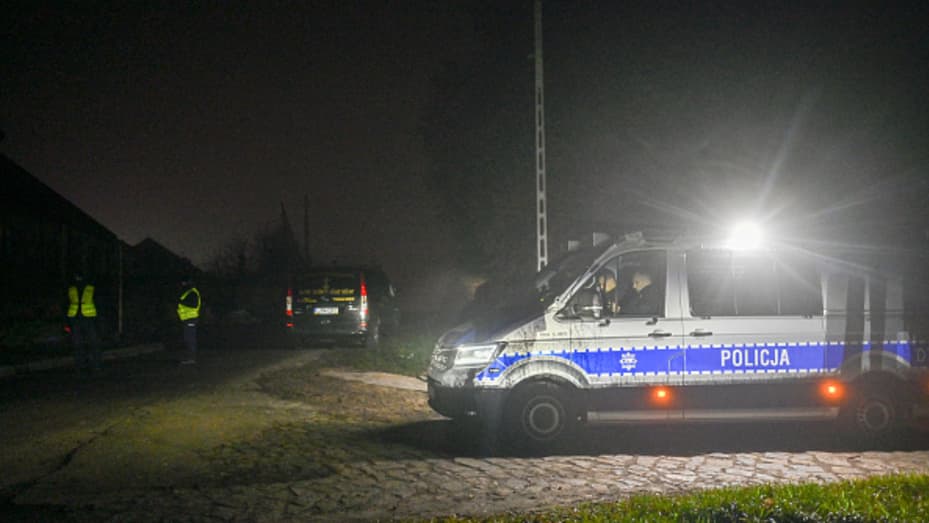
Police run a check point
outside the scene in Przewodow, Poland, where authorities in Warsaw say
a Russian-made missile struck its territory, killing two civilians.
Omar Marques | Getty Images News | Getty Images
"He [Bogdan Wos, retired local worker] was my friend from school. He was a good man."
"I was terrified when I heard about his death."
"The first thought that came to my mind was that we were finally attacked by the Russians."
Marian Praytula, Przewodow village, Poland
"Since the start of the war we keep analyzing the danger. It has quietened down recently, but here we are today."
"It's terrifying."
Ewa Byra, school headmistress
"I heard an explosion and ran out of the house to see what had happened."
"I came back home scared and then my friend said that Jozefa's husband had died. I started crying."
Renata, school janitor
The
rocket of unknown origin and wild speculation landed in Przewodow 100
metres from the primary school, close to a block of apartment flats. Of
the 71 pupils of the school more than half witnessed the explosion. The
students remained locked in their homes following the explosion on
Tuesday afternoon. Most of the villagers followed suit, the first time
in memory that no one in the village arrived at the church to observe
Mass.
The
following day classes at the school were cancelled. Instead a
psychologist was asked to help traumatized pupils and residents. Of the
two men killed who were working at a grain facility, Bogdan Wos's widow,
Jozefa worked as a cleaner at the school. In her grief she was placed
in the care of a medical specialist.
The
residents of he farming village of Przewodow were convinced the war in
Ukraine had finally spilled across the border and they were being
engulfed in the violence. And nor was it that village alone that felt of
a certainty they were being drawn into the violent confrontation
between Ukraine and Russia. With only 5 kilometres separating the
village from the border where Russia was pounding Ukraine's vital
infrastructure the villagers could be forgiven for imagining Armageddon.
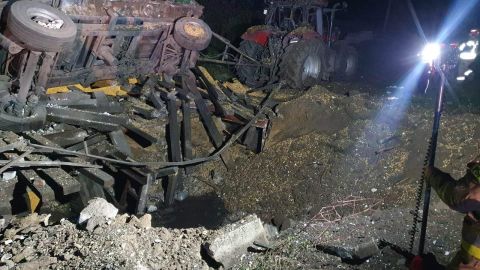
The missile landed outside the rural village of Przewodów. Photo: Facebook
Poland,
of course as a NATO member sees Article 5 standing behind it since an
attack on any member of NATO is considered an attack on the entire
military group with consequences for the attacker facing 30 national
militaries. In the interests of cooling down rising anger in avoidance
of rash reactions, it made eminently good sense, despite Ukrainian
President Zelenskyy's intimations of a deliberate Russian attack, in the
greater interest of keeping the conflict confined to a country rather
than risk a regional spread and a global war.
Understandably,
Ukraine wants an end to its agony, and drawing in superior numbers to
face off with a failing Russian advance and conclude the invasion with
Moscow's ignominious forced withdrawal including the reparations that
would be imposed would reflect Ukraine's first order of priorities. As
the only country in the region with a full frontal attack, all others
hoping to deflect one, even by a Russia that has been fairly effectively
defanged.
NATO's
vow to defend "every inch" of its territory, despite Warsaw's initial
readiness in response to what appeared to be a direct attack challenging
the military coalition, would not be put to the test this time around,
however. After all, while world leaders were in conference in Bali,
Moscow decided to launch an unprecedented barrage of missiles all over
Ukraine, targeting its energy infrastructure; telecommunications, gas,
water, plunging the country into a winter war plague.
Poland's
NATO partners sent messages of solidarity and the G20 was in a state
of consternation as Volodymyr Zelenskyy addressed them by videolink; the
strike, he hammered home, represented a "true statement brought by Russia for the G20 summit"; a "terrorist state"
was seated among them. But then, after all, tiny Przewodow a mere 130
kilometres from Lublin would not be the epicentre of the Third World War
after all.
No
evidence exists, Polish President Duda said a day later, of an
intentional attack, as did President Biden. Mateusz Morawioecki, the
Polish prime minister, said that Russia could "perfectly plan such a thing". And a former Polish general stated, "You don't start a war by blowing up a tractor". Tense calm prevailed.
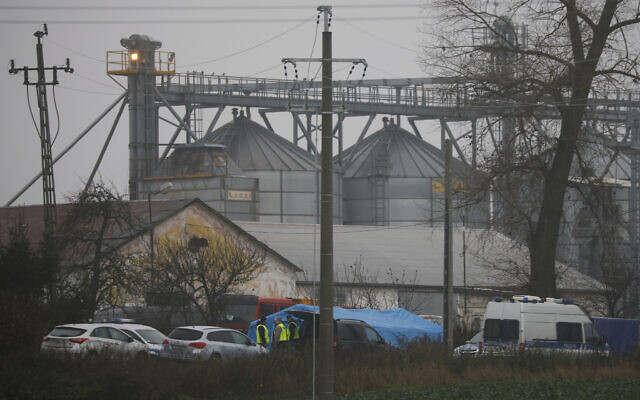
Police officers work outside a grain depot where, according to the
Polish government, an explosion of a Russian-made missile killed two
people in Przewodow, Poland, November 16, 2022. (Michal Dyjuk/AP)
"We recognize that the impacts of climate change at 1.5°C are much lower
than at 2°C. Keeping 1.5°C within reach will
require meaningful and effective actions and commitment by all
countries, taking into account different approaches, through the
development of clear national pathways that align long-term ambition
with short- and medium-term goals, and with international cooperation
and support, including finance and technology, sustainable and
responsible consumption and production as critical enablers, in the
context of sustainable development."
"We acknowledge that methane emissions represent a significant
contribution to climate change and recognize, according to national
circumstances, that its reduction can be one of the quickest, most
feasible and most cost-effective ways to limit climate change and its
impacts."
G20 post-summit Communique
"If the G20 was a dress rehearsal for COP26, then world leaders fluffed
their lines."
"Their communique was weak,
lacking both ambition and vision, and simply failed to meet the moment."
"Now they move on to Glasgow where there is still a chance to seize a
historic opportunity, but the likes of Australia and Saudi Arabia need
to be marginalized, while rich countries need to finally grasp that the
key to unlock COP26 is trust. "
Jennifer Morgan, executive director, Greenpeace International
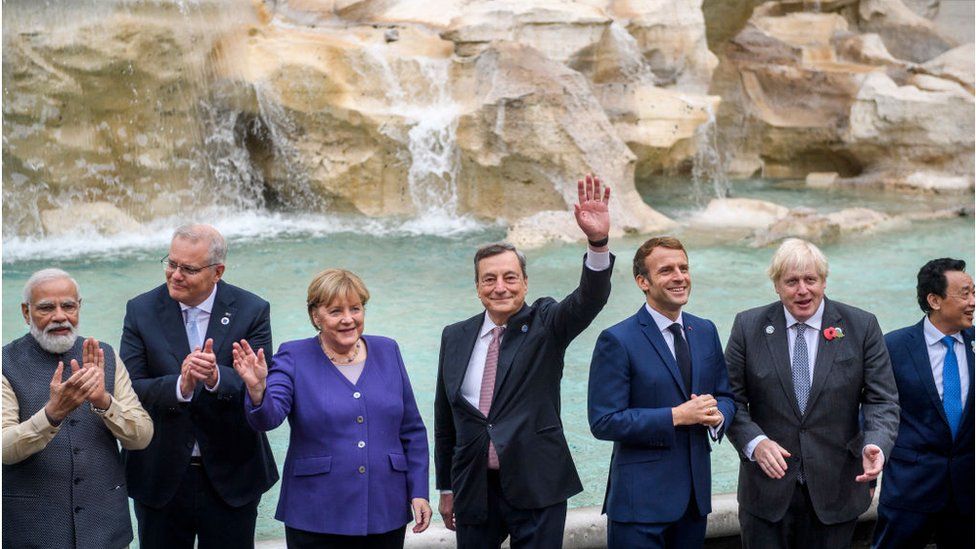
G20 Leaders posed for a picture by the famed Trevi Fountain, Rome Getty Images
"Private jets are a disaster for the climate."
"A
single, one-hour private flight emits two tons of carbon emissions,
which is a quarter of the carbon produced by the average European in a
whole year."
Helena Bennett, senior policy adviser, Green Alliance
You
just cannot please everyone. All the pomp and pompous displays with the
glorified collective presence of the leaders of the most influential,
wealthiest nations on Earth cannot dispel the impression that climate
change warriors have garnered of the wanton energy wastefulness that
conferences like that of the G20 and their follow-up 13-day conference
in Glasgow sponsored by the UN and dubbed COP26 climate talks are in and
of themselves energy wasters -- both of the fuel to convey them and of
the exhaustive efforts to convince the world their decisions are
meaningful.
"We'll
cap oil and gas sector emissions today and ensure they decrease
tomorrow at a pace and scale needed to reach net-zero by 2030",
gushed Canada's Prime Minister Justin Trudeau of his country's energy
resources, preferring to leave Canadian oil and gas abundance
underground and import energy from Saudi Arabia instead. A logic that
stymies the cerebral process. This is a man determined to lead the world
toward salvation, offering Canada as a sacrifice to offset the growing
emissions from China.
The COP26 host, Prime Minister Boris Johnson, addressing world leaders, urged them to put a halt to "quilting the Earth in a suffocating blanket of CO2", to "get real"
about planetary responsibilities. Presumably, following his example.
And they have. Private jets all around. Private aircraft are known to
emit between ten and 60 times more carbon dioxide per passenger as do
scheduled commercial flights and up to 140 times as much as a
diesel-powered train.
World
leaders and delegates -- roughly 30,000 delegates representing 197
countries visiting Glasgow for two weeks -- are being watched
environmentally and sourly accused of contributing to a "climate
disaster" with their profligate use of hundreds of private jets, flying
to Glasgow, along with helicopters and motorcades. Starting with the
U.K. PM who will return to London via private jet, eschewing the rail
system that would take 4-1/2 hours' transit, Glasgow to London.
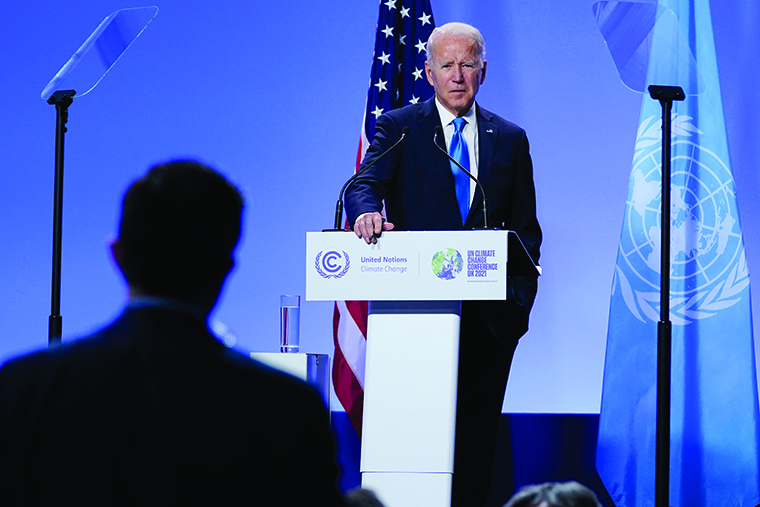
President Joe Biden listens to a question during a news conference at
the COP26 U.N. Climate Summit, Tuesday, Nov. 2, 2021, in Glasgow,
Scotland. (Evan Vucci/AP)
An
estimated 200 small executive jets are being deployed, each of which
takes six hours to generate as much CO2 as the average individual will
in a year. Regular passenger aircraft could have been chosen
alternately, and in some instances, rail. With few exceptions every
national leader is making use of private aircraft, carrying fewer
passengers than commercial flights, in the process making quite the
environmental impact.
Take,
for example, U.S. President Joe Biden whose Air Force One and an
additional four large jets accompanying him generating close to 1,000
tons of CO2 in his round-trip from America to Europe. A motorcade was
the chosen mode of transit for the president to travel from Edinburgh
airport to the Glasgow summit; a motorcade consisting of 22 vehicles
whose function created about four tons of CO2 for the 150-km round trip.
If memory serves, this is a hugely committed environment president.
The
Beast, the president's armoured limousine, ekes out eight miles per
gallon, emitting 4kg of CO2 each mile, whereas a hybrid family vehicle
emits something like 0.12kg per mile. European Commission president
Ursula von der Leyen flew to Glasgow via jet. She who has a habit of
"air taxis" for over half her official trips abroad; hops to Paris and
London from Brussels included.
Setting
an example for the world in a global responsibility to react
environmentally to reverse the horribly negative impacts of climate
change, a process helped in part by human waste and negligence of
nature's gift to humanity.
"Most
people had assumed there would be a trade-off between health and the
economy; that if you imposed restrictions to limit the virus's spread
and keep deaths down, your economy would be hurt -- and the tougher the
restrictions the worse for the economy."
"But
not so. Countries that imposed restrictions early and severely, keeping
deaths per million low, also had a low decline in GDP."
"By
contrast, countries that applied restrictions haphazardly, letting
deaths reach high levels while hoping to protect jobs, had among the
biggest declines in GDP."
"It turns out the best economic policy was successful aggressive action to limit COVID's spread."
George Fallis, professor emeritus, economics and social science, York University, Toronto
Sweden
had decided on the advice of their chief medical officer of health, not
to impose restrictions on its population, hazarding the belief that
Swedes would behave sensibly, following basic guidelines of a level of
social distancing and protective hygiene. Swedes for the most part,
acted accordingly, and voluntarily limited activities while they went
about their normal lives and trusted that their government's reliance in
their population's good sense would lead to a better outcome than that
of their neighbours who had gone in the opposite direction; lockdowns.
People walk near a trash can with a sign reading “The danger is not over — Keep your distance” in Uppsala, Sweden, in October.Photo by TT News Agency/Claudio Bresciani via Retuers files
The
lack of formal restrictions in Sweden led to a large number of deaths
early on, and the situation failed to improve as time wore on.
Swedish politicians were determined to forge ahead with no restrictions
on trade and business; the idea was to proceed as normal; perhaps not
taking into account in their deliberations that with their largest
trading partners -- their neighbouring states -- closed down, the
faltering economy that hit their neighbours would also impact on them.
In the end, they gained nothing and lost more lives than did their
neighbours.
High-income
advanced economies with reliable health-care systems represented by 20
OECD countries came out of their ordeal with the global pandemic with
mixed results. Using Canada as an example, its government faltered in
initial decision-making, fluctuating between cautious instructions to
its population, to eventual lockdown after downplaying the emerging
seriousness of the SARS-CoV-2 virus that causes COVID-19. The federal
government's attitude toward securing its borders was lax, it denied the
usefulness of mask-wearing, instead championing testing, tracing and
isolating.
Pedestrians in downtown Toronto during the start of the city's second lockdown in November.Photo by Cole Burston/Bloomberg files
But
even these practices were poorly executed in comparison to the take-up
rate of their counterpart nations in other OECD countries. One thing all
countries had in common, however, despite their modern, technically
advanced economies and excellent health-care systems, was
unpreparedness. Along with a critical lack of PPE and other related
hospital-medical equipment. This, despite more than ample warning that
just such a threat as a global pandemic hovered on the near horizon.
This, despite that SARS-1 had proven itself to be a deadly virus the
world handled poorly, offering a lesson in the necessity of proactive
preparation.
The
first entry of the novel coronavirus took the world by surprise as it
swept through the globe following its initial emergence in Wuhan, China.
Which Beijing initially played down, giving inadequate and incorrect
information to the WHO, delaying the declaration of a pandemic. The
world looked on, fascinated and disbelieving as China then took
draconian measures to cope with a dread new virus with the intention of
isolating the infection and stopping its spread. Despite which COVID
appeared to experience little trouble escaping the boundaries set up to
contain it as it spread virulently.
When
the winter of 2020 merged into spring, it began to appear as though
much of the world had succeeded in controlling the spread of COVID, and
restrictions that were imposed were relaxed while the number of cases
dwindled and a sense of optimism prevailed. Until the Northern
Hemisphere entered fall, then winter and the fearsome second wave of
infection re-entered. Monetary stimulus, support for businesses and
workers were activated by governments even as GDP shrank and the death
count rose.
Some
countries had moved expeditiously and severely to limit the first wave
while others struggled to contain that huge entry of infections, with
mixed results. South Korea as an example experienced a mere 4.4 percent
decline in GDP, with eight deaths per million population, while the U.K.
took a 21.8 percent decline in GDP, and suffered 595 deaths per
million. It was soon realized that those countries with the largest GDP
decline experienced a larger bounceback with the mid-year decline of
COVID infections.
Austria
Denmark, Finland, Germany, South Korea, New Zealand, Norway and
Switzerland experienced a smallish decline in GDP and a lower death rate
per million, while Belgium, Italy, Spain and the United Kingdom were
hit much harder in both metrics. On the other hand other countries came
off better in one metric and worse on another; France,
Ireland,Netherlands, Japan, Sweden and the United States. Among these
countries many committed errors in judgement, now facing a larger second
wave of cases.
European
countries -- in particular those that performed poorly during the first
wave and lockdowns, have faced distinctly high daily death rates due to
COVID-19. Severe lockdowns were re-instituted by early November and in
some countries daily deaths are on the decline, while others remain
struggling with ongoing high death counts. Austria, Belgium and
Switzerland's death rates have been horrifically high. But it is in the
United States where throughout the nine months of the coronavirus
onslaught its spread was never brought under control, resulting in
ongoing daily death rise surpassing levels seen in the first wave.
Those
countries that realized partial successes in controlling the
coronavirus are continuing to perform well at present, including South
Korea, Japan, Norway, Finland and Denmark, where death rates have been
kept at a relatively low rate. Australia and New Zealand are stand-outs
for their success in avoiding a second wave entirely. What has been
proven to be highly successful is a protocol of strict lockdowns
maintained until low levels of cases are realized, then held there with
tighter border controls. Testing-tracing-isolation regimes on a large
scale has become a tool of necessity.
"President
Obama hasn't been elected by the American people in order to be
pleasant to Russia. And your humble servant hasn't been elected by the
people of Russia to be pleasant to someone either. We work, we argue
about some issues. We are human. Sometimes one of us gets vexed. But I
would like to repeat once again that global mutual interests form a good
basis for finding a joint solution to our problems." Russian President Vladimir Putin, Novo-Ogaryovo, Russia
"I
didn't set a red line; the world set a red line. My credibility is not
on the line. The international community's credibility is on the line.
And America and Congress's credibility is on the line because we give
lip service to the notion that these international norms are important.
Congress set a red line when it ratified that treaty. "We
have been very clear to the Assad regime, but also to other players on
the ground, that a red line for us is we start seeing a whole bunch of
chemical weapons moving around or being utilized. That would change my
calculus. That would change my equation." American President Barack Obama, Washington, United States of America
Warnings,
ultimatums, red lines, they set the stage for confrontation. On the
other hand, the issues at hand are of inestimable importance. Weapons of
mass destruction can make conventional warfare obsolete if they are
permitted to be utilized in the heat of war. Weapons of mass destruction
have the potential to make humankind obsolete, for that matter.
Which
is a way of pointing out how utterly indefensible their use is. Their
use can be defended by psychotic religious maniacs who believe that with
their use they advance the long-awaited end of days and herald in a
time of perfection, of heaven on Earth, with the kindly visage of a God
smiling benevolently upon all who are worthy of his benediction and
welcome.
It's often enough been said that humankind
often requires simple little lessons in civility, in humanity. Some
rehearsals in fact have occurred in some of the great cities of the
world. Take New York City as an example, where it was bruited about that
a broken window left unattended could eventually result in a broken
city. Fix that window and establish a norm, that destructive acts even
on a low level mount to become catastrophic acts of destruction.
In
Bashar al-Assad's Syria the use of chemical gas as a silent
life-destroyer is no more lethal than a powerful bomb or series of
bombs, but what's to stop totalitarian brutish governments or well
organized terrorist groups from using bacterial warfare to even greater
effect, if they can manage that tricky manipulation leading to mass
barbarity? And if that milestone is accomplished, why not then the
re-utilization of the supreme weapon of mass destruction?
"Some
have tried to suggest that the debate we're having today is about
President Obama's red line. I could not more forcefully state that is
just plain and simply wrong. This debate is about the world's red line.
It's about humanity's red line. And it's a red line that anyone with a
conscience ought to draw." American Secretary of State John Kerry
"From
our viewpoint, it seems absolutely absurd that the armed forces -- the
regular armed forces, which are on the offensive today and in some areas
have encircled the so-called rebels and are finishing them off -- that
in these conditions they would start using forbidden chemical weapons
while realizing quite well that it could serve as a pretext for applying
sanctions against them including the use of force", averred Mr. Putin.
As
logic goes it's superficial enough to overlook the larger truth that
when a tyrant is determined to achieve an end result, the means by which
he pursues it is not necessarily always -- or ever -- palatable, nor
readily explicable, other than that the goal must be achieved by any
means. In this particular instance, shifting about in the shadows of
events behind Syria is its primary mentor, Iran, whose nuclear
technology fixation aligned with ballistic missile technology perfection
spells finality.
Iran is understandably curious to see
the outcome of the current situation. And from it, the Islamic Republic
of Iran is prepared to take its lesson. One mounted by a country which
has itself experimented in dropping nuclear devices in the world's only
such events in Japan, and which went backward, in a sense, also using
chemical agents in Vietnam proving it is never too late to develop a
conscience.
"If
there is evidence that chemical weapons have been used, and used
specifically by the regular army, this evidence should be submitted to
the UN Security Council", Mr. Putin smugly
recommended. Where, needless to say, the game of 'ring-around-a-posy'
can once again proceed, in the very chamber whose existence is
predicated on the need to forestall any future catastrophic events like a
global Holocaust.
The host was genial and effusive. Taking time to welcome each of the G20 presidents, prime ministers to his humble abode. Humble it might be, but he was busy putting on the Ritz. And he has the imperial palaces to do so within in grand style. Perhaps it was just the man himself who presented himself humbly, at the service of his peers, delighted to welcome them to Russia, his Russia.
"Terrorists are always a threat to someone. If we're scared of them, it means they have won. But that doesn't mean we can have a devil-may-care attitude toward this threat. We must do everything to stop these threats and not give the terrorists a single chance to demonstrate their brutality and hatred of mankind", said the great but humble man in a pre-summit interview with the Associated Press.
Speaking knowledgeably of terrorists, for doesn't Russia have its own problems with Chechnyan jihadists? So Russia, the great good friend of Syria's Bashar al Assad knows of what they both speak when they decry the threat that terrorists represent to humanity and good rule. The international community has leapt to a hasty conclusion in assuming that President Assad would countenance such an unspeakable atrocity as to permit his military to use chemical agents on his own people.
"We have a contract for the delivery of the S-300s We have supplied some of the components, but the delivery hasn't been completed. We have suspended it for now. But if we see that steps are taken that violate the existing international norms, we shall think how we should act in the future, in particular regarding supplies of such sensitive weapons to certain regions of the world." A quiet threat? Perish the very thought!
"As for that footage, video footage showing the dead children allegedly killed in the chemical attack, it is horrible. The question is only who did it and what they did, and who is responsible for this. These pictures do not answer the questions I have just posed. There is an opinion that it's a compilation by these very rebels, who are connected with al-Qaeda and who were always distinguished by exceptional brutality." Ah, well.
A wrong-headed, precipitate strike against his good friend President al-Assad would, he asserted, sit quite ill with Mr. Putin. Should such a precipitate strike occur he could, of course, send Syria the components of a missile shield to aid against American aggression. No surprise there; U.S. General Martin Dempsey, chairman of the Joint Chiefs of Staff testified Russia might replace any military assets the U.S. might destroy in a strike.
"If Russia decided to strike at us in that theater ... we can certainly say that Russia would have options to strike us in that theater in retaliation for us striking their ally" warned Rep. George Holding during the hearing. A tit-for-tat proxy war ... Russia and the United States, a diplomatic escalation of distrust and burgeoning antipathy between the two world powers.
With China on the sidelines. And the support for the United States of its usual allies shrinking back in dismay.
"Russia has capabilities that range from the asymmetric, including cyber, all the way up through strategic nuclear weapons. And again, it wouldn't be helpful in this setting to speculate about that", commented General Dempsey, before the U.S. Senate hearing urging that the discussion on that particular trajectory be limited; speculation on what might be not particularly helpful to the matter at hand.
Which of course, is the prospect of a strictly limited strike. Whose purpose is to show-and-tell, that America remains vigilant and cares, even if nobody else does, about the moral precepts of right and wrong, what can be forgiven and what cannot be overlooked. And the reminders that must, in all conscience, be issued. It's a matter of principle, of conscientiousness, of humanity toward others. One has a reputation to maintain.
It is also, hugely, a matter of fumbling about in the dark. In the depths of the dark unknown, actually. That old adage of supporting the devil you know; invariably the other devil lurking around the corner may just turn out to be legions of hell worse than the one who has limited your patience and risen your gorge.
The US Friday, Sept. 6, ordered the withdrawal of
non-emergency workers and their families from the embassy in Beirut and
the consulate general in Adana, southeast Turkey, and warned Americans
against traveling to those areas amid looming threats to their security.
The State Department posted these advisories after an unscheduled
20-minute one-on-one meeting between Presidents Barack and Obama and
Vladimir Putin on the sidelines of the G20 at St. Petersburg. No
information was released on results of their conversation, but the staff
withdrawals from Beirut and Turkey pointed to the two leaders remaining
at loggerheads as much as before amid a mounting buildup of Russian
naval might around Syria.
Moscow announced earlier that the Nikolai Filchenkov landing
ship was on its way to the Mediterranean, stressing that it would first
put in at Novorossisk port on the Black Sea to pick up “a special
cargo.”
This cargo was widely identified as advanced Russian S-300 interceptors for warding off a US attack on Syria.
debkafile’s
military and US sources reported Friday that President Obama had
resolved to expand America’s operation against Syria’s chemical weapons
to include air strikes as well as Tomahawk cruise missiles fired from
warships.
There was never much hope that the 20 most influential national
leaders in the world meeting in the Russian town of St. Petersburg on
Sept 5-6 would occasion a thaw in the icy relations between the American
and Russian presidents and some sort of accord for stopping the
bloodshed in Syria.
In his opening statement, Thursday, Sept. 5, Vladimir Putin announced
an open-ended discussion would start over a working dinner and go on
into the small hours of Friday. The Russian leader was clearly setting
the stage for a showdown with the US president, having loaded the dice
in Moscow’s favor with the opposition of most of the Asian and European
leaders to US military intervention in Syria. The only exceptions were
French President Francois Hollande and Canadian Prime Minister
Stephen Harper.
Tense eyes were trained on the G20 venue as Thursday night wore on to
see the upshot of this weighty conference, which started out with the
two parties solidly entrenched in their positions – the US president
determined to exercise military force against the Assad regime’s use of
chemical weapons against its people, and the Russian president equally
determined to oppose it.
But even after Putin managed to isolate Obama diplomatically by
carrying a majority motion against US military intervention, he
must still have to face up to the failure of his policy to stop the
United States carrying out its second military offensive against an Arab
nation in two years, after the 2011 Libya campaign.
As for Obama, the longer a decision to go forward in Syria drags out,
the greater the pressure by lawmakers in Congress, whose votes he needs,
and military imperatives, to embark on a broader operation against
Syria than the narrow missile assault he first contemplated.
Had he wished to stick to his original plan, he should have instantly
fired off a number of Tomahawks at the Syrian forces as soon as they
gassed the eastern outskirts of Damascus on Aug. 21. Instead, he let ten
days go by before suddenly deciding on Aug. 31, to put the operation on
ice for congressional authorization.
Had he acted expeditiously, the whole issue of US military
intervention in Syria would have been behind him by the time he reached
the summit in Russia.
The American assault will now have to be expanded and revised to cover
widely-dispersed targets distributed across large areas in view of the
following developments:
1. The Syrian government has scattered the chemical units responsible
for the atrocity, along with its chemical stocks in dozens of hideouts
across the country to minimize damage.
2. The recommendation by Chairman of the Joint US Chiefs of Staff
Gen. Martin Dempsey, cited by President Obama to justify the delay in
the offensive – it could take place “tomorrow, in a week or a month” –
hasn’t held water.
The chief of US naval operations, Adm. Jonathan Greenert, commented
Thursday that the four US destroyers off the coast of Syria are “fully
ready” for “a vast spectrum of operations, including launching Tomahawk
cruise missiles at targets in Syria and protecting themselves in the
event of retaliation.”
And indeed, the Senate Armed Forces committee, in backing US military
force in Syria, gave the president up to 90 days to finish the job.
3. The certainty voiced by some US intelligence sources that they can
locate the hideouts of Syrian chemical units and weapons overstates the
capabilities of even the most sophisticated spy technology at their
disposal.
4. Not just the Russian leader, but Syria’s Bashar Assad and Iran’s
Ayatollah Ali Khamenei, have bought enough time to set up military,
intelligence and political ambushes for the Americans, and will be ready
to pounce when the US operation goes forward.
As the G20 summiteers took their seats in St. Petersburg, three Russian
warships passed through the Bosporus in their way to the Mediterranean. debkafile’s military sources identitied them as the SSV-201 intelligence ship Priazovye and two landing craft, the Minsk and the Novocherkassk, which carry 200 marines and 10 amphibious tanks.
All three leaders have issued a constant stream of threats to deter Washington from striking Syria:
a) They could supply Syria with highly-advanced arms capable of catching US forces by surprise;
b) Russia and China could transfer advanced cyber warfare measures
to Damascus via Tehran, which Iranian cyber experts could operate in
Syria and Lebanon.
c) The Russian president has indicated that if the Americans attack
Syria, he might sell Iran super-weapons on the premise that the strike
on Syria would be the precursor to a US attack on Iran’s nuclear
program.
5. The basic presumption in Washington and Jerusalem at the outset
of the US plan to use military force in Syria last month was that
Hizballah would stay out of it. In the interim, the Lebanese Shiite
militia has begun mobilizing for defending Syria and for cross-border
reprisals against Israel from Syria and Lebanon.
Thursday night, Iran’s National Security Council inner group held a
secret meeting in Khamenei’s inner sanctum on the ramifications of the
forthcoming US action against Syria.
debkafile’s Iranian
sources report that Revolutionary Guards commanders spoke out in favor
of activating the mutual defense treaty binding Iran and Syria.
President Hassan Rouhani objected. In his view, Tehran must continue to
issue vague and general statements without showing its hand on military
action against the US. He warned that a vast American military and naval
force was piling up in the region and Iran must beware of provoking a
military response in which it would be quickly bested.
Khamenei did not wait for the G20 to reach conclusions. He issued a
public statement saying: “We believe that the Americans are committing a
folly and mistake in Syria and [they] will accordingly take the blow
and definitely suffer.”
The
US and Russia have not bridged their differences over the issue of
possible military action in Syria, Russian President Vladimir Putin
says.
Mr Putin said it was "counter-productive" to destabilise the situation in the Middle East.
His comments came in a news conference on the final day of the G20 summit in St Petersburg.
US President Barack Obama had been pushing for support among leaders at the G20 for a US strike on Syria.
The US government accuses President Bashar al-Assad's forces
of killing 1,429 people in a poison-gas attack in the Damascus suburbs
on 21 August.
Mr Assad has blamed rebels for the attack. China and Russia,
which have refused to agree to a UN Security Council resolution against
Syria, insist any action without the UN would be illegal.
Mr Putin said the discussions about Syria on Thursday evening had gone on well past midnight.
He added that he had a one-to-one meeting with Mr Obama in which they had discussed Syria.
Both men had listened to the other's position but had not agreed, he said.
Also speaking at the end of the summit, Mr Obama said there was a "unanimous" view that chemical weapons had been used in Syria.
Mr Putin said a one-on-one meeting with Mr Obama had not changed his position on Syria.
He also said most leaders present at the summit thought it was most likely that the regime of President Assad was responsible.
Mr Obama argued action was required even when the Security
Council was paralysed, as the international consensus against the use of
chemical weapons had to be upheld.
However, Mr Putin described the use of chemical weapons as "a
provocation on the part of the militants who are expecting to get
support from outside".
British Prime Minister David Cameron said only responding to
the crisis through the UN Security Council would mean the UK
"contracting out its morality and foreign policy to the potential of a
Russian veto".
The US government accuses Mr Assad's forces of killing 1,429
people in a poison-gas attack in the suburbs of Damascus on 21 August.
While the UK, Canada and Turkey all support Mr Obama's call
for action, the only leaders at the G20 meeting to commit to force in
Syria are the US and France.
Correspondents in St Petersburg say opponents of US military intervention appear to far outnumber supporters within the G20.
There was never much hope that the 20 most
influential national leaders in the world meeting in the Russian town
of St. Petersburg on Sept 5-6 would occasion a thaw in the icy relations
between the American and Russian presidents and some sort of accord for
stopping the bloodshed in Syria.
In his opening statement, Thursday, Sept. 5, Vladimir Putin announced
an open-ended discussion would start over a working dinner and go on
into the small hours of Friday. The Russian leader was clearly setting
the stage for a showdown with the US president, having loaded the dice
in Moscow’s favor with the opposition of most of the Asian and European
leaders to US military intervention in Syria. The only exceptions were
French President Francois Hollande and Canadian Prime Minister
Stephen Harper.
Tense eyes were trained on the G20 venue as Thursday night wore on to
see the upshot of this weighty conference, which started out with the
two parties solidly entrenched in their positions – the US president
determined to exercise military force against the Assad regime’s use of
chemical weapons against its people, and the Russian president equally
determined to oppose it.
But even if Putin manages to isolate Obama diplomatically by carrying
a majority motion against US military intervention, he will still have
to face up to the failure of his policy to stop the United States
carrying out its second military offensive against an Arab nation in two
years, after the 2011 Libya campaign.
As for Obama, the longer a decision to go forward in Syria drags out,
the greater the pressure by lawmakers in Congress, whose votes he needs,
and military imperatives, to embark on a broader operation against
Syria than the narrow missile assault he first contemplated.
Had he wished to stick to his original plan, he should have instantly
fired off a number of Tomahawks at the Syrian forces as soon as they
gassed the eastern outskirts of Damascus on Aug. 21. Instead, he let ten
days go by before suddenly deciding on Aug. 31, to put the operation on
ice for congressional authorization.
Had he acted expeditiously, the whole issue of US military
intervention in Syria would have been behind him by the time he reached
the summit in Russia.
The American assault will now have to be expanded and revised to cover
widely-dispersed targets distributed across large areas in view of the
following developments:
1. The Syrian government has scattered the chemical units responsible
for the atrocity, along with its chemical stocks in dozens of hideouts
across the country to minimize damage.
2. The recommendation by Chairman of the Joint US Chiefs of Staff
Gen. Martin Dempsey, cited by President Obama to justify the delay in
the offensive – it could take place “tomorrow, in a week or a month” –
hasn’t held water.
The chief of US naval operations, Adm. Jonathan Greenert, commented
Thursday that the four US destroyers off the coast of Syria are “fully
ready” for “a vast spectrum of operations, including launching Tomahawk
cruise missiles at targets in Syria and protecting themselves in the
event of retaliation.”
And indeed, the Senate Armed Forces committee, in backing US military
force in Syria, gave the president up to 90 days to finish the job.
3. The certainty voiced by some US intelligence sources that they can
locate the hideouts of Syrian chemical units and weapons overstates the
capabilities of even the most sophisticated spy technology at their
disposal.
4. Not just the Russian leader, but Syria’s Bashar Assad and Iran’s
Ayatollah Ali Khamenei, have bought enough time to set up military,
intelligence and political ambushes for the Americans, and will be ready
to pounce when the US operation goes forward.
As the G20 summiteers took their seats in St. Petersburg, three Russian
warships passed through the Bosporus in their way to the Mediterranean.
debkafile’s military sources identified them as the SSV-201 intelligence ship Priazovye and two landing craft, the Minsk and the Novocherkassk, which carry 200 marines and 10 amphibious tanks.
All three leaders have issued a constant stream of threats to deter Washington from striking Syria:
a) They could supply Syria with highly-advanced arms capable of catching US forces by surprise;
b) Russia and China could transfer advanced cyber warfare measures
to Damascus via Tehran, which Iranian cyber experts could operate in
Syria and Lebanon.
c) The Russian president has indicated that if the Americans attack
Syria, he might sell Iran super-weapons on the premise that the strike
on Syria would be the precursor to a US attack on Iran’s nuclear
program.
5. The basic presumption in Washington and Jerusalem at the outset
of the US plan to use military force in Syria last month was that
Hizballah would stay out of it. In the interim, the Lebanese Shiite
militia has begun mobilizing for defending Syria and for cross-border
reprisals against Israel from Syria and Lebanon.
Thursday night, Iran’s National Security Council inner group held a
secret meeting in Khamenei’s inner sanctum on the ramifications of the
forthcoming US action against Syria.
debkafile’s Iranian
sources report that Revolutionary Guards commanders spoke out in favor
of activating the mutual defense treaty binding Iran and Syria.
President Hassan Rouhani objected. In his view, Tehran must continue to
issue vague and general statements without showing its hand on military
action against the US. He warned that a vast American military and naval
force was piling up in the region and Iran must beware of provoking a
military response in which it would be quickly bested.
Khamenei did not wait for the G20 to reach conclusions. He issued a
public statement saying: “We believe that the Americans are committing a
folly and mistake in Syria and [they] will accordingly take the blow
and definitely suffer.”
This represents a general opinion site for its author. It also offers a space for the author to record her experiences and perceptions,both personal and public. This is rendered obvious by the content contained in the blog, but the space is here inviting me to write. And so I do.