Thursday, February 23, 2023

Betrayal of Country And Its Penalty

"I am sure that you committed these crimes intending to assist Russia ... "
"Your motive in assisting them was to damage British interests."
"You were paid by the Russians for your treachery."
Judge Mark Wall, Old Bailey Courthouse, London
 
"[David Ballantyne Smith was motivated by] greed and a hatred of our country."
"That hatred was palpable and led him into engaging in what can only be described as really despicable behaviour."
Nick Price, head, Crown Prosecution Service, Special Crime and Counter Terrorism Division
 
"He betrayed us all and put our embassy and our country at risk."
"I'm, grateful to MI5 and their amazing officers, the police and our German partners for seeing him put on trial and sentenced."
British Security Minister Tom Tugenhat
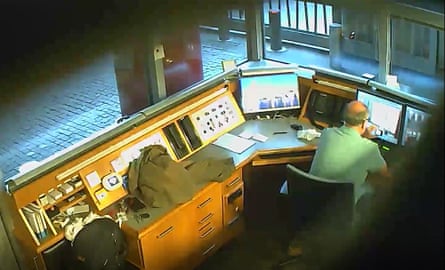
A still from a covert camera shows Smith taking a video of CCTV monitors in the British embassy security kiosk in Berlin
A still from a covert camera shows Smith taking a video of CCTV monitors in the British embassy security kiosk in Berlin. Photograph: Metropolitan police/AFP/Getty Images

The court was addressed by Smith as he told them he was ashamed of what he had done. He had, he explained, filmed the documents in question after "seven pints of beer". It just "seemed like a good idea at the time." 
"Your regrets are no more than self-pity", responded the judge, rejecting the man's statement of remorse.

58-year-old David Ballantyne Smith, a former security guard posted at the British embassy in Berlin, passed hugely sensitive information to Russia. He was well paid for his efforts in collecting confidential data for over three years, including a secret letter from ministers to then-prime minister Boris Johnson, along with additional sensitive documents. For this, Judge Wall sentenced him to prison for over 13 years.

Although Smith pleaded guilty to eight charges under the Official Secrets Act, including conduct between 2020 and 2021, the judge felt his "subversive activities" had truly been initiated even two years before. Smith, according to prosecutor Alison Morgan, had forwarded a letter containing "highly sensitive information" relating to the embassy and its staff to General Major Sergey Chukhrov, his counterpart at the Berlin embassy.

The letter he sent to the Russian military attache in 2020 written on British embassy-headed notepaper, provided the names, home addresses and telephone numbers of embassy staff. Enclosed with the letter were documents written by the British embassy's lead officer dealing with Russia. The letter's discovery initiated a joint investigation between British and German authorities, described by Justice Wall as a "sting operation".

A USB stick containing several photographs of embassy staff and diplomatic passports was discovered in a search of Mr. Smith's Potsdam, Germany home. The court heard from Smith of his regret, but they were understandably unimpressed. Guilty as charged.
"[Smith] abused his position in the British Embassy in Berlin [to carry out] an attack on our country."
"His actions were not just driven by money and greed. On multiple occasions, he expressed a strong dislike towards the U.K. and Germany and expressed sympathy with the Russian authorities."
"These beliefs may have caused further damage had Smith not been discovered and prosecuted."
Nick Price, Crown Prosecution Service

Labels: , , , , , ,

Monday, December 26, 2022

Accessory to Mass Murder

"[Furchner] knew and, through her work as a stenographer in the commandant's office of the Stutthof concentration camp from June 1, 1942 to April 1, 1945, deliberately supported the fact that 10,505 prisoners were cruelly killed by gassings, by hostile conditions in the camp, [by transportation to the Auschwitz death camp and by being sent on death marches at the end of the war]."
"The promotion of these acts by the accused took place through the completion of paperwork [in he camp commander's office]."
"This activity was necessary for the organization of the camp and the execution of the cruel, systematic acts of killing."
German court in Itzehow State, Northern Germany
An elderly woman sits at a table during a court hearing.
Irmgard Furchner, seen here in court in Itzehoe, Germany, was convicted on Tuesday of being an accessory to murder for her role as a secretary to the SS commander of the Nazis' Stutthof concentration camp during the Second World War. Her face is obscured in this photo by order of the court. (Christian Charisius/DPA)
 
In her teens when she chose to be a cog in the machinery of mass murder of Jews assembled from throughout Nazi-occupied Europe, Irmgard Furchner lived a long life as an ordinary German citizen until her past caught up with her when she was identified as an accessory to the murder of over ten thousand people. This past week a German court convicted Irmgard Furchner, now 97 years of age, of her World War II crimes.

She was, undeniably a part of the apparatus set up to accommodate and assist the camp near Danzig (now the Polish city of Gdansk) to efficiently pursue its assignments of mass annihilation of European Jews. The court handed down a two-year suspended sentence for her role as an accessory to murder in 10,505 cases and an accessory to attempted murder in five other cases.

Prosecution demands were reflected in the verdict and following sentence. Defence lawyers, on the other hand, had requested of the court that their client be acquitted under the argument that evidence failed to show beyond doubt that Furchner definitely had knowledge of the systematic killings at the camp; proof of intent as required for criminal liability was never presented.

In a statement, the accused stated she regretted what had happened, that she had been at Stutthof at the time. It was, noted Judge Dominik Gross "simply beyond all imagination" that Furchner failed to notice the killings at Stutthof. She could, he said, view from her office window the collection point where new prisoners waited following arrival. The crematorium was in constant use in the fall of 1944, smoke spiralling across the camp.

Because the accused had been 18 and 19 years old at the time of the mass executions, she was tried in juvenile court. Judge Gross further stated that she could have, at any time, resigned from her position, to refuse to be part of the machinery of mass death. In September 2021, there was an attempt by Furchner to become a fugitive and hide somewhere rather than attend the trial, but she was foiled when police picked her up and placed her in detention for several days.

Irmgard Furchner, 97, has been convicted as an accessory to 11,412 murders at the Stutthof concentration camp, where she worked as a stenographer for an SS commander.

Labels: , , , ,

Follow @rheytah Tweet