"Let’s be clear about the eight men for whom the University of Alberta
maintains named endowments. They fought for the Waffen-SS, an armed wing
of the Nazi Party which was declared a criminal organization at the
Nuremberg trials because of its role in war crimes. Their division was
implicated in brutal wartime massacres of civilians, including one
atrocity in which Polish women and children were locked inside buildings
and burned alive."
"It should publish a complete list of all endowments honouring a
Waffen-SS member, together with a timeline for resolving them. It should
pursue renaming, seek legal variations where necessary, and return to
court if required. The university must make clear that those who fought
in service of the Nazis have no place of honour at a Canadian
university."
Nazi SS leader Heinrich Himmler inspects
volunteers of the Ukrainian Waffen SS division during the Second World
War. Library and Archives Canada is now reviewing whether to release the
names of alleged Nazi war criminals who fled to Canada after the war.
(File photo)
The
Waffen SS Galicia comprised of Ukrainian volunteers and overseen by
Nazi SS groups were implicated in WWII war crimes; Jewish groups as well
as the Polish government denounced the Ukrainian volunteer group for
its part in murdering civilians, as well as for massacres it was
involved with. The Nazis made use of the division in Slovakia to crush a
national uprising; another condemnation for war crimes committed by the
group.
In
the wake of receiving a legal permission to proceed with dissolving a
research trust in the name of Ukrainian SS veteran Yaroslav Hunka who
received accolades in Parliament during a visit to Canada by Ukraine's
President Volodymyr Zelenskyy in 2023 when a standing ovation honoured
the misconception that he was a war hero by Western standards by
fighting against the Soviet occupation of Ukraine, at a time when Russia
was viewed as an ally alongside the U.K., U.S. and Canada, the
University of Alberta announced it would go no further in expunging
Ukraine-centred research funding.
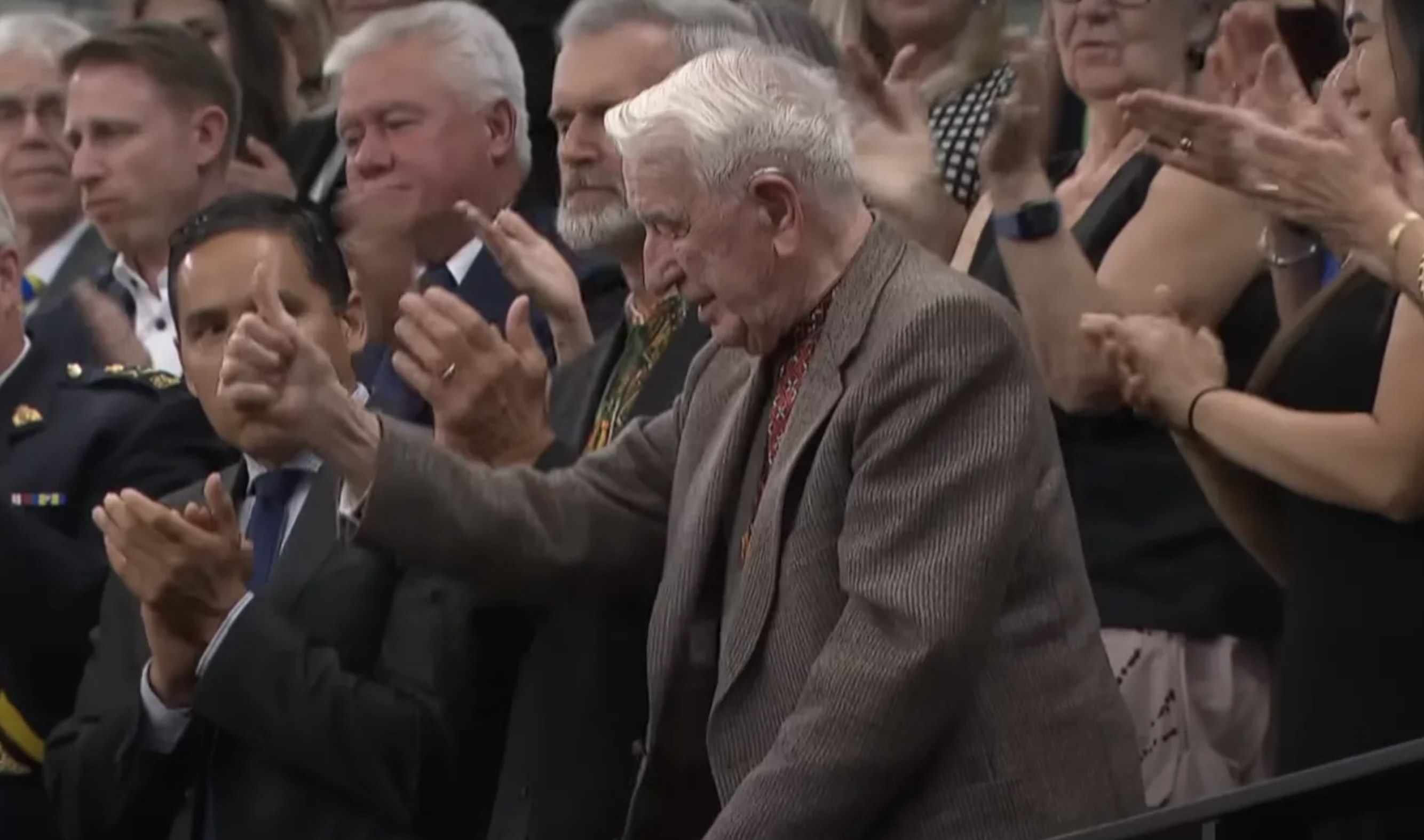
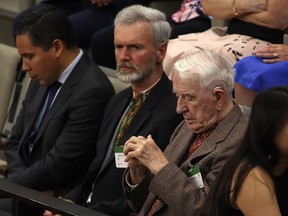
Yaroslav Hunka (giving a thumbs up) during applause in the
Canadian Parliament, September 22, 2023. Photo: YouTube/CBC News: The
National
The
university planned to retain eight other endowments involved with
Waffen-SS soldiers, claiming it would be too costly in time and legal
fees to seek court approval for termination of the endowments.
Researchers with the Friends of Simon Wiesenthal Center. a Toronto-based
Holocaust research organization, totaled a list of 12 endowments at the
University of Alberta with a value to the university of $2.2 million in
funding, linked to Nazi-allied individuals during WWII in Ukraine.
"This is dirty money and it's unconscionable they are continuing with this. It's beyond despicable",
84-year-old Andy Reti, a child survivor of the Holocaust stated in
condemnation of the university's position. An alternative, he felt
reasonable was that the Canadian Institute of Ukrainian Studies at the
university should donate the endowment funding of he Waffen-SS to the
Salvation Army so that something positive could result from the
untenably tainted funds.
Senior
director at the Friends of Simon Wiesenthal Center, Jaime
Kierzner-Roberts, stated that her group had called on a number of
occasions for the university to divest all of the Nazi-linked
endowments, including one named for Peter Savaryn, another SS-Waffen
member, who had in time become chancellor of the university. In 2023,
however, the office of the Governor General expressed its deep regret
for having awarded the Order of Canada to Savaryn in 1987. In the event,
at revelations of his wartime activities and connections, in
consequence of which the Order was revoked.
In its remediation defence, the University of Alberta revealed its intention to spend $100,000 to "deepen scholarship and education about the Galicia Division and other complex and difficult aspects of 20th-century history".
None of which can expunge the reality that the university had accepted
funds from the estate of Volodymyr Kubijovyc, a Nazi collaborator who
had helped create the Waffen-SS Galicia, and was as well an advocate for
ethnic cleansing to create an independent Ukraine without the presence
of Jews or Poles.
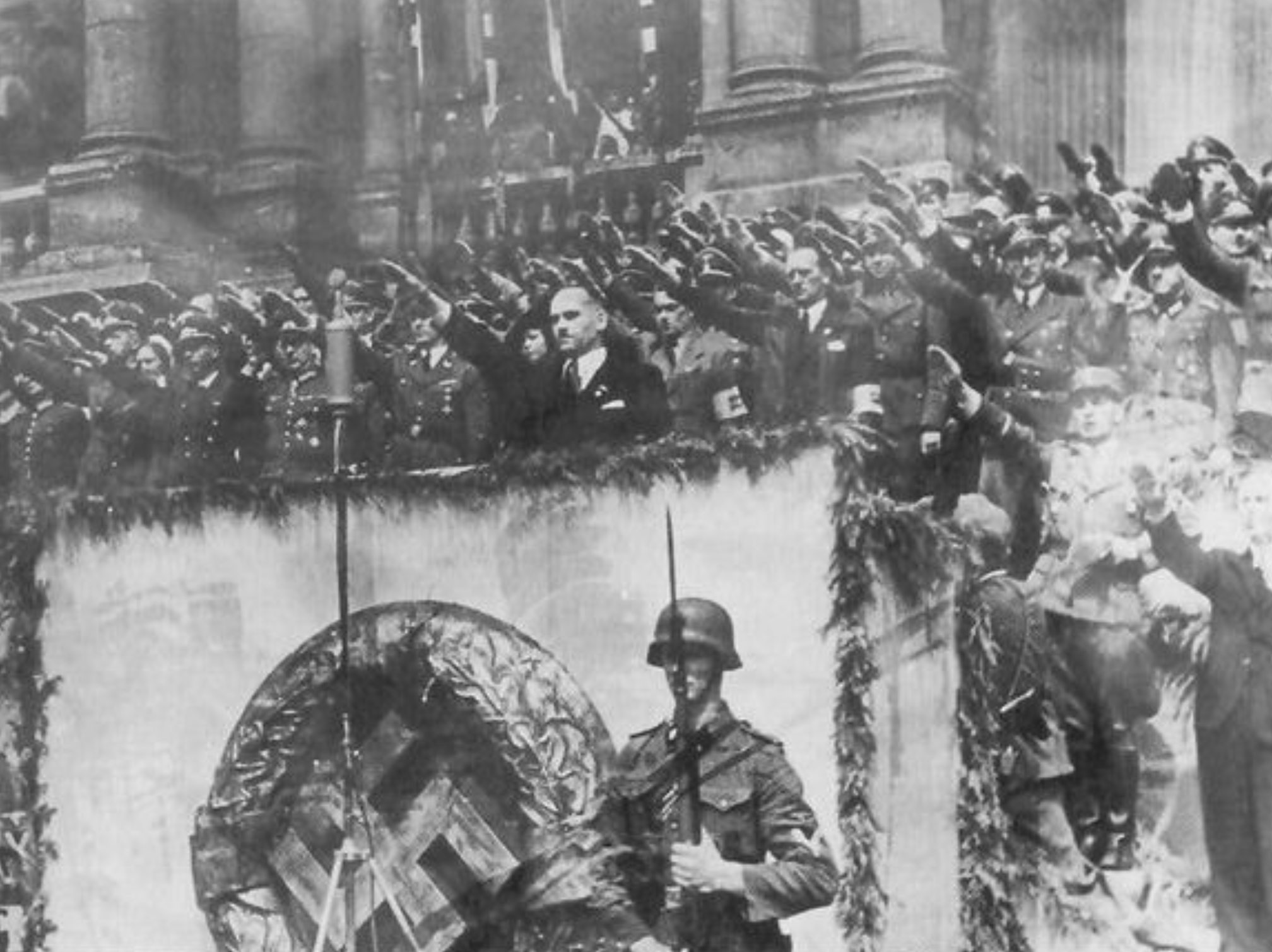
Parade of recruits of the Waffen SS “Galicia” Division in Lviv.
In the foreground is the head of the Military Administration, Col.
Bisanz. July 18, 1943. Photo: Wikimedia Commons
Members
of the Waffen SS Galicia are regarded as heroes -- who had fought
against Soviet forces -- among nationalist Ukrainian Canadians. In
summer day camps for Ukrainian children in Canada, this kind of folkhero
history is taught to the campers, where they can also view
commemorative statuary celebrating Waffen-SS WWII members for their
courageous heroism in confronting and killing Red Army servicemen.
Criticism of these heroes, they aver, represents Russian misinformation.
Critics
of the volunteer SS battalion point out that in volunteering themselves
to fight with the Nazis, Ukrainians were essentially freeing up German
soldiers to enable them to be redirected to fighting against the
British, Canadian,and American soldiers, at that time advancing toward
Berlin. Following the end of the war, the International Military
Tribunal declared the SS a criminal organization, with the inclusion of
Waffen-SS units.
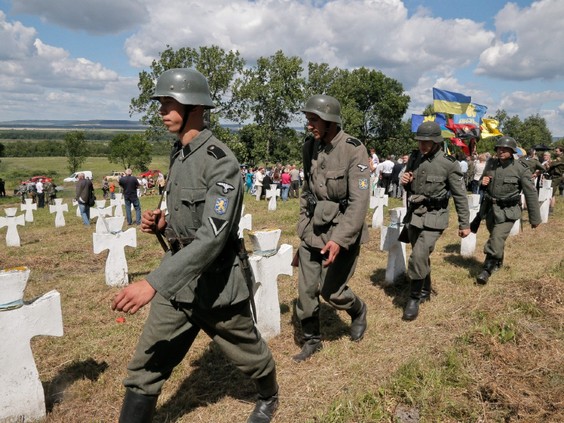
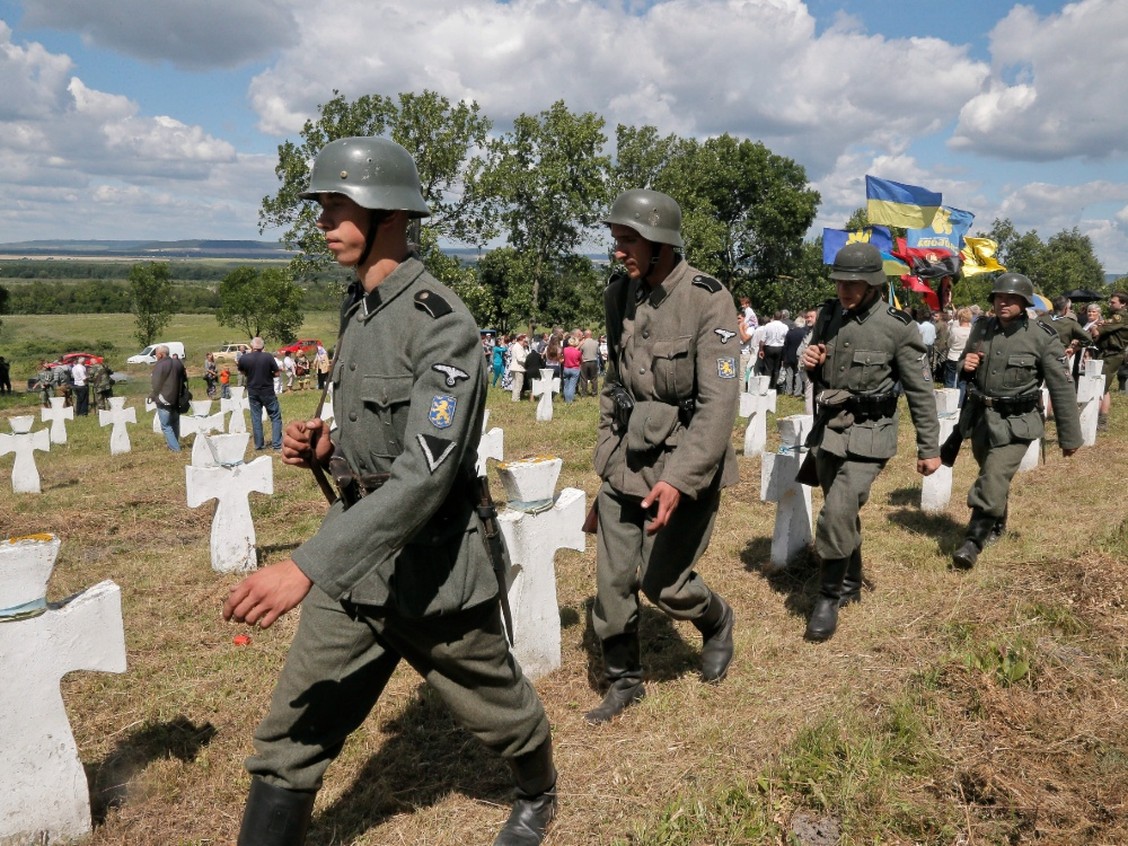
Ukrainians dressed in SS Galicia Division uniforms
march past graves during a re-burial ceremony at the SS Galicia
Division cemetery near the village of Chervone, Ukraine, in 2013.Photo by Efrem Lukatsky/AP/File
"Canada has a really dark history with Nazis in Canada."
"There was a point in our history where it was easier to get in [immigrate to Canada] as a Nazi than it was as a Jewish person."
"I think that's a history we have to reconcile."
Immigration Minister Marc Miller
"What little we know of their [SS members] war record is bad."
"We're still hoping to get rid of the less desirable Ukrainian PoWs either to Germany or to Canada."
British Home Office official Beryl Hughes, 1948
Ukrainians
dressed in SS Galicia Division uniforms march past graves during a
re-burial ceremony at the SS Galicia Division cemetery near the village
of Chervone, Ukraine, in 2013.Photo by Efrem Lukatsky/AP/File
Documents
compiled by a commission set up in the 1980s to scrutinize Canada's
record in permitting members of the Nazi SS into Canada through
government-sanctioned visas, including members of the Ukrainian
collaborationist special ethnic SS-linked divisions meant to work with
German SS units in
rounding up Jews
in massive pogroms of shooting deaths -- part of the Holocaust's 'Final
Solution', a priority with Nazi Germany while it was prosecuting World
War I --, have never been made available for public scrutiny.
In
the wake of a public scandal where a North Bay Ukrainian military
veteran was invited to parliament to meet with visiting Ukrainian
President Volodymyr Zelenskyy who was to address the House of Commons,
where the entire House inclusive of parliamentarians and diplomatic
guests rose on the introduction of the 98-year-old, a former volunteer
serving with a Ukrainian SS division, Jewish groups in Canada are now
demanding the release of the documents, unredacted.
The
40-year-old report along with allied documents that contain details
relating to Nazi war criminals residing in Canada remains in a 'secret'
category. It represents a second portion of a 1986
government-commissioned report on Nazis who were permitted to enter and
settle in Canada. Another 1986 report was heavily censored, one that
examined how it was that Nazis were enabled to enter Canada to begin
with, post World War Two. That commission was struck in the wake of
years of Jewish groups urging the government to investigate and
extradite Nazi war criminals known to be living in Canada.
Over
600 pages of the document finally obtained through the country's Access
to Information law, was censored. B'nai Brith is now demanding the
release of RCMP and Department of Justice files on Nazi war criminals in
Canada. "We've run up against a brick wall",
commented David Matas, counsel for the Jewish advocacy organization ...
in view of the government's ongoing decision to withhold such records
from public view. A ray of hope shimmered briefly when Canada's
Immigration Minister Marc Miller allowed that the government might
reconsider whether the records could be released.
Canada's
track record, he commented pointedly, with Nazi criminals was
notoriously poor. B'nai Brith pointed out in a submission to the House
of Commons committee on Access to Information in February that the
government's approach to Nazi war criminals reflected its "intentional harbouring of known Nazi war criminals" along with "deliberate inaction".
And
that historical puzzle has now been resurrected since MPs in the House
of Commons a week ago honoured a Canadian-Ukrainian who had served in a
Nazi SS division. Two standing ovations from those present were awarded
Yaroslav Hunka, sparking outrage on social media, prompting the
resignation of the House of Commons Speaker Anthony Rota on whose
invitation to the man living in North Bay, arrived at the House of
Commons, with no one apparently aware, despite that House security and
Canadian intelligence services were to have scrutinized the man's
background prior to his entrance.
Yaroslav Hunka, right, waits for the arrival of
Ukrainian President Volodymyr Zelenskyy in the House of Commons in
Ottawa last Friday.Photo by Patrick Doyle /The Canadian Press
The
now-98-year-old had volunteered to fight with the 14th Waffen-SS
Division Galicia, a Nazi military unit recruiting Ukrainians to fight
alongside German SS groups, and more to the point, help in the
extermination of Europe's Jews. Poland, along with Jewish groups
denounced the infamous division, citing its role in killing civilians in
grouped massacres during the war. Poland, in fact has petitioned Canada
for the man's extradition as a war criminal.
Large
numbers of SS soldiers and other Nazi collaborators from eastern Europe
settled after the war in Canada. Jewish refugee-survivors who had also
come to Canada, spoke in shocked whispers to one another when they
recognized on the streets of Toronto, German SS members they had last
seen in the ghettos and death camps. Many of the records sought have
links to the 1986 war crimes commission that was led by Justice Jules
Deschenes.
The
International Military Tribunal had declared the SS a criminal
organization, including units of the Waffen SS, like the Galicia
division that Yaroslav Hunka had fought with. There are nationalist
Ukrainian-Canadians today, who view the 14th Waffen Division as heroic
for battling Soviet forces who at that time were allies with the US,
Canada and Britain after Russia was invaded by Germany despite Russia
having begun the war as part of the Axis group.
The
release in Britain in 2005 of documents from British archives outlined
concerns relating to the members of SS Galicia along with intentions to
ship them to Canada. "The Division was an SS division and technically all of its officers and senior NCOs are liable for trial as war criminals",
noted one report for the British government. In another report dated
1948 there were discussions on sending SS members to Canada. And they
did.
"They brought their factories of death to the Polish lands."
"In
Poland, even if you gave a glass of water or a slice of bread [to a Jew
during the Nazi occupation] that was considered help and was punishable
by death."
"The
Polish state has a special obligation, a special duty to make sure that
remembering the Holocaust is preserved. We need to make sure that this
remembrance is passed on to the future generations."
Wojciech Kolarski, Polish culture minister
"The
government tries to impose a certain narrative showing Poland as the
most pure nation of the world. Many governments do this; it is not a
very original idea."
"There's no doubt whatever that the Ulma family were heroes and what they did was absolutely heroic. We should remember them."
"The problem is that using the righteous people for an electoral campaign is very low."
Piotr Wrobel, history professor, University of Toronto, Konstanty Reynert Chair of Polish Studies
"Jews were generally accepted in Poland when they weren't necessarily accepted in other places in Europe."
"Most
of the Holocaust survivors are people who survived in hiding, either
because they went east [fleeing to Russia], or because they were given
out by their family members to non-Jewish families [to hide and give
Polish names and backgrounds to]."
"What
we try to do is we try to expose people to the idea that war is
complicated and it brings out the best and the worst in people."
"Did Poland perpetrate the Holocaust? No. Were there Poles who contributed to the suffering of the Jews? Yes."
Sebastian Rudel, deputy director, Jewish Community Centre, Krakow, Poland
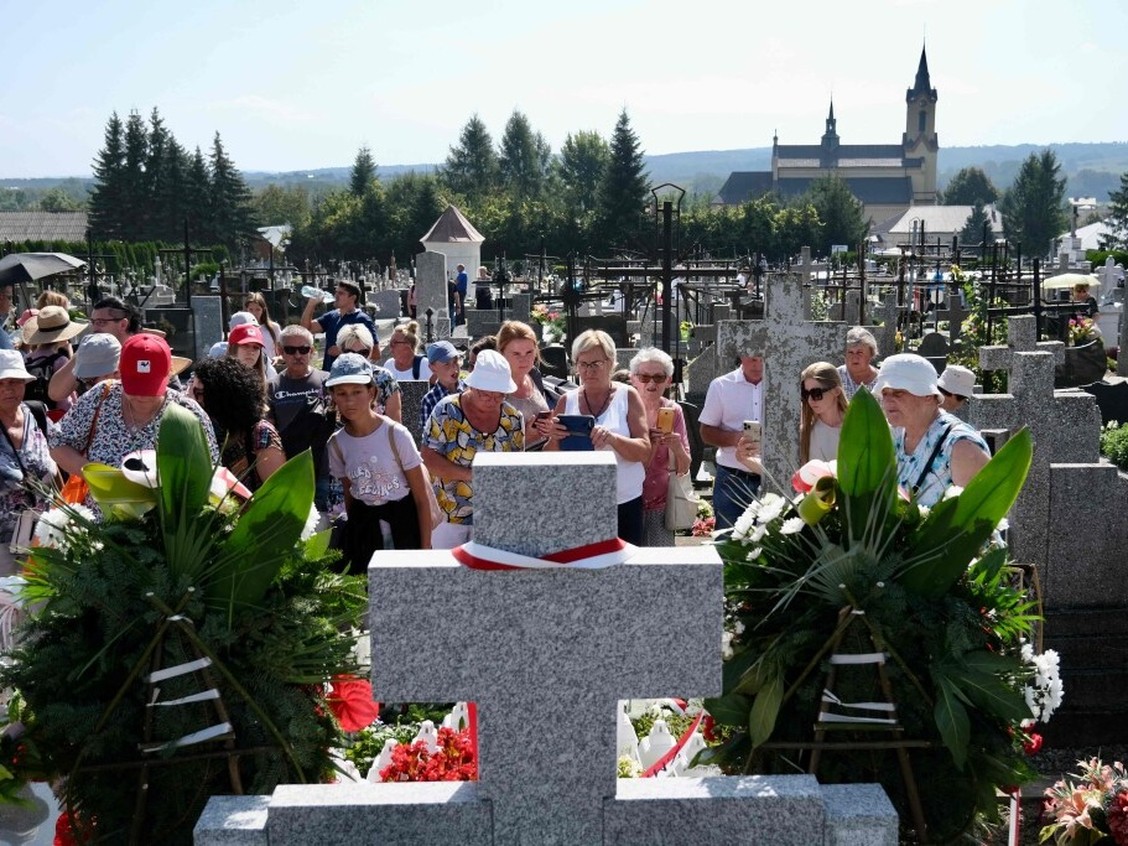
People stand at the Ulma grave during the beatification of the family in Markowa on September 10, 2023.Photo by BARTOSZ SIEDLIK/AFP via Getty Images
The
Catholic Church in Poland earlier this month beatified Wiktoria and
Jozef Ulma, along with their children and their unborn child, in what is
potentially the first step on the path to sainthood in the Church for
the family. It will represent the first time in Catholic history that an
entire family will have been so honoured. Poland holds this family in
the highest regard, memorialized in postage stamps and coins. A museum
is even dedicated to the family and to hundreds of other Polish families
who stepped into the lethal danger zone of aiding Jews during the
Holocaust.
Ulma Family, circa 1943
In
the case of the Ulmas, an indigent rural family with a stern moral
outlook on life that committed them unequivocally to face danger in
exchange for self-respect and empathy for the plight of their
neighbours, they undertook to shelter two Jewish families, eight people
in total in their modest home close to the village of Markowa in the war
years. Jozef was 44, his wife Wiktoria 31, their daughters Stanislawa,
7, Barbara,6, Maria, 18 months, and sons Wladyslaw, 5, Franciszek, 3,
and
Antoni, 2.
The Jews they sheltered and who were
summarily slaughtered by the Nazis in the crowded little farmhouse were
70-year-old Saul Goldman, his sons Baruch, Mechel, Joachim and
Mojzesz, along with Golda Grunfeld and her sister Lea Didner with her
young daughter Reszla, according to Poland’s Institute of National
Remembrance which documented the Ulmas’ story. The family was previously
memorialized as 'righteous among the nations' by Yad Vashem in Israel
in 1995.
On March 24, 1944 when
German police -- responding to an informer who became aware of the
family's involvement in sheltering Jews and then reported them to
authorities -- raided the home. Not only were the eight Jews being
sheltered by the Ulma family murdered, but the murder spree included
Jozef and Wiktoria, pregnant at the time, and their six children. During
the violence, Wiktoria went into sudden labour and the Ulma family's
youngest was briefly introduced to the world. None survived.
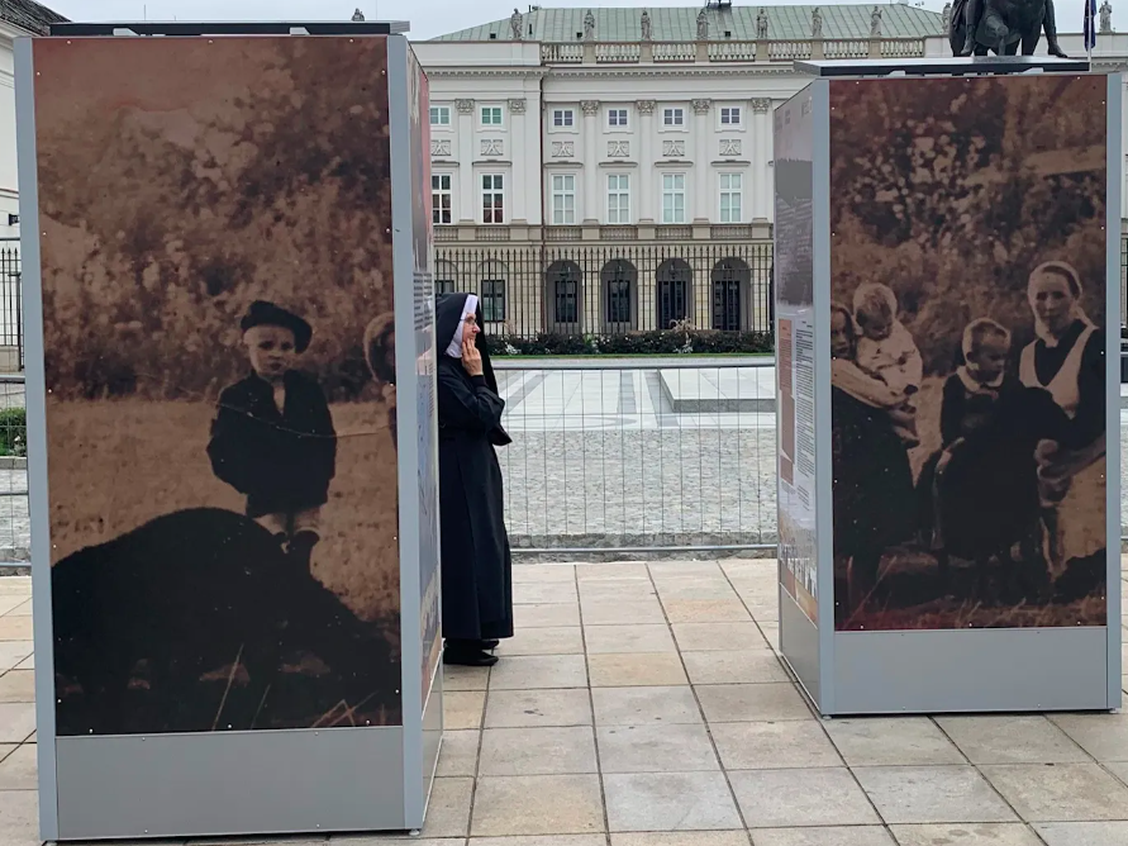
A nun views a display about the Ulma family outside the presidential palace in Warsaw. Photo by Ryan Tumilty
The
family has been recognized as an important symbol of national honour
for Poles, fitting right in with the national narrative that Jews and
Catholics lived a peaceful co-existence before the German occupation
shattered the status quo and produced the Holocaust, drawing Poland into
Germany's state-sponsored genocide through its orchestrated mass
extermination of Europe's Jews.
Before
the advent of the Second World War, an estimated 3.5 million Jews lived
in Poland. During the Nazi occupation of Poland, 90 percent of Polish
Jews were murdered, along with hundreds of thousands of Poles whom the
Nazis also considered to be a sub-human species. It was not only Polish
Jews that were annihilated in the many death camps established in Poland
by Nazi Germany; Poland became a gathering-point for Jews transported
from other parts of Europe.
The
six most-infamous extermination camps were established in Poland:
Auschwitz-Birkenau, Belzec, Chelmno, Sobibor, Majdanek, and Treblinka.
Although Jews felt more accepted in Poland than in many other countries
in Europe, particularly in the east, there was ample persecution and
antisemitism along with deadly pogroms carried out against Jews in the
country. Violence by Poles, stoutly religious Catholics where the church
itself acted in promoting antisemitism, was not uncommon before the
war.
There
were many Jew-hating Poles who took their hate out in persecution and
violence against Polish Jews. The Ulma family was an exception, among
even the thousands of Poles who sacrificed their security in favour of
trying to help neighbours frantic to escape mass death. Postwar, when
Communists ruled Poland, they encouraged the Jews that remained to leave
the country, continuing the old tradition of antisemitism. In fact,
Jews who survived the Holocaust, returning to their towns and villages
were met with threats from former neighbours now living in their homes.
Relations
between Jews and the Polish Law and Justice party government in 2018
became strained when the country's Holocaust denial law made it illegal
to publicly claim Poland or the Polish nation to have been involved in
Nazi atrocities. The changes were withdrawn under outraged protests,
including from the government of Israel. What remains is the potential
of civil penalties for anyone implying Poles had any element of an
active role during the Holocaust. Which, in certain documented instances
they did have.
Jan
Gross, Polish American history professor, has received opprobrium and
has been investigated for libel, criticized by the current Polish
government in relation to his work identifying a number of pogroms
carried out in Poland against Jews by Poles themselves in the early
period of the war. As Piotr Wrobel, University of Toronto history
professor points out, Poland's view of history and Jews is accurate
enough, albeit politicized by the government Law and Justice party.
The
estimated 16,000 people comprising the Jewish community in today's
Poland is small in a country of close to 38 million, yet the many
synagogues that serviced Poland's large pre-war Jewish population have
been protected and preserved. Sebastian Rudol, deputy director of
Krakow's Jewish Community Centre, states that the contemporary
community views the debate surrounding responsibility as more nuanced in
view of various aspects of the past in Polish-Jewish relations.
His
centre caters to their small Jewish community. And it has reached out
to respond to the war in neighbouring Ukraine to help the conflict's
refugees. Its agenda is also to help people whom ancestry searches
identify their families' hidden backgrounds as Jews. When their forbears
sought to protect themselves from antipathy to and persecution of Jews,
by hiding their Jewish identity and assuming a Christian background in
its stead.
Clergy attend the beatification ceremony of the Ulma family, who were
murdered by German Nazis for sheltering Jews in Markowa, Poland
September 10, 2023. Patryk Ogorzalek/Agencja Wyborcza.pl via REUTERS
"[Furchner] knew and, through her work as a stenographer in the commandant's office of the Stutthof concentration camp from June 1, 1942 to April 1, 1945, deliberately supported the fact that 10,505 prisoners were cruelly killed by gassings, by hostile conditions in the camp, [by transportation to the Auschwitz death camp and by being sent on death marches at the end of the war]."
"The promotion of these acts by the accused took place through the completion of paperwork [in he camp commander's office]."
"This activity was necessary for the organization of the camp and the execution of the cruel, systematic acts of killing."
German court in Itzehow State, Northern Germany
Irmgard Furchner, seen here in court in Itzehoe, Germany, was convicted
on Tuesday of being an accessory to murder for her role as a secretary
to the SS commander of the Nazis' Stutthof concentration camp during the
Second World War. Her face is obscured in this photo by order of the
court. (Christian Charisius/DPA)
In her teens when she chose to be a cog in the machinery of mass murder of Jews assembled from throughout Nazi-occupied Europe, Irmgard Furchner lived a long life as an ordinary German citizen until her past caught up with her when she was identified as an accessory to the murder of over ten thousand people. This past week a German court convicted Irmgard Furchner, now 97 years of age, of her World War II crimes.
She was, undeniably a part of the apparatus set up to accommodate and assist the camp near Danzig (now the Polish city of Gdansk) to efficiently pursue its assignments of mass annihilation of European Jews. The court handed down a two-year suspended sentence for her role as an accessory to murder in 10,505 cases and an accessory to attempted murder in five other cases.
Prosecution demands were reflected in the verdict and following sentence. Defence lawyers, on the other hand, had requested of the court that their client be acquitted under the argument that evidence failed to show beyond doubt that Furchner definitely had knowledge of the systematic killings at the camp; proof of intent as required for criminal liability was never presented.
In a statement, the accused stated she regretted what had happened, that she had been at Stutthof at the time. It was, noted Judge Dominik Gross "simply beyond all imagination" that Furchner failed to notice the killings at Stutthof. She could, he said, view from her office window the collection point where new prisoners waited following arrival. The crematorium was in constant use in the fall of 1944, smoke spiralling across the camp.
Because the accused had been 18 and 19 years old at the time of the mass executions, she was tried in juvenile court. Judge Gross further stated that she could have, at any time, resigned from her position, to refuse to be part of the machinery of mass death. In September 2021, there was an attempt by Furchner to become a fugitive and hide somewhere rather than attend the trial, but she was foiled when police picked her up and placed her in detention for several days.
Irmgard
Furchner, 97, has been convicted as an accessory to 11,412 murders at
the Stutthof concentration camp, where she worked as a stenographer for
an SS commander.
"It is where it all began for the Jewish community, and it has such historical significance."
"It's
going to be eco-friendly. It's going to have a memorial garden. It's
going to be a beautiful space. It's going to be a hub of research and
education. It's going to have a beautiful auditorium with 150 places."
"It's going to have a gallery that can host temporary exhibits."
Richard Schnurback, president, Montreal Holocaust Museum
"It
will transform the landscape of the area. It will help to revitalize
downtown and so we feel we're really contributing to our city in a
significant way as we all hope eventually to come out of this pandemic."
"We expect it to be an internationally renowned, world-class institution and an architectural statement."
"It
will be a gathering place for other communities who have been targeted
by genocide, for the local population, for students, for tourists. We
are going to be a warm, welcoming, accessible space that draws people in
and that transforms them and encourages them to stand up today, to act,
to remember."
Dorothy Zalcman Howard, co-president, Montreal Holocaust Museum renewal project
"We've outgrown our physical facilities and we have to regularly refuse school groups."
"This
museum will really be Canada's Holocaust Museum. It will tell the story
of the Holocaust and also talk about the Montreal survivors, people who
came to Canada, to Quebec, and helped to build our city."
Julia Reitman, campaign cabinet president, Montreal Holocaust Museum
Eva
Kuper, standing in front of the Montreal Holocaust Museum, tells how her
life was saved just as she and her mother were being loaded onto cattle
cars for transport away from the Warsaw Ghetto
"[The]
relocation to downtown Montreal should allow increased accessibility
and that is all the more necessary, as we have seen in recent days."
"Unfortunately,
many people are not sufficiently aware of the Holocaust and of the
consequences and the lingering after-affects of that tragedy."
"Let's
hope that having a museum that allows us to better understand this
reality will lead people who have trivialized the use of the yellow star
and trivialized certain Nazi symbols in the past few months to
reflect."
Benoit Charette, Quebec minister of Culture
A collection of yellow stars, worn by Jews during the Holocaust, is one of the many exhibits by the Montreal Holocaust Museum. (Simon Nakonechny/CBC)
A
museum, another museum dedicated to the premise that to forget is to
airbrush history out of existence. Can there be too many museums and
edifices whose sole purpose is to remind humanity of its obligations to
ensure that the organized mass elimination of a people -- whose humanity
had been denigrated amidst accusations of sinister conspiracies to rule
the world, to establish themselves as an ethnic-religious-ideological
world power, subjugating all other peoples to their command -- is never
repeated?
A
criminal, deliberately purposeful campaign undertaken by Nazi Germany
to dehumanize Europe's Jews, to justify the Third Reich's carefully
staged enterprise of delegitimization of what they labelled sub-humans
belonging to a specific ethnic-religious group in preparation to launch a
program of mass slaughter, one that would not raise objections among
populations inured to compassion for the men, women and children slated
for death, because they were exposed to a lethal hatred and believed
that Jewish dominion over the globe must be stopped at all costs.
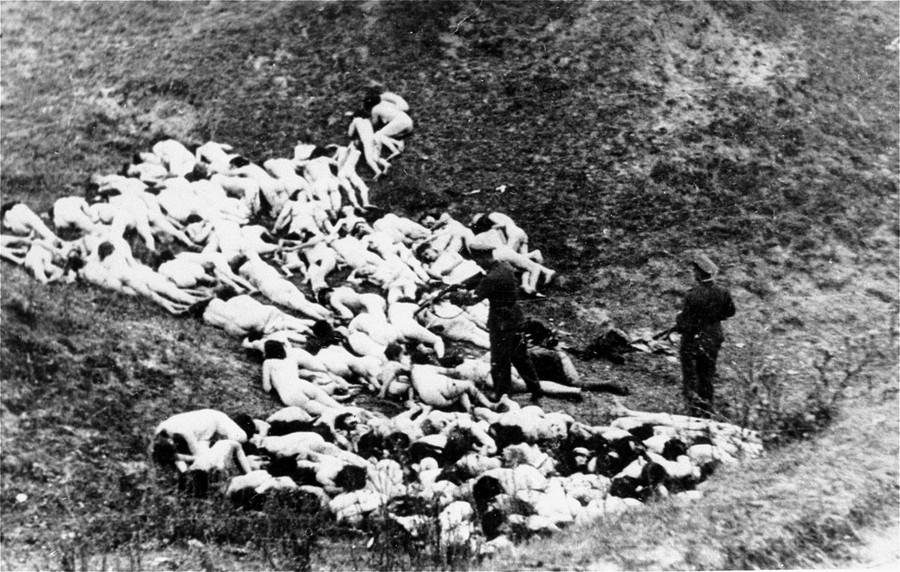
A German in a military uniform shoots at a Jewish woman after a
mass execution in Mizocz, Ukraine. In October of 1942, the 1,700 people
in the Mizocz ghetto fought with Ukrainian auxiliaries and German
policemen who had intended to liquidate the population. About half the
residents were able to flee or hide during the confusion before the
uprising was finally put down. The captured survivors were taken to a
ravine and shot. Photo provided by Paris' Holocaust Memorial.
The
cost was six million lives. The European Jew-cleansing pogrom cost
Jewish children their future, Jewish women and men their hopes, as they
were gathered up, murdered en masse, buried in mass graves, used as
slave labour, died of starvation and disease. And then the Final
Solution seeking more efficient, quicker methods thought of Zyclone B to
gas assembled Jews whose humanity had been stripped away, just as their
worldly possessions, their hair, their gold rings and gold teeth were
gathered to help the World War II effort of the Axis forces.
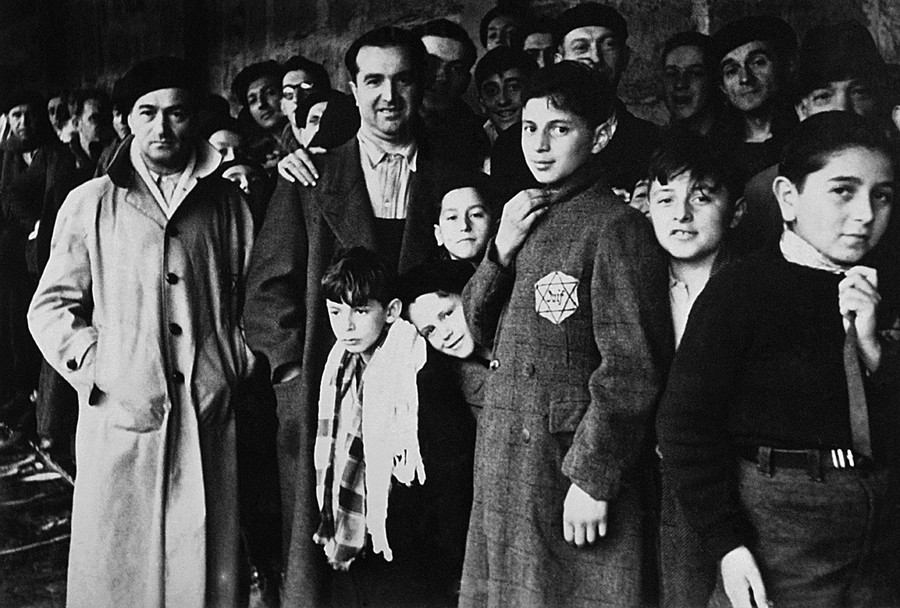
Jewish deportees in the Drancy transit camp near Paris, France, in
1942, on their last stop before the German concentration camps. Some
13,152 Jews (including 4,115 children) were rounded up by French police
forces, taken from their homes to the "Vel d'Hiv", or winter cycling
stadium in southwestern Paris, in July of 1942. They were later taken to
a rail terminal at Drancy, northeast of the French capital, and then
deported to the east. Only a handful ever returned.
This
was their destiny; a giant sacrifice for their noble cause; ridding the
world of Jews for the greater purpose of elevating Aryan qualities of
physique, emphasizing the health virtues of abstaining from alcohol,
smoking, poor nutrition, and global command of lesser nations. The
golden mean of 'doing unto others as you would have them do unto you',
underpinning Jewish traditions only emphasized their suffering as they
cried out to the heavens for having abandoned them. Remembering the
atrocities, the humiliations, the suffering is integral to modern Jewish
life.
The promise made Never to Forget
was forged in blood and bone in memory of those whose lives were taken.
So, no, such places of memorial and teaching must carry the torch of
remembrance. There are far too many in today's world who doubt the very
existence of a machinery vast enough and dedicated enough to have
murdered six million Jews. And many among them feel the effort was
halted before it could properly complete its goal. The spectre of
once-hushed Jew-hatred has resurfaced with a vengeance.
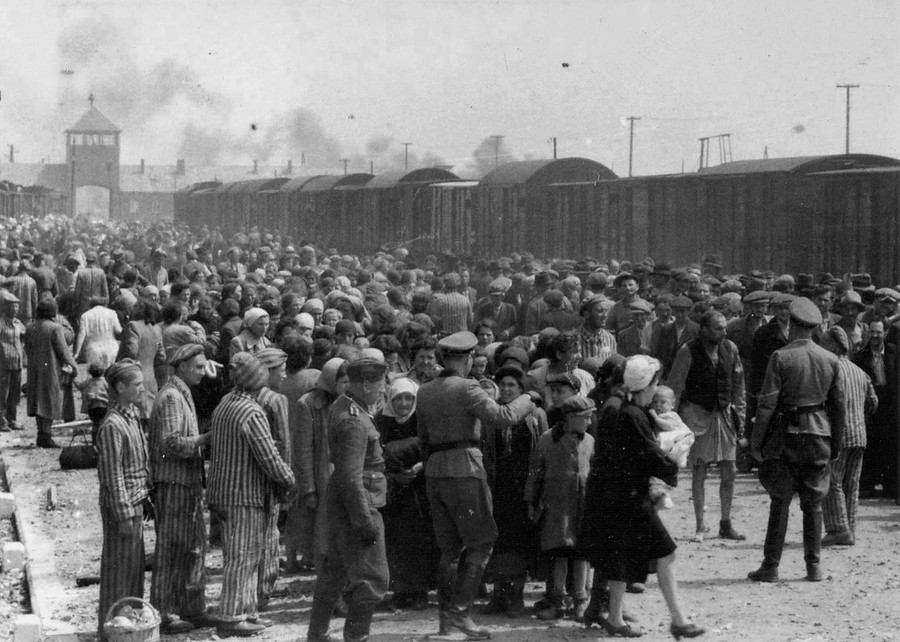
The arrival and processing of an entire transport of Jews from
Carpatho-Ruthenia, a region annexed in 1939 to Hungary from
Czechoslovakia, at Auschwitz-Birkenau extermination camp in Poland, in
May of 1944. The picture was donated to Yad Vashem in 1980 by Lili
Jacob.
The
Montreal Holocaust Museum's current location in a building shared with
other Jewish community organizations has outlived its ability to convey
the full measure of what fascist Germany accomplished. A mere 400 of its
14,000 artifacts are displayed, reflecting a lack of room to amply and
effectively expose visitors to a fuller understanding of the Holocaust.
With a purpose-built edifice for which funding is being raised, for
construction to commence in 2023 in the expectation of the museum
opening two years later, a generous endowment by the province's Culture
Ministry of $20 million, another $15 million from the Azrieli
Foundation, as well as public, corporate and private sources see the
project on goal for $80 million.
The
museum is to move from Cote Ste-Catherine Road to what once was the
beating heart of the Montreal Jewish community, St.-Laurent Blvd., The
Main. Where a parking lot now sits, a building to house the Holocaust
Museum is to rise, with 71 percent of its funding already raised.
Destination Montreal represented the third most important city per
capita after Israel and New York, for Holocaust survivors leaving the
charnel house of Europe for a new beginning. Of the roughly 40,000
survivors immigrating to Canada after the Second World War, 9,000
arrived in Montreal.
Among
the museum's collection, there are 858 recorded survivor testimonies.
Research indicates that people who learn about the Holocaust are
likelier to be aware of and to care about other communities, to oppose
persecution and to tend to develop anti-racist values. "For
so many victims, there are no places that mark their existence. In a
way, we are their voices. We are the repository for those people who
were killed. We tell some of their stories and we encourage future
generations to care about what happened and to translate those stories
so they find expression in their own times", explained Dorothy Salcman Howard.
An urn containing ashes from the Auschwitz concentration
camps sits surrounded by the names of other Nazi extermination camps at
the Montreal Holocaust Museum. (Simon Nakonechny/CBC)
"Initially, she must have been terrified of every knock at the door." "But time went by and everything seemed fine. She didn't want to keep him cooped up in the house. He'd already gone through so much and was probably mentally quite damaged." "Presumably, it started with getting a breath of fresh air. Then she became a little braver. It snowballed. By the end, there are reports of her taking him to church and the two going into town on the bus together." "[Gould] held on to Bill for too long. Others who sheltered people moved them on. She just loved him too much to let him go." Jenny Lecost, writer, film maker, London, England
Louisa Gould cared
for a Russian prisoner of war after her son was killed fighting in the
Second World War - only to be exposed to the Nazis two years laterCredit:
Jersey Archive
Louisa Gould had lost her son Edward who served with the Royal Navy in the Mediterranean during the Second World War. And then she was presented, a year later, with a possible surrogate. Not that the young man, a Russian pilot in his early 20s shot down by German fire in 1942 was meant to be a surrogate. He found himself in Jersey, the Channel Islands, at that time occupied by the Nazis, where he was taken as a prisoner of war. The young Russian made his escape from the prison camp Immelman.
In his search for safe haven, he was taken by a sympathizer of his plight to the widowed Louisa Gould. She welcomed him into her home and hid him in her house in Millais in the island's northwest for close to two years. His name was Feodor Burriy, but she gave him another name, feeling that 'Bill' would suit him better under the circumstances. He was given a room of his own and her dead son's clothing, altered to fit him. She taught him to speak English, in an effort to shield his Russian identification from detection.
He was to be introduced as a nephew; alternately a friend of the family. Before long "Bill" felt comfortable in his new life, successfully hiding from the German occupation. Another of Louisa Gould's sons, studying in Oxford and joining the Royal Air Force, along with her brother, her sister and others in the village knew who "Bill" really was. Twenty months on, rationing was increasing and tensions rising, and the identity of Louisa Gould's 'nephew' was revealed through a letter sent to a local academic.
Who forwarded the letter on to German authorities, and at the same time warning Mrs. Gould that her secret had been revealed. That warning gave her the opportunity to move the young Russian to a safe house. A succeeding search of her house by the German occupying authority, however, unearthed a Russian-English dictionary and a Christmas gift tag with 'Bill's' Russian name. Louisa Gould was sentenced to prison for a two-year period; taken by cattle truck to Ravensbruck concentration camp in Germany.
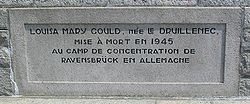
Plaque on war memorial, Saint Ouen, Jersey, to Louisa Mary Gould, victim of Nazi concentration camp Ravensbrück:
Eight weeks before Ravensbruck was liberated, this woman was sent to the gas chamber where she perished, aged 53. As for Bill, he was never recaptured, eventually making good his return to Russia, post-war. He married, remaining in communication with some of the residents of Jersey. In 1994 he travelled back to the island to unveil a plaque recognizing the courage and determination of Louisa Gould to foil the Nazi occupation.
While she was at Ravensbruck this woman befriended other camp inmates. She did her best to instill hope in them, and prepared them for their future freedom by teaching them to speak English.
Photo: Patriots on the island of Jersey tarred the houses of
collaborators with a swastika. This was counteracted by the Germans who
painted hundreds of houses with the swastika, including the home of
these two ladies in 1944. (Popperfoto/Getty Images)
"I call it the Fuehrer-high. It makes you feel on top of the world even if the world is collapsing around you." "There's not one sober day after the fall of 1941 [within the ranks of the Nazi government and military, and a large segment of the civilian population]." "Every animal that was slaughtered in the Ukraine, all the organs would go to Morell [Dr. Theodor Morell, Adolph Hitler's personal physician]; he would send them to his factory ... and concoct hormonal doping agents to introduce into the bloodstream of Hitler." "He [Hitler] was going cold turkey as he lost the Second World War. He was basically a wreck." "I have no idea how it [Nazi assaults] would have worked without Pervitin [closely related to present-day crystal meth]." "Nazism was toxic, in the truest sense of the word. It has given the world a chemical legacy still with us today, a poison that won't soon disappear." German writer Norman Ohler, author of Blitzed "In the proper dosage, one's self-confidence is significantly elevated, and one's fear of undertaking even difficult work is lowered." Wehrmacht order, April 17, 1940, pre-invasion of France
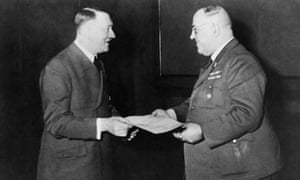
Adolf Hitler awards the Merit Knight Cross to his private doctor, Theodor Morell, in February 1944.
Photograph: Keystone-France/Gamma-Keystone via Getty Images
Hitler favoured a healthy society; he frowned upon consumption of alcohol, of tobacco, and was a proponent of whole foods in the German diet. Aryans, like the German ideal of the tall, blond, muscular German, should be beautiful to look upon, healthy and vibrant, the very picture of youth and vigour. That was the message he promoted among the civilian and military when he came to power. He was himself the antithesis in presentation of the perfect Aryan without the athletic appearance he favoured.
And just as he was personally the very opposite of what he promoted as the perfect human body and healthy mind to do credit to the Germany whose future he planned, his coda of healthy living was in competition with his penchant for drug-taking. His personal physician saw to it that Hitler was well supplied with regular injections of steroids, opioids and an assortment of new drug formulations that the physician produced with the Fuehrer in mind.
When the author of the newly published book on Hitler's passion for the values he saw in the strategic use of recreational drug products for the military, let alone for himself, began his research he uncovered a plethora of data that glued together his narrative of a demented dictator whom drugs helped to assure he would one day control the world and in so doing making it a superior place.
That this charismatic madman was documented to have been peculiar in his erratic behaviour, particularly as the war came to a close, the theories of the strain brought about by stress, by early senility, by the mind corruption that absolute power invariably brings to its possessor, were all contemplated. But it was, in reality, his indiscriminate and passionate use of drugs that drove him to the excesses of mannerisms that intrigued those who documented his trajectory and compulsions.
Not much the man did made intelligent sense, since he represented a total and complete moral vacuum while espousing a high degree of moral values all his very own, which possessed a veneer of potential, but rotten to the core. From his viral hatred of Jews and plan to formulate a Final Solution in lock-step with his determination to rule the world and transform it into a stalwart and glorious Aryan satrapy, to his self-assurance that anything he undertook would succeed, irrespective of the lives taken in the process, he was certifiably mad.
What the book that Mr. Ohler produced does point out was that the Nazi military, all three million under arms and more marched imperiously in the company of millions of tablets of Pervitin. This combination brought the fantasy of the Aryan Superman to life and the German Blitzkreig to fruition when soldiers fed the equivalent of a diet enriched with crystal meth needed less sleep than those they attacked; marching and doing battle when their enemies were long since exhausted.
Fascism and paranoia seemed to have been perfect bedmates, aided by the presence of mind-altering drugs to produce a semi-permanent high, from the civilian German population, to the German troops, to their government leaders. Until commanders of the troops realized their men needed a longer recuperation time than their enemies who were not dependent on drugs. The Pervitin-addicted soldiers were soon acquainted with psychotic episodes and breakdowns.
And, said, author Ohler, "You can't take Russia with crystal meth".
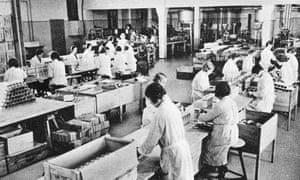
Workers at the Temmler factory in Berlin produced 35m tablets of
Pervitin for the German army and Luftwaffe in 1940. Photograph: Temmler
Pharma GmbH & Co KG, Marburg
This represents a general opinion site for its author. It also offers a space for the author to record her experiences and perceptions,both personal and public. This is rendered obvious by the content contained in the blog, but the space is here inviting me to write. And so I do.