Saturday, September 02, 2023

Addiction Compassion, Community Safety Disinterest


"Used needles also started popping up in the rear lanes on both sides of Heward Avenue, my street. These lanes are playgrounds for the many children who live on these streets, relatively traffic-free spaces where they can ride their bikes, play catch and shoot at basketball and hockey nets."
"By 2019 there was a distinctive shift outside the South Riverdale Community Health Centre. It had, in a short amount of time, been transformed from a place of semi-discreet open use to something that bore a much closer resemblance to the open-air drug emporium that would grow over the next four years."
"Drug dealing was becoming more rampant, as was open use."
"Drug dealers would arrive by car across from my house most mornings, and the buyers would not-so-discreetly arrive to make purchases. There were also suddenly dealers on foot. But the most common dealers, especially of late, are ones on bikes, typically wearing backpacks."
Derek Finkle, Leslieville, Toronto
Safe consumption site
A view of the South Riverdale Community Health Centre. (CBC)

This is a description of a 'supervised consumption' site. Where the drug-addicted receive special care in an effort to keep them from being yet another statistic of a fatal overdose scenario. Fentanyl use is raging across Canada. Toronto isn't the worst Canadian city for drug overdoses, Vancouver takes that very special award. In fact, Vancouver is likely the most overdose-prone city in all of North America. The struggle by compassionate health authorities to keep people alive is commendable.
 
The people who live adjacent to supervised consumption sites may not consider their proximity to be much of a boon to the quality of their lives and that of their children, however. The sites are notorious for public disorder and crime; the centres' managers seem incapable of addressing these inconvenient side-issues that turn ordinary citizens' lives inside-out and upside-down. The commitment of the drug centres is to the addicted, not to people living in close proximity to their life-saving facilities.
 
Some of these centres hire active drug users and dealers for the success of their programming; people who have the 'lived' experiences, since who else knows as much about addiction as they do? And who would be more sympathetic to the plight of the addicted? And less affected by the crime scenarios that abound? As for example when an area resident was killed by a stray bullet near the safe injection site in the Leslieville community in July.
 
https://pbs.twimg.com/media/F3bE8IcXYAAXDaM?format=jpg&name=900x900
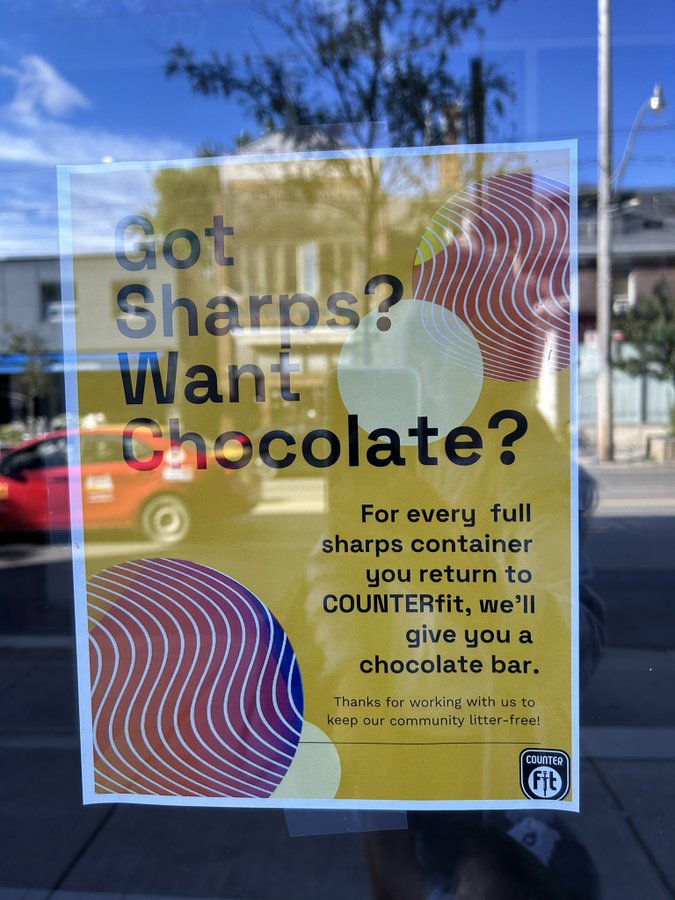
If you live in Leslieville and you're concerned about your kids picking up needles that surround the drug consumption site, you don't have to worry. In fact, if your kids collect enough they can trade them in for chocolate! Ginnie Roth
A harm reduction worker at the South Riverdale Community Health Centre, Khalila Zaa Mohammed, was arrested a month later, charged for assisting one of the shooting suspects to escape and hide from authorities. In the wake of her arrest a "critical incident review" was initiated of Ontario's consumption sites beginning with the SRCHC. The safe injection site sits within 100 metres of two schools and three daycares where used needles are ubiquitous, and a 5-year-old boy found a baggie with a chunk of orange fentanyl.

The South Riverdale Community Health Centre has initiated "Harm Reduction Satellite Sites" and there drug users are paid to operate quasi-supervised consumption sites right out of their own homes. A partner organization had an operating guide published for the edification of other service providers who might want to launch similar programs. The guiding principles of the document include building "spaces and services where repressive drug laws cannot be enforced". Service providers are encouraged to hire drug dealers to run the sites.

Trafficking is viewed as a type of expertise, and cooperation with dealers "a great way to reach people who otherwise don't typically engage with harm reduction services". Going to jail is a "part of life", the guide asserts; and satellite workers should remain on the payroll while incarcerated. It is "not appropriate to expect sobriety" from contracted drug users or dealers even while providing harm reduction services; "expectations that workers not use drugs with clients, which might be standard in other programs, should not apply to satellite workers".

The sites' existence should be hidden from landlords and other tenants to avoid eviction, service providers and satellite workers are advised by the guide that argues satellite workers can help users with information about police activity since they're within distressed communities. Citing journalist and Leslieville resident Derek Finkle, neighbours witness harm reduction workers using drugs outside the main consumption site of SRCHC, where police are "disinvited" from the property.

The situation prevails right across the country with Canadians reporting similar experiences at other consumption sites -- public drug use and trafficking, along with a crime epidemic and violent harassment. With it all a complete disinterest in how local residents are faring in this maelstrom of drugs, crime and flouting of the criminal justice system.
https://smartcdn.gprod.postmedia.digital/nationalpost/wp-content/uploads/2023/08/rjb109-the-canadian-press-2.jpg?quality=90&strip=all&w=1128&h=846&type=webp&sig=hae4YZ7-L-FGfZjXNRNqgA


Labels: , , , , ,

Saturday, November 06, 2021

Desperate Moves to Save Lives Hovering on Extinction

"Despite throwing all this at it, we still are seeing terrible increases in drug toxicity and terrible loss of life."
"We hear from people on the ground that stigma and shame is making people hide their drug use."
"I certainly hope that it's the first thing that is on Minister Bennett's desk. This is something that could inform approaches in the rest of the country."
"And we've got a lot of support here in British Columbia to move quickly and the public emergency demands that we move urgently."
"Criminalizing it and driving it into the shadows has not worked; it has not helped."
Sheila Malcolmson, Minister of Mental Health and Addictions, British Columbia

"As the opioid and overdose crisis continues to worsen, we must take every measure possible to reduce harms and save lives."
"We recognize the different approaches cities, provinces, and other organizations are taking and are supportive of their work."
"We know there is more to do and our government will remain engaged with them to move these health-based approaches forward."
Mental Health and Addictions Canada statement 
A rose placed at the intersection of East Hastings and Main streets in the Downtown Eastside of Vancouver on Feb. 11, in memory of those lost to the opioid crisis. (Ben Nelms/CBC)
 
British Columbia has been the first province in Canada to open controversial harm-reduction clinics and to experiment novel new stances in the hope that the humanitarian impulse to help the addicted move away from their drug dependency, and in worst-case scenarios where diehard drug abusers cannot be convinced to take steps to turn themselves away from drugs, helping them to inject safely with required attention to the vital importance of hygiene in this time of COVID-19, have found themselves facing a brick wall of failure.

Despite all the best efforts of health care institutions, humanitarian aid and government intervention, the rate of overdose deaths simply keeps rising. Now, the provincial government has approached the federal government with a request for exemption for people in possession of small amounts of heroin, cocaine and other illicit drugs, including fentanyl. The request is that the Controlled Drugs and Substances Act be suspended at this historical time of COVID intersecting with drug overdose increases.

To allow people possession of up to 4.5 grams or less of heroin, fentanyl, crack or powder cocaine and methamphetamine, lifting the fear of criminal charges and seizure of the drugs by police. Such an exemption to be based on a like principle permitting supervised injection sites to operate within the law, to apply province-wide. There are observers who question whether decriminalization would succeed in reducing deaths by overdose, citing the reality that there have been such policies in place in B.C. for years, none of which have succeeded in reducing opioid deaths.

During the pandemic, overdose deaths have actually soared. Furthermore, the province's solicitor-general had given instruction to provincial police forces to no longer make arrests for simple possession, long before the arrival of the pandemic. Over a year ago in another effort to address ways of reducing the constraints, the Public Prosecution Service of Canada had directed prosecutors that the most serious drug crimes be focused on; "and to otherwise pursue suitable alternative measures and diversion from the criminal justice system for simple possession cases".

Despite all of these moves 1,204 people died from drug overdose; 184 of them in July alone,according to the B.C. Coroners Service. A new record awaits of over 2,000 deaths in the current year, over five times the number of fatal overdoses that occurred ten years earlier. Such overdose deaths now exceed deaths linked to suicide, homicide and car accidents in total; Fentanyl is implicated in 86 percent of these overdose deaths.
 
Over 100 treatment beds have been opened, with another 200 in the planning stages, by the B.C. government. Safe supply programs have been created, allowing doctors and nurses to prescribe opioids (including fentanyl patches), alcohol, stimulants and benzodiazepines in an effort to persuade users to avoid street drugs laced with fentanyl.  

These are clearly acts of desperation in desperate times. The best of intentions appear to fuel the problem rather than dampen the situation. Making drugs more readily available in sterile situations  to avoid COVID infections may diminish the spread of the virus, but it also has the effect of normalizing drug addiction since the addicted, while being referred to drug-reduction programs also have the option of refusing them, their needs being met in the short-term. The programs may not expire, but the addicted do.

It is expected that others will follow British Columbia's example. It's the compassionate way to address the human obligation to give aid and support to others in need. And the demographic that fits into the category of desperate addictions is steadily growing. Even as their numbers reduce through untimely deaths new recruits to the hopeless impulsion of drug misuse are multiplying, exacerbating a situation already past dire. 

The City of Toronto is witnessing the steady growth of overdose deaths as are many other municipalities, all of which feel compelled to face the growing problem not with punishment of people whose lives have been turned toward a ritual revolving around rewarding drug dealers with the offshoot problem of petty crime to feed the need of a wasted life. City councils, in desperation, turn to calling for exemptions or broader access to a safe supply of illicit drugs.

People hold signs during a memorial march to remember victims of overdose deaths in Vancouver  Globe & Mail


Labels: , , , , ,

Follow @rheytah Tweet