Saturday, December 06, 2025

Violent Hatred 'In Good Faith'

"We fear that because representatives, or would-be representatives, of some groups, came to the committee and sat there, that the Liberals fear backlash against them within some communities and that because of that, they have cancelled today's meeting."
"If the Liberals had, in the matter of religious exemptions, the same courage that they have for oil and gas infrastructure, this would have been dealt with a long time ago."
"[The minister proposed that] our amendments, particularly of course the one putting an end to the religious exemption, be integrated into C-9 in order for it to be adopted with the Bloc Quebecois's support because no one else was interested in doing it and the Bloc Quebecois holds the balance of power at the justice committee."
Bloc Quebecois Leader Yves-Francois Blanchet 
https://smartcdn.gprod.postmedia.digital/torontosun/wp-content/uploads/2024/08/Image-1-2.TS_.jpg?quality=90&strip=all&w=564&h=423&type=webp&sig=HY9f1KIs3idGRvBq-kE7xg

Unsaid, but quite well understood is the identity of those would-be representatives, the Muslim community in Canada's various representative groups, all of which are offended by a move by the minority federal government, requiring support from opposition parties to pass bills that would affect them. As in 'freedom of speech' careening into hate speech which moves beyond the civil permissible into the dark areas of threats and support for violence to the point where killing a certain segment of the population is inferred, if not outright stated.
 
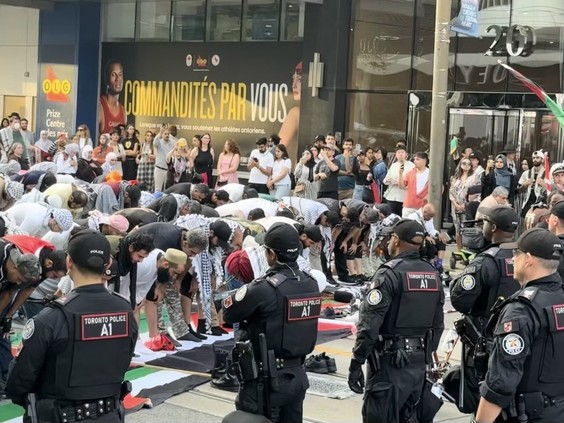
The Canadian-Jewish community has been increasingly targeted by various Islamist Muslim groups within Canada in constant 'demonstrations' and mass rallies where masked, keffiyeh-clad, Palestinian-flag -waving groups gather in the public square, block highways, pose threats in front of synagogues, Jewish parochial schools, Jewish community centres, private Jewish businesses, municipal council chambers to shout the invectives of 'globalize the intifada', 'final solution', 'from the river to the sea', and 'Jews go back to Europe!'
 
There are laws in Canada that prohibit this kind of action and activities that border on and often exceed permissible public social behaviour where property is damaged, defaced, and otherwise vandalized, threats are issued and peoples' ingress and egress to schools, meetings, hospitals are impeded. Much less vehicular traffic stopped, including fire trucks and ambulances when shouting, threatening groups fill the space and become deliberately immovable, or prostate themselves in unison in displays of public prayer.
 
Unfortunately, those laws have not been enforced; neither municipal authorities nor the police associated with those municipalities act to stop such events, clear the streets and apprehend those whose actions stand out as abusive and threatening and criminal in nature. What is cited is the sacrosanct right of  'freedom of speech', amidst the intimidating scenarios. And the propensity of many wearing masks, holding placards damning Israel and shouting 'globalize the intifada' to become physically violent, including toward police, when arrests will take place.
 
https://i.cbc.ca/ais/1.7022457,1699469215000/full/max/0/default.jpg?im=Crop%2Crect%3D%280%2C0%2C3529%2C3024%29%3BResize%3D805
In a speech to protesters on Oct. 28, Imam Adil Charkaoui, speaking Arabic, denounced "Zionist aggressors" and called on Allah to "kill the enemies of the people of Gaza and to spare none of them." X
 
Now, instead of using the laws prescribing acceptable social behaviour, a new anti-hate bill is being proposed, one that will remove a clause forgiving abusive activity if it is done in a spirit of 'sincere belief' in a religious context which would exonerate say, a Muslim who proclaims 'kill the Jews', because something in his sacred scripture allows that. The Canadian Council of Imams attended the last committee meeting discussing the amendment to the Criminal Code's religious defences for hate speech charges. They opposed the religious defences removal.
 
The proposed legislation seeks to make it an offence to intimidate or obstruct at places of worship. Presented by Justice Minister Sean Fraser, it proposes the criminalization of hate promotion through the display of symbols that have links to designated terror groups. The rise in police-reported antisemitic violence in the wake of the Israel-Hamas war has spurred Jewish advocacy groups to call for additional measures of protection for the Jewish-Canadian population. 
 
It was the Bloc Quebecois's proposal for the religious defences to be removed dealing with the 'wilful promotion of hate' and promotion of antisemitism, defined by the law as minimizing or denying the Holocaust, which states specifically that anyone in 'good faith' who expresses or communicates an opinion "on a religious subject or an opinion based on a belief in a religious text" not be convicted of hate speech. The Bloc has advocated for the religious exemptions to be removed from the Criminal Code. 
 
https://i.cbc.ca/ais/1.6996066,1697234290000/full/max/0/default.jpg?im=Crop%2Crect%3D%280%2C375%2C4032%2C2268%29%3BResize%3D860
Pro-Palestinian demonstrators gathered in downtown Montreal in October 2023. In November, Montreal police received a complaint about speeches made during those demonstrations. (Danielle Kadjo/Radio-Canada)


Labels: , , , , ,

Sunday, September 21, 2025

Opioid Prohibition on First Nation Territory

"[There is no] hate [for those involved in drug offences; they are not considered] bad people."
"We are now seeing much more dangerous substances, like meth and fentanyl, creeping into our region..." 
"We cannot afford to ignore the signs [in considering the safety of the community]."
Chief and Council, Buffalo River Dene Nation, Saskatchewan 
 
"In Manitoba and across Canada, fentanyl poisonings are taking lives daily."
"Our front-line workers and families are doing all they can, but support from federal and provincial governments remains fragmented, underfunded and reactive."
Chief Angela Levasseur, Nisichawayasihk Cree Nation 
 
"Families are torn apart, two children are left without parents, and our social fabric is broken." 
"The scale of this crisis demands immediate, co-ordinated federal action."
"Piecemeal funding and short term pilots are not enough. The federal government has both fiduciary and treaty obligations to act."
Cold Lake First Nations Chief Kelsey Jacko 
https://www.vmcdn.ca/f/files/shared/feeds/cp/2025/09/3782237864d9358dcd26b94a735ecfcfbe715f2ce812d61534c4be0222bea34f.jpg;w=960
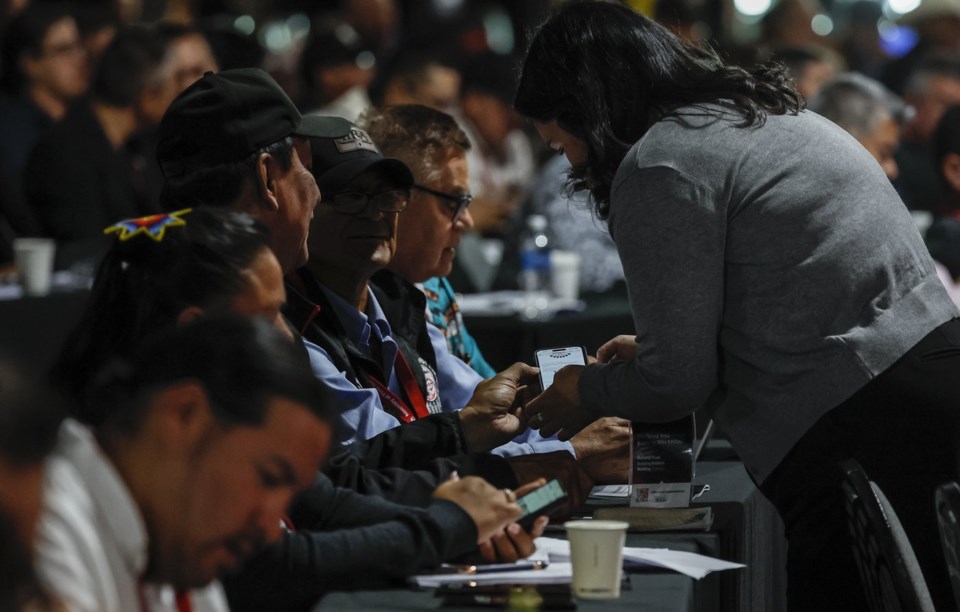
Delegates vote electronically on resolutions at the Assembly of First Nations (AFN) Annual General Assembly in Winnipeg on Wednesday, Sept. 3, 2025. THE CANADIAN PRESS/John Woods
 
Friday saw a proposed law that First Nations chiefs voted unanimously to support while calling on the federal government to begin enforcing a crackdown on drug dealers selling illegitimate drugs in their communities that claim the lives of users. The Assembly of First Nations was also called upon to declare a state of emergency among all First Nations, and to appeal to the federal government for greater support for treatment and prevention. The law, as proposed, would see sentences for drug traffickers to a 15-year minimum where death occurs from tainted drugs.
 
Law enforcement, furthermore would be given authority to access the cellphones of victims in search of those traffickers responsible for the proliferation of the drugs. The resolution appealed to the Assembly of First Nations to advocate for federal resources required to address root causes of drug use, focusing on prevention, intervention and rehabilitation. The proposal called for "legal reforms that reflect the true scale and human impact of the fentanyl crisis, and that prioritize the protection of life over the criminal impunity currently enabling  traffickers and dealers."
 
Countrywide, Canada's First Nations have become actively involved in banishing drug dealers from their communities, their effort to curb the skyrocketing rate of drug overdoses, in sharp contrast to government strategies which prioritize harm reduction and drug trafficking-lenient treatment. September 3 saw the Ojibway community of Netmizaaggamig Nishnaabeg in Ontario authorize the Anishinabek Police Service to treat unauthorized visitors as trespassers. 
 
https://scontent-yyz1-1.xx.fbcdn.net/v/t39.30808-6/547246599_1186967026800602_2002949840548466428_n.jpg?stp=dst-jpegr_s600x600_tt6&_nc_cat=108&ccb=1-7&_nc_sid=833d8c&_nc_ohc=WqlrkF0-lUoQ7kNvwE_45sn&_nc_oc=AdlnkeOUzdIo9-xOXyOvNeIJSNhbmoq0rJxKPzB-QPh2PUSDknBaBTxFm_SfVm2Lq_0&_nc_zt=23&se=-1&_nc_ht=scontent-yyz1-1.xx&_nc_gid=HXLaKvEBqX27Qy9l2Vkr4w&oh=00_AfYEGA8jVFX9qsryWOFcyfbZNxP6ODemMZpzTO03wWZosA&oe=68D5377F

 
"Unfortunately, there's people coming into the community with these drugs that are taking advantage of our people", stated deputy chief Thurston Kwissiw. Saskatchewan's Buffalo River Dene Nation last month announced it planned to begin evicting its own members from reserve housing who are involved in drug activities. Kwakiutl First Nation on Vancouver Island looked at available options for the eviction of members accused of drug dealing. Hereditary chief David Knox informed local media "we're tired of watching our loved ones get killed from these toxic drugs". 
 
The family of an alleged drug trafficker and accused murderer's family on Haida Gwaii saw their home demolished and were forced to leave the islands. Pickets followed the family to the mainland, intercepting them at bus stops to ensure they moved on. Multiple Indigenous communities in the North enforce blanket bans on alcohol, assisted by the RCMP. In the northern Alberta community of Fox Lake, a bootlegger was recently detained while attempting to smuggle in 124 bottles of illicit vodka.
 
https://www.netnewsledger.com/wp-content/uploads/2019/01/Opioid-Addiction-Depositphotos_137871552_xl-2015-696x462.jpg
Opioid Addiction – image: depositphotos.com
 
Fatal overdoses among Indigenous people in British Columbia is seven times greater than the average. Overdose deaths in Alberta have been responsible for a sharp drop in Indigenous life expectancy. The average First Nations person in Alberta lives to 62.8 years, down in a decades' time from a 2013 peak of 72.4, much less than the current non-Indigenous life expectancy in Canada of 81.8 years. 
 
It has long been acknowledged by government health authorities that Indigenous communities are affected more dramatically by illicit drugs than non-Indigenous communities. Yet, official strategies have tended to sidestep the issue of drug trafficking interdiction. Published in 2023, the official Canadian Drugs and Substance Strategy, posits that high Indigenous drug use is attributable to "historial and intergenerational trauma, including the impact of colonization".
 
The self-flagellating federal government gave expression to then-attorney general David Lametti's statement that "We hare repealed the mandatory minimum penalties that have most contributed to the over-incarceration of Indigenous people, Black persons and racialized Canadians", in explaining the 2022 passage of Bill C-5, the Liberal legislative gift influenced by Critical Race Theory to non-punishable minority groups held to be disadvantaged and not responsible for their misdemeanors, thus removing mandatory minimum penalties for drug trafficking offences.
 
Finally, the Assembly of First Nations is signalling that this approach has not worked, and will not work, to address these habitual problems of sociopathy prevalent in specific groups. The 1,500-member Mississauga First Nation last October scored a precedent-setting legal victory with an Ontario court upholding their trespassing order against an accused drug dealer who  continually frequented the community. In the process the Mississauga leaders emphasized their long struggle to have police enforce their community codes. 
 
https://smartcdn.gprod.postmedia.digital/nationalpost/wp-content/uploads/2025/09/548108040_1186967113467260_6205002241907255265_n.jpg?quality=90&strip=all&w=564&h=423&type=webp&sig=Y9wGYrGVK4prEw5padYAYg


Labels: , , , , ,

Friday, July 25, 2025

Canada's Liberal Government, True to Form

Labels: , , , , , ,

Saturday, November 06, 2021

Desperate Moves to Save Lives Hovering on Extinction

"Despite throwing all this at it, we still are seeing terrible increases in drug toxicity and terrible loss of life."
"We hear from people on the ground that stigma and shame is making people hide their drug use."
"I certainly hope that it's the first thing that is on Minister Bennett's desk. This is something that could inform approaches in the rest of the country."
"And we've got a lot of support here in British Columbia to move quickly and the public emergency demands that we move urgently."
"Criminalizing it and driving it into the shadows has not worked; it has not helped."
Sheila Malcolmson, Minister of Mental Health and Addictions, British Columbia

"As the opioid and overdose crisis continues to worsen, we must take every measure possible to reduce harms and save lives."
"We recognize the different approaches cities, provinces, and other organizations are taking and are supportive of their work."
"We know there is more to do and our government will remain engaged with them to move these health-based approaches forward."
Mental Health and Addictions Canada statement 
A rose placed at the intersection of East Hastings and Main streets in the Downtown Eastside of Vancouver on Feb. 11, in memory of those lost to the opioid crisis. (Ben Nelms/CBC)
 
British Columbia has been the first province in Canada to open controversial harm-reduction clinics and to experiment novel new stances in the hope that the humanitarian impulse to help the addicted move away from their drug dependency, and in worst-case scenarios where diehard drug abusers cannot be convinced to take steps to turn themselves away from drugs, helping them to inject safely with required attention to the vital importance of hygiene in this time of COVID-19, have found themselves facing a brick wall of failure.

Despite all the best efforts of health care institutions, humanitarian aid and government intervention, the rate of overdose deaths simply keeps rising. Now, the provincial government has approached the federal government with a request for exemption for people in possession of small amounts of heroin, cocaine and other illicit drugs, including fentanyl. The request is that the Controlled Drugs and Substances Act be suspended at this historical time of COVID intersecting with drug overdose increases.

To allow people possession of up to 4.5 grams or less of heroin, fentanyl, crack or powder cocaine and methamphetamine, lifting the fear of criminal charges and seizure of the drugs by police. Such an exemption to be based on a like principle permitting supervised injection sites to operate within the law, to apply province-wide. There are observers who question whether decriminalization would succeed in reducing deaths by overdose, citing the reality that there have been such policies in place in B.C. for years, none of which have succeeded in reducing opioid deaths.

During the pandemic, overdose deaths have actually soared. Furthermore, the province's solicitor-general had given instruction to provincial police forces to no longer make arrests for simple possession, long before the arrival of the pandemic. Over a year ago in another effort to address ways of reducing the constraints, the Public Prosecution Service of Canada had directed prosecutors that the most serious drug crimes be focused on; "and to otherwise pursue suitable alternative measures and diversion from the criminal justice system for simple possession cases".

Despite all of these moves 1,204 people died from drug overdose; 184 of them in July alone,according to the B.C. Coroners Service. A new record awaits of over 2,000 deaths in the current year, over five times the number of fatal overdoses that occurred ten years earlier. Such overdose deaths now exceed deaths linked to suicide, homicide and car accidents in total; Fentanyl is implicated in 86 percent of these overdose deaths.
 
Over 100 treatment beds have been opened, with another 200 in the planning stages, by the B.C. government. Safe supply programs have been created, allowing doctors and nurses to prescribe opioids (including fentanyl patches), alcohol, stimulants and benzodiazepines in an effort to persuade users to avoid street drugs laced with fentanyl.  

These are clearly acts of desperation in desperate times. The best of intentions appear to fuel the problem rather than dampen the situation. Making drugs more readily available in sterile situations  to avoid COVID infections may diminish the spread of the virus, but it also has the effect of normalizing drug addiction since the addicted, while being referred to drug-reduction programs also have the option of refusing them, their needs being met in the short-term. The programs may not expire, but the addicted do.

It is expected that others will follow British Columbia's example. It's the compassionate way to address the human obligation to give aid and support to others in need. And the demographic that fits into the category of desperate addictions is steadily growing. Even as their numbers reduce through untimely deaths new recruits to the hopeless impulsion of drug misuse are multiplying, exacerbating a situation already past dire. 

The City of Toronto is witnessing the steady growth of overdose deaths as are many other municipalities, all of which feel compelled to face the growing problem not with punishment of people whose lives have been turned toward a ritual revolving around rewarding drug dealers with the offshoot problem of petty crime to feed the need of a wasted life. City councils, in desperation, turn to calling for exemptions or broader access to a safe supply of illicit drugs.

People hold signs during a memorial march to remember victims of overdose deaths in Vancouver  Globe & Mail


Labels: , , , , ,

Follow @rheytah Tweet