"The murder of civilians and the destruction of civilian infrastructure are acts of terror. Ukraine will continue to demand a decisive response from the world to their [Russian] crimes."
"We'll renew everything and get through all of this because we are an unbreakable people."
Ukrainian President Volodymyr Zelenskyy
"Massive blackout in Moldova after today's Russian attack on Ukraine's energy infrastructure."
"[The Moldovan grid operator was trying to reconnect] more than 50 percent of the country to electricity."
Moldovan Deputy Prime Minister Andrei Spinu
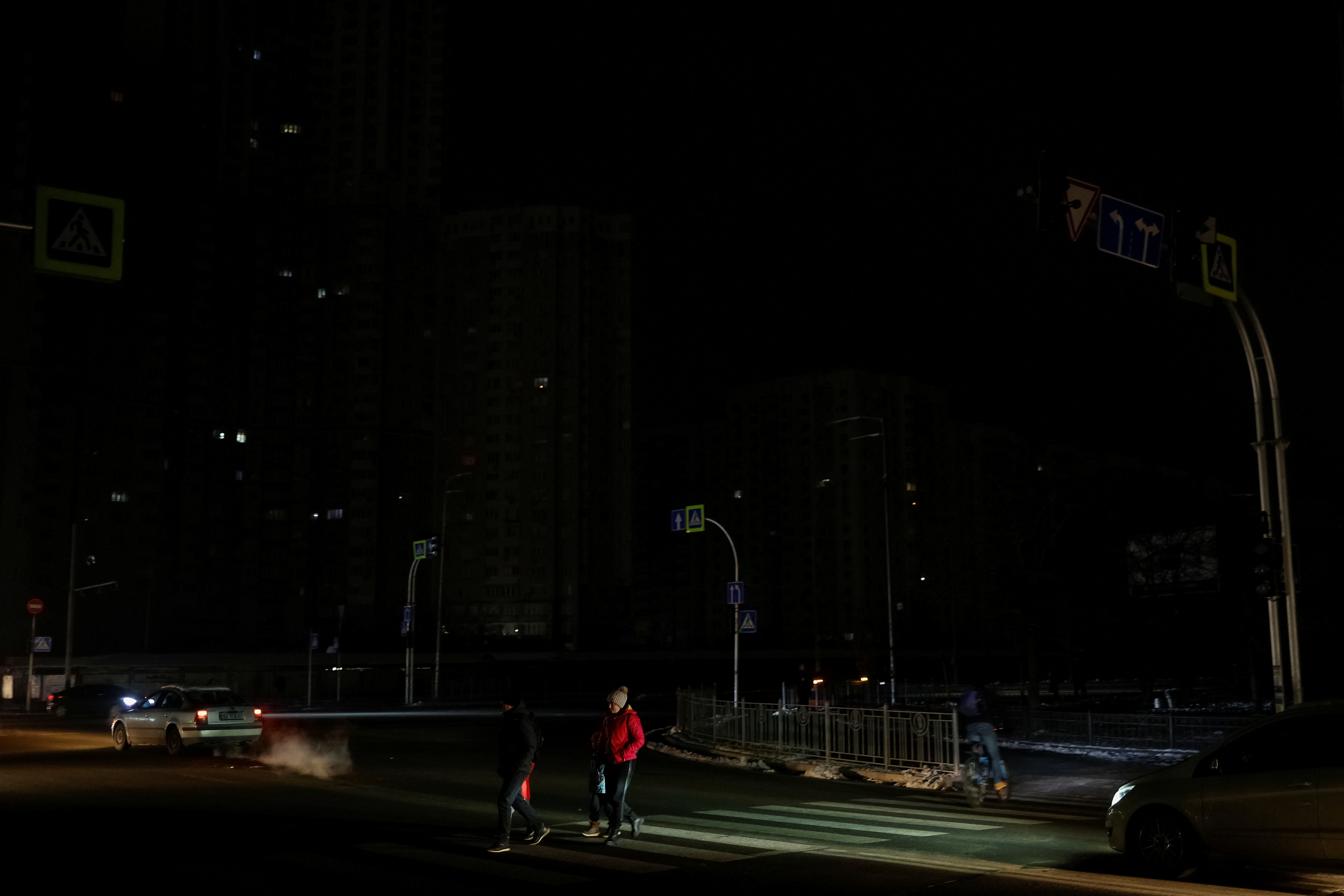
People cross a street without electricity after critical civil
infrastructure was hit by Russian missile attacks, amid Russia's
invasion of Ukraine, in Kyiv, Ukraine November 23, 2022.
REUTERS/Valentyn Ogirenko
Yet another missile barrage was unleashed by Russia across Ukraine, forcing the shutdown of nuclear power plants, killing civilians in Kyiv, Moscow pursuing is campaign to leave Ukrainian cities powerless in the dark and cold with oncoming winter. The entire capital region of Ukraine with its three million people, deprived of power and of running water, along with many other regions similarly affected.
The maternity ward of a hospital in eastern Ukraine was struck by a Russian rocket, killing a newborn baby, critically injuring a doctor. The hospital in Vilniansk was left a crumpled mass of bricks in the overnight explosion. President Zelenskyy plans to urge an emergency meeting of the United Nations Security Council with the assurance that Russia would be contrite, apologize, and speedily order its military out of his country.
Across the border in Moldova, officials announced the loss of electricity to over half their country. Marking the first time a neighbouring state reports extensive damage from the war Sussia is waging in Ukraine. The shutdown of reactors was forced by blackouts, at Ukraine's Pivdennoukrainsk nuclear power plant in the south and the Rivne and Khmeinitskyi plants in the west, according to Energoatom, the state-operated nuclear energy agency.
Ukrainian State Emergency Service firefighters
work to extinguish a fire at the scene of a Russian shelling in the town
of Vyshgorod outside the capital Kyiv, Ukraine
-
Credit: AP
"Currently, they [power units] work in project mode, without generation into the domestic energy system", explained Energoatom. The largest nuclear complex at Zaporizhzhia close to the front lines in the south is under Russian control and because of nearby shelling was switched off. Across the country, air raid sirens blared in alert mode.
On Wednesday afternoon, explosions reverberated across Kyiv as Russian missiles tore out of the sky while Ukrainian air defence rockets fired to intercept them. "I was sitting in my flat and I heard an explosion. My windows in my hall, kitchen and bedroom were thrown open by the blast wave", said Yuriy Akhymenko, who lives across the road from a building that was hit.
Thermal and hydroelectric power plants were forced to shut down, and as a result, the great majority of electricity consumers in areas of the country under Ukrainian control were cut off. Repairs led to electricity in half of the city of Lviv being restored by evening. According to Moscow, the strategy of depriving Ukraine of electricity, heat and water is to weaken the nation's capacity to continue fighting.
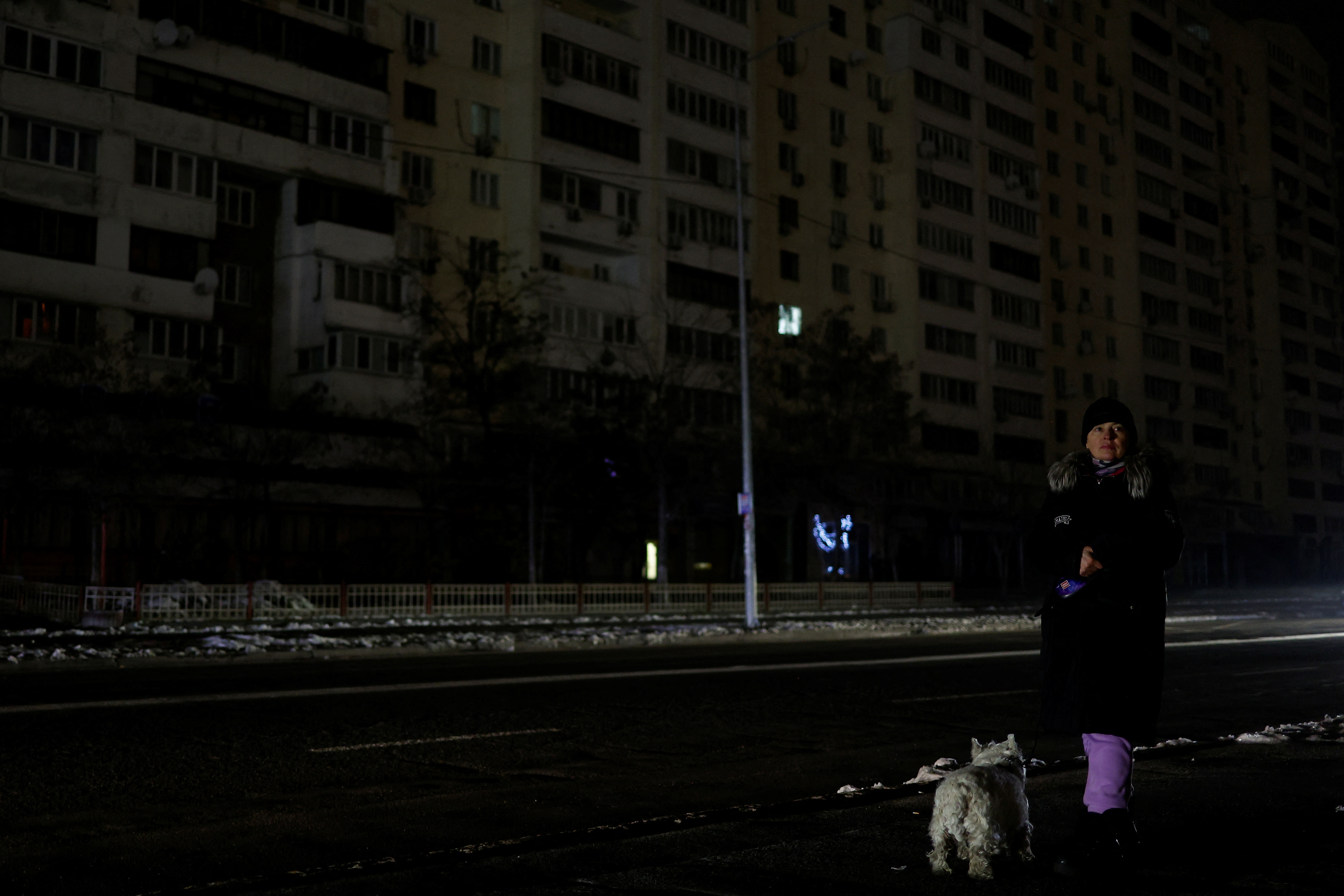
A woman with a dog waits for a bus in a street without
electricity after critical civil infrastructure was hit by Russian
missile attacks, amid Russia's invasion of Ukraine, in Kyiv, Ukraine
November 23, 2022. REUTERS/Valentyn Ogirenko
"What we're seeing today is making me, frankly, calibrate not only what my children will be living, but what I will be living, what I am currently living." "We haven't caught up to it. I haven't caught up to it, personally." Kim Cobb, professor of earth and atmospheric science, Georgia Institute of Technology, Atlanta
"Decades ago when the science on the climate issue was first accumulating, the impacts could be seen as an issue for others, future generations or perhaps communities already struggling." "In our increasingly muggy and smoky discomfort, it's now rote science to pinpoint how heat-trapping gases have cranked up the risks" "It's a shift we all are living, together." Katherine Mach, climate scientist, Stanford University
Image: windy.com
According to a study published in the journal PLOS Medicine last month, a five-fold rise for the United States is predicted in mortality rates, resulting from exposure to extreme heat events by the year 2080. The prognosis, understandably, for other, less wealthy countries is considerably worse; as example, for the Philippines, researchers forecast twelve times a greater number of death events to result from extreme heat occurrences as time progresses.
As for the year of 2018, it is looking like it will be known as the fourth-hottest year on record, lagging the three years previous, a string of records unenviably representing a portion of an accelerating rise in temperatures -- beginning at the introduction of the industrial age. And representing, according to the scientists studying it, clear evidence of greenhouse gas emission-caused climate change.
Regardless of whether variations in weather patterns result in coming years in the introduction of some cooler years interspersing the warming trend, the result is obvious; 17 of the 18 warmest years reflecting modern record-keeping have taken place since 2001. "It's not a wake-up call anymore. It's now absolutely happening to millions of people around the world", stated Cynthia Rosenzweig, operating the climate impacts group at the NASA Goddard Institute for Space Studies.
It now appears inevitable that with rising temperatures heat waves are certain to become increasingly intense, and more frequent occurrences can be anticipated as emissions continue to rise. Should events continue on the same plane, a future of cascading system failures that will certainly threaten basic necessities from food supply to electricity are on the horizon. The imminence of these threats is just now penetrating he consciousness of some scientists with the realization that climate change is directly impacting their lives right now.
Thus far on an international scale, 2016 has the distinction of being recognized as the hottest year on record which squared with the concomitant event of an El Nino, the climate cycle out of the Pacific whose effect is to amplify atmospheric heat. And then there was 2017, absent an El Nino event but nonetheless almost as hot as the year before. According to the National Oceanic and Atmospheric Administration, 2017 rates as either the second or third-warmest year on record. Which makes 2018 the fourth warmest.
Sea levels are rising about three inches higher than levels seen in1993. "We are living in a world that is not just warmer than it used to be. We haven't reached a new normal. This isn't a plateau", warned Daniel Swain, a climate scientist at the University of California Los Angeles, who points out these latest statistics vindicate the mathematical models reflecting the scientific community's findings.
After holding steady for the previous three years, industrial emissions of carbon dioxide grew to record levels in 2017; atmospheric carbon was found to be at the highest levels in 800,000 years. Many of the world's greatest polluters inclusive of the United States -- the only country that pulled out of the Paris accord on global warming -- are simply not following through on their pledge of reduction targets, voluntary though they are. Despite which, scientists still hold out hope that changes in how we live can help reduce greenhouse gas.
Melbourne, Australia is planting more trees, and Ahmedabad in India is planning to cover rooftops with reflective white paint; modest measures to be sure, but the hope is that if enough places make an effort it will reflect globally. Agronomists are focusing on the development of seeds that may survive heat and drought. Switzerland is focusing in painting railway tracks white to prevent them from buckling in adverse heat conditions.
The downside is the impact of heat and drought on farms, where in El Salvador, farmers are faced with a failed corn harvest in the country's east as heat soared to 41C and no rain fell for 40 days. Many EU countries are seeing their wheat production decline this year; Britain seeing a five-year low, and German farmers predicting lower grain harvests than normal, while Sweden's record-high temperatures have produced parched fields and desperate searches to find livestock odder.
"We get quite a few phone calls from farmers who are lying awake at night and worrying about the situation. This is an extreme situation that we haven't seen before", noted Palle Borgetrom, president of the Federation of Swedish Farmers -- estimating a $1-billion agriculture sector loss.
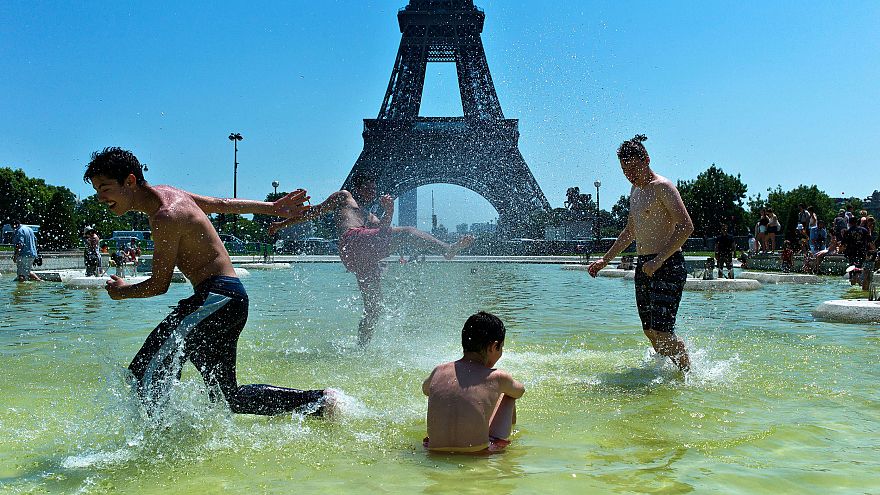
Boys play in a fountain near the Eiffel Tower in Paris.Thibault Camus
This represents a general opinion site for its author. It also offers a space for the author to record her experiences and perceptions,both personal and public. This is rendered obvious by the content contained in the blog, but the space is here inviting me to write. And so I do.


/https%3A%2F%2Fblueprint-api-production.s3.amazonaws.com%2Fuploads%2Fcard%2Fimage%2F818289%2F93557152-de06-4177-ad81-32e7f328cb67.png)