Iran's Influence on International Affairs
Iran's Influence on International Affairs
"The first thing that comes to your mind is that this was not a mistake. This could not have been a mistake.""This is a plane leaving the airport and three minutes later it's shot down.""I never gave [my brother] a strong hug at the end because I was not very emotional. I was thinking 'He is going, I will see him shortly'.""I couldn't really believe what had happened. I took the phone and tried to call the airport to see if there was another Ukrainian airliner. The person I talked to said, 'No, there was only one flight.' I was just shaking."Ali Pourzarabi, bereaved brother of Ukraine Airlines PS752 doomed flight, Iran"I think this is a new low they went to.""To be able to ruthlessly sacrifice a planeload of people in the worst possible way, subject them to the pain and agony for three minutes on a plunging plane ... that's just unimaginable.""I told her [his mother] I'm really getting worried.""She said, 'No, you'll see me tomorrow, you'll pick me up at the airport.""All the hopes I had were shattered. I could not even cry because I was so shocked."Amir Alavi, Iranian-Canadian, bereaved son, Toronto
 |
There
was a total of 167 passengers, 58 Canadian citizens, 30 permanent
residents of Canada and another 53 returning to Canada for studies.
Others aboard were from the UK,Ukraine, Afghanistan, and Sweden. They
had flown to Iran to visit relatives, to celebrate the season, to get
married, two years ago. "Full takeoff thrust", Captain Volodymyr Gaponenko, the 50-year-old pilot of the Ukraine Airlines plane said. "Eighty knots"
responded First Officer Serhii Khomenko, 48, the Boeing 737-800 lifting
off from Iran's Imam Khomeini Airport on 8 January, 2020.
"Good morning", Khomenko greeted the air traffic control: "On board, on course".
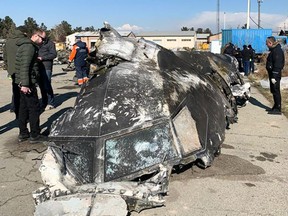
Six minutes after takeoff the plane plummeted to earth, flames from its
fuselage lighting its way in the pre-dawn darkness. The airliner hit a
park gazebo, plowed across a soccer field and finally exploded in a
fiery ball, breaking the jet into pieces. No living soul could survive
that inferno and its disastrous crash. Passengers' possessions were
strewn everywhere, the passengers themselves, torn to pieces, were as
well.
Iran's
Republican Guard Corps had in the early morning hours moved a mobile
anti-aircraft battery near the airport six hours previously. Tehran was
on high alert, after missiles had been shot off into Iraq to hit two
American bases in retaliation for a U.S. missile strike that hit a
vehicle carrying the senior head of the al-Quds division of the Iranian
Republican Guard Corps, Brig.-Gen.Qasem Soleimani, whose function was to
act for the state abroad.
In
anticipation of a response strike from the U.S. the IRGC was on high
alert. Nevertheless no one in command, nor the government in Tehran
closed their air space to commercial traffic At least four other
commercial flights took off from the airport in a trajectory similar to
that of PS752, unaware of the tense situation, but suffering no
consequences.
The cockpit voice recorder of the downed airliner recovered after the crash had picked up "a strong and short impulse similar to a detonation" at 6:15 a.m.; an altitude warning tone sounding in the cockpit. "I have a strong feeling about [a] bad event", the instructor pilot said in the recording. "What is this?! the captain responded. And seventeen seconds later the recording stopped: 6:16 a.m.
The
Ukrainian jet had taken off from the airport at 6:12 a.m. and for three
minutes all was calm as it headed toward Kyiv, a three-and-a-half-hour
flight. At 6:16 a.m. the pilot of an incoming flight of Iran's
Aseman Airlines reported to air traffic controllers an unusual sighting: "A series of flares ... like that of a missile ... Is there anything like this over there?" Not that the controller knew of. But he attempted for the following two minutes to repeatedly raise the Ukraine International flight, but had no response.
Aseman Airlines reported to air traffic controllers an unusual sighting: "A series of flares ... like that of a missile ... Is there anything like this over there?" Not that the controller knew of. But he attempted for the following two minutes to repeatedly raise the Ukraine International flight, but had no response.
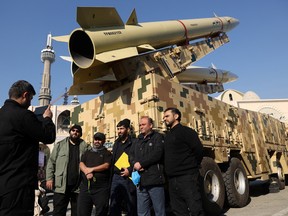 |
| Iranians take photos during an exhibition displaying missiles of the kind used during Iran’s retaliatory strike on the U.S Ayn al-Asad military base in 2020 are seen on display at Imam Khomeini Grand Mosalla in Tehran Jan. 7, 2022. Photo by Majid Asgaripour/WANA (West Asia News Agency) via REUTERS |
"It was an explosion sir; we saw a huge light over there. I wonder what it was really!",
the approaching Aseman pilot said, when the flight controller asked
just exactly what was seen. The IRGC crew of the TOR M1 air-defence
system spotted they decided, not an airliner full of passengers at 6:14
a.m. but an infinitely smaller, faster cruise missile, assuming the U.S.
military deployed it. It took 39 seconds and the crew fired their first
SA-15 missile, hitting the plane. A second missile was dispatched 12
seconds later.
The
PS752 flight path shows the pilots making a desperate attempt following
the first blast to turn around to fly back to the airport. Engulfed in
flames the 737 crashed near Khalajabad instead, southwest of Tehran.
Amateur video showed a massive explosion lighting up the still-dark sky.
A video that would be played all across the world, while the government
of Iran denied they had any involvement it what they claimed was a
'technical' crash.
Soon
after the crash of PS752, Tehran, refusing to admit it had any hand in
the catastrophic collision between a passenger jet and two missiles
fired by the IRGC, deliberately destroying the airliner and all those
within, photographs taken of the site of the vast debris field showed
bulldozers shovelling up debris, completely and deliberately destroying
any vestiges of the crash that might be helpful to investigators into
its cause. People were seen in the area, looting pieces of the plane
along with the personal belongings of its passengers.
"Iran contends that its decision to keep its airspace open and its corresponding airspace management decisions were justified and based on sound risk assessment. Iran’s risk assessment, as presented in the Final Report, failed to address contradictory information suggesting that risk levels were much higher. Iran’s air defences represented a clear and present danger. Its military was on high alert and tasked with monitoring airspace where multiple civilian aircraft would be present. Iran implemented a single mitigation measure that required military pre-authorization for flights before take-off from Imam Khomeini International Airport (IKA). Iran’s determination that the risk was “low,” the decision to keep its airspace open over Tehran, and the implementation of only one preventative measure were all flawed decisions. It is the Forensic Team’s assessment that this fell short of internationally recognized standards in place to ensure airspace safety.""Furthermore, Iran did not provide official notification of the increased risk to airlines and pilots before Flight PS752 departed or adequately explain why this basic measure was not implemented. Iranian military authorities were the only ones who were aware of the recent military activities and high alert resulting from Iran’s launch of missiles into Iraq. Only they knew that SAM units had been deployed in proximity to an international airport. Despite having knowledge of International Civil Aviation Organization guidance from 2018 with respect to “conflict zones,” Iran chose not to notify airlines of this danger. This lack of pertinent threat-related information deprived airlines (such as Ukraine International Airlines) of the full and up-to-date picture of conditions necessary to determine whether it was safe to fly."Forensic Examination and Assessment Team, Government of Canada
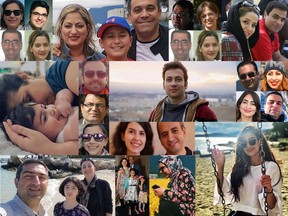 |
| Some of the Canadian victims of Ukraine International Airlines Flight PS752, which was shot down by the Islamic Revolutionary Guard Corps shortly after takeoff from Tehran on Jan. 8, 2020, killing all 176 aboard. Photo by Handout |
Labels: Iranian Canadians, IRGC, Islamic Republic of Iran, Missiles, Ukraine Flight PS752, United States
posted by Pieface @ Sunday, January 09, 2022


