Saturday, September 30, 2023

Celebration Turned to Tragedy

"One door was blocked, so we opened it by force [in an outsider rescue attempt]. Massive flames came out of the hall. It was like Hell's doors opened."
"The temperature was unbearable. I cannot describe the extreme heat."
"I could not do anything but run away from the fire."
"After the firefighters arrived, I rushed inside to look for my friends. I saw 26 dead bodies in the bathroom. A 12-year-old girl was completely burnt and left in a corner."
"I cannot describe what I feel. I know families that lost almost everyone. At least three families have lost every single member in the fire."
"The whole community is sad, not only in Nineveh province, but all over Iraq. The whole country is sad." 
Nineteen-year-old Ghaly Nassim    
 
"What I saw was very difficult."   
"I have seen people with more than 90% of their bodies completely burnt [at least 50 children were pronounced dead as soon as they arrived at the hospital]."
Chief Nurse Israa Mohammed, Mosul's specialized medical centre for burns 
 
"We miraculously left the place. The groom and the bride were among the people who survived the accident. I was just with them, and their psychological condition was very difficult."
"I took some wounded to the hospital. What I saw in the hospital is difficult to describe. Many of the victims were burned and dead."
Wedding family member 
https://i.guim.co.uk/img/media/ae5a6b8fb213ea9003a8770866051b9f83691573/0_232_3500_2100/master/3500.jpg?width=700&quality=85&auto=format&fit=max&s=7e438ecc89640c87dce4b0a9bca9bde2
Chandelier catches alight in fire that killed more than 100 people at wedding in Iraq – still from video

What could represent a more festive social occasion than a wedding? At this one, in the mostly Christian-occupied Hamdaniya area of Nineveh province, in Iraq, not far from Mosul the entertainment aftermath was a critical disaster. There were 250 guests. All invited to celebrate a wedding, the start of a new life together for a couple looking into the future. All too soon, as the celebratory dancing was initiated by the new bride and groom the 250 attendees panicked; guests in the Haitham Royal Wedding Hall stampeded toward the exits as flaming decorations and pieces of ceiling rained down on them.

Some cultures have strange and dangerous ideas about how they express jubilation, the joy of an event. As for example, shooting firearms into the air as an expression of excited happiness and power. What goes up will come down, and bullets can be lethal in their original forceful trajectory as well as their re-entry from a targetless shooting. And then there is the addiction to brilliant lights and explosive sounds inherent in fireworks displays, capturing attention, enrapturing the eyes, exciting the pulse.
 
Kurdish television news channel Rudaw showed footage of the event, of pyrotechnics blasting flames from the event's floor, hitting a chandelier and setting it afire. Authorities blamed flammable building materials that contributed to the blaze. An eruption of hellfire that killed 100 people and injured 150 more, accounting in total for the number of invited guests. 
 
Witnesses explained what they recall of the shocking events. Faten Youssef described the bride and groom initiating a ritualistic slow dance, when the fire began and raced through the plastic decorations that festooned the hall. And soon the ceiling began collapsing, the 50-year-old woman said. "Flames started falling on us. things were falling down and blocked the way to the exit".
 
Her family found a way through a kitchen exit, struggling through smoke and flames. A bystander shot video that showed a desperate attempt by people outside the hall to aid the escape of those trapped within. One man attempted to knock down a wall with an excavator. Soon, local hospitals were receiving victims conveyed by screeching fleets of ambulances. 
 
Bandaged survivors received oxygen. Workers at the hospital organized more oxygen cylinders, but then it was realized there was a shortage of oxygen; too many calls too suddenly exhausted hospital supplies, including burn bandages. Children were among those being treated for severe burns. Paramedics worked for hours after the fire was extinguished bringing out the injured.

It is customary in many countries in the Middle East for extravagant wedding ceremonies and entertainment planned for the hundreds of relatives and community members representing the wedding parties' close acquaintances and family members. Spectacularly elaborate decorations in the halls, with music and entertainers, and quite often pyrotechnics for the amusement and entertainment of all concerned.
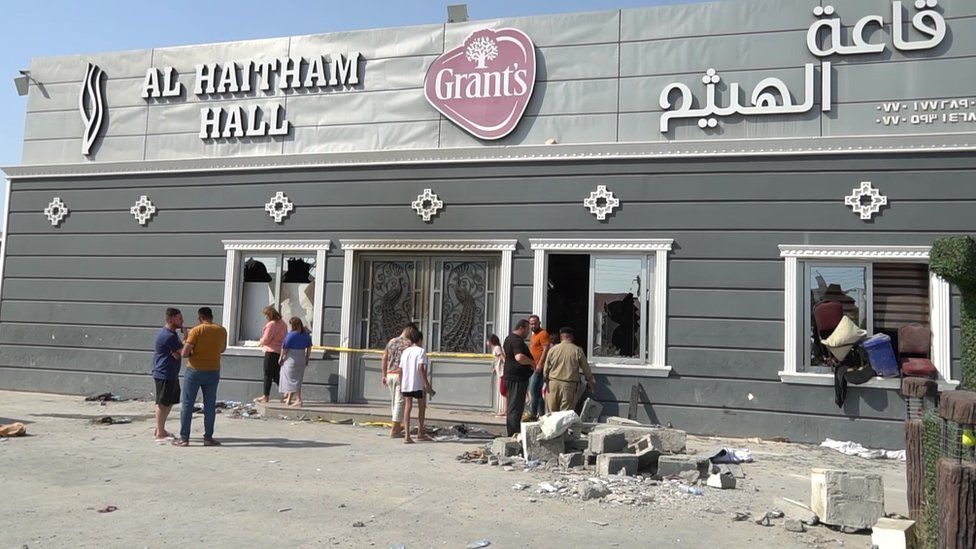
 
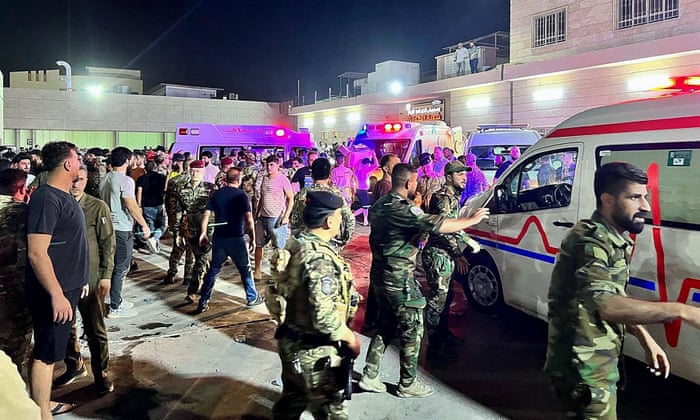
Scene of blaze (27/09/23)
Highly flammable material is thought to have fuelled the blaze


Labels: , , ,

Tuesday, October 26, 2021

Ally By Default

"All embassies are welcome, as long as they do not interfere in Iraqi affairs and government formation. Iraq is for Iraqis only."
"From now on, arms must be restricted in the hands of the state. The use of weapons shall be prevented outside of the state's framework."
"It is time for the people to live in peace, without occupation, terrorism, militias, kidnapping and fear."
Muqtada al-Sadr, Iraqi cleric, political leader

"No country wants forces that are stronger than its army."
"That [2,000 U.S.forces] is labeling or classifying the troops as trainers and not fighters [by mutual agreement with Washington and Baghdad]."
"The decision should be revisited again and decided by [Iraq's] Parliament and the government."
Dhia al-Assadi, al-Sadr aide
Shi'ite cleric Muqtada al-Sadr on a billboard in Baghdad's Sadr City district - a stronghold of his movement. June 21, 2021. REUTERS/Ahmed Saad
 
Shiite cleric Muqtada al-Sadr's father lived in Iran for decades, exiled from his native Iraq during the Sunni minority reign of Iraqi dictator Saddam Hussein, when the country's Shiite population was the underdog. His son returned to his native Iraq in opposition to the presence of U.S. and allied troops with the invasion of the country ostensibly for the purpose of neutering it from the 'weapons of mass destruction' amassed by Saddam, threatening regional stability. At a time when the-then U.S. administration contended there were links between Iraq and al-Qaeda.

With that invasion ancient animosities were unleashed, leading to Sunni and Shiite groups launching covert night-time attacks in neghbourhoods specific to each of the major branches of Islam leading to mass slaughters. The Shiite cleric played no part in these sectarian conflicts; instead he launched a militia to target the presence of U.S. troops in the country which often led to deadly clashes. U.S. forces ended up considering the Mahdi Army militia battling them as serious an issue as their clashes with al-Qaeda.

The U.S. forces planned to assassinate the Shiite cleric as a threat to their presence in Iraq, but never managed to succeed. Now that Iraq is finally settling down with a new government, it is becoming increasingly apparent that Iraq is struggling to separate its sovereignty from Iranian interference. Iranian Shiite militias which roamed Iraq as Iranian-backed functionaries like Lebanon's Hezbollah are now non-grata.

As a result of the evolving political situation in Iraq, Muqtada al-Sadr's political aims have been rewarded by an electorate that views him as a trusted Iraqi patriot with no interest in establishing himself as a commanding power, but rather an influence in establishing a working government aspiring toward the country's future prosperity and security. Gaining 73 seats in the national Parliament, the Sadrists have the largest single bloc in the 329-seat Parliament.

In a recent speech he referenced Iranian-backed militias, challenging in power and numbers the country's official security forces, that will be facing disarming any militias not under government control, including his own militia. Iran's proxy militia Hezbollah in Lebanon is more powerful, better armed than Lebanon's national military, answering to no one but Iranian orders. An obvious contraindication to Iraq's plans to stabilize and ensure its future independence and development prospects.

Although initially invited by Baghdad to have its troops remain in Iraq, the U.S. has agreed on withdrawal of all its combat troops by year's end, those currently deployed as trainers to remain for the time being. The former defender of the Shiite majority in Iraq, Mr. al-Sadr now is making his peace with the country's Sunni population who once comprised the elite, the politics, the military in the country, under Saddam Hussein. 
 
Now, Christians, Kurds, Sunnis and other minorities are to be recognized as equal members of Iraqi society. Outreach to other Middle Eastern nations led by Sunni majorities is meant to ultimately result in a change in the country's once-dysfunctional political system which highlighted party loyalty with sectarian divisions reflecting senior government appointments.

Sadrists are poised to be the biggest winners in elections to Iraq’s parliament (above) in October. Iraqi Parliament Media Office/Handout via REUTERS

Labels: , , , ,

Saturday, February 20, 2021

Don't Menace Israel: There To Stay

Don't Menace Israel: There To Stay

"The Arrow systems cover the highest altitudes of Israel’s missile defense arsenal, which also includes the Iron Dome and David’s Sling systems. The announcement of the Arrow’s latest system comes after the Israeli Defense Ministry hailed the success of the country’s first-ever multilayered missile defense test in December."
"Preliminary designs for the Arrow 4 originated in 2017 as the Missile Defense Organization sought to expand the capabilities of the Arrow 2. Israel Aerospace Industries was announced Thursday as the new system’s primary contractor. The unveiling comes just a day after US President Joe Biden spoke with Israeli Prime Minister Benjamin Netanyahu by phone."
"Iran possesses the largest ballistic missile arsenal in the Middle East. While Tehran initially relied on past technology from North Korea and China, it has continued to develop its own projectiles in recent years."
"Both US and UN officials have said there is evidence that Iran has transferred some of that technology to proxy forces in the region, such as the Houthis in Yemen and local militias in Iraq and Syria. Iran’s expanded arsenal has raised concerns over the past several years among officials in Israel and Washington about the Islamic Republic’s ability to strike targets across the Middle East."
Jared Sziba. Al-Monitor
 
"The Israeli army should be the one to be banned from acquiring weapons used to commit massacres against our Palestinian people,” he said, stressing the enormous ongoing efforts on the part of the Israeli army to 'prevent the resistance from exercising its right to obtain the necessary tools to defend its people'."
"But the resistance does not give in to such obstacles', Qasem [Hamas spokesman Hazem Qasem] said alluding to the local manufacturing of some military equipment."
Entsar Abu Jahal, Al Monitor
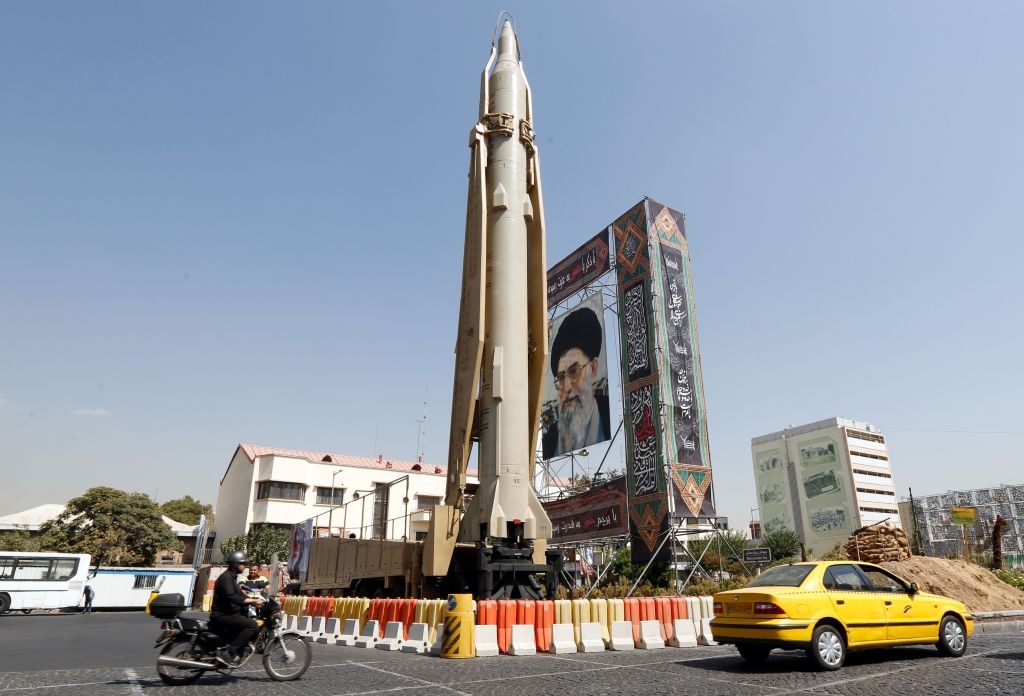
In spite of the Iranian leaders' claim that their nuclear program is for peaceful purposes, evidence reveals that the Iranian regime has long sought to acquire nuclear weapons. The regime's ballistic missile program to deliver nuclear warheads, a core pillar of its foreign policy, is closely linked to the nuclear program. Pictured: A Shahab-3 ballistic missile on display in Tehran, Iran on September 26, 2019. (Photo by STR/AFP via Getty Images)

What irony, the State of Israel came into being as a renaissance of its ancient heritage presence following Nazi Germany's horrendous 'Final Solution' success in methodically annihilating most of Europe's Jews. Now, the one country in the world that officially declares itself unimpressed that the Holocaust ever occurred, is diligently working toward accomplishing another genocide, this time against the Jewish state considered to be a haven for world Jewry. 

The Islamic Republic of Iran has made no secret of its intention to destroy the State of Israel; its clandestine but obvious search for nuclear weapons also threatens many other Middle East states.

Those Middle East states that can rest easy that they are not targets of the Iranian ambition to reassume a position it believes belongs to it by heritage in achieving preeminent power status are those fractured countries where Shiism predominates although the sect has minority status in comparison to Sunnis. Iranian proxies in Yemen, Lebanon, Syria and Iraq, and Iran-friendly nations like Qatar, Algeria and Turkey, support the Republic's antipathy toward Israel.

The Hezbollah Shiite militia that effectively rules Lebanon, Islamist Hamas (along with Palestinian Islamic Jihad and other terrorist groups) in Gaza, both of which have charters that distinctly express Israel's elimination as their goal, along with other terrorist Shia militias in Iraq all linked to Iran, form a cliquish threat to the predominance and security of the Arab Sunni states. Iran believes itself to be the true custodians of the two Muslim holy sites, Mecca and Medina, intent on replacing Saudi Arabia's eminent position as guardian of Islam's heritage.

The Middle East is nothing if not a roiling, unsettling cauldron of sectarian, political, tribal and clan enmities. And Israel is right in the middle of it all, but with the special status of its Judaic heritage, a square peg in a round hole which has no business squatting on Islamic geography as far as Iran is concerned. The leadership of the Palestinian Authority, Fatah and its sister organization Hamas agree without reservations. 

Iran, broadly acknowledged as the world's greatest terrorist-sponsoring nation, has been steadily supplying its proxies with weapons for years, and those weapons grow increasingly more sophisticated and powerful; Hamas has advanced from home-made rockets to semi-guided missiles, stockpiling more technologically advanced weapons which Israel's blockade of the Strip has attempted to stall. Hamas's dedication to its goal of destroying Israel leads it to spend inordinate sums the international community hands it to improve the lives of Gaza's population -- on building smuggling and offensive tunnels into Israel and Egypt.

Israel military strength 

For 2021, Israel is ranked 20 of 139 out of the countries considered for the annual GFP review. It holds a PwrIndx* rating of 0.3464 (0.0000 considered 'perfect'). 
Global FirePower

Israeli soldiers from the Golani Brigade take part in a military training exercise near the border with Syria (Jack Guez/AFP via Getty Images)

In efforts to both hinder Iran's transfer of weapons to Syria, Lebanon and Gaza, Israel conducts nighttime aerial strikes on weapons smuggling targets in Syria. Raids which continue to deliver the message that Israel will not tolerate these ongoing threats meant to embroil it in defensive wars where when it confronts its most direct enemies like Hezbollah and Hamas after lethal provocations, it faces an enemy that takes shelter behind civilian populations, inviting Israel's military to destroy non-militia lives as fodder for terrorist propaganda and international censure.

Iran has succeeded in building a hostile threatening ring to surround Israel from Syria, Lebanon and Gaza. Bases it has established in Syria and Lebanon where Hezbollah rules under Iranian auspices have their purpose. Not only to forestall direct attacks by Israel against Tehran's nuclear installations but to counter the threats its proxies mount against Israel's existence.

During the diaspora years it was Europe that surrendered its Jews that had lived there for a thousand years and more, to the agenda of Fascist Germany. Now that a Jewish homeland has been re-established it is the neighbourhood of Arab states and Aryan Persia that planned to rid its geography of a Judaic presence proclaiming itself to have a right of return to its origins. 

Currently, Sunni Arab states have recognized the futility of denying Israel's presence, a detente leading to recognition and conciliation by some moderate Islamic states toward Israel. Discovering, after all, that they have much in common and much to gain through cooperation with one another heading into the future of amicable engagement.

While Europe, which during World War II became a slaughterhouse for Jews, still finds common cause to criticize the Jewish nation for defending itself from terrorism and threats against its existence. Israel, however, has equipped itself with defences that will withstand all manner of threats. Extending first a hand of friendship to those who would return the embrace. And the fallback of ensuring it has a military second to none in motivation and equipment capable of formidable defence capabilities.

"Since the early 2000s, Iran has supplied cruise and ballistic missiles to its proxies in at least three countries -- Iraq, Lebanon and Yemen."
"[One of its primary goals is] the deployment of missiles under Iran's direct or indirect control would allow it to strike an adversary during a conflict from multiple directions."
Andrew Hanna, U.S. Institute of Peace
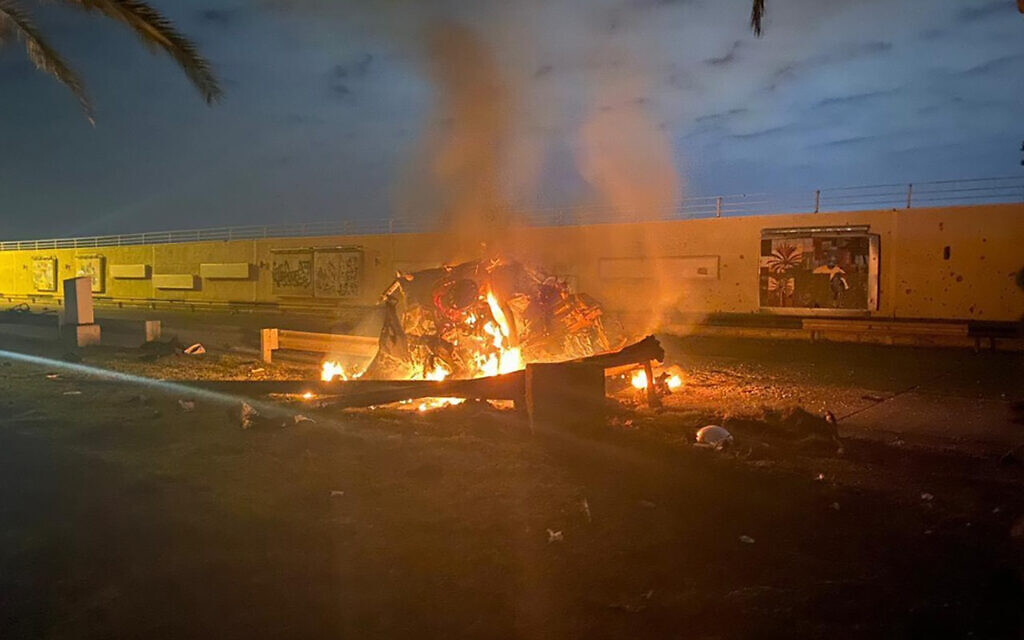
A burning vehicle at the Baghdad International Airport following an airstrike in Baghdad, Iraq, in which Iranian Gen. Qassem Soleimani was killed January 3, 2020. (Iraqi Prime Minister Press Office via AP)


Labels: , , , , , , , , , ,

Saturday, October 03, 2020

Iran's Shiite Axis

We expressed our deep concern at the rise in the number and sophistication of attacks against diplomatic premises in Iraq, including rocket and [improvised explosive device] attacks."
"We noted that these attacks endanger not only foreign embassies but also Iraqis, as evidenced by the tragic death of a family near Baghdad international Airport following a rocket strike on Monday."
International envoys in Iraq

"The big challenge is still Iranian interference. They're really testing the current government and prime minister, to be exact. He's really tried to stand firm and be strong, but he's between a rock and a hard place."
"But let's be frank, it's not just about [ISIL]. It's about Iranian expansion into Iraq. It's about Iranian expansion into other parts of the Middle East."
"At the end of t he day, like it or not, even though we've tried to position ourselves as being different from the Americans, we are seen as the same. So we are vulnerable."
Bessma Momani, Middle East expert, University of Waterloo, Ontario
al-monitor
The US Embassy compound is pictured in Baghdad's Green Zone on May 20, 2019, in the Iraqi capital. A Katyusha rocket crashed the previous day into Baghdad's Green Zone, which houses government offices and embassies including the US mission, Iraqi security services said in a statement.  Photo by AHMAD AL-RUBAYE/AFP via Getty Images.

The six-year-old war against the Islamic State group that brought Western troops under the umbrella of the United Nations, and led by the United States, still struggles to control the remnants of the Islamic State that continues its violent predation within Syria and Iraq, and still threatens Western nations by the force of its persuasive jihad impact on impressionable Islamist recruits living in Europe and North America. Iran's undeniable influence in Iraq, both Shiite-led nations, has created a diplomatic fissure between Iraq and the United States.

The result of which has been escalating tensions between Iraq and the United States, a fallout of the political challenges between Washington and Tehran. A series of rocket attacks launched by Iranian-backed militias targeting U.S. diplomatic and military facilities has created an untenable situation, with the U.S. warning it is prepared to pull its troops out of Iraq and to shut down its huge embassy complex. An attack on Wednesday hit a base in the Kurdistan region, home to American troops, along with a number of Canadian special forces soldiers.
 
Initially, the U.S. had reported rockets fired at the coalition base next to the main airport in Irbil failed to reach the facility, but that was contradicted by later reports suggesting that several had landed within the compound, though no Canadian Armed Forces personnel were injured. "The recent attack on a military base in Irbil did not affect coalition forces", reported Jessica Lamirande, spokeswoman for the Canadian Defence Department.  "All CAF members are safe and accounted for and we continue to monitor the situation closely with our allies and partners in the region."

The Popular Mobilization Forces, an umbrella group comprised mostly of Iran-backed Shiite militias, part of Iraq's security forces, were identified by Kurdish authorities as being responsible for the attacks. Responding to that accusation the Popular Mobilization Forces stated it would be investigating the incident that just happened to coincide with Canada's ambassador to Iraq along with counterparts from over a dozen other nations meeting with Iraqi Prime Minister Mustafa Al-Kadhimi over concerns relating to a number of other attacks on diplomatic missions in the country. Attributed to Iran-loyal militias.

al-monitor
A member of an Iraqi Shiite paramilitary group helps a fellow protester holding a placard denouncing the United States climb on the outer wall of the US Embassy in the Green Zone during a demonstration, Baghdad, Iraq, Dec. 31, 2019. Photo by AHMAD AL-RUBAYE/AFP via Getty Images.

These are the militias that were formed in 2014 in the general push to stop the caliphate of the Islamic State of Iraq and the Levant from any further expansion into Syria and Iraq. Al-Kadhimi had condemned the attacks, insisting they threatened Iraq's stability, promising to hold the perpetrators to account. International observers question how much power is left to the government of Iraq to crack down on the militias in light of Iran's total influence in the country given its links to the paramilitary groups as well as members of the Iraqi government.

Labels: , , , , , , ,

Follow @rheytah Tweet