Canada and Poland, Not Quite in Complete Agreement on Social Issues
"There is too much silence, and I think we are on the edge in Poland.""How can you have a shared commitment to democracy when there is a clear threat to the electoral process?""It threatens for sure not only the electoral process but also academic freedom, because the commission has such large powers to question people from academia.""This timing doesn't serve the social agenda of the Trudeau government.""For Canada, many times the economic interest and security interests are more important. And sometimes it means that Ottawa has abstained from saying what it should say. Nevertheless, the case in Poland is so clear; it has been for so many years. And I didn't see any reaction from Canada."Marcin Gabrys, political scientist, Jagiellonian University, Krakow
Mr.
Gabrys, a Polish academic, specializes in Canadian studies. He has made
the observation that since the ruling Law and Justice party, known in
Poland as PiS, came to power in 2015, an unprecedented amount of
collaboration has been undertaken by Canada and Poland, despite that the
PiS has "a strong discrepancy" with the values of the Liberal
government in Canada headed by Prime Minister Justin Trudeau.
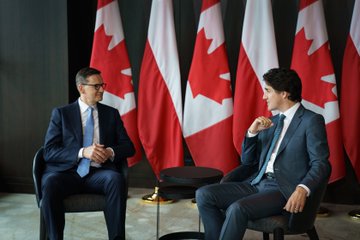 | |
| Prime Minister JustinTrudeau meets with Polish Prime Minister Mateusz Mrawiecki, in Toronto on Friday, Chris Young/The Canadian Press |
A
new law is destined to create a commission in Poland whose purpose it
is to probe for Russian interference in the country, with academics and
civil-rights groups describing its mandate as so opaque it is seen to be
likely that the panel comprised for the most part of government Members
of Parliament will be manipulated for the purpose of partisan politics,
to attack Polish opposition parties. Clearly an underhanded plan, more
in tune with a dictatorship than a democracy.
Polish
Prime Minister Mateusz Morawiecki is being welcomed on a state visit to
Canada. Not a word from the Trudeau government on the country's
backslide in democracy. This, from a prime minister who sees himself as a
world-class symbol, an icon of progress virtue, a champion of women's
rights, of the right to an abortion as a health and medical necessity, a
man whose dedication to the collective cause of the LGBTQ-2 community
is unwavering; under his mandate the trans community has been
flourishing in its presence in primary schools influencing children to
join whatever gender appeals to their fancy.
In
Justin Trudeau's Canada, where the prime minister has more than
adequately demonstrated his own personal hypocrisy on race and gender
issues, diversity, equity and inclusiveness has stormed corporate
boards, school boards, universities and government departments to the
extent that white male candidates for positions of any kind are now at a
distinct disadvantage, their human rights and practical skills matching
them to positions on merit have proven demerits because they're not
women, aboriginal, or people of colour deserving of recognition on the
basis of past struggles.
Concern was expressed by the U.S. State Department over the new law "that could be misused to interfere with Poland's free and fair elections",
but not a word of doubt from Justin Trudeau. A Polish MP from the
far-right Confederation party saw fit to block University of Ottawa
history professor Jan Grabowski from giving a lecture in Warsaw meant to
touch on Polish complicity in crimes during the Holocaust. Dr.
Grabowski has written extensively through his research on a topic that
Poland insists is forbidden to air.
In
2018 the governing PiS passed a law that made it illegal to issue
truthful statements that in reality many Poles were complicit with Nazi
war crimes, making themselves useful to the occupying Nazi authorities
in their zealous dedication to gathering up European Jews for the
ultimate purpose of genocide, a prospect that many Poles found matched
their own views that Jews had no right to live in Poland or anywhere in
Europe for that matter, and that erasing their lives would be a benefit.
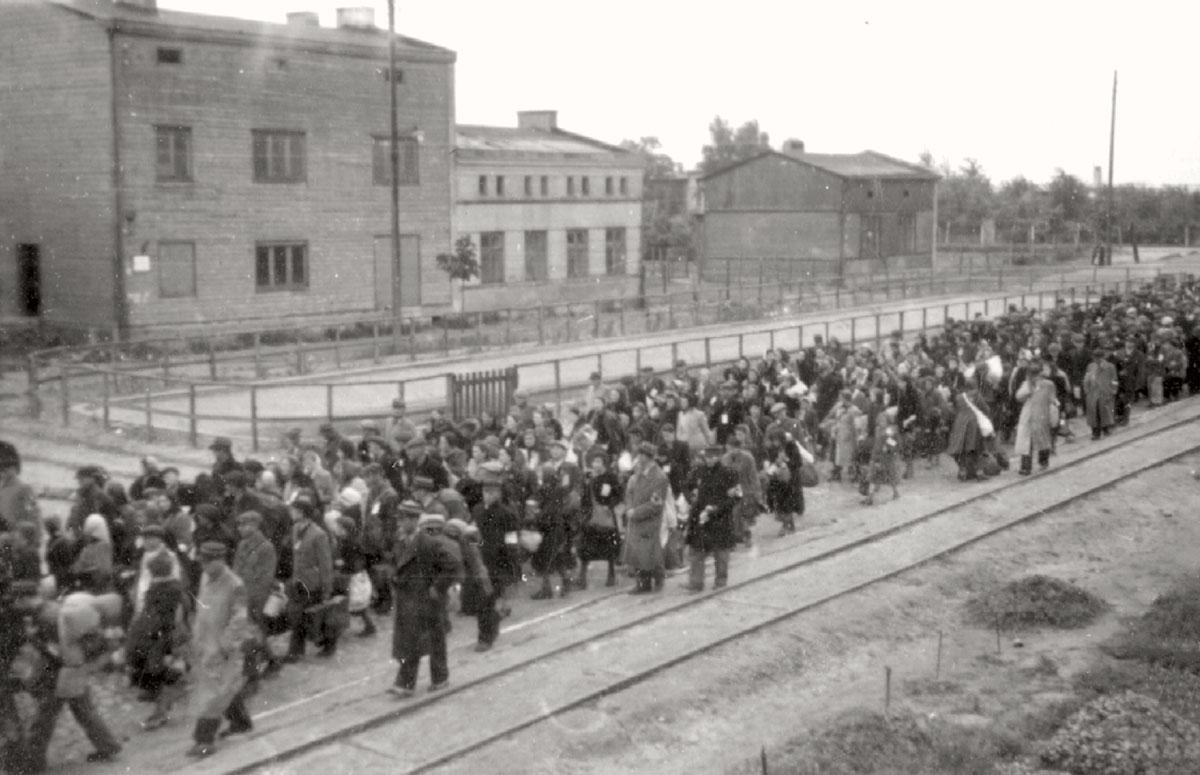 |
| Lodz, Poland, Deportation from the ghetto in the summer of 1944 Yad Vashem |
Not
only were Jews sent to the gas chambers in the many death camps
specializing in annihilating Jewish lives, but in many towns and
villages throughout Poland, Jews were expedited to death in mass
shootings, dumped into mass graves on the outskirts of the towns, the
process aided and abetted by local villagers who had lived alongside
Jews for countless generations and often took part in regular Pogroms
meant to keep Jews alert and on notice that their presence was not
welcomed.
Abortions
in Poland, a heavily Catholic society, were limited two years ago, to
cases where a pregnancy resulted from a criminal act or posed a serious
health act. Justin Trudeau last month publicly lectured Italy's Prime
Minister Giorgi Meloni over her country's record on LGBTQ rights, at the
Hiroshima G7 meeting. He has a penchant for lecturing other world
leaders on their failures on progressive social issues as he sees it,
annoying them and embarrassing Canada as he interferes with other
countries' internal matters while promoting himself as a paragon of
virtue.
 |
| Prime Minister Justin Trudeau and Italy Prime Minister Giorgia Meloni sit side by side at the G7 leaders' summit in Hiroshima, Japan on Friday. Meloni looked annoyed when Trudeau said Canada was concerned about 'some of the positions Italy is taking on in terms of LGBT rights.' (Ministry of Foreign Affairs of Japan/Reuters) |
Poland's Law and Justice party speaks of LGBTQ rights as "an attack on the family and children", while turning a blind eye to Polish municipalities and regions that have decided to declare themselves "LGBT-free zones". What does rank high in Trudeau's official notice of the visit by the Polish Prime Minister is the opportunity "to address the regional defence and security challenges resulting from Russia's brutal and unjustifiable war of aggression", for Canada has the third-largest population of Ukrainian-born emigres outside Ukraine and Russia.
Poland,
among the most assertive European countries urging military allies to
send equipment to Ukraine in part due to a conviction, according to
Professor Gabrys, that a Russia in victory in Ukraine would feel
sufficiently assured that the world will sit back and remain
non-involved, while Moscow would then target Poland, along with the
three Baltic countries, all sitting by nervously while the Russian
military continues to target Ukraine and its civilian infrastructure,
shuddering they may be next.
 |
A Ukrainian 31st Mechanized Brigade gunner. Ukrainian army photo |
Labels: Canada, Military Alliance, Poland, Polish Laws, Russian Invasion of Ukraine
posted by Pieface @ Tuesday, June 06, 2023