The People's Liberation Army Military Technological Advances
China unveiled at least three mobile, ground-based, high-power microwave-directed energy weapon systems during the Zhuhai Air Show in November. According to the excerpted article published on Chinese blog and news outlet Sina, these weapons are capable of paralyzing hundreds of drones with one strike and could give China an advantage in future wars. The article argues that the new weapon system will be an especially important counter-drone technology. The article outlines several key advantages of the high-power microwave weapons:
- They can quickly deploy, lock onto, and attack a target the moment it comes into range
- They produce electromagnetic pulses over a wide area and can attack multiple drones simultaneously
- They are economical to employ, do not consume ammunition, such as missiles and artillery, and can be launched multiple times in succession
- They are ideal in more complex environments, including urban settings, compared to traditional kinetic weapons, preventing civilian casualties and preserving necessary infrastructure
 |
Specifically, China North Industries Group Corporation unveiled the
Hurricane 2000 and Hurricane 3000 high-power microwave weapons systems.
The article describes the first system as a large, flat array mounted on
top of an 8×8 light armored vehicle chassis[i]
or similar variant. The system features a small rotating radar for
target detection and tracking. The second system, larger than the first,
is mounted on a Shaanxi Auto SX2400/2500 series 8×8 truck. It also
includes “planar arrays and radars.” Some sources claim the Hurricane
2000 and Hurricane 3000 have an effective range of 2000 to 3000 meters,
an order of a magnitude higher than the U.S. manufactured Leonidas
high-power microwave weapon system.[ii]
The article also describes a third high-power microwave weapon system,
which comes from China Aerospace Science and Industry Corporation. Like
the Hurricane 3000, it rides atop the Shaanxi Auto SX2400/2500 series
8×8 trucks.
According to the article, China has achieved major breakthroughs in
the field of high-energy microwave weapons, which could indeed give it
an edge in future warfare. Finally, China’s microwave weapon systems
underscore its commitment to developing advanced weapons technologies,
particularly to counter emerging aerial threats, such as UAVs.
Foreign Military Studies Office, U.S. Army, Training and Doctrine Command
"China attracts customers for its military equipment with cut-rate pricing and financing, but there are hidden costs -- especially when gear malfunctions", wrote Cindy Zheng, as a researcher at Rand Corp. before joining the U.S.-China Economic and Security Review Commission. Inferior, low-cost, advanced technology on the surface, seemingly a kind of built-in obsolescence-production. Myanmar, facing the reality of structural cracks and other technical issues in its fleet of Chinese-made fighter jets, complained to Beijing in 2022.
Pakistan's Navy has been grappling with issues in its F-22P frigates bought from China, having to operate the vessels with wholly degraded capabilities. Bangladesh complained to Beijing about its Chinese-made military hardware's lack of quality, last year. "Questions about combat capabilities and other issues, including concerns about interoperability with non-Chinese platforms have hampered China's ability to expand exports beyond a handful of countries", observed Bloomberg Intelligence senior associate analyst Eric Zhu.
 |
| cdn.i-scmp.com |
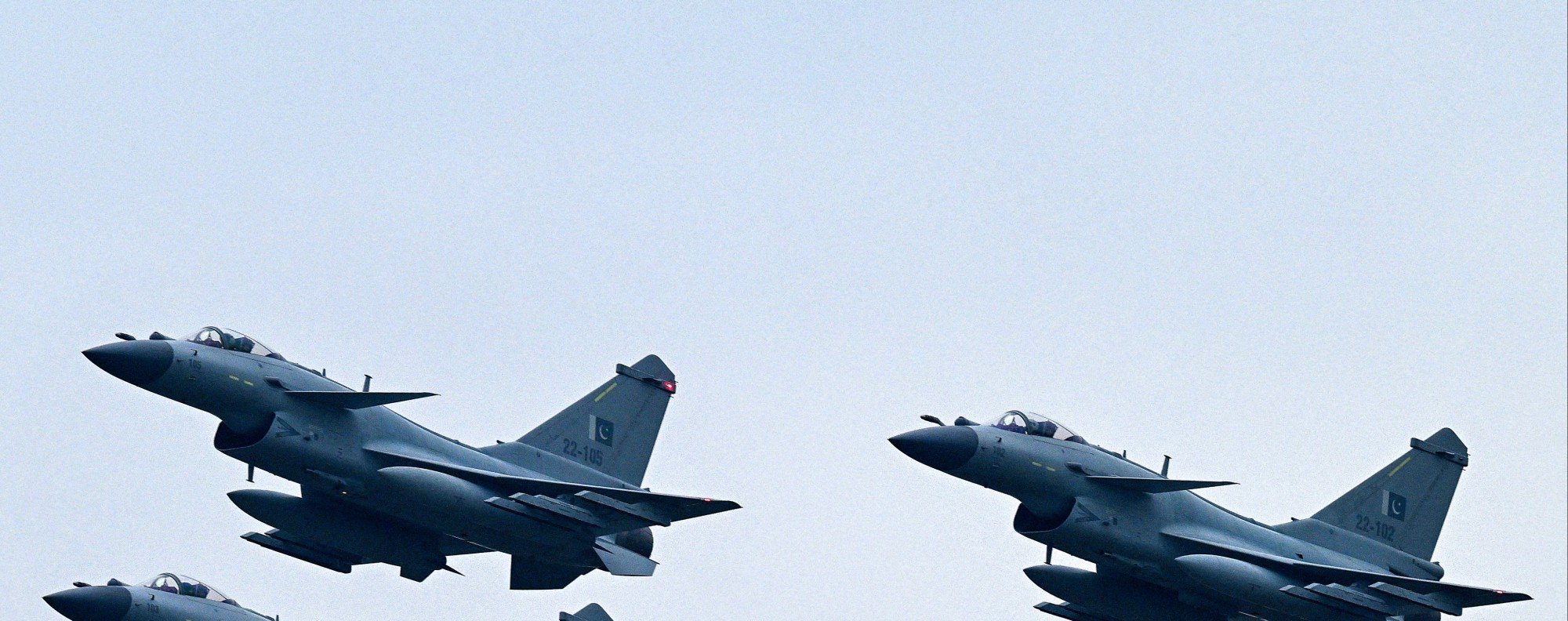
But wait...during the recent conflict between India and Pakistan, Pakistan celebrated its Chinese J-10Cs, claiming to have shot down five Indian fighter jets, among them French-made Rafale aircraft, in response last week to Indian military strikes. India has not commented and though the reports have yet to be confirmed, the jet's maker saw its market capitalization rise by over 55 billion yuan (US$10-B). Leading China's nationalist Global Times to warn that "Taiwan should feel even more scared" if the Pakistani strikes were fact.
Indeed, according to Shu Hsiao-Huang, an associate research fellow at the Institute of National Defence and Security Research, a think-tank based in Taipei, Taiwan had scrutinized the clash between Pakistan and India. "We may need to reassess the PLA's (People's Liberation Army) air combat capabilities, which may be approaching -- or even surpassing -- the level of U.S. air power deployments in East Asia". The J-10Cs have had few battle tests, are used to patrol the Taiwan Strait by the Chinese military's Rocket Force whose combat-readiness has been in question. How they would stand up against U.S. fighters like the F-16 is still in doubt.
 |
| Sources: CSIS, US Navy and Naval Technology |
Yet another Chinese weapon in Pakistan's military arsenal is set to come under intense scrutiny, the PL-15 missiles deployed on Pakistan's J-10C aircraft, parts of which were found in India following the reported shootdowns. The PL-15 is rival to Western air-to-air missiles, with its top speed above Mach 5. This latest development could support Beijing's sales pitch. "There is a good chance the weapons systems China is able to offer will be even more appealing to potential buyers", noted James Char, of the China Program, S.Rajaratnam School of International Studies.
While Chinese-produced weapons exports have been plagued by defects that add to the operational costs of the inexpensive systems, draining security budgets for maintenance expenses, customers for Chinese-produced weapons are largely developing nations with limited funds, which can ill-afford escalating repair costs for cheaply-produced-and-sold weapons.
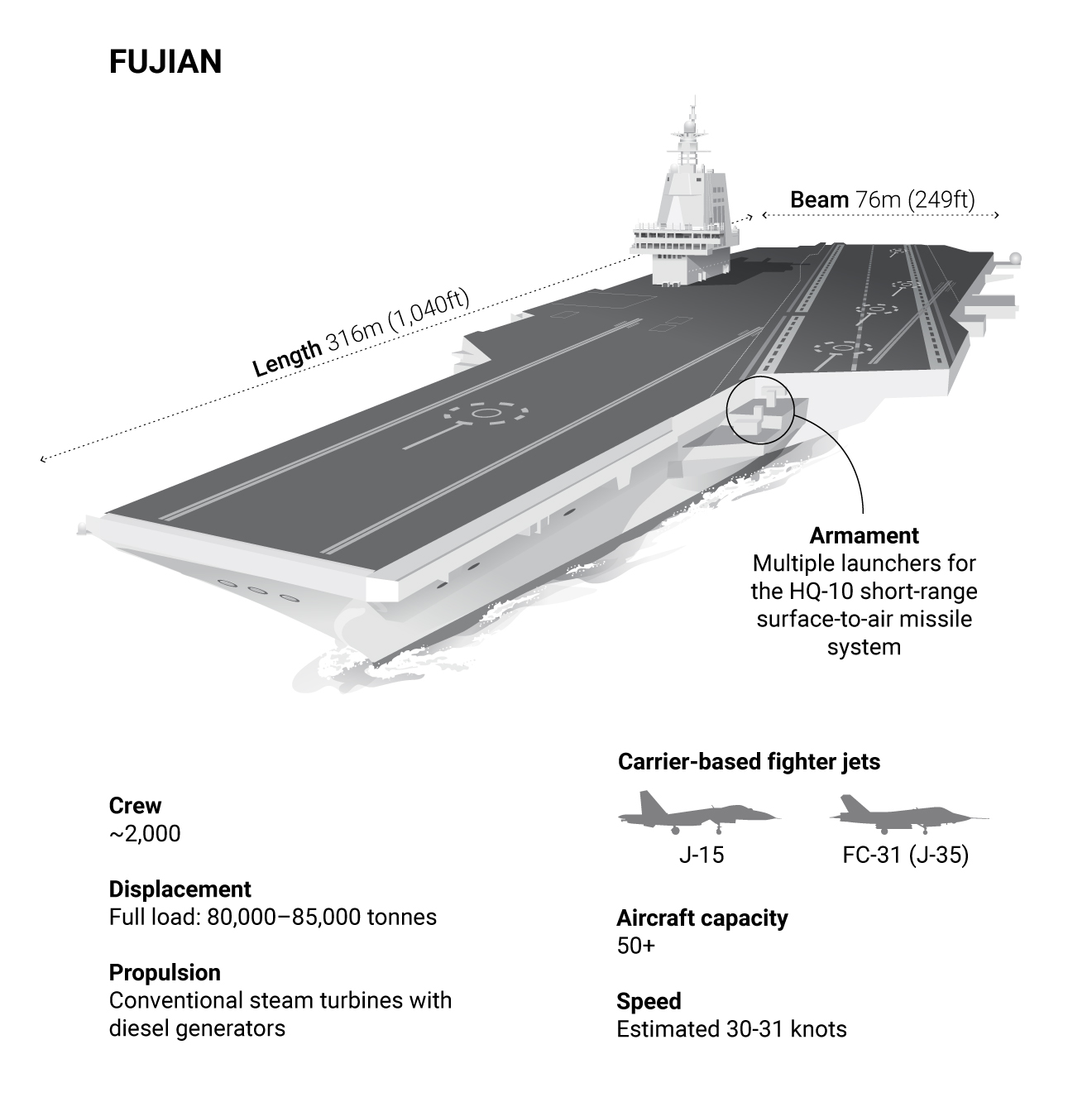
In the same token, China has been focusing on transforming the PLA to a modern force which has led to breakthroughs such as China's first next-generation amphibious assault ships, the largest of their kind. The country's test flight of its sixth-generation fighter jet circulated on social media brought a rally in defence stocks. "A lot is being learned about how Chinese systems perform under combat conditions", suggested M. Taylor Fravel, director of Security Studies Program at the Massachusetts Institute of Technology.
 |
As the Chinese People’s Liberation Army (PLA) seeks to become a
“world-class military,” its progress in advanced weapons systems
continues to provoke intense concern from its neighbors and competitors.
The Chinese military and China’s defense industry have been pursuing
significant investments in robotics, swarming, and other applications of
artificial intelligence (AI) and machine learning (ML). Thus far,
advances in weapons systems described or advertised as “autonomous” (自主)
or “intelligentized” (智能化) have built upon existing strengths in the
research and development of unmanned (无人) systems and missile
technology. While difficult to evaluate the sophistication of these
emerging capabilities, this initial analysis concentrates on indicators
of progress in weapons systems that may possess a range of levels of
autonomy.
Brookings Institute
Labels: Chinese Defence Industry, Military Technology
posted by Pieface @ Monday, May 19, 2025