Compromised Minister of Defence, Dysfunctional Canadian Military
"[Canada's 'whistleblower' laws are slow to deal with cases, often ruling against whistleblowers; they are] nearly entirely dormant.""Too often the rights that look impressive on paper are only a mirage of protection in practice.""It takes tenacity and financial resources for any whistleblower to sustain a reprisal dispute for over six years, only to lose."International Bar Association report
 |
"I'm not surprised.""The report doesn't go far enough. We need whistleblower protection for everyone involved in federal politics.""Whistleblower protection is one of the most potent accountability mechanisms you can have, and it's clear the Trudeau Liberals don't want that accountability."Duff Conacher, co-founder, Democracy Watch
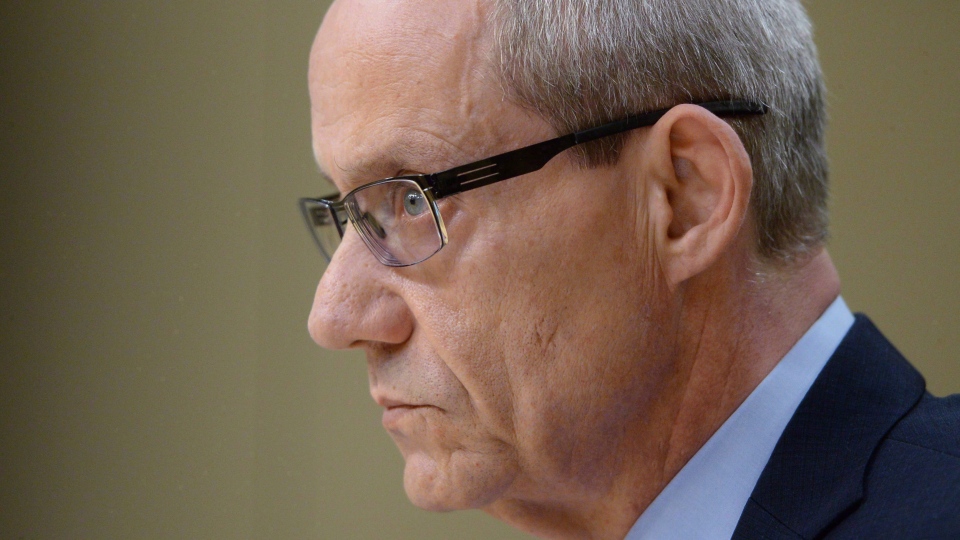 |
| CF ombudsman Gary Walbourne CP/Sean Kilpatrick |
"I left the job early on the advice of my doctors and my own realization that no reasonable person could possibly be expected to continue in the hostile circumstances created by the Department of National Defence.""It was obvious this process was being used as a means of intimidation prior to my testimony before the committee.""The only thing I ever wanted the minister to do was his job. Doing nothing was not the response I was looking for."Gary Walbourne, former Canadian Military Ombudsman
"The Minister has always been committed to having a productive working relationship with the CAF [Canadian Armed Forces] Ombudsman and had regular meetings up until he was informed of the then-Ombudsman's intention to resign."Tod Lane, spokesman, Minister of Defence, Harjit Sajjan
Oddly
enough, just as former National Defence and Canadian Forces ombudsman
Gary Walbourne was testifying before a Parliamentary committee, news
came from a study released by the International Bar Association, rating
Canada's performance with respect to commitment for the protection of
whistleblowers; which is to say people who reveal misdoings and
misbehaviours on the part of institutions and leaders to alert
government, industry and the public that matters are not as they should
be.
The
International Bar Association report ranks Canada at the very bottom of
the list of nations which have committed to whistleblower protection.
Canada meets a mere one of twenty best practices -- for transparency and
review -- placing it alongside Norway and Lebanon for weakest
protections, well behind nations such as Ireland, the United States and
Serbia, all three top-ranked. Canada fell back on whether whistleblower
laws protect identity, protection against harassment, prevention of gag
orders and granting a "genuine day in court".
Through
former ombudsman Gary Walbourne's testimony we now know that Defence
Minister Harjit Sajjan saw fit to cancel no fewer than 17 consultative
meetings in lock step with the military watchdog's increasingly vocal
voicing of the need for government to give greater aid to injured
soldiers. Mr. Walbourne tabled his calendar and dates of the cancelled
appointments with the House of Commons committee in their examination of
allegations of sexual misconduct against General Jon Vance, who
recently stepped down as chief of the defence staff.
Minister
Sajjan headed a conspiracy along with senior defence officials, to
freeze Mr. Walbourne out of the position he occupied for the past four
years in reaction to his insistence on doing the work he was hired for.
Mr. Walbourne did not consider himself a decoration the government could
point to elaborating its commitement to whistleblower protection, but a
dedicated spokesman for the vital task of ensuring members of the
military had a voice that would be heard at the executive level and into
the governing cabinet.
 | |
| Canada's
new top military commander, Admiral Art McDonald, has voluntarily
stepped aside as he is investigated by the Canadian Forces National
Investigation Service on unspecified allegations. McDonald assumed
command on Jan. 14 CBC |
Once
he began pressing into the shabby way injured Canadian Forces personnel
had been treated it gave him sufficient ammunition to produce six
reports within a two-year period, detailing lack of support for military
staff and families. Ombudsman Walbourne recommended that his office
would be more effective were it to be removed from the control of senior
defence officials, to enable the office to report instead directly to
Parliament. Reprisals came his way as he found himself cut off in 2018
once he had informed Sajjan of serious allegations of sexual misconduct
on the part of General Vance, personal friend of the Minister.
The
immediate result of that meeting was cancellation of seven scheduled
meetings, with another ten to follow. A portrait of a toxic culture
prevailing at National Defence headquarters was revealed through the
ombudsman's testimony before the Commons defence committee which heard
testimony directly contradicting that of Minister Sajjan who insisted he
had no knowledge of the situation until several weeks ago when it
became public news. Not only had Mr. Walbourne briefed the minister in
March of 2018, but he had offered evidence of the allegations which the
minister refused to accept.
Additionally,
his request for independence resulted in a vindictive campaign to drum
him out of the ombudsman position, and the military. Soon Mr. Walbourne
found himself requiring permission from the deputy minister to enable
him to travel to a base for the purpose of hearing concerns expressed by
military personnel and their families. A few months following his
report in March 2017 recommending his office be made independent, DND
officials informed him that a complaint had been lodged against him,
refusing to divulge details, but suggesting it involved inappropriate
contracting.
In
October of 2017, deputy minister Jody Thomas informed him the
allegation would proceed to a formal investigation even as the specifics
were withheld from him. That notification arrived the very day prior to
Mr. Walbourne's testifying before a Commons committee about DND's
failure to act on his recommendations to give assistance to military
personnel.
 |
Labels: Canada's Government, Chief of the Defence Staff, Minister of National Defence, National Defence, Ombudsman Gary Walbourne, Sexual Malfeasance, Whistleblower Protection
posted by Pieface @ Saturday, March 06, 2021