Global Wildfires ... Climate Change
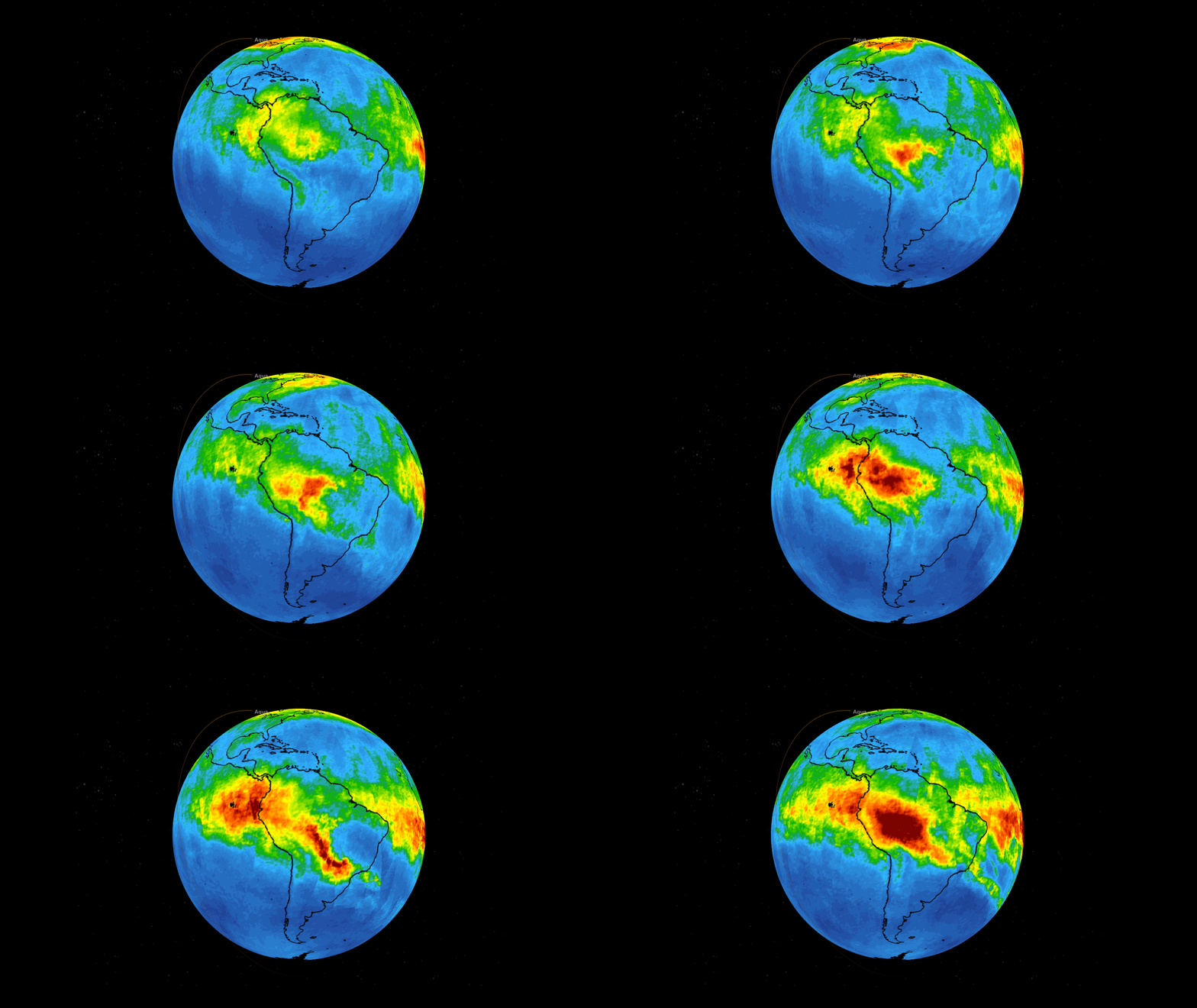 |
| This time series shows carbon monoxide associated with fires from the
Amazon region in Brazil from Aug. 8-22, 2019. Made with data collected
from the Atmospheric Infrared Sounder (AIRS) on NASA's Aqua satellite,
the images map carbon monoxide at approximately 18,000 feet (5,500
meters) altitude. Each "day" in the series is made by averaging three
day's-worth of measurements. Credit: NASA/JPL-Caltech. |
"[Hotter, drier temperatures] are going to continue promoting the potential for fire; large, uncontainable fires globally [if warming trends continue]."
"There also is expected to be more lightning [a significant cause of fires in remote areas]."
"This is really the most fire-prone ecosystem globally [the savanna ecosystem north and south of Africa's tropical rainforest]."
"It's the right combination of it being wet enough to have enough fuel and dry enough to burn."
Dr. John Abatzoglou, associate professor, department of geography, University of Idaho
 |
| As the climate warms, moisture and precipitation levels are changing, with wet areas becoming wetter and dry areas becoming drier Union of Concerned Scientists |
The Amazon Basin is on fire and Central Africa is seeing stretches of savanna in flames while Siberian regions are burning at a pace never before seen. The international community speaks of the fires in Brazil as a crisis -- that the 'lungs of the world' are in danger of collapsing yet wildfires are burning around the world in hugely significant areas of environmental degradation. As a gross contributor to climate change, wildfires release immense amounts of carbon dioxide, viewed a major greenhouse gas, into the atmosphere.
The fires kill trees and animals -- along with vegetation that is recognized for their vital qualities of removing climate-warming emissions from the atmosphere. Fire charred roughly 2.4 million hectares of Siberian forest since July-- while in Alaska, fires consumed over a million hectares of tundra and snow forest. Researchers are concerned that the combination of climate change and wildfires might alter the region's forests permanently.
The fact that in the Arctic wildfire situation along with trees and grassland peat, a material in the ground
[aeons-old dead plant matter] releases more carbon dioxide per hectare than trees, is also burning. Peat fires in northern climes have been rare because of the moistness of peat bogs, but that moisture appears to be shrinking. Arctic wildfires have a vastly different origin and cause than the fires in the Amazon, which are deliberately set.
In the Amazon, fires clear forested land for farming or livestock grazing, driven by a global demand for soybeans and cattle. Regional deforestation had been on the decline, but latterly the expansion of the farming industry in Brazil has led to concerns of an increase in deforestation rates. Fire has been used traditionally in the Amazon in Indigenous communities in the cultivation of crops. Fire returned minerals and other elements to the soil, enriching it. The fired land would be left fallow, then reused.
The problem is that larger farming models have emerged where industrialized agriculture leads to deforestation and permanent clearance, similar to what is happening in Southeast Asia. There, 71 percent of peat forests across Sumatra and Borneo in Indonesia and peninsular Malaysia have vanished between 1990 and 2015. The forests to be replaced by farms producing palm oil used in industrial food industry production.
Fires driven by rising temperatures that dry plants making them more ignition-prone are a distinct concern, with researchers describing the heat as a climate change signal in regions where the warming has been swifter than elsewhere on the planet. Areas of Alaska broke records this summer, with Anchorage reaching a high of 32 degrees Celsius in July as compared to the average temperature of 24 degrees.
Soot produced by burning peat -- rich in carbon -- settling on nearby glaciers where the ice absorbs the sun's energy instead of reflecting it, speeds the melting of the glaciers. California's wildfires are held like much of the West and Southeastern United States to be the result of a fire-adapted ecosystem where landscapes have evolved to tolerate fire. Lodgepole pine, common in the Western United States, requires heat from wildfires to release seeds and produce new forests.
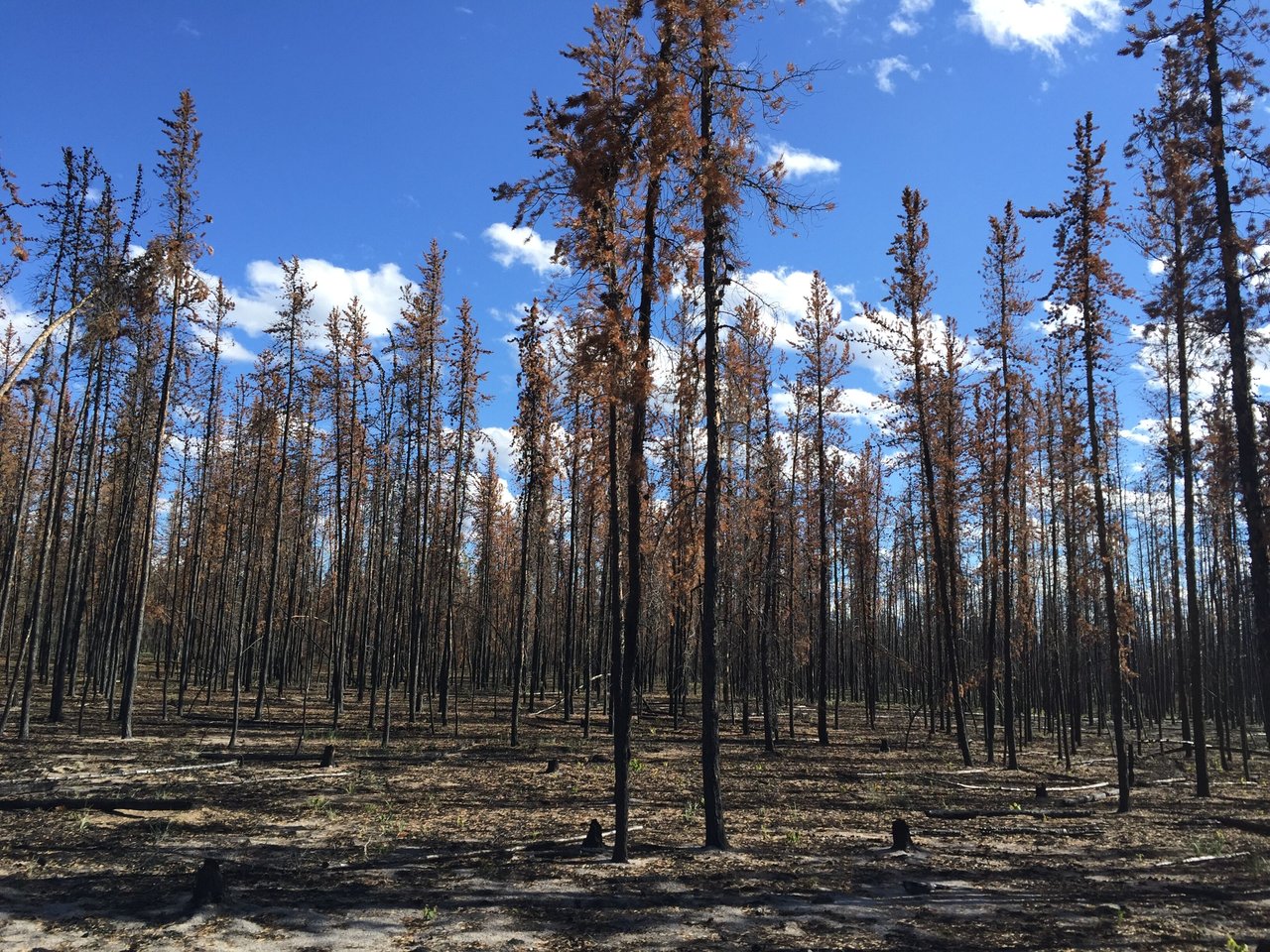 |
| The 2014 fires in Canada’s Northwest Territories burned more than 7
million acres of boreal forest, mainly comprised of cone-bearing trees
like these jack pines. The fires released nearly 104 million tons of
carbon into the atmosphere. Credit: NASA / Xanthe Walker, Center for
Ecosystem Science and Society at Northern Arizona University |
Labels: Climate Change, Environment, Nature, Wildfires
Warming Seas, Fish Scarcity
"That four percent decline [the figure arrived at through the study of declining fish populations attributable to warming seas] sounds small, but it's 1.4 million metric tons of fish from 1930 to 2010."
"And that region [northeast Atlantic Ocean and the Sea of Japan where a much steeper decline was noted] is home to some of the largest-growing human populations and populations that are highly dependent on seafood."
"We hope that this highlights the importance of accounting for the fact that climate change is driving shifts in productivity."
"Overfishing is a one-two punch: it makes populations more vulnerable to
ocean warming and rebuilding overfished populations is hindered by
warming,"
"We recommend that fisheries managers eliminate overfishing, rebuild fisheries and account for climate change
in fisheries management decisions."
"Policymakers
can prepare for regional disparities in fish catches by establishing
trade agreements and partnerships to share seafood between winning and
losing regions."
Chris Free, researcher, University of California, Santa Barbara
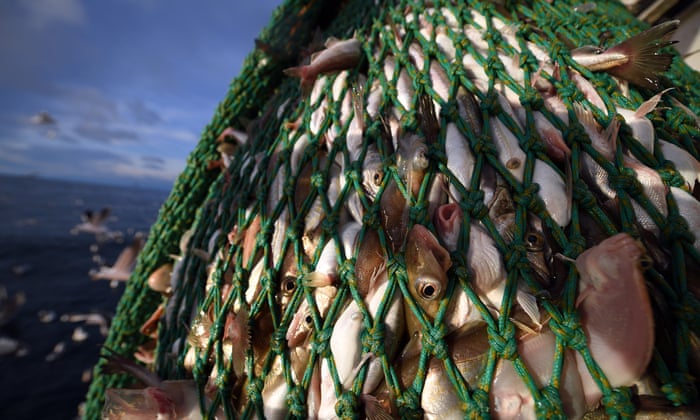 |
| Fishing in the North Sea off Shetland, Scotland, where fish stocks have declined.
Photograph: Jeff J Mitchell/Getty Images
|
"We were stunned to find that fisheries around the world
have already responded to ocean warming."
"These aren’t
hypothetical changes sometime in the future."
Malin Pinsky, study co-author, associate professor, Rutgers’ Department of Ecology, Evolution,
and Natural Resources
"Fish populations can only tolerate so much warming, though."
"Many of the species that have
benefited from warming so far are likely to start declining as
temperatures continue to rise."
Olaf Jensen, senior study author, associate professor, Rutgers’ Department
of Marine and Coastal Sciences
A new study published in the journal
Science warns that climate change has already impacted seafood catches around he world, that fish populations are declining in response to warming oceans, placing a food source and fishing income at risk, affecting millions of people worldwide. In some coastal areas and island nations fish represent 70 percent of the animal protein people consume. Elsewhere, around the world, fish make up 17 percent of the intake of animal protein.
 |
| Haddock in the North Sea are among the climate change "losers" as a result of warming ocean temperatures. Credit: NEFSC/NOAA |
Climate change is steadily impacting marine life where oceans have absorbed 93 percent of heat trapped by greenhouse gases. Ocean temperatures, according to a study published in January, were increasing faster than previous estimates suggested they would. Fish are consequently migrating to other areas more conducive to their existence since high ocean temperatures can kill fish, along with the food those fish depend upon.
In the northeast Atlantic ocean where Atlantic cod proliferate, there was a 34 percent decline in sustainable catches. In other regions representing a quarter of the world's fishing populations, no significant changes were noted. Fish had, however, expanded their range in roughly a quarter of the studied regions so that off the Atlantic Coast of the United States catches of black sea bass have increased by six percent; a rare reversal of the shrinking fish habitat.
 |
| Black sea bass are one of the climate change "winners" that have seen
their productivity increase with warming ocean temperatures. Credit:
Orion Weldon |
Over the eight decades that the study encapsulates, more populations of fish declined than increased. This new research studied historical data to determine that the declines which previous studies predicted would lead to fewer ocean fish in the future, had already begun to occur noticeably.
"This is going to be one of those groundbreaking studies that gets cited over and over again", noted Trevor Branch, associate professor, University of Washington School of Aquatic and fishery Sciences.
In colder parts of the ocean, fish populations tended to fare more favourably; cold fails to impact deleteriously on fish the way warming does. The researchers found less detail in the data they studied relating to the tropics, leading them to the realization that in those regions fish losses may have been steeper than in regions the study focused on. When warm ocean areas are overfished this adds to the vulnerability of the stock, since fish are hindered in their reproduction.

Labels: Climate Change, Fish Stocks, Nature, Ocean Warming, Research
Beautiful British Columbia
"The
orange colour is often the colour you see from the smoke from fires
because the particulate matter in the smoke filters out a lot of the
blue light from the sun and you see a red tinge."
"It's like a sunset, but it's overtop of you."
John Paul Cragg, Environment Canada warning preparedness meteorologist
"[I was very concerned, it looked like the apocalypse out there this morning."
"At
first I thought the sun had gone out or [was] certainly rising a little
later ... then at 7 o'clock it was still dark and I thought, 'We have a
problem here'."
John Stanton, marathon organizer, founder, Running Room

British Columbia has declared a state of emergency for a two-week period
which may be extended to reflect the situation at any given time.
"Public safety is always our first priority and, as wildfire activity
is expected to increase, this is a progressive step in our wildfire
response to make sure British Columbia has access to any and all
resources necessary", explained the province's Public Safety Minister Mike Farnworth.
"Taking
this step will further ensure we can protect the public, property and
infrastructure, and assist with firefighting efforts."
No fewer than 500 wildfires are burning. And the smoke that has ensued
from those out-of-control wildfires has darkened the atmosphere so
severely in some places it is as though day has been turned into night.
Air quality is certainly compromised. Even neighbouring Alberta has seen
its air reflecting the effect of the wildfires. Thick, black smoke
blows where it will with the wind, respecting no provincial boundaries.
"Fire tends to be most active between 4 and 7 in the afternoon",
because of the tendency for landscapes to dry over the day's hours.
explained Marg Drysdale of the B.C. Wildfire Service Northwest Fire
Centre..
Resulting in air quality warnings issued for parts of the province,
along with Alberta, Saskatchewan and southern Manitoba. Currently, 3,372
firefighters and contractors are responding to the blazes, with 465 of
that number from other provinces; Alberta, New Brunswick, Northwest
Territories, Quebec, Saskatchewan, Parks Canada as well as Australia,
Mexico and New Zealand, volunteering their expertise, energy and in
fact, their lives in a communal effort to tame nature's outbursts. The
number of fires this year is greater than last year's wildfire season's.
But by this time last year, according to Kevin Skrepnek of the Wildfire
Service, hundreds of homes had been lost to wildfires, with tens of
thousands of residents displaced as a result. British Columbia is a huge
province, rich with mountain ranges, great tracts of forest,
desertified areas, lakes and rivers galore
(the mighty Fraser and the Thompson),
and farmland devoted to apple orchards, ginseng crops, beef ranches. In
an area where there was a gold rush, Cache Creek, some 350 kilometres
northeast of Vancouver that was evacuated in last year's wildfire
season, a group of auto aficionados from the province on a driving
adventure encountered an antidote to wildfires.
The group of friends, all owners of vintage British vehicles,
convertible Morgans, planned to drive together from West Vancouver to
Kamloops, British Columbia. On arrival at their destination, the members
of the Pacific Morgan Owners Group planned to enjoy dinner together,
and return home the following day. On Saturday, however, by the time
they had reached Cache Creek, they came across the threat of a sudden,
violent thunderstorm and all hastened to put the tops up on their
convertibles.
 |
| Tom (driving) and Valerie Morris in their 1969
Morgan Plus 8 at the start of a trip from West Vancouver to Kamloops on
Aug. 11, 2018, that ended in tragedy when a mudslide swept the vehicle
with Valerie in it off Highway 99 near Cache Creek during a violent
thunderstorm.
Submitted /
PNG |
The sky had turned dark, and the rain gushed down. And that downpour
sent logs, boulders, mud and water rushing across Highway 99. The couple
that was the organizer of the group's outing had stopped on the highway
as did the others, to put their convertible top up with the intention
of carrying on. Valerie and Tom Morris thought, as did the others who
had stopped nearby, that they would ride out the storm and continue on
their way. As Tom prepared to get back behind the driver's seat in his
carefully restored Morgan the vehicle with his wife sitting in it was
inundated with mud, and slid off the road.
"All
of a sudden it started to get really cloudy and it started to
absolutely pour down and we had never seen anything like it, and we've
been through a tornado before", recounted Pat Miles, one of the Morgan group who had been directly behind the Morrises.
"Visibility went down to zero and it was like someone was throwing buckets of water against the windshield", Steve Blake, another of the Morgan group further described the weather assault that had overtaken them.
As the others turned around to drive back from where they had come, they
had no way of knowing that the mudslide had sent the vehicle of the
Morrises with Valerie in it, down a steep embankment beside the highway.
Tom, Valerie's husband was saved, though he was cut and bruised over
his entire body. His wife was lost, completely inundated by the mud,
along with the prized vehicle they took such pride in. Authorities are
attempting to recover her body.
Nature plays her tricks as she will; the tumultuous rain event that
caused the mudslide would have effectively put out any wildfire it might
have encountered, only there was no wildfire where it came down and
where the Morgan Group were driving, anticipating a pleasant drive with
good company, instead encountering a threat to their lives. Wonderful,
wild, and bountiful British Columbia; a nature-lover's dream.
Labels: British Columbia, Nature, Wildfires


