"Climate
change is greatly increasing the flammability of the fuel available for
wildfires because the trees, fallen trees and underbrush are all so
dry."
"This means that a single spark, regardless of its source, can rapidly turn into a blazing inferno."
Natural Resources Canada
"What we're getting now is bigger fires, faster-moving fires and also a faster return rate of those fires."
"Instead of burning through once every 50 to 200 years, they're coming through every five years, every 10 years."
John Vaillant, author, Fire Weather: A True Story from a Hotter World
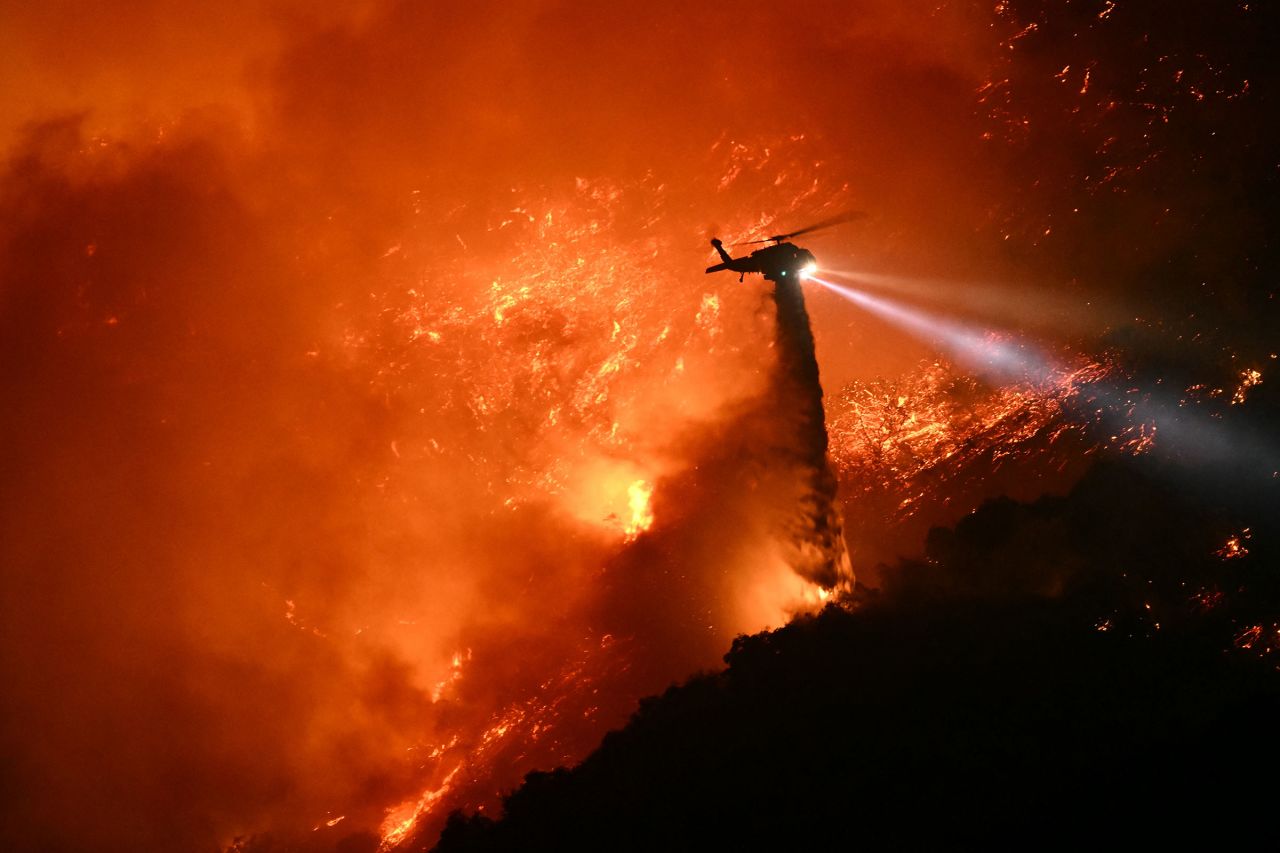
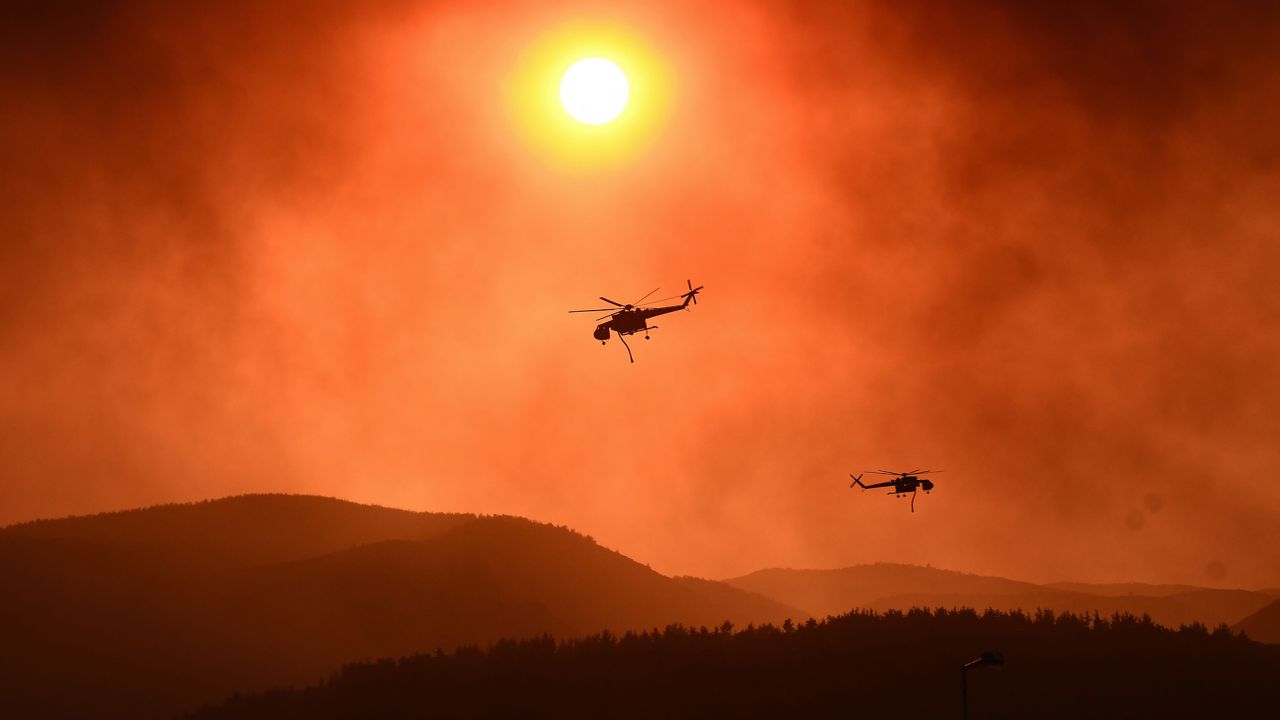
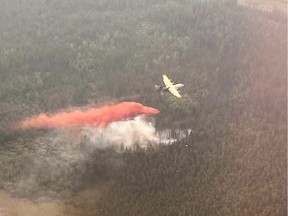
A helicopter battles wildfires near Coombs, B.C., on Sunday, Aug. 3, 2025. THE CANADIAN PRESS/Chad Hipolito
This
week alone in Canada, 7.4 million hectares of forest has burned; twice
as much damage as wildfires caused to date this year in the United
States; almost as much as burned areas of Argentina, Chile and Columbia
in combination. Saskatchewan and Manitoba declared states of emergency; a
few other provinces ordered residents out, even entire communities in
view of the fast-moving fires and dangerous smoke. Air-quality alerts
have been triggered in the largest of Canadian cities.
In
this country of massive, magnificent forests, firefighting resources
are stretched to breaking across Canada. The Canadian Interagency Forest
Fire Centre - the country's national firefighting co-ordinating body --
reported 721 fires raging across the country; 158 of that total are
classified as out of control. The CIFFC states that national wildfire
preparedness level is at the highest possible rating -- Level Five;
translating to all national firefighting resources having been
deployed.
In
Atlantic Canada, the Weather Network states the region could expect
thundershowers shortly; the other option is for the hot, dry weather to
continue, fanning wildfires. Saskatchewan has lost 2.8 million hectares
to wildfires this year, far more than the 1.9 million during the 2023
season which was Canada's worst year for wildfire devastation. In
neighbouring Manitoba, 1.7 million hectares have been scorched; the
second hardest-hit province.
Wildfire
devastation has spread throughout the country with the exception of
Prince Edward Island. British Columbia, Alberta and Ontario are
experiencing above normal fire numbers with more forest than usual being
consumed. Newfoundland's wildfires threatened St. John's and in New
Brunswick 15 active wildfires were announced, two out of control. Nova
Scotia is battling a new wildfire. A bolt of lightning, a discarded
cigarette, a spark from a piece of machinery, all represent a source of
ignition; with the right conditions the initial flame erupts and rapidly
spreads.
Hotter
temperatures trigger more lightning strikes. According to Natural
Resources Canada, those lightning strikes cause about fifty percent of
all fires, yet account for about 85 percent of annual area burned. Fires
on average burn 2.1 million hectares of forest annually in Canada,
according to government statistics; a fraction of the 15 million acres
consumed by the 2023 inferno, barely a quarter of the loss this year to
date.
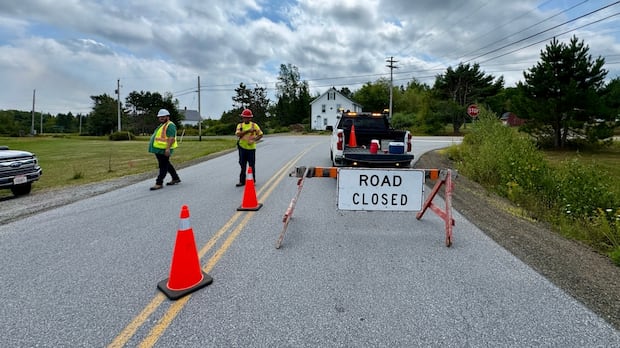
An
out-of-control wildfire in the Annapolis County community was estimated
to be 300 hectares in size on Thursday, prompting a mandatory
evacuation. CBC
Saskatchewan's
Public Safety Agency states that about 80 percent of the 2025 fires in
the province were caused by human activity, mostly accidental in nature,
and that statistic holds for Manitoba as well. In heavily forested
British Columbia, however, six of ten wildfires this year were
attributed to lightning strikes. Whereas an open fire left unattended
by someone began the wildfire at Susie Lake on the outskirts of
Halifax, this week.
Eight
firefighters died in their battle with the 2023 blazes. During the
2013-2018 period, records show that wildfire smoke contributed to some
240 premature deaths per year in Canada. A growing body of research
found links between exposure to particulates from wildfires and the
likelihood of being diagnosed with dementia and experiencing worsening
symptoms of epilepsy and cognitive decline.
At
the present time, wildfire response is a provincial and territorial
responsibility. The country's fire chiefs for the past decade have been
calling for a body to coordinate, support and strengthen wildfire
responses across Canada. "Work
is already underway to identify and advance options to improve Canada's
wildfire response capacity, including better co-ordination across
jurisdictions and building long-term resilience", announced Emergency Management and Community Resilience Minister Eleanor Olszewski.
Traffic is diverted as the Trans Canada Highway remains closed outside
of St. John's N.L. due to a wildfire in the Paddy's Pond area on
Wednesday, August 13, 2025. File photo by The Canadian Press/Paul Daly
There is no Consolation for Devastation Wildfires Produce
"[The
Los Angeles area] had another night of unimaginable terror and
heartbreak, and even more Angelenos evacuated due to the northeast
expansion of the Palisades Fire."
County supervisor, Lindsey Horvath
"We're not out of the woods yet. We have some very significant fire
weather ahead of us."
"We've prepositioned additional engines, fire crews, helicopters,
bulldozers, water tenders across all of Southern California ... all
poised to assist and support the additional fire threat."
Nancy Ward, director of the California Office of
Emergency Services
"There's likely to be a
lot more [fatalities in the wildfires devastating the Los Angeles area]."
"We
always have to be careful on the death toll."
"I've got search
and rescue teams, we've got cadaver dogs out, and there's likely to be a
lot more."
California Governor Gavin Newsom
"To all residents, please be assured that we will continue to be here
for you until the last fire is completely extinguished."
"We stand alongside all of you as we begin to plan for the repopulation
of evacuated areas, establishment of disaster recovery centers, and the
rebuilding of your homes, your communities, and your lives."
Los Angeles County Fire Chief Anthony Marrone
"[Curfews remain in place for the Pacific Palisades
and Brentwood neighborhoods, which is a] measure that is necessary to
ensure public safety, as high winds are expected to pick up again."
"[The
Palisades Fire] remains active, and as others have said, this situation
is far from over."
"Pacific Palisades still faces dangerous
conditions, including downed power lines, broken gas and water pipes and
now slide conditions because of water activity."
Los Angeles City Council member Traci Park
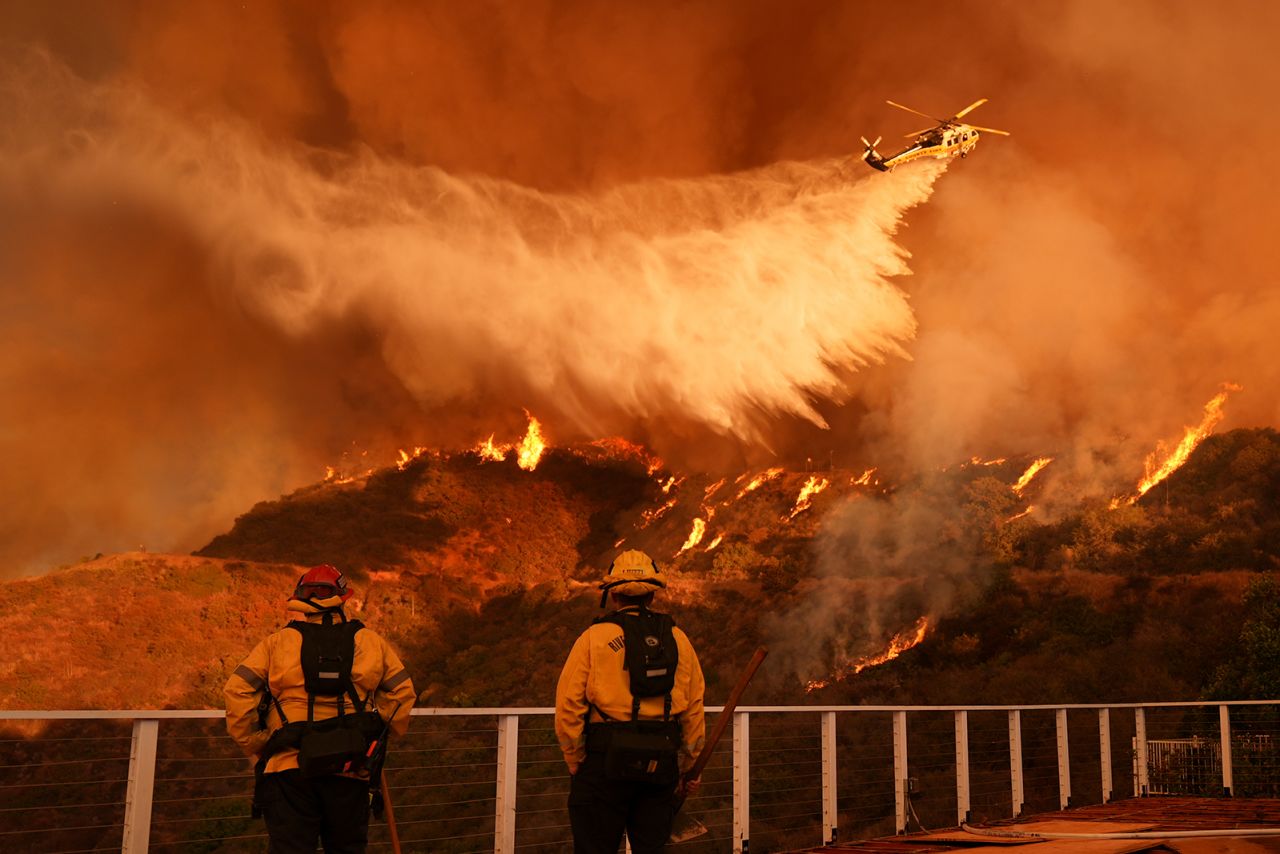
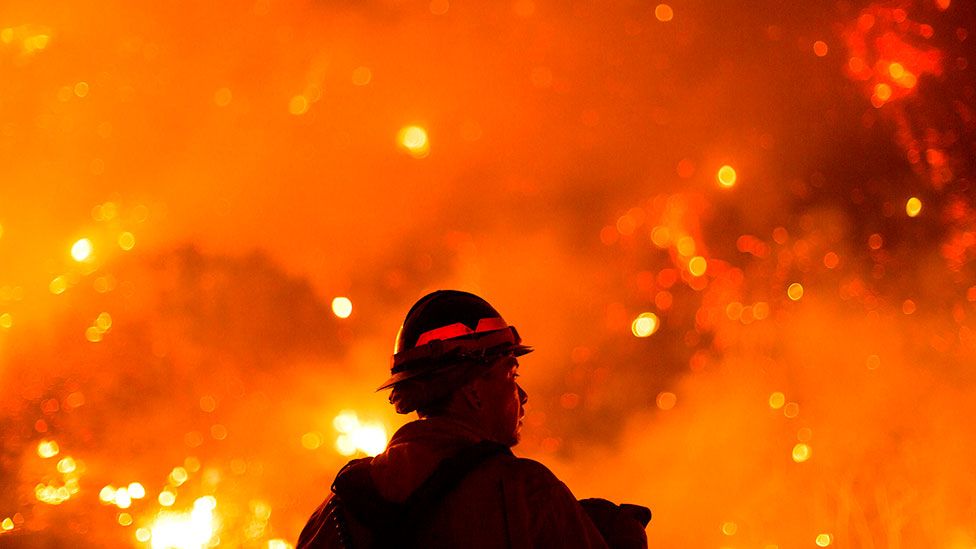
Firefighters watch as water is dropped on the Palisades Fire in Mandeville Canyon, in Los Angeles, on January 11.Jae C. Hong/AP
Spreading
wildfires saw firefighters racing to cut them off before the return of
howling winds that could shove the flames closer to the J. Paul Getty
Museum and the University of California Los Angeles. More home-owners
were left on edge by new evacuation warnings, as a fierce battle was
underway in Mandeville Canyon against the flames. Swooping helicopters
were seen near the Pacific coast, dumping water on the downhill charging
blaze. On the ground, firefighters were using hoses in an effort to
beat back flames leaping everywhere, as thick smoke blanketed the
hillsides.
CalFire
operations chief Christian Litz explained their major focus on the
Palisades Fire in the canyon area, not far from the UCLA campus. "We need to be aggressive out there",
he said. The National Weather Service warned strong Santa Ana winds
could soon return to replace the light breezes that were fanning the
flames on Saturday. Santa Ana winds have been credited for the infernos
that the wildfires were transformed into, levelling entire
neighbourhoods which have seen no rainfall of any significant for the
past eight months.
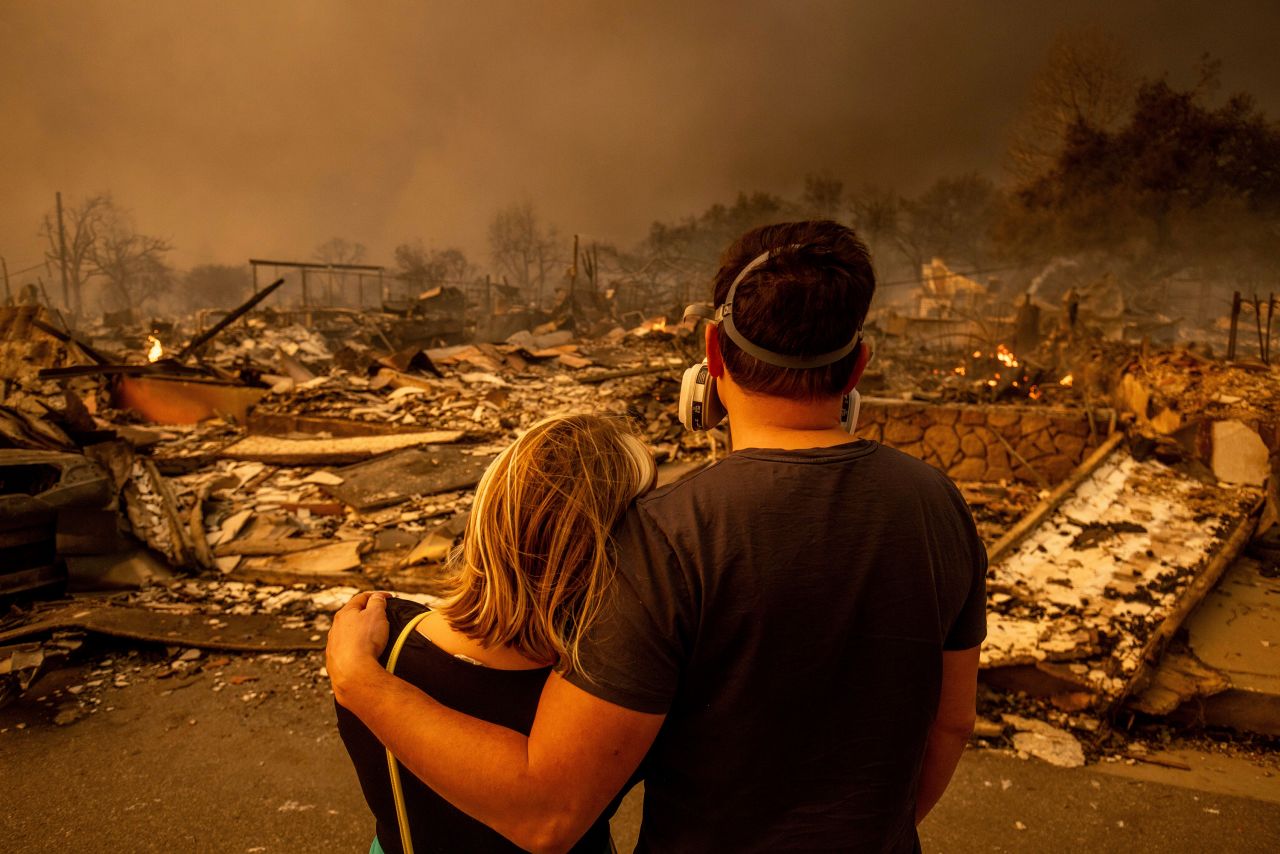
Megan
Mantia, left, and her boyfriend Thomas, return to Mantia's fire-damaged
home after the Eaton Fire swept through in Altadena, California, on
January 8. Ethan Swope/AP
There were fears that the fire threatened to leap over Interstate 405, into the Hollywood Hills and San Fernando
Valley, both highly populated. Teams conducted systematic grid searches
on Saturday in the grim work sifting through the devastation with
cadaver dogs. A family assistance centre was set up in Pasadena as Los
Angeles County Sheriff Robert Luna urged residents to abide by curfews. "We have people driving up and around trying to get in just to look. Stay away."
The death count now stands at 26.
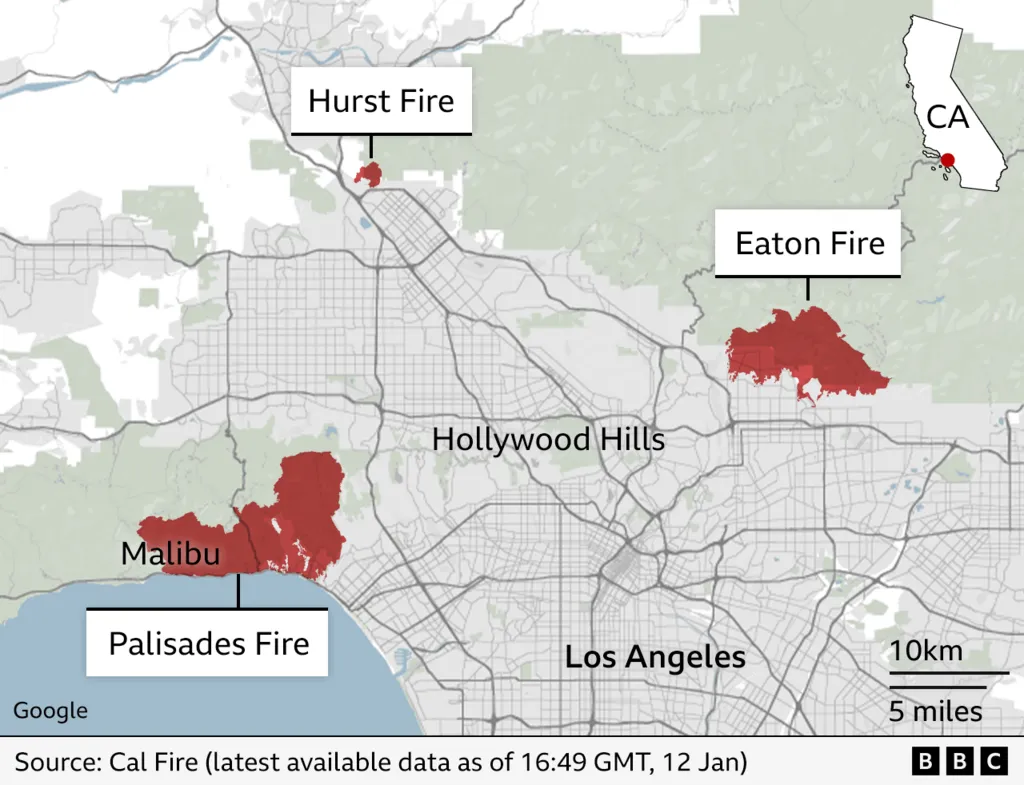
Over 12,000 structures have been burnt to a cinder. Some 145 square
miles have been consumed by the fires. Tens of thousands remain under
evacuation orders while new evacuations were ordered Friday evening,
following a flare-up on the Palisades Fire eastern side.Since the start
of the fires on Tuesday north of downtown Los Angeles, structures
including homes, apartment buildings, businesses, outbuildings and
vehicles have been burned.
No
cause has yet been attributed to the largest fires that have caused
the nation's costliest wildfires event in its recorded history. Donation
centres on Saturday were overwhelmed by volunteers to the point that
many were turned away, although donations of necessities were accepted.
Some residents have been returning in hopes of salvaging keepsakes,
sifting through what was left of their homes in the rubble.
People
were urged by officials to stay away. The ash, they warned, can contain
lead, arsenic, asbestos and other dangerous materials. "If you're kicking that stuff up, you're breathing it in", advised a spokesman for the unified command at the Palisades Fire. "All of that stuff is toxic."
"We're looking for a little respite on Friday and Saturday from the Santa Ana winds but then they're going to pick up again Sunday through most of next week."
Meteorologist Rich Thompson
"[Right now, it's impossible to quantify the extent of the destruction other than] total devastation and loss."
"There are areas where everything is gone, there isn't even a stick of wood left, it's just dirt."
Barbara Bruderlin, head, Malibu Pacific Palisades Chamber of Commerce
"I've lived out here since the mid-80s and I don't think I've
experienced anything as strong and forceful as these winds. I'm looking
at a number of houses that have been destroyed of people I know."
"Not
everybody who lives in California is a multimillionaire. There are a
lot of [regular] folks here. If you're a person who doesn't have good
finances, this is going to be devastating."
"I think this is a game changer for Los Angeles. People
are going to have to re-evaluate where they live and I'll be surprised
if they're going to rebuild in the areas quickly."
Hollywood Actor John Kapelos
A still from a video that Kapelos took from his condo's rooftop on
Tuesday near La Brea and Franklin Avenues, looking west from Hollywood
toward the Pacific Ocean. (Submitted by John Kapelos)
"It's been scary. Looking around, you can see the smoke in
the air and you're smelling it. Obviously the air quality is terrible
right now."
"All these areas that are on fire, the majority of them are in the
hills, so those are really narrow and winding roads, and a lot of people
park on those streets and are trying to get out, so getting a firetruck
up there would be an absolute nightmare. That really slows things
down."
"I've had a few people I know who've lost their homes. Right now,
they're just in shock because there's places they've been in for decades
and all of a sudden everything is gone. Basically they just have what
they could fit in their cars and nobody knows the next steps."
David Cooke, realtor, Toluca Lake neighbourhood
A man walks in front of the burning Altadena Community Church on
Wednesday in in Pasadena, Calif., as wildfires continued to create
devastation in the L.A. area. (Chris Pizzello/The Associated Press)
To the present, 16 people have died in the blazes in the Los Angeles area. Entire neighbourhoods have been obliterated in America's second-largest city. Firefighters had hoped for a break frmo fierce winds that fuelled the area's massive blazes. Over 10,000 homes have been burned, along with other structures since Tuesday. Fires first began appearing around the 40-kilometre expanse north of downtown Los Angeles, a densely populated area.
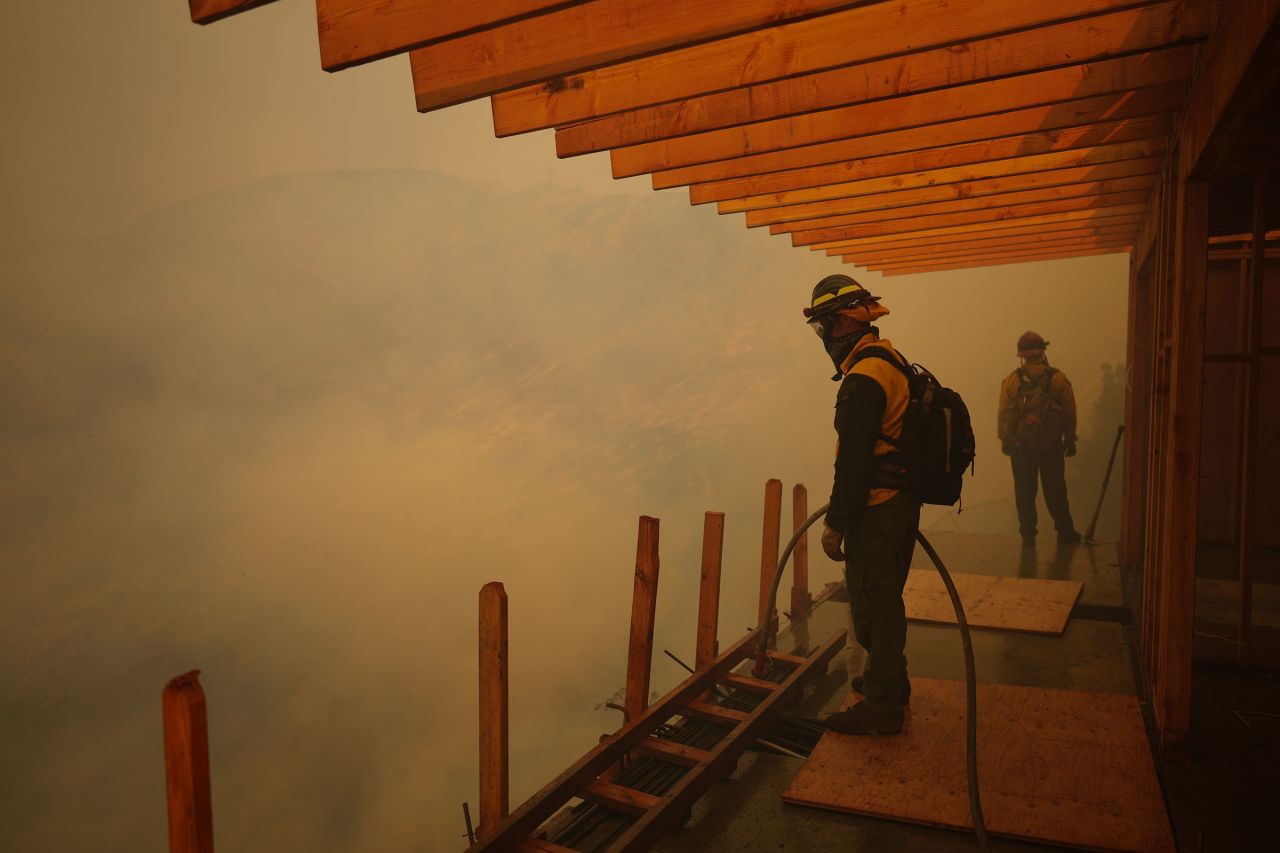
Firefighters monitor the advance of the Palisades Fire in Mandeville Canyon on January 11.
Eric Thayer/AP
California is accustomed to massive wildfires. Even so the shock at the fierceness and swift spread of these fires are like none before them, with dozens of blocks of Pacific Palisades flattened, and smouldering -- rubble only remains. The 13 million inhabitants of Metropolitan Los Angeles awoke Friday to another day of high winds stoking the fires with the threat of new flare-ups. Earlier in the week hurricane-force winds ignited the nearby hillsides with embers.
The forecast by meteorologist Rich Thompson was for Santa Ana winds to pick up once more on Sunday and throughout the following week. Thursday afternoon, the San Fernando Valley Kenneth Fire saw new blazes where evacuees from another fire were taking shelter in a school. An aggressive response by firefighters managed to quell the flames in neighbouring Ventura County. Calmer winds and out-of-state crews helped firefighters beat back two devastating wildfires.
Over 5,000 structures were burned in the Altadena area by the Eaton Fire. Finally, firefighters have seen progress in containing the Eaton blaze. The fire in Pacific Palisades, the largest in the Los Angeles area, destroyed over 5,300 structures, with firefighters establishing the first containment on Thursday. Even so, that blaze is considered the be the most destructive in the history of blazes in Los Angeles.
With the assistance of aircraft water drops, crews were able to knock down a blaze in the Hollywood Hills. The famed Hollywood Bowl outdoor concert venue was close to immolation near the heart of the entertainment industry. No figures have yet been released on the cost of the damage to date, but AccuWeather on Thursday increased its preliminary estimate of the damage and economic fallout to a range of $135 billion to $150 billion.
A fire fighting helicopter drops water on the Palisades fire on January 11.
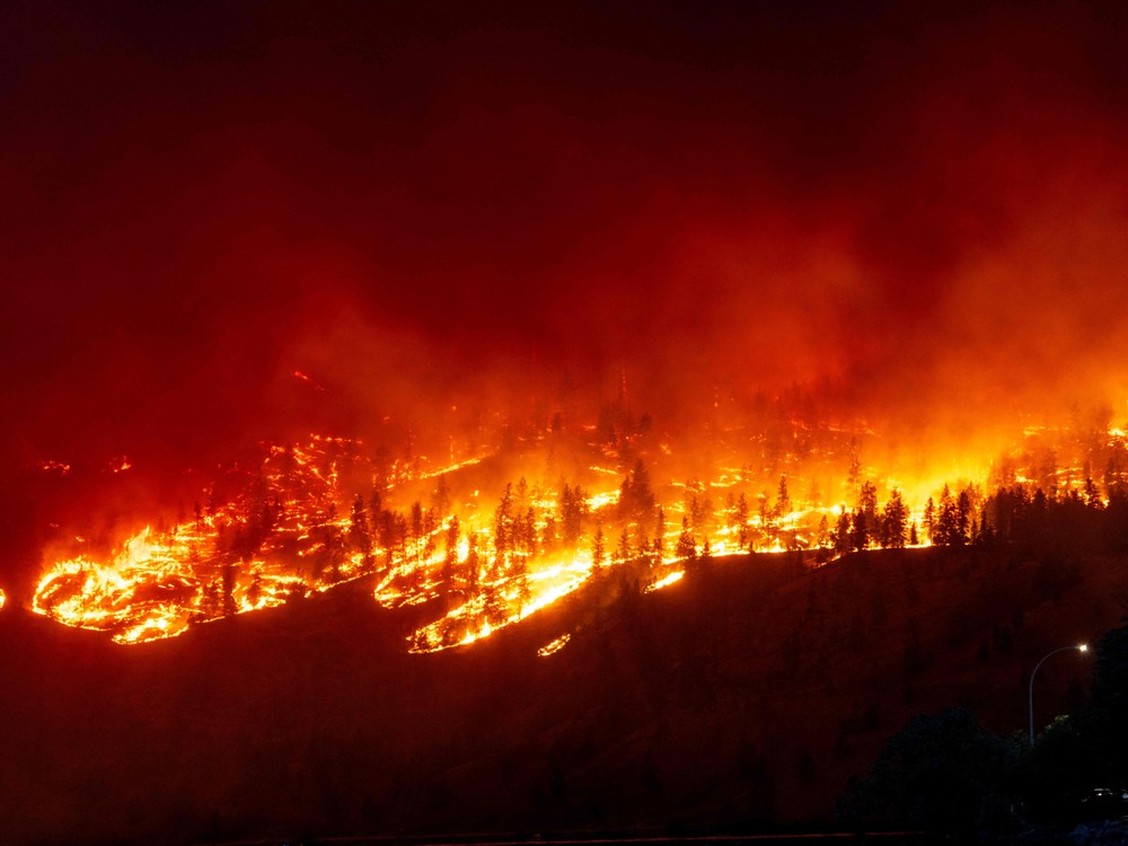
The McDougall Creek wildfire burns in the hills in West Kelowna on Aug. 17, 2023, as seen from Kelowna.Photo by DARREN HULL /AFP via Getty Images
"Then the flames started, and they started everywhere all at the same time because it was an ember shower."
"We're
a pretty small fire department, we have three apparatus, so we tried to
do our best but there was just absolutely no way that we could attack
all of it. And as soon as you don't attack it, it spreads."
"We
fought for as many houses as we could. We stopped the flame front and
saved probably, I'd say, 65 to 75 percent of the houses in Traders
Cove."
"I
saw my house burn. When we were fighting the fires in Traders Cove, we
literally had fire personnel with their backs to their house that was
burning behind them, and they were fighting the neighbour's, trying to
save the neighbourhood."
"It
was extremely, extremely fast. The wind was blowing directly, I mean
literally, at my house. It was a wall of fire 100, 125 feet high,
travelling 35 kilometres an hour."
"It was surreal. It was watching nature at its worst. ... It just kind of ate my house."
Paul Zydowicz, chief, volunteer fire department, Wilson's Landing, British Columbia
"I
quickly found myself in a pretty tricky battle. I was able to call in
our own firefighters to come and help me. And that's when it became real
for me that we were surrounded by fire and it was bearing down on our
community hard. And we were all in the fight of our careers."
"I
was thinking: If we just had one more fire engine we could save that
house. And if we had one more fire engine, then we can save those other
two houses. And if we had one more, we could get the other ones on the
other side of the street. And, you know, of course you can never have
enough resources in that situation."
"It's unprecedented. We are not used to fighting wildfire fire against six-storey condominium buildings."
Jason Brolund, West Kelowna, McDougall Creek wildfire
"It moved 20 km south in under 12 hours, which is extremely [aggressive] for fire behaviour in British Columbia."
"That is a force of nature similar to a tornado, similar to an earthquake or a tsunami."
Forest Tower, B.C. Wildfire Service Information officer
"[The fire that blew into this region] was something I've never seen before."
"When I saw the flames coming that day, it was something bigger than any of us could handle."
"but
the community rallied together, they saved what they could save. It was
actually just among the most impressive displays of community spirit
I've ever seen."
"I want to stress the fact that we've lost structures, people are hurting, but we haven't lost lives -- not yet."
District deputy regional fire chief Sean Coubrough
"This
MacDougall fire has been a very harrowing experience for everyone. I'm
grateful that there has been no confirmed loss of life that we know of,
and we hope that this remains."
"It's
very devastating for the loss of property and the impact of businesses
that has occurred. There's lots of collective grief and high emotions."
Chief Robert Louie, Westbank First Nation
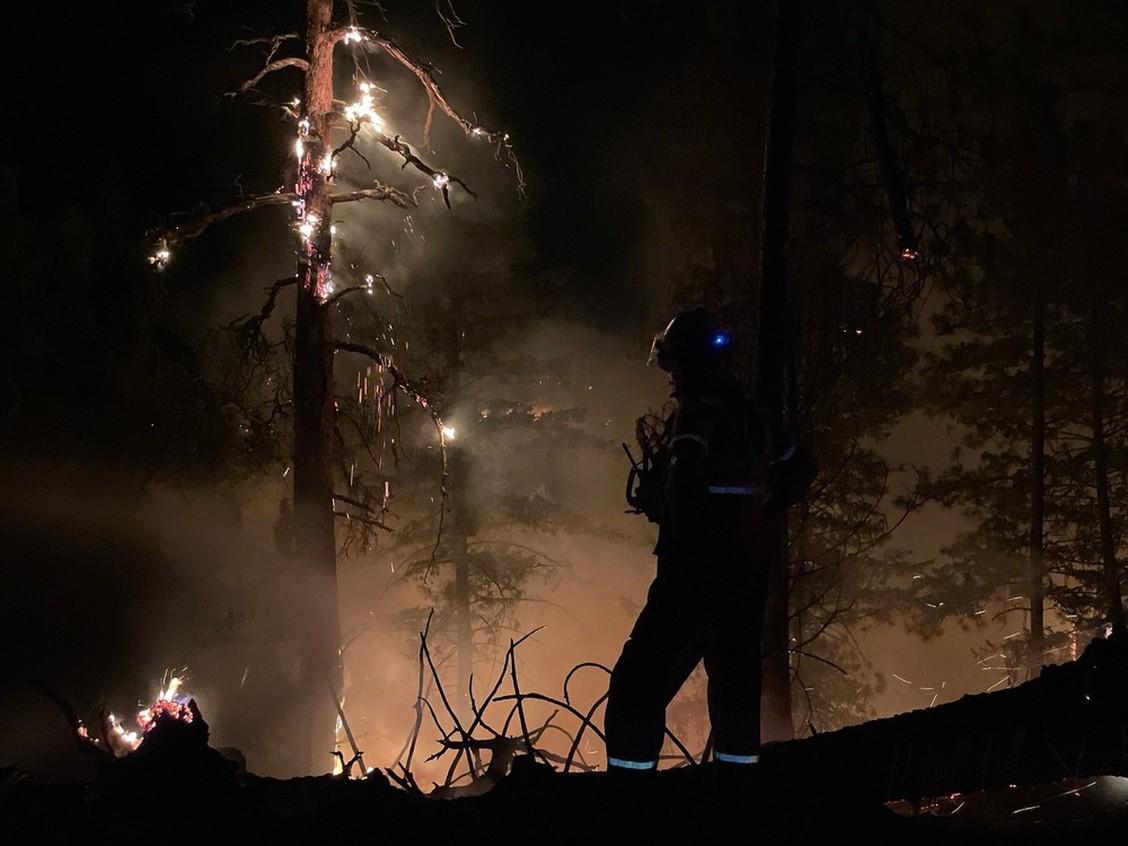
Photo from the frontlines as Wilson's Landing firefighters battled the McDougall Creek blaze north of Kelowna.Photo by Wilson's Landing Fire Department
As
gusting winds whipped up the McDougall Creek wildfire, airplanes dumped
fire retardant in the area. Fire chief Zydowlicz had firefighters
staked out on the west side of Okanagan Lake, additional crews on a
local forest road. As evening fell flames could be seen thrusting toward
Wilson's Landing. The two dozen on-call firefighters with three trucks
stared down the fast-moving blaze, leaping and growing voraciously.
That
was August 17, the start of the worst week of the worst year for
wildfires in the history of British Columbia, which led to hundreds of
properties damaged, thousands of evacuations across the province, and
hundreds of firefighters arriving from near and abroad to pitch in and
work as an emergency team to address the crisis. A day later the
McDougall Creek wildfire blew into West Kelowna, roughly 13 km south.
Jason
Brolund, the city's fire chief spent the day organizing how best to
attack the blaze, overseeing the command post in the city. On his way
home August 18 for a few hours of sleep he stopped in West Kelowna
Estates to check on his firefighters and an "overwhelming" scene
assailed him. A colleague pointed him to a subdivision street not yet
visited by the firefighters. He knocked on doors to check that residents
had evacuated, and as the night sky glowed orange fluorescence,
firefighters used water from swimming pools "right before it hits the person's lawn, like inches from the house".
The
inferno melted street signs, uprooted large trees, and ripped propane
tanks open, blowing them into the woods. At Wilson's Landing
firefighters attacked the blaze roaring north along Westside Road, work
that stretched into the next morning, staying one step ahead of the
flames to protect small communities, but finally forced to retreat 10 km
when they reached the Lake Okanagan Resort.
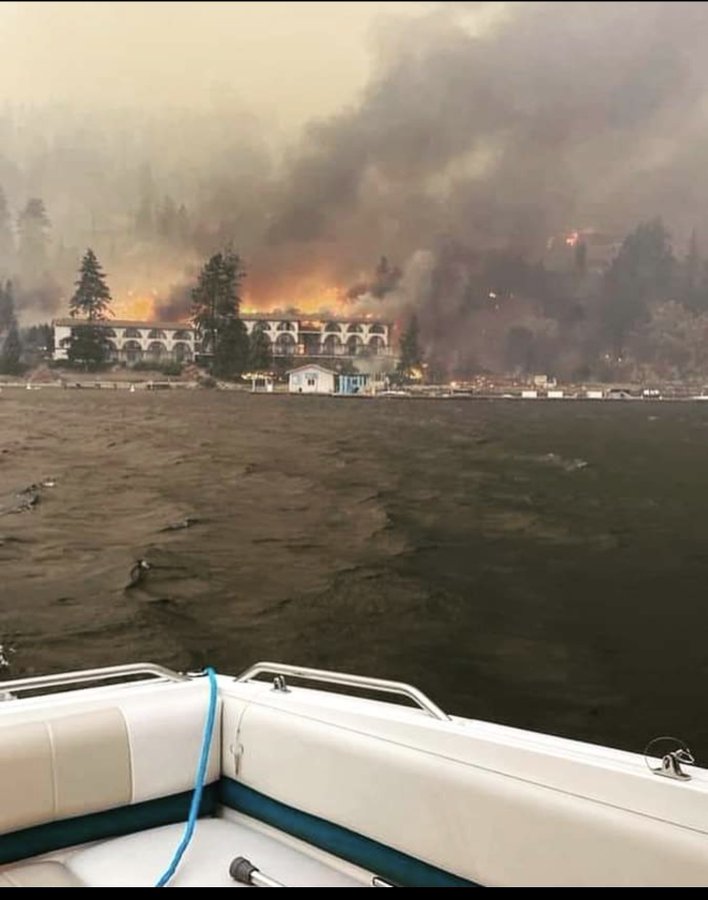
Lake Okanagan Resort on fire Photo: Tedd Buddwell
"The fire chased us out of Lake Okanagan resort"
explained Chief Zydowicz. Boaters posted photographs of the 217-room
historic resort engulfed fully in flames. The tradespeople, doctors,
lawyers and entrepreneurs who formed the troop of volunteer firefighters
experienced a harrowing 22 hours. Two were injured; one with facial
burns, the other a broken wrist.
"These two firefighters, after being treated at the hospital, called me
from the hospital and said put me in a next shift please, and
preferably earlier", said Chief Zydowicz.
Along
with losing his own house, the fire had destroyed $150,000 in boats
and other gear for his riverboat company, Northwest River Boats. Other
Wilson's Landing firefighters lost everything and continued to fight the
wildfire. The fire in the North Westside rural area destroyed or
damaged about 90 properties in both Traders Cove and Wilson's Landing,
as well as a children's summer camp. Most homeowners had heeded
evacuation orders, even though a handful were rescued after waiting too
long to leave.
In
the city of West Kelowna and the Westbank First Nation another 84
properties were damaged or destroyed, along with four in Kelowna and
three in Lake country. West Kelowna firefighters that afternoon fought a
ground fire that was threatening a gas storage facility, a mobile home
park and a number of new condominium developments. That day in
mid-August was hot, dry and windy across most of the province. Other
areas of the province saw mounting fire crises with several communities
in the Columbia Shuswap Regional District given evacuation orders as the
area faced "its most devastating wildfire day in history".
A
base camp for 400 firefighters west of Adams Lake was forced to
evacuate when the fire risk was acute and cold air whipped up the nearby
Bush Creek East fire. Under 12 km from the camp the Lower East Adams
Lake fire was increasing in intensity close to the Interfor Adams Lake
Mill, a major area employer. It was saved, while flames tore south
attacking other communities on the north side of Shuswap Lake. Losses of
100 homes were reported by residents in Scotch Creek and Celista.
By August 20 the situation began to change when Chief Broland said "We're
now four days in. It feels like months. But things are looking better.
We are finally feeling like we're moving forward rather than we're
moving backwards, and that's a great feeling for all of us to have. In
saying that, make no mistake, there will be difficult days ahead, and we
are continuing to prepare and address those."
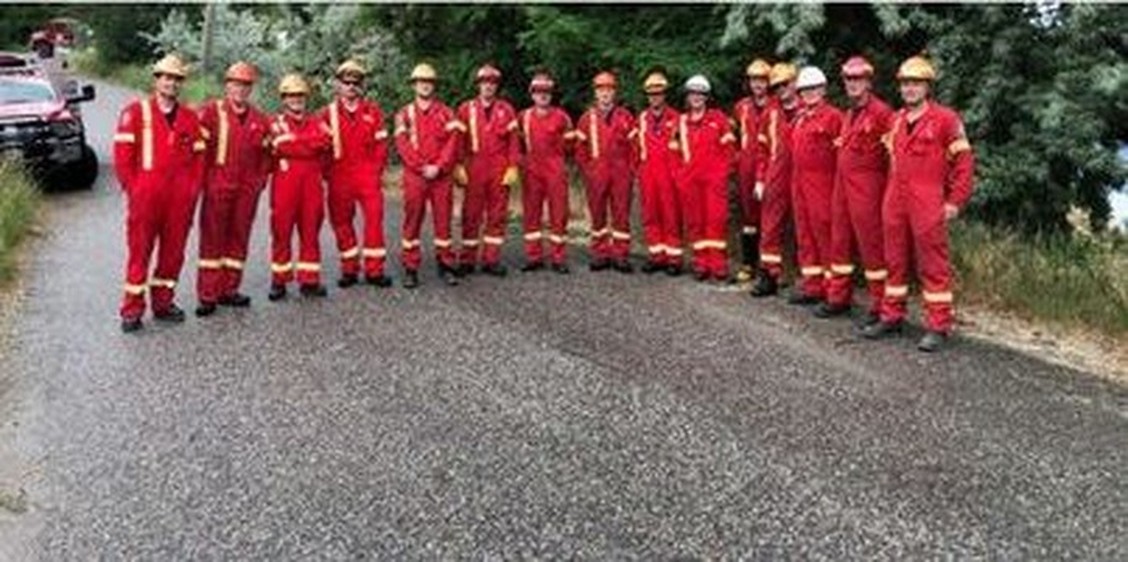
A recent photo of some of the Wilson’s Landing
firefighters. Thirteen people in the 24-member department lost their
homes in the blaze. Photo: GoFundMejpg
"Given
that there have been no reports of a missing person or missing
residents from the surrounding areas, the possibility is being
investigated that these are people who had entered the country
illegally."
Ioannis Artopios, spokesman, fire department, Avanta area
"When we add the fires in Canada, the United States, Africa, Asia and
Australia to those in Europe, it seems that the situation is getting
worse every year."
Antonello Fiore, president, Italian Society of Environmental Geology
Helicopters fly over as wildfire rages near Alexandroupolis, northern Greece, on August 21, 2023. Sakis Mitrolidis/AFP/Getty Images
The
bodies of 18 people were discovered by firefighters scouring the area
of a major wildfire in northeastern Greece, burning out of control
Tuesday for a fourth day. Authorities were left to consider whether the
group remains might be those of migrants who had entered Greece through
its nearby border with Turkey.
Hundreds
of firefighters were battling dozens of wildfires breaking out across
the country, with galeforce winds fanning the flames. Two people died on
Monday while two firefighters were injured in separate fires in
northern and central Greece. The 18 bodies were found in the Avanta area
of the city of Alexandroupolis.
The
hot, dry summers of southern Europe are especially susceptible to
wildfires. Across Tenerife in Spain's Canary Islands, another major
blaze has been burning for a week, with no injuries or home damage yet
reported. Blame is being placed by European Union officials squarely on
climate change to explain the increasing frequency and intensity of
European wildfires.
Police
activated Greece's Disaster Victim Identification Team in hopes of
identifying the 18 bodies discovered close to a shack in the Avanta
area. Alexandroupolis sits close to Greece's border with Turkey, along a
route frequently used by people fleeing poverty and conflict in the
Middle East, Asia and Africa, seeking to enter the European Union.
Many
villages and settlements close by Avanta were under evacuation orders,
push alerts sent to mobile phones. A massive wall of flames raced
overnight through forests toward Alexandroupolis that prompted
authorities to evacuation an additional eight villages along with the
city's hospital. The sky over the city was flaming red and choking smoke
with swirling ash flecks filled the atmosphere.
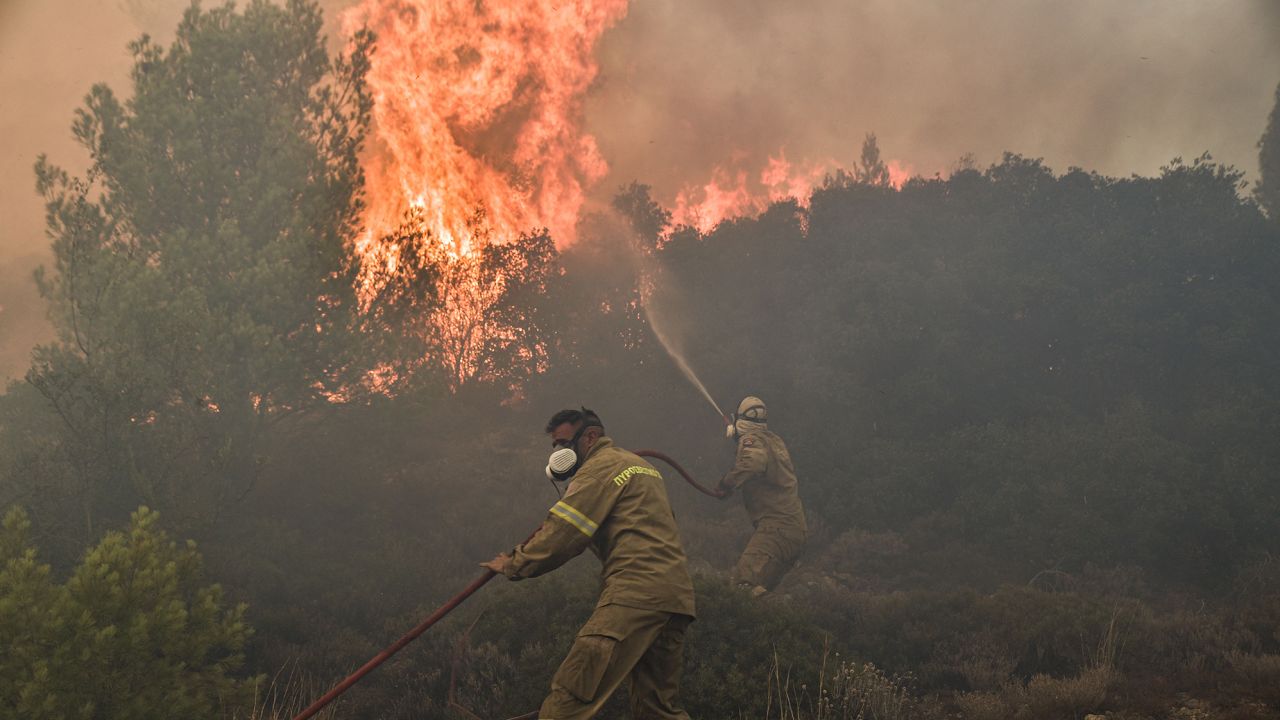
Firefighters battle flames during a wildfire near Prodromos on August 21, 2023.Spyros Bakalis/AFP/Getty Images
The
city's hospital transported 65 of its over 100 patients to a ferry boat
docked at the city's port; mores were taken to other hospitals in
northern Greece. Another 20 patients were ferried to the port town of
Kavala, to be transferred from there to yet another hospital. Speaking
on Greece's Skal television the country's deputy health minister
explained that the Alexandroupolis hospital moved its patients elsewhere
given the smoke and ash circulating, as a threat to health toward
already compromised people.
Patrol
boats and private vessels evacuated another 40 people by sea from areas
west of Alexandroupolis, ferrying them to the port. Satellite imagery
showed smoke from a fire burning through forest in a protected national
park, blanketing northern and western Greece. Woodland northwest of
Athens and at an industrial area on the capital's western fringes were
susceptible to new fires that broke through in parts of the country.
From
the industrial area of Aspropyrgos, small explosions resounded as
flames reached warehouses and factories, authorities shutting down a
highway and ordering the evacuation of nearby villages. Greece, with its
firefighting forces stretched to the limit, appealed for help from the
civil protection mechanism of the European Union.
The
response was five firefighting planes from Croatia, Germany and Sweden,
and a helicopter, 58 firefighters and nine water tanks from the Czech
Republic heading to Greece on Tuesday. Two aircraft from Cyprus arrived
on Monday as did 56 Romanian firefighters. A blaze on the island of Evia
was being tackled with the assistance of French firefighters. "We are mobilizing actually almost one third of the aircraft we have in the rescEU fleet", EU spokesman Balazs Ujvari recounted.
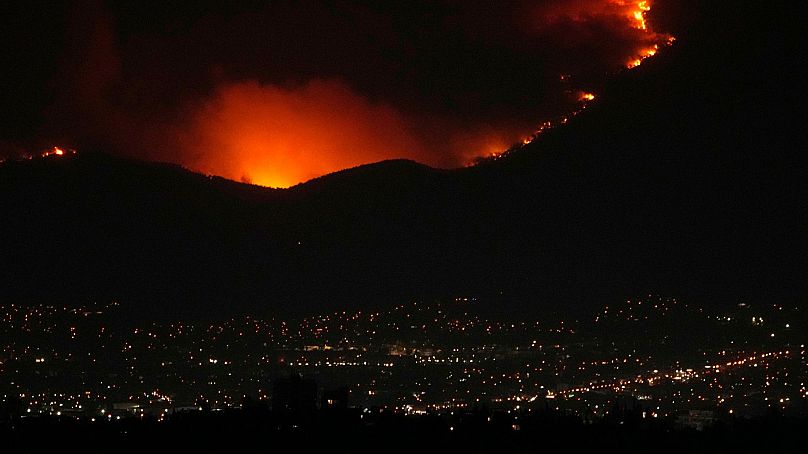
Flames burn a forest during a wildfire on Parnitha mountain near Hasia suburb, northwestern Athens, 22 August 2023. AP Photo/Thanassis Stavrakis
"Grocery
stores aren't open. There's no services here in town. The smoke's going
to get thick, so really encouraging folks [to] head out now."
"Please don't spread rumours. There's no looting in Yellowknife."
"RCMP are patrolling the neighbourhoods. I contacted them this morning. I saw them on my walk to work this morning."
"There is no looting. Your homes are safe. You've gotta lock up and head out of town."
Yellowknife mayor Rebecca Alty
Rebecca Alty,
Yellowknife's mayor, says there are still exit options for people who
stayed behind in the N.W.T. capital. 'The fire is approaching, we're
working hard to stop it but let's not get to a situation where we have
to do that emergency evacuation,' CBC News
"It's a ghost town. This is kind of the D-Day for the fire effort. If it's going to get bad, it's going to get bad today."
"It's
kind of like having a pint at the end of the world [exhausted
firefighters taking a break at one bar still open, following long
shifts]."
"Our
members [First Nations] know the land better than anyone else. We're
confident they'll be safe out there [those residents who choose shelter
in cabins or camps out on the land]."
Kieron Testart, Yellowknife
Fishers Stephanie Vaillancourt and Annika Olesen, seen here on
Friday, have a plan to shelter in place as wildfires threaten
Yellowknife. (Jennifer Gauthier/Reuters)
Yellowknife
has become a ghost town, as wildfires loomed nearby while the
territorial capital's mayor urged residents to put away their fears of
looting, and leave while they still could. The city of 20,000 saw
thousands leaving by air or road Friday while a noon deadline to leave
approached. Its goal was to see that everyone could evacuate in an
orderly manner before the fire at 15 kilometres distance from the
outskirts of the city, advanced to cut off access.
1,600
people will remain in the city, workers fighting the flames, hoping to
save as much of the city as possible. 236 fires are burning in the
territory, a wildfire situation that is critical.
According
to officials, the roads would remain open while flights would continue
past the deadline as long as both avenues remained safe. Once-busy
streets in the city had emptied, stores and businesses shuttered.
Yellowknife gas stations were still operating, those that still had
fuel. A single grocery store and a pharmacy remained open for the time
being. Some First Nations people have chosen to take shelter in place
while most people were clearing out.
"Busy skies today",
commented fire information officer Mike Westwick, as work battling the
flames continued. Eleven air tankers flew overhead, another plane
dropping fire retardant, while a ten-kilometre fire line had been dug,
backed up by 20 kilometres of hose and a plethora of pumps. Fire
fighting implements representing "the most extensive heavy water operation we've ever seen in the territory", commented Westwick.
People
who were evacuated from Yellowknife due to an approaching wildfire are
watching from places like Alberta to see what happens with the ongoing
fires in the Northwest Territories. CBC
Havoc
was threatening, with winds picking up from the north and northeast
being predicted for Friday and Saturday. Hoped-for rain failed to
materialize overnight, in an already drought-stricken environment. "Both
of those winds would push the flames in directions we don't want them
to go. We've still got some really difficult days ahead. There's no
denying that", commented Mike Westwick.
Sprinklers,
water cannons and fireguards were set up Wednesday as evacuation orders
were given late on Wednesday. The following day, about 1,500 people
left on evacuation flights, in addition to commercial planes. More
flights scheduled for Friday that could see roughly 1,800 additional
people leave the city. Steady, orderly convoys of vehicles headed for
evacuation points on the main highway out.
A Thursday view of another wildfire burning to the northeast of Yellowknife near the Ingraham Trail. (N.W.T. Fire)
"I urge all residents under evacuation orders to please adhere to them as they are issued."
"These orders are never issued lightly and always consider our collective health and safety."
"You could be jeopardizing your safety and that of others."
North West Territories' environment and communities minister, Shane Thompson
"We have been in a blocked pattern across North America all week long."
"That kept an area of upper level low
pressure stuck over the Northeast. The flow around the low pressure has
been guiding wildfire smoke from Quebec into the Northeast, Great Lakes,
and even Ohio Valley and down in the mid-Atlantic."
Jen Carfango, Weather Channel meteorologist
Wildfire near EdsonPhoto Gov Alberta Fire Service
"The
Air Quality Health Index (AQHI) is a scale from 1 to 10+ that provides
an indicator of the health risk related to air quality and can be found
on the Environment Canada website or provincial environment ministry
sites. Canada’s WeatherCAN app can send alerts about what to do when the
air quality is poor."
"There
are growing concerns about how to grapple with the long-term health
impact of worsening air quality. Experts advise higher-risk individuals
to take immediate steps to protect themselves when the risk level of the
AQHIincreases.
According to the index, levels of 4 to 6 are considered moderate risk
and vulnerable individuals are urged to reduce or reschedule outdoor
activities. Levels of 7 to 10 are considered high risk, and anything
above 10 is considered very high risk."
murat yĂĽkselir / THE GLOBE AND MAIL Source: Government of Canada
Image released by the Ontario
Ministry of Natural Resources and Forestry, the Sudbury 17 wildfire
burns east of Mississagi Provincial Park near Elliot Lake, Ontario, on
June 4, 2023.
Canada,
beset by an earlier-than-usual wildfire season this year, has been
forced to confront a much worse than usual wildfire season. Close to 350
firefighters from the European Union are arriving in Quebec alone to
give aid to Canadian wildfire fighters tackling a devastating season.
Over a hundred French firefighters arrived a week ago to spend the
weekend putting out flames in Quebec where 14,000 people were forced to
flee from their homes, threatened by fast-approaching fires.
Reinforcements
from Portugal numbering 140, along with another 97 from Spain are
expected in Quebec City; the first time in the European Union Emergency
Response Coordination Centre's 22-year history it has sent firefighters
to help in Canada.
"There is this solidarity. Today unfortunately, it's Canada that is
facing these terrible fires. But last year in Spain, it was also a
terrible year", noted Claire Kowalewski, the EU's ERCC's liaison officer, stationed temporarily in Canada.
The
destruction from this year's wildfire season has been described by
Canadian officials as "unprecedented", with nearly 430 forest fires
roaring through the country on Sunday, 210 of them burning out of
control, according to the Canadian Interagency Forest Fire Centre. They
have necessitated widespread evacuations, forcing over 100,000 people in
nine provinces and territories to leave their homes for safety to
escape swiftly-spreading flames.
Personnel from the Royal Canadian Air Force are helping battle the fires
on the North Shore of Quebec. (Royal Canadian Air Force)
By
Wednesday, 459 wildfires raged across Canada, 234 listed as out of
control. There are now 5,000 firefighting personnel from varied
countries who have been deployed across Canada to help in the battle
against the all-consuming flames with more expected to arrive from Chile
and Costa Rica in coming days. Contingents of French and American
reinforcements are helping to fight 130 fires raging across Quebec. In
the province, 2,800 people remain under evacuation down from over 13,500
last week.
Some
14,000 people were unable to return to their homes in Alberta even as a
large portion of Western Canada is anticipating forecasted rain, along
with risk of lightning. A major highway in British Columbia, connecting
Yukon and northern British Columbia to the rest of the province now is
threatened by the huge Donnie Creek wildfire, the blaze chewing through
woodlands south of Fort Nelson, B.C. An evacuation alert has been posted
for a section of the Alaska Highway by the Peace River Regional
District as flames creep within two kilometres.
The
B.C. Wildfire Service has reported over 80 active wildfires
province-wide, with 37 ranked out of control, in the northeast and
another on Vancouver Island included. The Island fire charred over two
square kilometres of trees on steep hillside above the only highway
linking Port Alberni, Tofino and Ucluelet to the rest of the region. Air
quality statements have been posted by Environment Canada for
northeastern B.C.
"The fire is so large and generating so much energy and extreme heat that it's changing the weather."
"Normally the weather predicts what the fire will do. In this case, the fire is predicting what the weather will do."
"We are fighting the fire aggressively, and there are active efforts to build a containment line wherever it is safe to do so."
Marcus Kauffman, spokesman, state forestry department, Oregon
A firefighting aircraft drops flame-retarding chemicals on the Bootleg Fire in Bly, Oregon, on July 15.
Drought-parched Oregon is host to a wildfire so large the area it covers is analogous to the size of Los Angeles. It is so large, its atmospheric impact so affecting that it is being seen to generate its own weather system. The "Bootleg Fire" is so far this year the largest to burn in the United States. No less than 1,372 square kilometres of forest and grassland have been burnt, with more yet to be consumed. Over 2,000 people have been displaced of necessity.
The wildfire, blazing for over two weeks to the present, has now begun affecting winds, disrupting the surrounding atmosphere. The fire is so large it is creating pyrocumulus clouds which can form when extreme heat from flames of a wildfire force air to rise rapidly, then condensing and cooling moisture on smoke particles the fire produces. These resulting clouds then morph into their very own thunderstorms with lightning and strong winds.
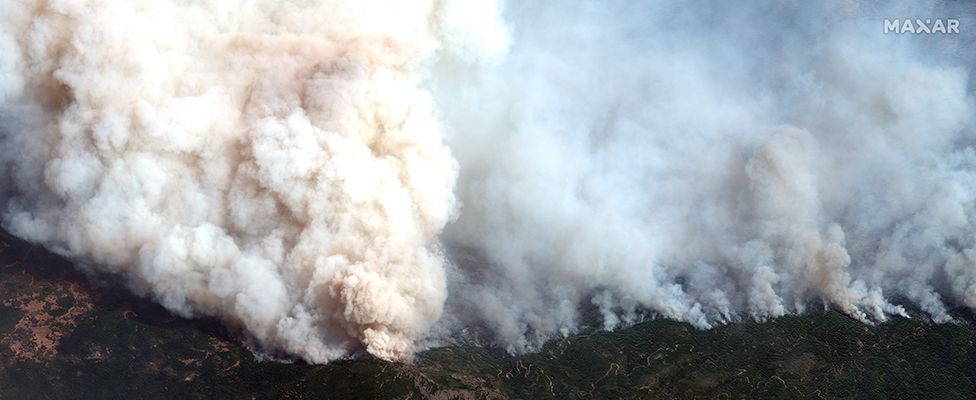
Smoke from the Bootleg Fire rises behind Bonanza, Oregon, on July 15.
Numerous such clouds have developed this season, resulting from wildfires, but primarily in Canada, which has been experiencing unusually hot and dry weather conditions, and the usual wildfire season developed earlier than usual, hotter than usual, drier and conducive to hosting greater numbers of wildfires, resulting in evacuations of wildfire-threatened towns. A mid-July heat wave smashed heat records in British Columbia.
A three-day immovable heat dome baked the town of Lytton, B.C. reaching an impossibly record-breaking high temperature of 49.4C, leading to dozens of extreme fires breaking out which then led to fiery, violent thunderstorms. Close to three quarters of a million pyrocumulonimbus-sparked lightening strikes hit British Columbia between June 30 and July 1.
Meanwhile, the U.S. Forest Service estimated that since The Bootleg fire erupted on July 6 the landscape was charred by another 40,000 acres on one day alone, reaching a total of close to 340,000 acres that have gone up in flames. Of 80 major active wildfires, The Bootleg is the largest that has seen a collective burn of nearly 1.2 million acres across 13 states, figures released by the National Interagency Fire Centre in Boise, Idaho confirm.
A pyrocumulus cloud from the Bootleg Fire drifts into the air Friday near Bly, Oregon
Rampaging Nature : COVID, Wildfires, Floods : America Assailed
"The fact that these fires are emitting so much pollution into the atmosphere that we can still see thick smoke over 8,000 kilometres away reflects just how devastating they have been in their magnitude and duration."
Senior Scientist Mark Parrington, CAMS [Copernicus Atmosphere Monitoring Service], EU
"We had a body wash up, we believe it was hurricane related, but we have no definite proof of that right now."
Trent Johnson, police lieutenant, Orange Beach, Alabama
"Normally, it goes away. But with this one it was first the anxiety of it coming and then when it finally came, it didn't move."
"It was just constant rain and wind."
Preity Patel, 41, Pensacola resident
Firefighting crews may be weary but they're continuing to battle deadly wildfires in the western United States while thousands of evacuees in Oregon and other states confront a daily struggle. In Europe, scientists now track the thick, stifling smoke as it spreads intercontinentally. An astonishing 1.8 million hectares of brush, grass and woodlands in Oregon, California and Washington State has burned since August. In the fires' wake, small towns have been left smouldering, no sign of life, nothing to come back to. Although there are people listed as 'missing', 34 people, found dead, will never 'come back'.
FEMA, the U.S. Federal Emergency Management Agency has gone into emergency mode, tasking mission assignments deploying five urban search-and-rescue teams to the region torn asunder by wildfires. Their mission is to scour through the incinerated homes, and to search for the missing, even as firefighters focus on their exhausting battle against heat, wind and leaping sparks firing up new areas.
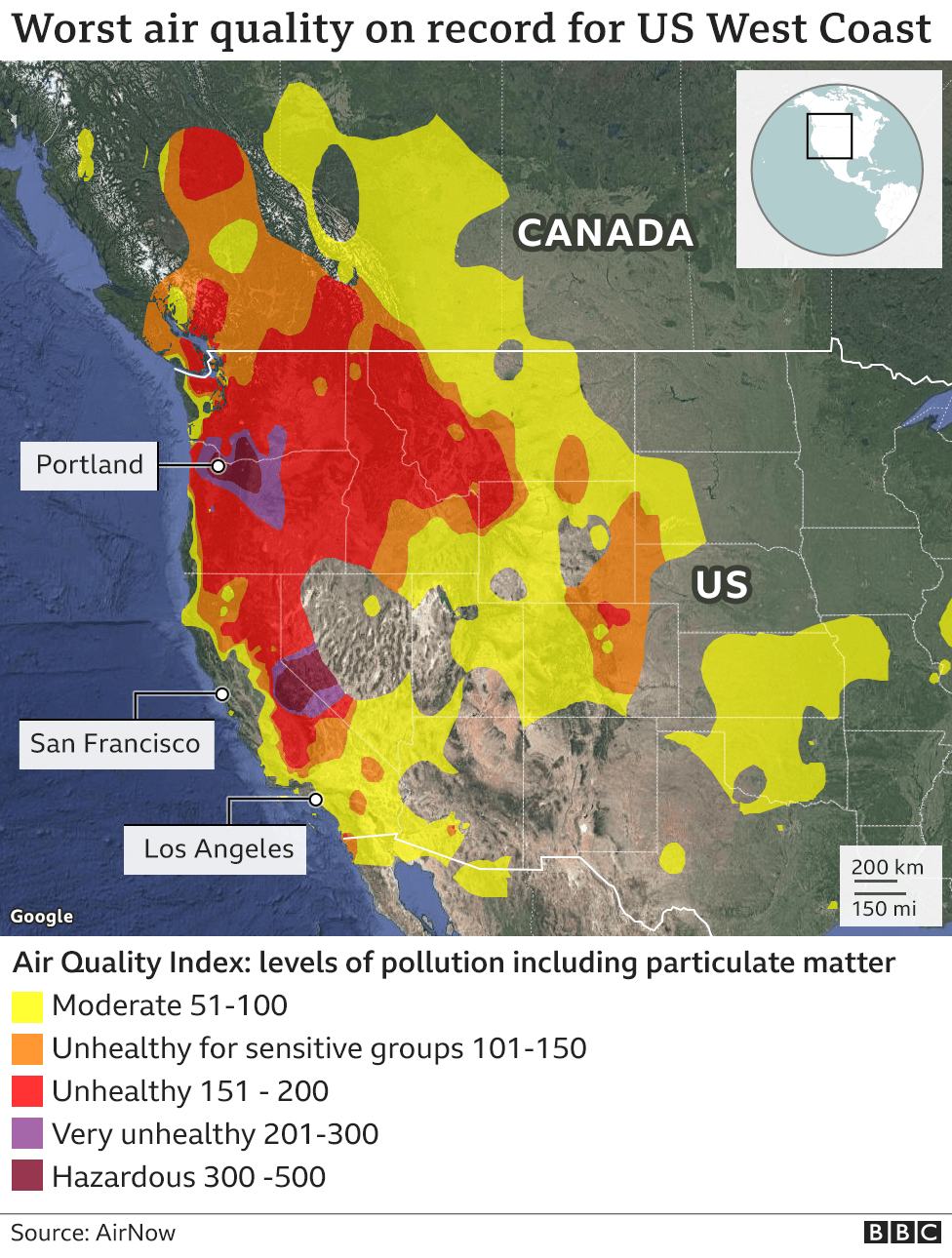
The region's skies have been filled with dense, acrid smoke that has been pronounced the worst air pollution on the globe. It has drifted over to British Columbia, where the air quality there has also become injurious to health. With the presence of the novel coronavirus, this represents a double health threat under trying conditions.
Now, scientists in Europe are tracking the smoke bearing down on the continent, emphasizing the magnitude of the fire-borne disaster. CAMS is monitoring the scale and intensity of the fires along with the wind-borne transport of smoke drifting across the United States and beyond. In mid-August, wildfires had roared into existence, erupting across Oregon and Washington at the beginning of September, many fires sparked by lightning storms augmented by record-breaking heat waves and howling winds.
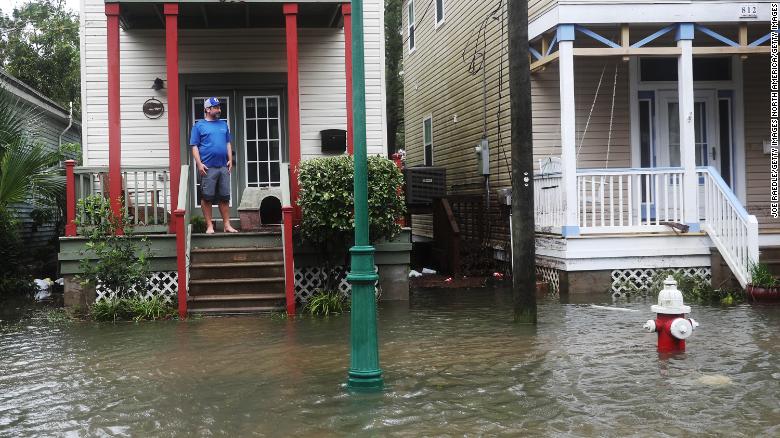
Compounding the misery in the West, is Hurricane Sally that has swept along the Gulf Coast, uprooting trees, flooding streets and cutting power to hundreds of thousands of homes and businesses, responsible for "historic and catastrophic" flooding to the Alabama-Florida coast, according to the U.S. National Hurricane Center. Making landfall early Wednesday near Gulf Shores, Alabama as a Category 2 storm it slowed to a tropical storm with maximum sustained winds of 113 km/h.
Parts of the Gulf Coast were inundated as over 45 centimetres of rain fell within 24 hours and no end in sight as the storm's winds stalled, according to the National Hurricane Center, leaving the coastal community of Pensacola, Florida with up to 1.5 metres of flooding. Roads have been damaged along with bridges, cutting off traffic access. Over 500,000 homes and businesses in the broad area had their power cut off as the storm knocked over oak trees and tore down power lines.
Hurricane Sally's winds were clocked at 155 kn/h when it hit landfall at Gulf Shores. Piers were ripped away by surges caused by the storm and high winds.A section of the Pensacola Bay Bridge is missing a "significant section", in the words of Florida Governor Ron DeSantis whose state once again is in need of all the good luck and help it can conceivably muster. Truth is, there's more on the way gathering steam...
"Why
are they [the U.S.] getting it and we [Canada] are not? It's because of
the weather they're getting. The warmer it gets, the longer the fire
season."
"Absolutely
it [COVID-19] had an impact [on wildfire events in Canada]. There were
fewer people out and about working or recreating [sic] in the woods, so
the number of caused fires was way down this year ... Forest closures,
quad bans, they work, they really work."
Mike Flannigan, professor, department of renewable resources, University of Alberta
"Emergency
and social resources at the provincial and municipal levels are already
taxed by the COVID-10 response, we don't need the added burden of a
human-caused wildfire this year", said Devin Dreeshen,
Alberta's minister of Agriculture and Forestry when bans on off-highway
vehicles were announced during the COVID lockdowns. And those bans were
effective in helping to reduce the human element in accidental wildfire
starts.
A
firefighter shoots an incendiary device during a back burn to help
control the Dolan fire at Limekiln State Park in Big Sur, California,
September 11
And
now, though the Vancouver and parts of southern B.C. areas' air quality
hasn't been impacted by wildfires in British Columbia this year thanks
mostly to the unusual rain events being experienced this summer, air
quality has been significantly reduced in any event, as a result of
winds blowing smoke from the epic fires burning in Washington and Oregon
states. Western Canada has seen fewer wildfires than is usual this
year, while the United States is facing an unprecedented number of huge,
uncontrollably destructive wildfires.
Last
year by this time, 850,000 hectares was burned in Alberta by 950
wildfires as compared to this year when 614 wildfires burned through
1,450 hectares, while in British Columbia 610 fires burned around 13,000
hectares as opposed to 2018 when 2,116 wildfires ripped across the
province burning over 1.3 million hectares. And now, in California
alone, seven dozen fires are burning, resulting in a record-breaking 2.2
million acres scorched, 2,000 percent steeper than the 118,000 acres
burned this time last year.
Neighborhoods in Monrovia, California, are enshrouded in smoke from the Bobcat Fire on Sunday
Fires
are raging across Oregon, Nevada, Washington and Utah, damaging homes,
leaving millions of people exposed to a smoky haze. Oregon Governor Kate
Brown at a news conference stated grimly: "This will not be a one-time event",
but a harbinger of things to come, attributing the severity of the
fires, the drought conditions enabling the fires and the severe
electrical storms sparking them, all symbolic of climate change.
Roughly
a half million people in Oregon, representing two percent of the
population in the state, were given orders to evacuate on Friday.
Oregon's largest city, Portland, saw residents warned to be prepared to
leave as wind-driven wildfires scorched the West Coast states, causing
at least two dozen deaths. An area close to the size of the state of New
Jersey has been burned to date across the U.S. West. California, Oregon
and Washington state are experiencing the absolute worst air quality
levels in the world.
A
community some 40 km south of downtown Portland, Molalla, became a
ghost town covered in ash once its 9,000 residents were urgently
evacuated, with 30 people refusing to leave the logging town on the
front line of a huge evacuation zone stretching within 4.8 km of
downtown Portland, county police setting a 10 p.m. curfew to deter "possible increased criminal activity". In the state, red "GO!" warnings targeted ten percent of the population to leave their homes immediately.
Hundreds of thousands of residents were signalled by the yellow "BE SET" warning; to leave at a moment's notice, while others were given the green "BE READY"
alert. Southeast of Portland, towns were left to the mercy of strong
winds when two of the largest wildfires in the state merged into a
single beast of a wildfire. Firefighters launched drones once winds
dropped on Friday, into a deep yellow smog to determine how close the
flames were. "We don't know where the fire is", Molalla Fire Department Lieut.Mike Penunri said.
Burned-out
residential subdivisions and trailer parks stretched miles along
Highway 99 south of Medford in southern Oregon through Pheonix and
Talent, the worse hit areas, with blazes leaping from wildfires burning
through scrub and forest into suburban firestorms, flames racing from
house to house. The three thousand firefighting personnel assigned to
Oregon Department of Forestry fire chief Doug Grafe led him to assess a
need of twice that number to maintain a hold on the three dozen major
blazes he's battling.
The Bobcat Fire burns in Angeles national forest north of Monrovia, California on Friday, September 11
In
California, over 68,000 people where the largest fire in state history
has burned over 299,470 hectares in the Mendocino National Forest were
under evacuation orders. "We had four hours to pack up our pets and a few medications and things like that",
retiree John Maylone explained, when he was forced to leave three of
his 30 cats behind, fleeing the massive Creek Fire. An arson
investigation has been opened by police into the Oregon fire which
destroyed most of Phoenix and Talent.
Multiple
communities in the Cascades were destroyed, while areas of coastal
rainforest normally wildfire-spared have been torched. The farming town
of Malden in eastern Washington state was destroyed. Americans have
taken to building their houses in forests as second seasonal homes.
Others as permanent dwellings resulting from unaffordable prices in
metropolitan areas such as San Francisco, Portland and Seattle.
Smoke from wildfires fills the sky over Pasadena, California, on Saturday.
This represents a general opinion site for its author. It also offers a space for the author to record her experiences and perceptions,both personal and public. This is rendered obvious by the content contained in the blog, but the space is here inviting me to write. And so I do.