Wednesday, January 25, 2023

Warsaw Ghetto Uprising


"Photographs depicting the smoke over the ghetto as well as in the streets and courtyards inside the ghetto, burnt-out houses, firefighters putting out the flames, posing on the roof of a building or eating from mess tins in the street." 
"It seems that Leszek Grzywaczewski tried his best to record these scenes, realizing the importance of documenting events inaccessible to the eyes of people on the other side of the ghetto wall."
POLIN Museum of the History of Polish Jews, Warsaw
 
"The Germans began to systematically burn down the buildings, turning the ghetto into a fire trap." "The Jews fought valiantly for a month until the Germans took over the focal points of resistance."
"It was the first popular uprising in a city in Nazi-occupied Europe."
Yad Vashem, World Holocaust Remembrance Center, Israel
Children eating in the ghetto streets. Warsaw, Poland, between 1940 and 1943. [LCID: 89473]
  USHMM Warsaw, Poland, between 1940 and 1943
On October 12, 1940, German military authorities occupying Poland decreed establishment of a ghetto in Poland's capital, Warsaw. The decree required all Jewish residents of the city to move into a designated area sealed from the rest of the city. The ghetto was enclosed by a wall 10 feet in height capped by barbed wire, closely guarded to prevent movement between the ghetto and the rest of Warsaw. 
 
The population of the ghetto was increased with Jews compelled to move there from nearby towns, the final total of ghetto residents estimated to be over 400,000. Ghetto residents were forced to live in an area of 1.3 square miles, equal to an average of 7.2 persons per room. Food was scarce and hunger was rampant.

Some young men and women ventured out of the ghetto over the walls at night or through underground sewer tunnels, to bring back outside news, to return with food, and eventually some joined the Polish Underground movement. Others brought back whatever weapons they could find. Over time a cache of weapons was built representing the armoury put to use in time by the resisters of the Warsaw Ghetto. Comprised mostly of young Jews who resolved to fight and to die in the effort. And they did -- accomplishing both goals.

Photographs of the period have been placed at various memorial sites; mostly photographs taken for recording purposes by German forces, addicted to record-keeping and maintenance. As though proud of their accomplioshments and determined to ensure a precise accounting of all measures taken in the extermination of Europe's Jews. To indicate how efficient and proficient they were, tasked by their Fuhrer to rid the world of the presence of Jews.
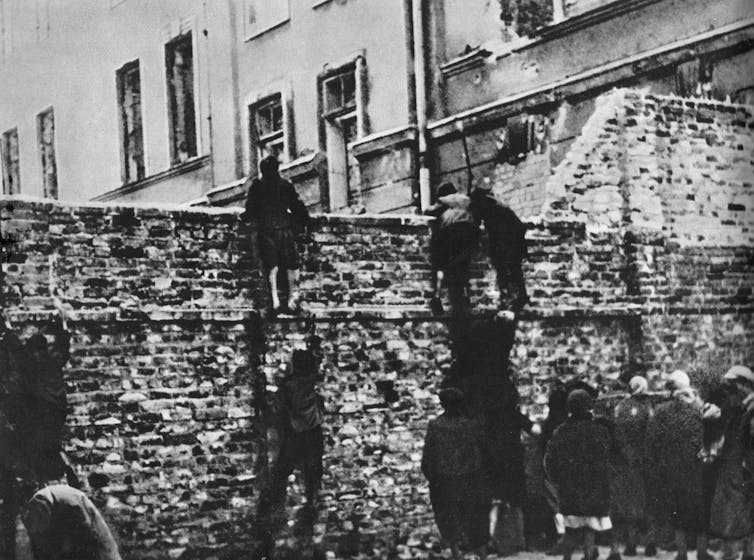
 
Children climbing a wall.
Smuggling was how most people in the ghetto got food, and children were often the ones sneaking out of the ghetto to do it. nieznany/unknown via Wikimedia Commons
A newly discovered cache of personal photographs, the property of a young Polish firefighter of the time, highlights the destruction the Nazis brought to the tight little enclave where Jews were fenced in, many dying of disease or starvation. When the German military became aware of a planned uprising they must have been astonished that a paltry few ill-equipped Jews had the temerity to fight back, and in fact manage to counter an offensive and keep the Germans at bay for a month; a rag-tag, starving group of Jews countering the mighty German military.

The German authority had begun slowly selecting Jews for deportation to the Treblinka extermination camp wth its goal to "eliminate the Jewish population". An estimated 265,000 Jews were deported from July to September of 1942, wth another 35,000 killed outright in the ghetto itself. This brought Jewish resistance groups to plan a response. The illusion that anyone would survive the ghetto  when the war eventually came to an end dissipated as the ghetto incarcerants began to realize they were all slated for death.
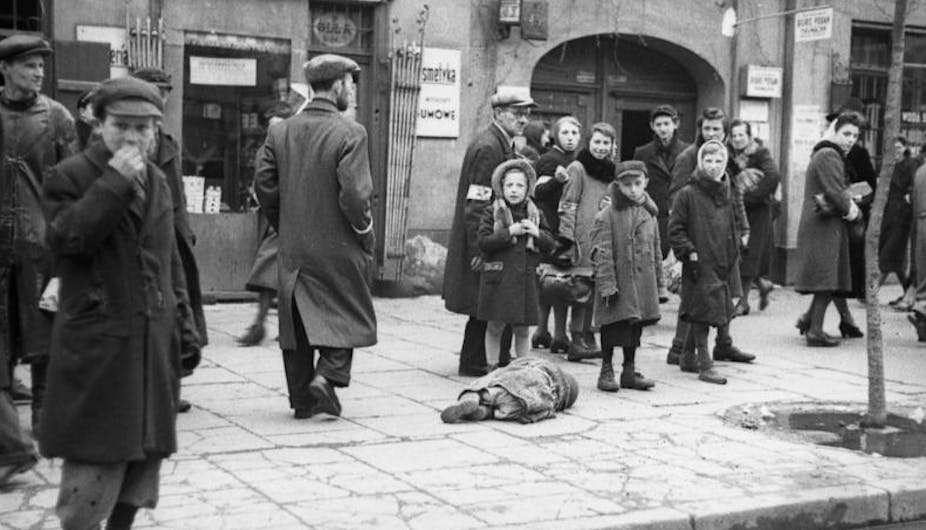
 
A small child lying on the sidewalk, presumably from starvation.
Starvation was omnipresent in the Warsaw Ghetto for both young and old. Blid Bundesarchiv/Wikimedia Commons, CC BY-SA
 
The Warsaw Ghetto Uprising was sparked by the evacuation of Jews to certan death. During the final days of the uprising the Nazis ended the Jewish resistance by setting the ghetto on fire. The German military called on Warsaw firefighters to make certain the blaze "did not spread to the houses on the 'Aryan' side", according to the POLIN Museum, located on the site of the former Warsaw Ghetto.

A yuung Zbigniew Leszek Grzywaczewski, 23 years of age, began snapping pictures while pursuing his duties as a civilian firefighter. Images show buildings on fire, smoke billowing, firefighting crews and Jews evacuated from the ghetto. The photographs, since the negatives were found by a son of the photographer, represent the sole known photos taken by a non-German.

A dozen of the 48 shots on the roll of negatives were published previously as prints, held at the Holocaust Museum in Washington and the Jewish Historical Institute. The POLIN Museum now possesses photographs never before seen. The negatives are now to be featured in an exhibition titled "Around Us a Sea of Fire" in honour of the Warsaw Ghetto Uprising's 80th anniversary, at the POLIN Museum.

Jews captured during the Warsaw ghetto uprising. Poland, April 19-May 16, 1943. [LCID: 46432]

Jews captured during the Warsaw ghetto uprising. Poland, April 19–May 16, 1943. National Archives and Records Administration, College Park, MD


Labels: , , , ,

Wednesday, July 13, 2022

Wonder of Wonders -- Behold the Universe!


"From the data I've seen so far, from the work we've seen in commissioning and then this first week of science, yeah, this is going to be revolutionary."
"These are incredible capabilities we've never had before."
Jane Rigby, Webb operations project manager, Goddard Space Flight Center, Greenbelt, Maryland.
 
"Those releases represented five days of observation with this observatory."
"And they include something that is a deeper infrared image than has ever been taken in history, deeper than Hubble images that required weeks to acquire. That was done in half a day with Webb."
Randy Kimble, Webb project scientist, Goddard. 
 
"I am so thrilled, and so relieved."
"It's just impossible to convey how hard it really was. We risked so much to say we're going to go do this, and it's so near impossible. But we did it."
John Mather, Nobel Prize winner, senior scientist, Webb project.
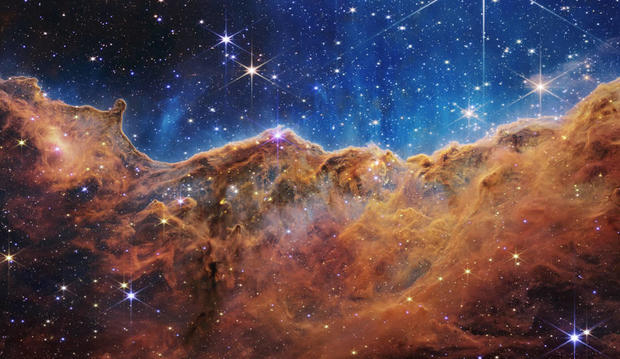
The James Webb Space Telescope's view of the Carina Nebula.
The James Webb Space Telescope's view of the Carina Nebula.  NASA

 Astronomers have awaited the results of the first photographs to be released, taken by the James Webb Space Telescope, the most powerful such telescope yet to search the Universe beyond our solar system, beyond our Milky Way Galaxy. The clarity of the photographs and the wide scope of far distant galaxies will in due time explain much about the Universe. Photographs are now being seen that reflect the birth and death of stars, nature's most mysterious secrets now on the verge of being unlocked through observation of what could never be imagined might be possible to analyze.
 
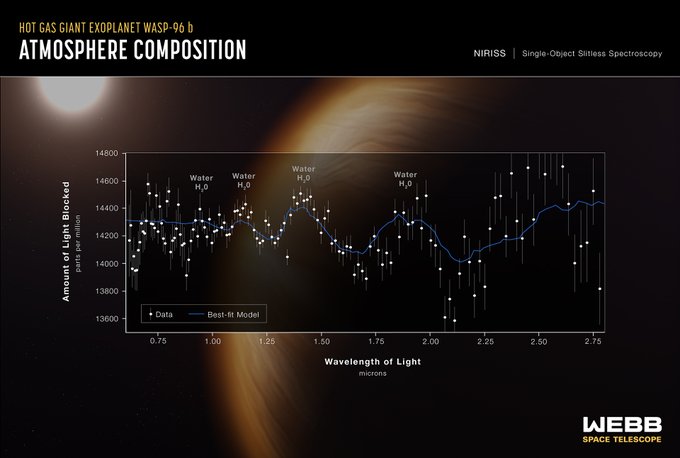
Graphic titled “Hot Gas Giant Exoplanet WASP-96 b Atmosphere Composition, NIRISS Single-Object Slitless Spectroscopy.” The graphic shows the transmission spectrum of the hot gas giant exoplanet WASP-96 b captured using Webb's NIRISS Single-Object Slitless Spectroscopy with an illustration of the planet and its star in the background. The data points are plotted on a graph of amount of light blocked in parts per million versus wavelength of light in microns. A curvy blue line represents a best-fit model. Four prominent peaks visible in the data and model are labeled “water, H 2 O.”
Clouds on another world.
@NASAWebb
Webb captured the signature of water on giant gas planet WASP 96-b, which orbits a star 1,150 light-years away. For the first time, we've detected evidence of clouds in this exoplanet's atmosphere: nasa.gov/webbfirstimages #UnfoldTheUniverse
"[The initial deep look unveiled on July11 is] proof of concept ... whetting our appetite for the record-breaking results we now know will come from this exceptional facility."
Heidi Hammel, planetary astronomer, scheduled to use the Webb

"[The telescope, the successor to the Hubble which is still in operation] has capabilities that far surpass my most optimistic dreams."
"The capabilities of Webb are truly out of this world."
Garth Illingworth, astronomer, University of California, Santa Cruz
A world-achievement, expectations were high for the success of this new eye in the sky that would send back messages and photographs from the most distant areas of the Universe. And what was revealed in those exceptional photographs of never-imagined detail was beyond extraordinary and exciting beyond measure to the fertile, now febrile minds of the world's greatest astronomers and astrophysicists. The $10-billion investment in the James Webb Telescope sent the world of space science into orbit yesterday.
 
The first image to be revealed at the White House is that of a cluster of galaxies called SMACS 0723. which only the massive lens of the Webb could have penetrated and portrayed so stunningly. Behind the magnification of the cluster are seen faint objects of vast cosmic distance. The "highest resolution images of the infrared universe ever captured", in the words of the American president who presided over the unveiling of the images.
 
the galaxies in Stephan's Quintet appear as purple-pink swirls against the blackness of space in this JWST image; some foreground stars appear with diffraction spikes from the telescope's mirrors; numerous other galaxies and stars bespangle the image
Stephan's Quintet   Credits: NASA, ESA, CSA, and STScI
 
The European Space Agency and the Canadian Space Agency partnered with NASA, maintaining a close grasp on the first images derived from the Webb during its initial sequence of observations as it orbits the sun a million miles from Earth. A few testing-phase images of the telescope were previously released, astounding astronomers with their detailed clarity. The newly-released photographs, however, were in full colour.

This initial first scrutiny deep into the universe by the Webb has excited the appetite of the world of astronomy for what is yet to come; revolutionary views of the universe crossing cosmic distances with unrivalled resolution. The coming months will transform what is currently known and assessed as an expansion of the understanding of the most basic rules and origin of the universe will gradually be resolved.

Now the formation of the earliest galaxies will be enabled by the Webb toward more intensive study along with the evolution of the expanding universe. Even our own solar system, hosting small worlds we hardly are aware of beyond the orbit of Neptune will come under scrutiny as nature's genius is examined and understood in time and space.

distant galaxies appear as bright glowing spots in this Webb telescope image, with some smeared by gravitational lensing; foreground stars appear bright with six-pointed diffraction spikes, owing to the shape of Webb's mirrors
SMACS 0723  Credits: NASA, ESA, CSA, and STScI


Labels: , , ,

Follow @rheytah Tweet