Tuesday, December 17, 2019

Indonesia's Environmental Negligence

"They start the burning early in the morning and go until evening."
"It happens every day and the smoke is always in the air. For me, it's difficult to breathe."
Karnawi, 84, Tropodo, Indonesia

"These stark findings illustrate the dangers of plastics for human health and should move policymakers to ban plastic waste combustion, address environmental contamination, and rigorously control imports."
Lee Bell, adviser, International Pollutants Elimination Network

"There are many tofu makers here and most of them do not care."
"The tofu makers only count the profit, profit, profit."
Ismail, 50, former mayor of Tropodo
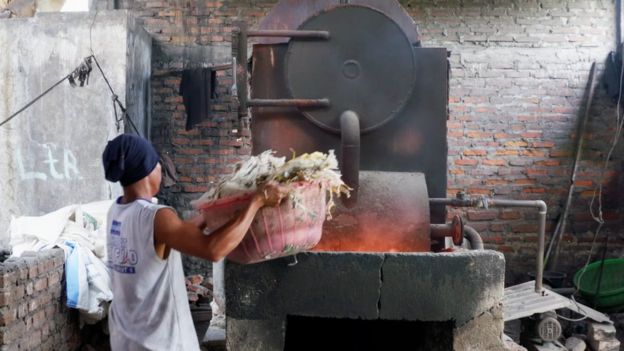
Plastic being used as fuel
At tofu factories, plastic is burned as fuel

A village of five thousand people, Tropodo was found to harbour high levels of several hazardous chemicals including dioxin -- known to cause cancer, birth defects and Parkinson's disease -- according to a recently released report written by an alliance of Indonesian and international environmental groups. They point the finger of blame at the level of dioxin found in the village as an end product in a chain of malfeasance, carelessness and government neglect.
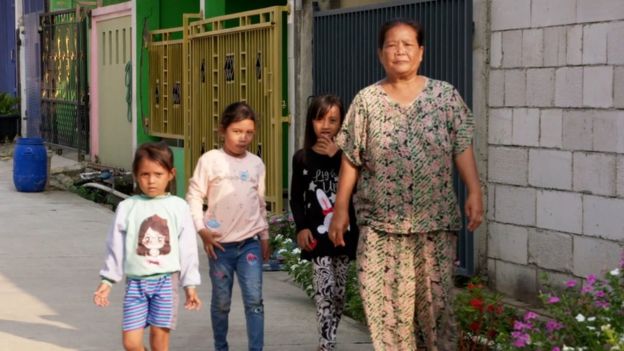
Mila Damila and granddaughters
Mila Damila says her granddaughters' health has been badly affected

The smell of burning plastic pollutes the very air where patches of black ash cover the ground as black smoke billows from towering smokestacks in the village. Over 30 commercial kitchens in Tropodo located on the eastern side of Indonesia's main island of Java, fuel their tofu production through the burning of a mixture of paper and plastic waste. In these kitchens much of the area's tofu  is produced.

An egg laid by one of Mr. Karnawi's chickens where he lives close by seven of the plastic-burning kitchens tested out with one of the highest levels of dioxin contamination ever recorded in Asia. One such egg from Mr. Karnawi's henhouse would exceed the European Food Safety Authority dioxin standard by 70-fold, for an adult. The waste produced in the West tends to be sent abroad, including to Indonesia.
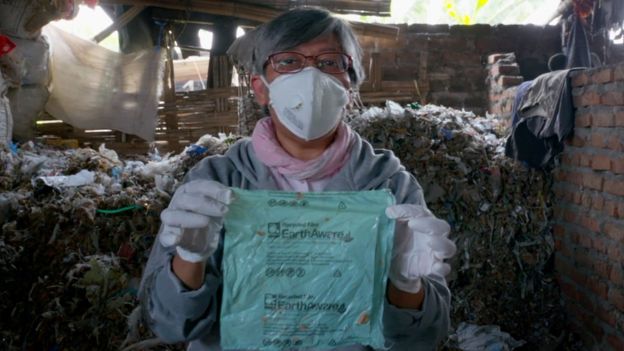
Yuyun Ismawati
Researcher Yuyun Ismawati found recyclable plastics among the waste set to be burned

That waste is combined with local waste for processing. Not to be processed into new consumer goods, but to be tossed into furnaces to fuel Tropodo's tofu boilers. Indonesia's president Joko Widodo has neglected health concerns in favour of economic development and environmentalists have urged him to address the urgent issue of toxic contamination, inclusive of air pollution and mercury contamination.

The Environment Ministry's director general for waste management visited Tropodo in July, acknowledging plastic burning was hazardous, but making no effort to put a stop to it. She would, she said, investigate how the toxic smoke could be controlled. Perhaps predictably, given its preferred priorities, the government has done nothing since.

Leaving Tropodo's residents to stifle in the stench of burning plastic but worse, ingest it, breathe it into their lungs where it leads to lethal health problems. The former mayor, a tofu producer himself, had banned the use of plastic as fuel in 2014, a prohibition that lasted several months before the burning of plastic was resumed.
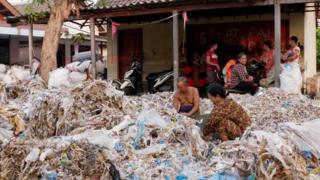
Villagers sort through plastic
Villagers sort through plastic in Bangun for the better-quality material they can sell

Labels: , , , , ,

Saturday, July 21, 2018

Drowning in Plastic Refuse
This dead albatross chick was found with plastics in its stomach on Midway Atoll in the Northwestern Hawaiian Islands. Marine plastic can be dangerous to wildlife.

"The interesting piece is that at least half of what they’re finding is not consumer plastics, which are central to much of the current debate, but fishing gear."
"This study is confirmation that we know abandoned and lost gear is an important source of mortality for a whole host of animals and we need to broaden the plastic conversation to make sure we solve this wedge of the problem."
 George Leonard, chief scientist, Ocean Conservancy
"I knew there would be a lot of fishing gear, but 46 percent was unexpectedly high."
"Initially, we thought fishing gear would be more in the 20 percent range. That is the accepted number [for marine debris] globally—20 percent from fishing sources and 80 percent from land."
Laurent Lebreton, oceanographer, Ocean Cleanup  
vaidehi shah from Singapore - Litter on Singapore's ECP
A 2017 study out of Helmholtz Centre for Environmental Research in Germany drew the conclusion that up to 95 percent of global ocean plastic emanated from ten rivers -- eight of which are in Asia and two in Africa. Ocean Conservancy issued its own report the same year with their conclusion that 60 percent of the world's ocean plastic pollution saw five countries as being responsible for that trash: China, Indonesia, the Philippines, Thailand and Vietnam.

According to the Helmholtz report, some of the lowest levels of floating plastic were found in the drainage basin of the Great Lakes, where over nine million Canadians live, an area that takes in as well on the U.S. side, Cleveland and Chicago. These are regions where waste undergoes management with recycling and collection programs reflecting the conscientious choices of consumers in the West whose trash plastic waste represents a minuscule proportion of worldwide plastic waste.

The rapid economic development in Asia through the previous thirty years is attributed to the virtual tidal wave of garbage consumers have become accustomed to discarding and which their municipal administrations have been incapable of instituting measures to minimize waste by recycling methodology or reducing plastic packaging. In North America overall, there are no beach landscapes overwhelmed with plastic garbage, nor do open-air dumps close to coastal areas proliferate as they do in Asia.

Countries were ranked in a 2015 study published in the journal Science, by their rate of "mismanaged" waste,  highlighting ocean pollution countries like Bangladesh where 89 percent of garbage has been mismanaged, in comparison to the U.S. rate of two percent. A panel of ecological experts was canvassed in a 2015 study led by Ocean Conservancy to figure out which types of plastic trash represented the most danger to marine life. Plastic bags, buoys, cigarette butts, balloons, fishing equipment, utensils and food packaging made the list, followed by plastic straws.

It is the plastic detritus that has the very real potential of entangling creatures of the sea that present the most damaging danger in the ocean. According to a paper published in the journal Scientific Reports, an estimated 46 percent of plastic making up the Great Pacific Garbage Patch is comprised of abandoned fishing gear, called "ghost gear", which has been lost or deliberately abandoned. "In comparison to other consumer items discarded in the ocean, it seems that fishing gear poses the greatest ecological threat", the 2015 Ocean Conservancy report noted.

Now three times the size of France, the Great Pacific Garbage Patch continues to exponentially expand. The great misfortune is that ocean plastic has a food odour attractive to seabirds, explaining why it is that up to 90 percent of all seabird species consume such trash. A whale washed up on the coast of Australia, died from consuming close to 30 kilograms of plastic. Seafood is beginning to host trace amounts of plastic.

A report by the World Economic Forum warns that should current trends continue, there will eventually be a greater presence of discarded waste plastic than the current number of fish in the sea by sheer weight alone.

NOAA marine debris removal Hawaiian Islands, 2014

Labels: , ,

Follow @rheytah Tweet