Live and Let Live? Muslim Student Groups Threatening Harassing Jewish Students, Toronto Metropolitan University
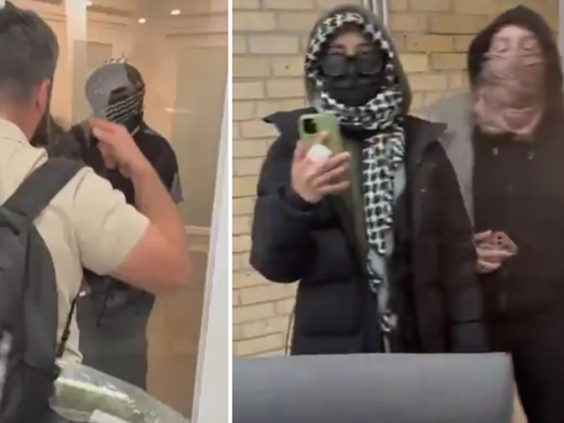
Images from Toronto Police after charges were laid
after a private off-campus event held by the TMU chapter of Students
Supporting Israel was disrupted on Wednesday, Nov. 5, 2025.
"I got outside of the building. The door was completely blocked by police officers as well as these protesters."
"It's really scary because I have no idea who these people are. They're wearing masks. I'm proud to be a Zionist. I'm proud to be Jewish. I'm proud to have my Israeli family. So when I show up to these events, I'm not covering my face, because I don't care who knows I'm here."
"These people who show up with the faces covered, what that says to me is they're cowards and they don't truly believe in what they're fighting for."
Sam (last name omitted)member of Allied Voices for Israel (AVI)
"It was supposed to be a moment of dialogue, a chance to share my story as an IDF veteran, to talk about the war, and about my uncle Sharon Edri, who was kidnapped and murdered by Hamas."
"But instead of a conversation, we were met with violence."
"Masked terrorists broke through the glass door and charged at us. One came at me with a drill bit."
Israeli soldier Jonathan Karten
"[The protest was a] targeted attempt to silence and intimidate Jewish students and their allies."
"[TMU must be prepared] to act decisively by holding those responsible accountable and revoking recognition for any club that engages in or promotes terrorism, violence or hatred."
Daniel Koren, founder, executive director, Allied Voices for Israel
On Wednesday of this week, an event was organized at Toronto Metropolitan University, one intended for the presence of a select group of students, its purpose and location deliberately not advertised; the details given only to those to whom an invitation to attend was extended. This special care not to have the location and the reason for the event made public had a purpose; to ensure that another TMU student group, Students for Justice in Palestine, would not mount a protest to interfere with the event, as is often experienced.
The event organized by AVI was not a one-off; such events had taken place on previous occasions. This most recent event's purpose, like its predecessors, was to hear directly from Israel Defense Forces soldiers about their experiences. Despite the precautions that the event organizers were careful to put in place, anti-Israel protesters showed up before the event began, forcing their way into the building lobby and from there attempting to get at those attending the event.
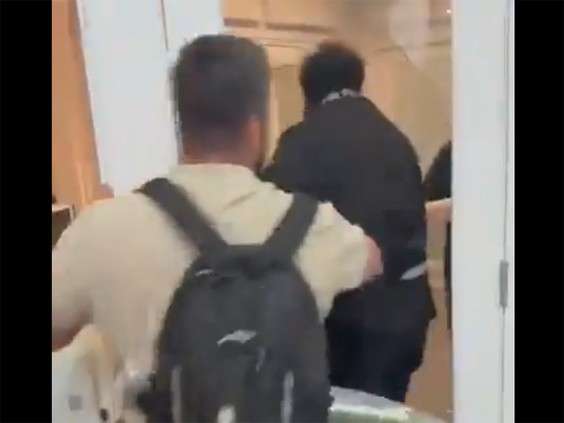
This screenshot from an unverified video is said
to be from the Students Supporting Israel event shows a man pushing back
an anti-Israel protester who broke through a glass door.Photo by Screenshot/X
Liat Schwartz, the event organizer, described how seeing protesters in the building lobby sent her into a state of disbelief that anyone would know where the event was being held, off campus, since the information was shared only with those the group was familiar with, and then only on the day previous to the event. Soon more masked protesters appeared. One of the protesters broke a glass door while trying to reach the Israeli soldier. Evidently, Students for Justice in Palestine had posted a call to action on social media.
19-year-old Centennial College student Sam had heard screams as she approached the building. When she entered the lobby, protesters assailed her, shouting 'terrorist', 'baby killer' 'murderer', then physically manhandled her, shoving her to the floor. Zionists, they hissed at her, were "worse than the KKK". She was told by the masked protesters surrounding her that they knew who she was and she would not be able to hide from them.
"This shocking act of antisemitic violence reflects the escalating climate of intimidation facing Jewish students on Canadian campuses."
"It demands more than statements of concern -- it requires action."
Michael Levitt, president, CEO, Friends of Simon Wiesenthal Center for Holocaust Studies
Sam described the shattered glass and blood she saw on the floor. She lost consciousness and suffered a seizure from 'emotional distress', as someone who suffers from non-epileptic seizures triggered by stress. Taken to hospital, she was released a day later. Altogether, five people were arrested, from age 23 to29, according to Toronto police -- and all of them female. On receiving reports that "a group of demonstrators forced their way into a building", police speedily arrived. Charges laid include forcible entry, obstructing a peace officer and unlawful assembly.
As the protesters attempted to reach the Israeli soldier, he fought them off, barricaded the door -- with videos showing Karten leaping through the door after the glass insert was shattered to chase down the protesters. Footage shows wounds on his forearms. "Hey guys, I'm fine", he assured the others. The university put out a boilerplate statement of condemning "acts of aggression, intimidation, or violence", planning to apply policies "as appropriate, to respond". That it was committed toe, though past events have proven otherwise.
Toronto
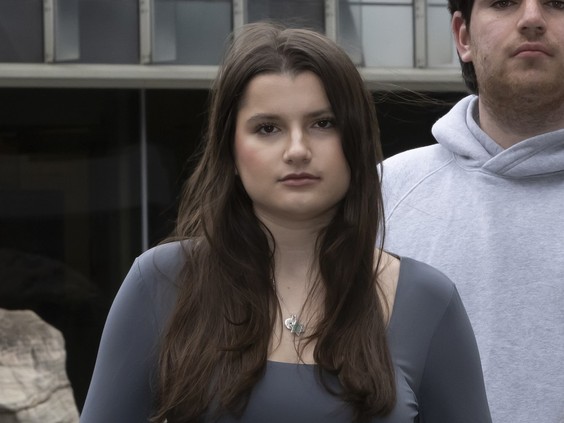
Metropolitan University student Liat Schwartz posed with other TMU
students in May 2025. She is speaking out again after an anti-Israel
protest at an event she organized on Nov. 5, 2025 turned violent. Photo by Peter J. Thompson/National Post
"I'm very upset that they put out a generic statement, because that just shows how little they care for the Jewish community at TMU."
"I'm sick of it, I'm tired, I'm upset. I'm angry, but this fuels me more to be more proactive. But I'm also scared. Being proactive at TMU [Toronto Metropolitan University] comes with a consequence, and the consequence is Jewish students stop feeling safe and get attacked like we did yesterday and verbally harassed."
"I don't feel safe. I've never felt safe at TMU."
"I've never been more scared in my life. I don't want to step foot on campus ever again."
"My body was shaking. I was hyperventilating. I was trying to talk to the police, but I was crying."
"I thought this was a nightmare."
Liat Schwartz, 20, president, Students Supporting Israel/student ambassador for Allied Voices for Israel
"Even
though CJPME [Canadians for Justice and Peace in the Middle East] was
founded as an organization for 'Canadians of all backgrounds', we are
now viewed through a lens of identity politics by many."
"Even
though CJPME has never claimed to be 'Palestinian' or to 'speak for
Palestinians', many in the movement presume that non-Palestinians in
leadership at CJPME are illegitimate."
"I've been ready to leave CJPME for some time, and these new winds indicated to me that the time had finally come."
"We
never intended to start an organization, but when the local Palestinian
community organization said that they could accept my wife as a member,
but not me [as a non-Palestinian], we realized that we wanted to build
an organization that welcomed ALL Canadians."
Thomas Woodley, founder and president CJPME
"CJPME is a diverse board and staff -- comprising people from all walks of life, both Palestinian and non-Palestinian."
"Our
mission is to enable Canadians of all backgrounds to promote justice,
development and peace in the Middle East, and here at home in Canada."
CJPME Board statement
"This
organization, which is led by two white men presents itself as the
largest Palestine solidarity group in 'Canada' while silencing &
punishing dissenting Palestinian voices."
"My
experience as a Board member exposed @CJPME & other 'non-profits'
as highly oppressive groups behind their benevolent facade."
"Shame on the cowardice & complacency of CJPME board members."
Ghada Sasa, former CJPME board member
Evidently
Ghada Sasa had been suspended soon after the October 7, 2023 atrocities
for having argued that the Nova music festival concertgoers were
slaughtered not by Palestinian terrorists but rather by Israeli forces.
She denounced the group, calling out the president and vice president,
Thomas Woodley and Michael Bueckert respectively, following her
suspension. She holds a social science doctorate from McMaster
University.
In an interview with an Alberta talk show host, she commented that she "was reading a lot of the people who were killed were actually killed by Israel. Hamas was not trying to kill [Israelis]". CJPME responded in a statement: "Ms.
Sasa has never been authorized to speak on behalf of the organization.
In addition, some views that Ms. Sasa has expressed publicly are not
aligned with the policies and positions of the organization".
Canadians
for Justice and Peace in the Middle East, an anti-Israel group
established in Canada that has attained a level of prominence, saw its
president resigning with the explanation that ongoing opposition to his
leadership among activists targeted him "as a non-Palestinian",
unsuitable to lead the group. When he felt compelled to resign the
presidency, Thomas Woodley wrote his supporters that since the October 7
Hamas attacks on Israel, the anti-Israel activist movement has viewed
CJPME as illegitimate, citing its non-Palestinian leadership.
It
was the exclusionary views of the local activist community, commented
Thomas Woodley, that led to his and his wife Grace Batchoun founding of
the group in 2004 in Montreal against the backdrop of the Second
Intifada. With Mr. Woodley's resignation, the CJPME board decided to
name Michael Bueckert as interim president of CJPME and its Foundation,
in refutation of Woodley's claim of discrimination as a
'non-Palestinian'.
On
the morning of October 7, one of CJPME's earliest public statements
rationalized the invasion of southern Israel by Palestinian terrorists
through blaming Israel:
"After years of Israeli assaults on Gaza, an attack by Hamas on Israel
has killed at least 40. Now Israeli airstrikes have already killed 160
as Gaza braces for bloodshed. Canada must call for a ceasefire and an
end to root causes of violence: occupation, siege & apartheid."
Soon
afterward, CJPME retweeted an image of a Hamas bulldozer destroying the
Israeli border fence posted by Palestinian journalist Mariam Barghouti
who wrote: "Gaza just broke out of prison".
CJPME followed that up by writing: "Israel's
decades-long confinement of more than 2 million Palestinians inside the
world's largest open-air prison is critical context for understanding
today's escalation of violence". Through the months
that ensued, violence flared across the region, Israel forced to counter
other Iranian-backed proxies in Lebanon, and Yemen's Houthis attacking
shipping in the Red Sea.
CJPME had no problems throwing its moral indignation at Israel's response to being attacked on all fronts. "The
Houthis are targeting Israeli-related ships of those that are heading
to Israel to show support for Palestine and for Israel to stop its
bombardment campaign on Gaza", wrote the group.
Wholeheartedly,
passionately supporting the terrorist groups manipulated by the Islamic
Republic of Iran whose foremost agenda is the destruction of the State
of Israel before launching itself a far more ambitious, larger, wider
net they feel is required in homage to fundamentalist Islamism to
destroy others as well, for having forfeited the right to life by
refusing to submit to Islam.
"In
the years after 9/11, people became dimly aware that Arabs were not the
same as Pakistanis or Indians. It was a faltering start to coming to
terms with the existence of Palestinians."
"Then
came the solidarity: white people wearing keffiyehs, the Free Palestine
badges, lovely posh ladies petitioning outside HSBC over the bank's
investment in illegal West Bank settlements."
British artist Tanushka Marah: Why I'm no longer talking to white people about Palestine
Although Passive in Response, a Majority of Canadians Support Removal of Pro-Hamas Encampments at Canadian Universities
"For
many, they had already made their point, and/or they were not going to
achieve their objective, however it was understood -- which was also
unclear to many Canadians."
"[The protesters' goals and objectives] are being seen as increasingly unclear."
"For
many, the underlying issue was a matter of trust, and the 55-plus group
trusts the university leaders to a much greater extent than they did
the encampment organizers."
"[A]
considerable [49 percent of students in the survey said they didn't
know or preferred not to answer] potentially suggesting a high degree of
stigma associated with taking a position on either side of this."
Jack Jedwab, president, Association for Canadian Studies
According
to a new national poll conducted by Leger for the Association for
Canadian Studies, most Canadians support police having taken down
illegal, disruptive pro-Palestinian encampments at Canadian
universities. Some 70 percent of Canadians surveyed were in agreement
that officials were correct in having police and private security
dismantle an encampment at McGill University and at downtown Victoria
Square in Montreal.
On
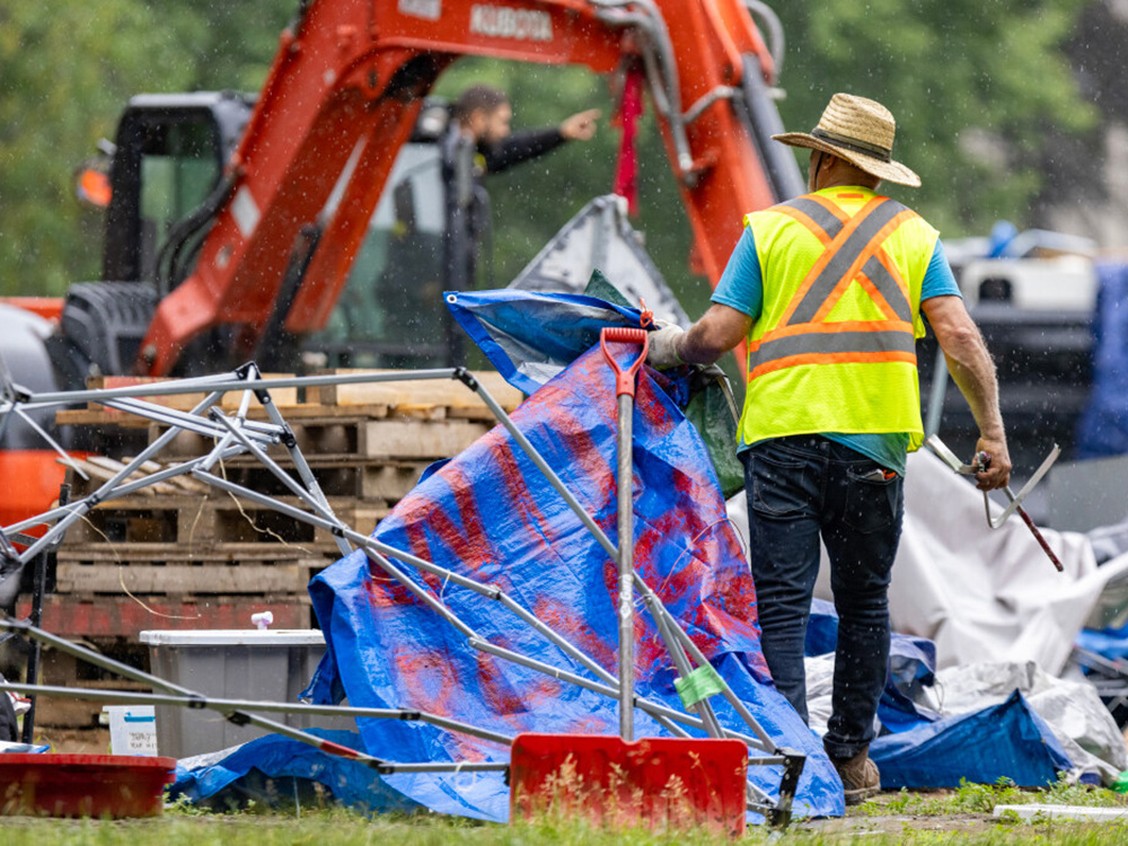
the morning of July 5, police in riot gear began to dismantle the camp
at Victoria Square, mere days following the province's public security
minister accusing the city in public of being too passive with the
presence of the protesters in the public arena. Once Victoria Square was
cleared of the encampment, in another five days police and private
security firm agents were at McGill using excavators and front-end
loaders to disassemble about a hundred tents and tarps at the McGill
encampment after over two months of legal battles, counter protests,
accusations of antisemitism and concerns over security risks.
Twice, Quebec courts refused to issue an injunction against the encampments. Finally, flyers promoting a "revolutionary summer program",
ostensibly to 'educate' those not sufficiently imbued with hatred for
Jews and Israel, who needed an additional propaganda boost to venerate
the terrorist group Hamas. The flyers featured photographs of
keffiyeh-wrapped Palestinian fighters with raised rifles.
Members
of the Divest for Palestine Collective had planned and organized the
Victoria Square camp, in an effort to apply pressure on Quebec's pension
fund manager to sever links with Israeli institutions that the group
accused of being complicit in the conflict in Gaza between Hamas and
Israel. Spurred by encampments set up at universities in the United
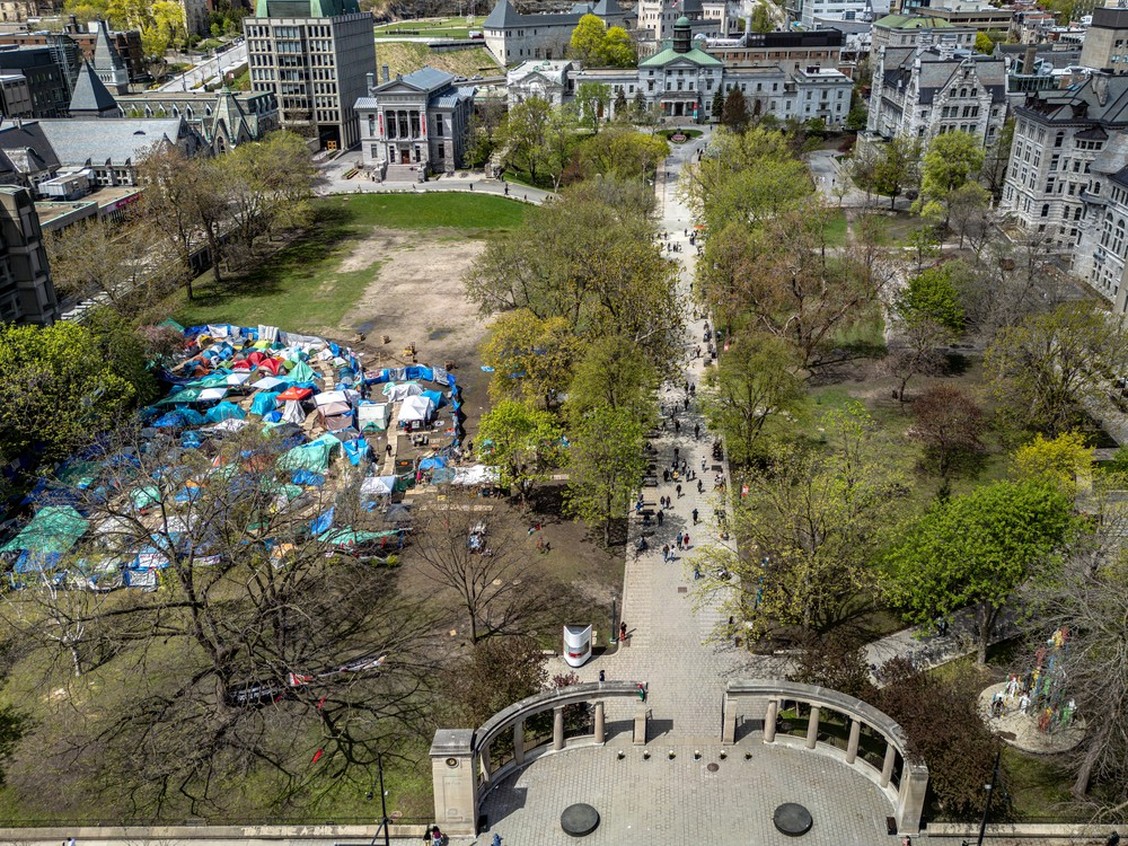
States, the McGill University encampment was the first to appear in
Canada. Quickly followed by over a dozen other Canadian universities,
including University of British Columbia, University of Toronto and
University of Alberta.
Workers dismantle the anti-Israel encampment at McGill University in Montreal on July 10.Photo by John Mahoney /Montreal Gazette
Demands
were noisily issued that universities cut ties with Israel, end all
collegial arrangements with Israeli universities and divest from any
companies or corporate interests that supply arms to Israel, or which
profit from the war with Hamas. Those protesters enjoyed the support of
19 percent of Canadians, according to earlier Leger polling. McGill and
Victoria Place, according to Jack Jedwab of the Association for Canadian
Studies were seen as valid proxies for public opinion on other
encampments.
A
majority of Canadians over -- 69 percent -- agreed with their removal.
Twice as many students favoured removal of the encampment of those
expressing an opinion, while 40 percent agreed that police were right to
take down encampments, while 18 percent disagreed. 42 percent of
students responded they preferred not to answer, or just did not know.
The degree of opposition to the encampments with just 13 percent of
Canadians of all ages polled disapproving of their removal suggested
protesters increasingly perceived them as disruptive to student life and
the broader community.
The encampment at McGill was described by its vice chancellor Deep Saini as a "heavily fortified focal point for intimidation and violence" organized largely by outsiders who used tactics designed to "threaten, coerce and scare people". Support for encampment removal was highest among Canadians aged 55 and older, with 62 percent reporting they "strongly agree" officials were correct for police and private security to take down the McGill tents.
Nearly half (48 percent)
of 18- to 34-year-olds strongly or somewhat agreed with the removal of
the McGill encampments, even as 24 percent strongly disagreed. Of that
age group, 27 percent said they did not know or preferred not to answer.
Aerial view of the pro-Palestinian camp on the McGill University campus in downtown Montreal on Thursday, May 9, 2024.Photo by Dave Sidaway /Montreal Gazette
This represents a general opinion site for its author. It also offers a space for the author to record her experiences and perceptions,both personal and public. This is rendered obvious by the content contained in the blog, but the space is here inviting me to write. And so I do.