"You've
got one end of the spectrum that's at zero and you've got that other
group that's disproportionately probably more and more susceptible to
following direction from influencers on selected social media, which is
probably what this is attributable to."
"Medium
to long term, there may be some unlearning that needs to be done
amongst persons that are adopting such positions that clearly are not
well informed if they think the majority of Iranians are supporting the
Iranian regime. That's incorrect."
Jack Jedwab, President and CEO, Association for Canadian Studies
"[Scores
of fake online accounts that were] coming from Iranians inside Iran
linked to the regime and fuelling the campus protests at McGill
[University, Montreal]."
"A massive, funded, co-ordinated and organized [effort by Iran designed to influence public opinion and government policy]."
Canadian investigative journalist Nagar Mojahedi
"As
the Israel-Hamas war broke out on October 7, 2023, Iran immediately
surged support to Hamas with its now well-honed technique of combining
targeted hacks with influence operations amplified on social media, what
we refer to as cyber-enabled influence operations."
"By
late October, nearly all of Iran's influence and major cyber actors
focused on Israel in an increasingly targeted, coordinated, and
destructive manner, making for a seemingly boundless 'all-hands-on-deck'
campaign against Israel."
Microsoft Threat Analysis team
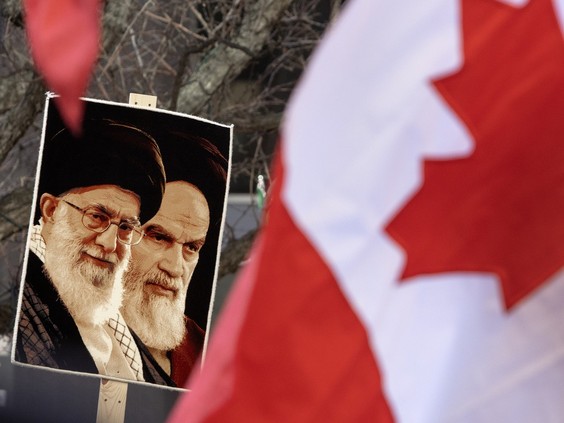
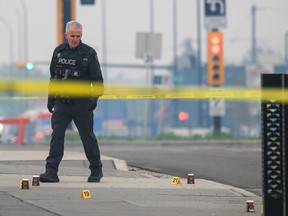
While most prefer neutrality in the Iran war, many
in the Gen Z cohort think Canada should support the Iranian regime,
according a new poll.Photo by Peter J Thompson/National Post
A
new Leger poll highlights that a significant portion of Canada's
youngest adults subscribe to the belief that Canada should be supporting
the Iranian regime in defence against the U.S. and Israel's aerial
onslaught against the Islamic Republic. One-fifth (20 percent) of
respondents between the ages of 18 to 24 felt that Ottawa should
'politically support' the Iranian regime's leadership. Among that age
cohort only eight percent think the United States, Israel and other
allied nations in the three-week-old war should receive Canada's
backing.
In
contrast, results for older Canadians are the reverse to the youth
contingent. Among Canadians aged 45 to 54, three percent support the
Iranian regime; among the age group 55 to 64, one percent, and zero
percent among Canadians aged 65 and older. A quarter of these older
Canadian groups feel that Canada should be in support of its historic
allies; at the rate of 23, 25 and 26 percent respectively.
The
Islamic Republic of Iran's Revolutionary Guard Corps has been listed on
the Canadian government terrorist list for the past two years. Jack
Jedwab, whose group commissioned the poll, felt that the response by
young Canadians reflected the fact of misinformation that has been
disseminated by malign foreign interests among the gen Z cohort -- among
whom 32 percent believe that Iranian-Canadians do not support the
U.S.-Israel military actions against Islamic Republic of Iran.
Despite
the demonstrations by Iranian-Canadians celebrating in support of the
U.S.-Israeli actions in Iran on the streets of Canada in jubilation that
this may see the end of that violently repressive regime, over half of
all respondents said they don't know.
Across
all age groups, half of the poll's respondents felt that Canada should
remain neutral in the escalating conflict, while one-fifth said they
don't know are aren't certain.
"It's a combination also of our own sort of self-evaluation or
assessment of ourselves as the nation that is seeking or desires
peaceful solutions and outcomes", was Mr. Jedwab's
interpretation of the poll results, highlighting a November 2024 ASC
poll finding that Canadians are 92 percent for peace with all nations,
yet still felt that war could not be avoided even if one side stood
down.
"Things are going to be more complex than that. I think some of that thinking underlies part of the neutrality view."
In his view, Mr. Jedwab stated it appears that the Liberal government
is attempting to balance neutrality with some Canadians' expectation
that Canada should aid its allies.
"That's a challenging position to take and we'll see what types of
pressure are exerted in the coming days and weeks on the part of the
U.S. and its allies for middle powers like Canada to become engaged, and
assist those who prefer greater disengagement to better understand what
the stakes are."
The
youth cohort, Mr. Jedwab observed, is especially drawn by anti-Trump
sentiment, despite the fact that the IRGC is a terrorist entity, and the
Islamic Republic itself is universally acknowledged to be a regime that
encourages and supports and funds terrorist groups like Hezbollah,
Hamas and the Yemeni Houthis, as well as Iraqi Shiite terror groups.
"That is not something that can be taken lightly at all in trying to see one's way clearer in this war."
"It's something one needs to consider carefully in terms of drawing conclusions about where Canada should stand on this."
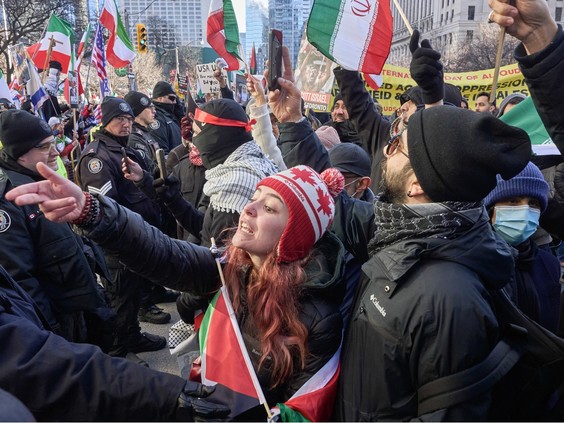
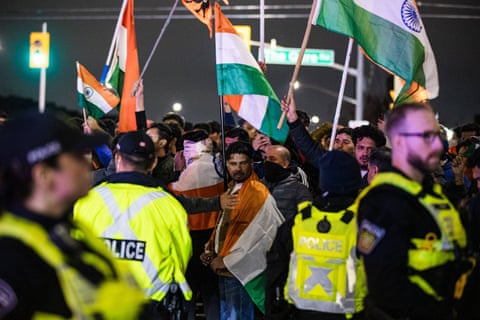
Al-Quds Day protesters, right, were met with a
sizeable counter protest near the U.S. Consulate in Toronto, Ontario, on
March 14, 2026.Photo by GEOFF ROBINS /AFP via Getty Images
"In
late 2024, Meta -- the company that owns and operates Facebook,
Instagram, and WhatsApp -- shut down a sophisticated Iranian influence
operation run by the dictatorship's Islamic Revolutionary Guard."
"Meta's
Threat Disruption Center revealed that Iran, aided and abetted by
Hezbollah, was running multiple fake accounts across Meta's platforms as
well as on TikTok, X, and others."
"Iran-supported Hezbollah created fake sites and purchased thousands of dollars of advertising on Facebook and Instagram."
Warren Kinsella, The Hidden Hand: The Information War and the Rise of Antisemitic Propaganda
"While
most observers attribute the persistent concern with the numbers of
refugees to economic concerns and housing challenges, the survey looks
at the extent to which Canadians trust immigrants and refugees and finds
that amongst those Canadians who feel that there are too many
immigrants, the level of trust in refugees is especially low."
"This
may imply that concerns over domestic intergroup tensions may be a more
important factor in concern with levels than has been previously
acknowledged."
Analysis of national Leger poll
Protesters at the Hindu Sabha Mandir temple in Brampton, Ontario. Photograph: Nick Lachance/Toronto Star/Getty Images
"Intergroup tensions",
as for example Canadian Hindus versus Canadian Sikhs with their
traditions of suspicion and distrust, acting out within Canada in viral
events of dangerous dimensions, the two solitudes coming to blows,
endangering the communities and bringing international attention to
their divisions. It is, in fact, the communities' propensities to have
among them cliques that also engage in illegal, criminal activities
domestically in Canada. But above all, the ongoing agenda of the
Khalistani Sikhs who agitate for a separate Sikh state to be divided
from India's interior. Canada's worst terrorist assault was one
committed by British Columbia Khalistanis who placed a bomb aboard Air
India Flight 182 that killed all 329 people aboard, in 1982.
Canada
has a population of Sri Lankans, among them members of the Tamil Tigers
who in the past agitated for their own separatist state, committing
violent crimes in Sri Lanka in support of their sovereign aspirations
against the country's military and members of government. Canadian Sri
Lankans belonging to the Tamil Tigers promulgated their violent
terrorist propaganda, drawing Canada involuntarily into a debate roiling
another country entirely, until the Tigers were delivered a crushing
blow that devastated their numbers in Sri Lanka and put their designs to
rest.
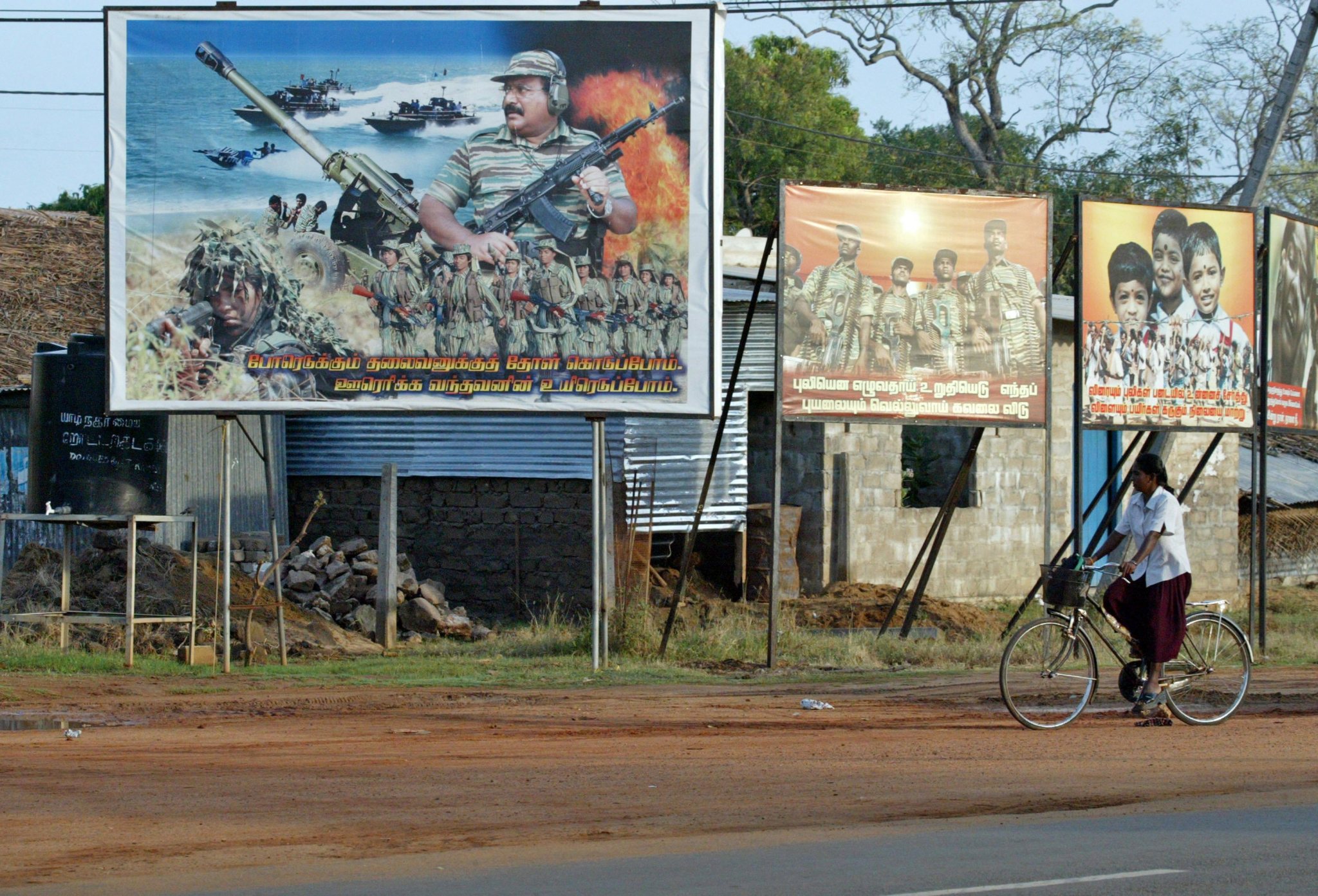
Propaganda billboards in the region of Sri
Lanka controlled by Liberation Tigers of Tamil Eelam, April 22, 2007.
(AP Photo/Gemunu Amarasinghe)
But
wait: the current Liberal government of prime minister Mark Carney
elevated a former sympathizer of the Tigers, MP Gary Anandasangaree, to
the important Cabinet post of Public Safety Minister. The Liberation
Tigers of Tamil Eelam, along with the Tamil Tigers and World Tamil
Movement, are listed terrorist groups in Canada. Minister Anandasangaree
took the step of recusing himself from anything to do with these two
groups, as Public Safety Minister. But it was discovered, that as a
Member of Parliament years previous, he had written a letter in support
of a former Tamil Tiger facing deportation from Canada.
And
nor to overlook the tens of thousands of Syrian refugees brought to
Canada during Syria's 14-year sectarian civil war when former regime
Shia-Alawite President Bashar al-Assad barrel- and chemical-bombed
Syria's Sunni population killing an estimated third of a million
Syrians; years that saw half the population of the country internally
displaced, and millions more seeking haven abroad. These intake refugees
along with a sizeable Palestinian-Canadian population and other Muslim
groups in Canada totalling almost two million have made their presence
known in ongoing street protests against Israel.
Pro-Palestinian protesters chant during a demonstration protesters are
calling a "National March for Palestine" near Parliament Hill (Spencer Colby/The Canadian Press)
Since
the 2023 October 7 incursion of thousands of Palestinian terrorists
from Gaza into southern Israel who embarked on a sadistically savage
rampage of rape, mutilation and mass murder, killing 1,200 Israelis and
kidnapping another 250 children, women, elderly, foreign farm workers
and a number of Israeli IDF members, leading to a military response by
the IDF into Gaza to route out Hamas leaders and operatives, Muslim
groups in Canada, led primarily by Palestinians living in Canada have
harassed Canadian Jews, threatened their security, committed violent
criminal acts and behaved in a manner inconsistent with Canadian values
and justice.
"We're
trying o probe here whether Canadians do have security concerns that
are also driving some of the reticence or hesitation about immigration
right now. My conclusion is that that is the case."
"The
point of the survey is, there is an issue that we need to pay attention
to. If there is a security concern associated with migration right now,
it requires some attention and a need to reassure Canadians that our
government and the responsible departments are taking care of those
issues, are paying attention to those issues if and when they arrive, or
where and when they may arise."
"We're
seeing the degree of trust expressed in refugees as especially low. And
particularly amongst those people who think there are too may
immigrants, the trust of refugees is low, lower than it is normally."
"Whether
you're born in Canada or not born in Canada, or whether you're a
minority or not, this issue around trust, and the perceptions around the
global instability, is affecting our perspectives around migration."
Jack Jedwab, president, chief executive, Association for Canadian Studies and the Metropolis Institute
The
new poll in question conducted nationally for the Association for
Canadian Studies and the Metropolis Institute, found 62 percent of
people polled feel Canada is accepting too many people, over double the
number that expressed those sentiments six year earlier. Only 20
percent disagreed, while 19 percent responded they don't know.
Canadians were asked if they think immigrants can be trusted, and the 52
percent of Canadians who said they can, saw 36 percent responding in
the negative when the issue is that of refugees being trusted -- 20
percent adamant that immigrants cannot be trusted; 23 percent felt the
same about refugees.
For
the question whether there are too many people coming to Canada, among
those who declare there are, 32 percent only, trust immigrants; 28
percent felt they cannot be trusted, and for refugees those numbers were
24 percent trusting; another 32 percent felt they cannot be trusted.
And it is immigrants themselves that agree, by 57 percent, that too many
immigrants are arriving to Canada, near matching the numbers of
non-immigrant responders. Non-white people surveyed saw 61 percent
agreeing there are too many immigrants in comparison to 58 percent of
white people.
"That
polarization is not based on whether you are yourself an immigrant or
you are a minority, it's not. It's transcending that. So the trust issue
is a critical factor. It's just not defined by, as I said, your status
as an immigrant or non-immigrant or as a minority. Those groups of
people are making observations to the same extent across those markers
of identity."
"It
is important that we properly understand what the factors are
underlying the reticence about immigration. So that's where the
importance ... is in trying to establish what the concerns are, how
significant those concerns are, where those concerns are coming from."
"And then, on that basis, to determine how best to address them rather than dismissing them."
Jack Jedwab
The Canadian Citizenship Ceremony -- Still from video
Although Passive in Response, a Majority of Canadians Support Removal of Pro-Hamas Encampments at Canadian Universities
"For
many, they had already made their point, and/or they were not going to
achieve their objective, however it was understood -- which was also
unclear to many Canadians."
"[The protesters' goals and objectives] are being seen as increasingly unclear."
"For
many, the underlying issue was a matter of trust, and the 55-plus group
trusts the university leaders to a much greater extent than they did
the encampment organizers."
"[A]
considerable [49 percent of students in the survey said they didn't
know or preferred not to answer] potentially suggesting a high degree of
stigma associated with taking a position on either side of this."
Jack Jedwab, president, Association for Canadian Studies
According
to a new national poll conducted by Leger for the Association for
Canadian Studies, most Canadians support police having taken down
illegal, disruptive pro-Palestinian encampments at Canadian
universities. Some 70 percent of Canadians surveyed were in agreement
that officials were correct in having police and private security
dismantle an encampment at McGill University and at downtown Victoria
Square in Montreal.
On
the morning of July 5, police in riot gear began to dismantle the camp
at Victoria Square, mere days following the province's public security
minister accusing the city in public of being too passive with the
presence of the protesters in the public arena. Once Victoria Square was
cleared of the encampment, in another five days police and private
security firm agents were at McGill using excavators and front-end
loaders to disassemble about a hundred tents and tarps at the McGill
encampment after over two months of legal battles, counter protests,
accusations of antisemitism and concerns over security risks.
Twice, Quebec courts refused to issue an injunction against the encampments. Finally, flyers promoting a "revolutionary summer program",
ostensibly to 'educate' those not sufficiently imbued with hatred for
Jews and Israel, who needed an additional propaganda boost to venerate
the terrorist group Hamas. The flyers featured photographs of
keffiyeh-wrapped Palestinian fighters with raised rifles.
Members
of the Divest for Palestine Collective had planned and organized the
Victoria Square camp, in an effort to apply pressure on Quebec's pension
fund manager to sever links with Israeli institutions that the group
accused of being complicit in the conflict in Gaza between Hamas and
Israel. Spurred by encampments set up at universities in the United
States, the McGill University encampment was the first to appear in
Canada. Quickly followed by over a dozen other Canadian universities,
including University of British Columbia, University of Toronto and
University of Alberta.
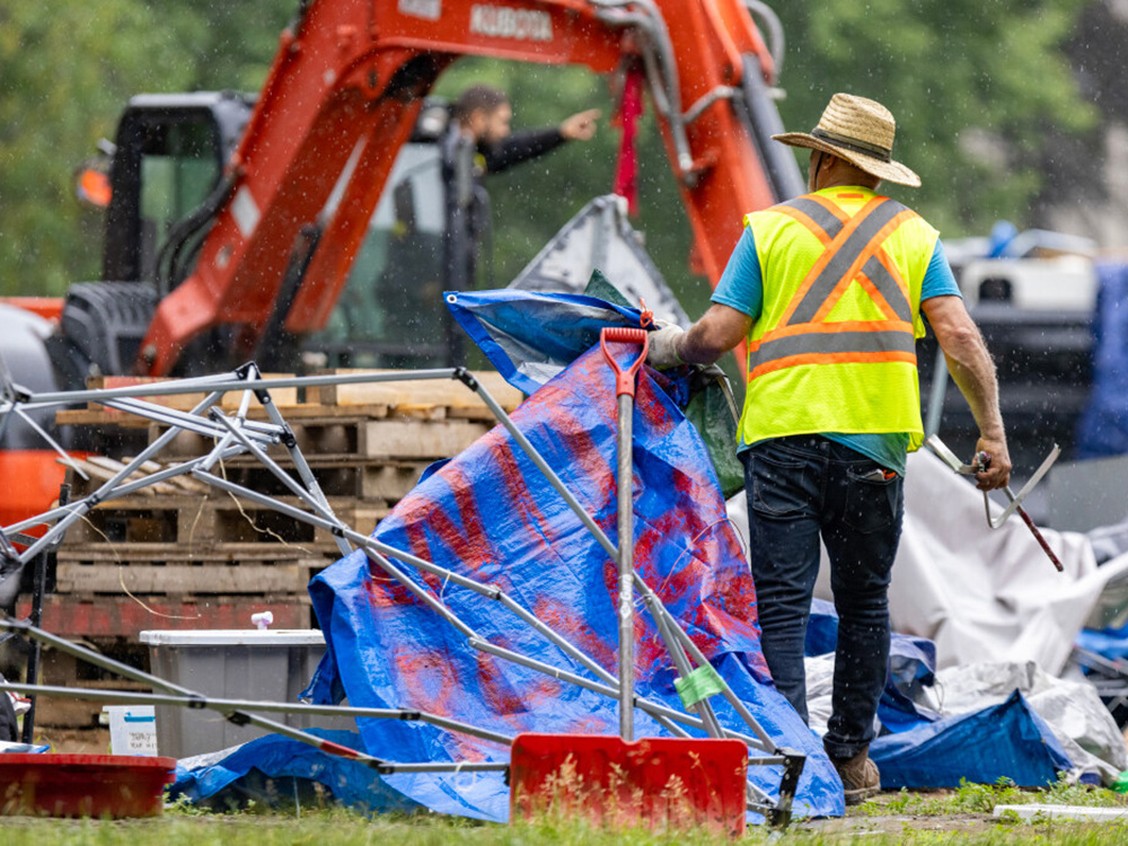
Workers dismantle the anti-Israel encampment at McGill University in Montreal on July 10.Photo by John Mahoney /Montreal Gazette
Demands
were noisily issued that universities cut ties with Israel, end all
collegial arrangements with Israeli universities and divest from any
companies or corporate interests that supply arms to Israel, or which
profit from the war with Hamas. Those protesters enjoyed the support of
19 percent of Canadians, according to earlier Leger polling. McGill and
Victoria Place, according to Jack Jedwab of the Association for Canadian
Studies were seen as valid proxies for public opinion on other
encampments.
A
majority of Canadians over -- 69 percent -- agreed with their removal.
Twice as many students favoured removal of the encampment of those
expressing an opinion, while 40 percent agreed that police were right to
take down encampments, while 18 percent disagreed. 42 percent of
students responded they preferred not to answer, or just did not know.
The degree of opposition to the encampments with just 13 percent of
Canadians of all ages polled disapproving of their removal suggested
protesters increasingly perceived them as disruptive to student life and
the broader community.
The encampment at McGill was described by its vice chancellor Deep Saini as a "heavily fortified focal point for intimidation and violence" organized largely by outsiders who used tactics designed to "threaten, coerce and scare people". Support for encampment removal was highest among Canadians aged 55 and older, with 62 percent reporting they "strongly agree" officials were correct for police and private security to take down the McGill tents.
Nearly half (48 percent)
of 18- to 34-year-olds strongly or somewhat agreed with the removal of
the McGill encampments, even as 24 percent strongly disagreed. Of that
age group, 27 percent said they did not know or preferred not to answer.
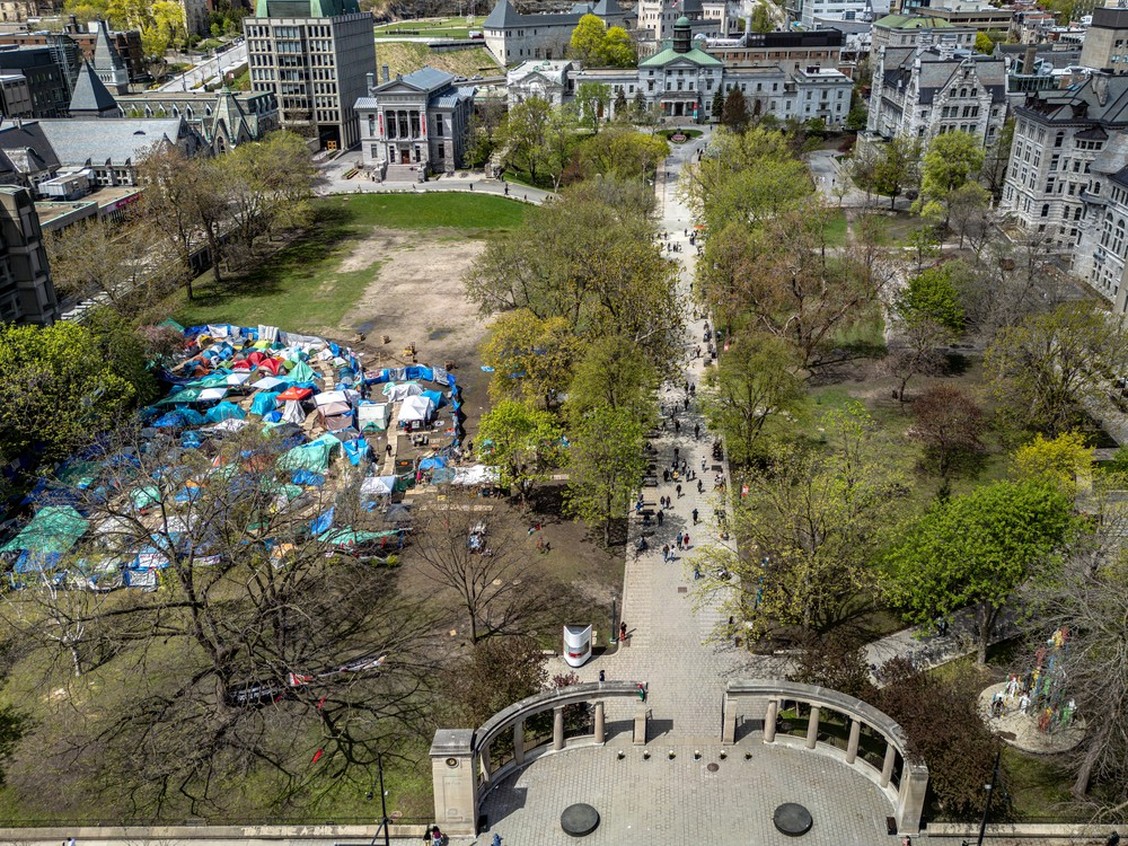
Aerial view of the pro-Palestinian camp on the McGill University campus in downtown Montreal on Thursday, May 9, 2024.Photo by Dave Sidaway /Montreal Gazette
"I
think policy makers and decision-makers need to realize that there are
some very strong sentiments being expressed on these issues [involuntary
addiction treatment, criminal charge bail, decriminalization of
drugs]."
"We're seeing large percentages of people saying things are getting worse."
"I
think there was a perception, correct or not, that safe injection sites
would lead to a solution, and those problems are instead amplified
probably ten-fold from where they were. So there's this frustration of,
'What else can we do. This isn't working'."
Andrew Enns, executive vice-present, Leger Marketing
Little
wonder Canadians are fed up. Inflation is raging, the cost of consumer
goods sky-high, additional taxes on energy linked to the Trudeau
government's environmentalist agenda has sent the price of gas at the
fuel pumps soaring, homelessness is a growing concern, and more people
than ever before are turning to food banks. Canada's once-proud
universal health care system has been gutted; wait times for surgery,
for access to medical specialists have become dangerously inadequate.
The 911 emergency system is collapsing, ambulances are increasingly late
responding to calls, and so are police.
But
the latest poll by Leger Marketing looked at other acute concerns of
Canadians; that of growing crime rates, of growing addiction rates and
consequent deaths from overdosing. Fixes that governments have been
relying on have proven to be failures. Leaving the public frustrated and
angry. And those sentiments of failed government actions in addressing
these societal problems were emphasized on the latest poll.
The
status quo is unacceptable and the response of governments has been
inadequate to say the least. Canadian public opinion was found through
this latest poll to be completely opposite government priorities
channelled through programs that have proven to be worthless. The issues
of bail, involuntary addiction treatment, and the decriminalization of
drugs in a desperate attempt to ease the growing problems in society are
topmost in people's minds behind the cost of living.
A
clear majority of poll respondents agree the Canadian justice system is
mishandling bail, too lenient on violent criminals. Example: the
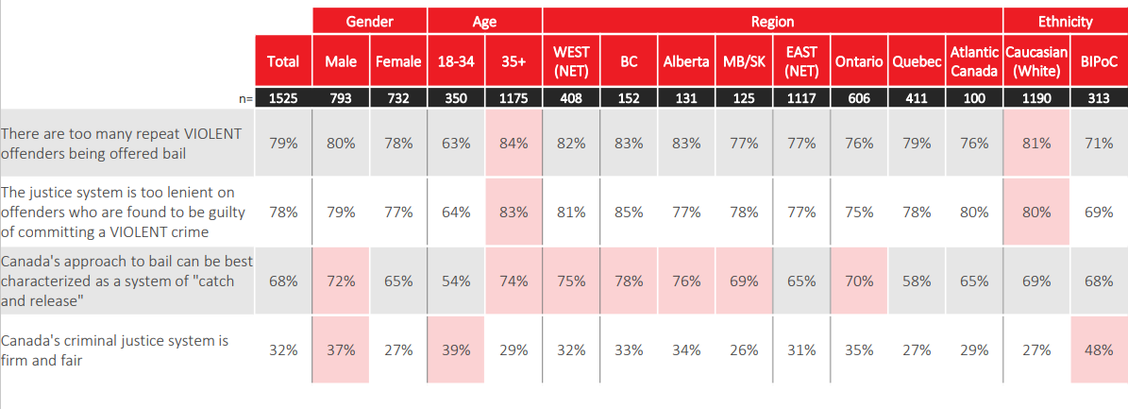
statement "there are too many repeat violent offenders being offered bail" had the agreement of 79 percent of the surveyed. The statement "the justice system is too lenient on offenders who are found to be guilt of committing a violent crime" was endorsed by 79 percent. While less than 32 percent agreed that Canada had a "firm and fair" system of justice.
On
the issue of strengthening bail, solid agreement was seen, with 82
percent of Western Canadians, 77 percent of Eastern Canadians, 80
percent of men, 78 percent of women, 81 percent of white Canadians and
71 percent of BIPOC (Black, Indigenous, People of Colour)
Canadians, reporting that too many violet offenders were given bail.
General agreement was seen on the viewpoint that Canada's top priorities
on criminal justice should be "violent crime", "illegal firearm possession" and "drug and substance abuse".
A
course has been adopted in Canada of setting aside law enforcement from
the equation of drug addiction, prioritizing harm reduction policies
with the like of safe consumption sites. Included was British Columbia's
experiment in decriminalizing personal use quantities of hard drugs
like heroin and cocaine. Canadians indicated a more nuanced view of how
Canada's climbing rates of fatal overdose could be addressed.
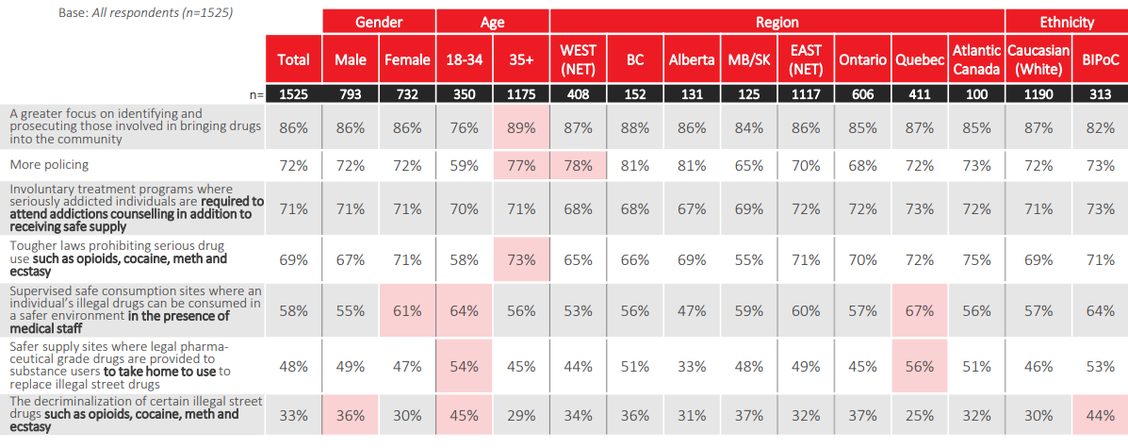
Major support was expressed (58 percent) for "supervised safe consumption sites",
yet almost all respondents wanted to have drug dealers prosecuted and
chronic addicts to be mandated to the necessity of treatment. Over 7 in
ten respondents opted for "more policing" on drugs, the highest being expressed (at 81 percent) in British Columbia, the recognized epicentre of the overdose crisis. Asked should Canada focus on "identifying and prosecuting those involved in bringing drugs into the community", 86 percent agreed.
"There
was one [safe consumption site] when we came into office in 2015, now
there are dozens and dozens and dozens across the country and they are
saving lives significantly", boasted Prime Minister Justin Trudeau. He slammed it as "unfortunate" and "anti-science"
when Alberta began the pursuit of a treatment-centered approach to
address its overdose crisis. His boast is a hollow sham; lethal
overdoses, in the face of 'dozens and dozens' of 'safe injection' sites,
are on a pronounced upward curve. Moreover, the 'safe' opioids handed
out at the sites are leaking onto the streets.
Although
involuntary treatment for chronic addicts has been denounced as extreme
by the Canadian political and public health establishment, it was
endorsed by 71 percent of poll respondents who agreed "involuntary
treatment programs where seriously addicted individuals are required to
attend addiction counselling in addition to receiving safe supply", sounded like a solution.
As
for the criminal justice system reflected by government policy, opinion
polls find majority support for capital punishment which since the
1970s was officially abolished in Canada. Incarceration and detention
issues have hardened in the wake of recent murders and assaults
committed by suspects either on bail or recent early releases from
prison. Random fatal stabbings by people on parole for similar random
attacks infuriate the public.
The
fatal shooting of an Ontario Provincial Police constable by a repeat
violent offender on bail, prompted a letter co-signed by all 13 Canadian
premiers urging the federal government to reform bail (the Trudeau government had loosened bail issues after the previous Conservative-led government had tightened them) and take steps to get violent criminals "off the streets".
Canadian bail policies were described as a system of "catch and release"
by over two-thirds of poll respondents, with white respondents at 69
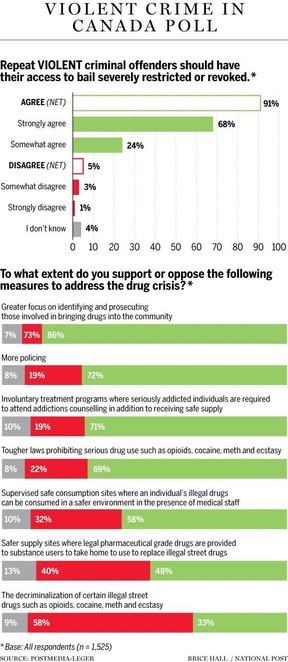
percent and non-white respondents, 68 percent. If offenders keep
committing crimes while on bail, in the opinion of the survey
respondents, stop giving them bail. 92 percent of poll respondents
endorsed the statement "repeat violent criminal offenders should have their access to bail severely restricted or revoked".
Canadians
were generally in agreement that the country’s top priorities on
criminal justice should be “violent crime,” “illegal firearm possession”
and “drug and substance abuse.”Photo by Gavin Young/Postmedia
This represents a general opinion site for its author. It also offers a space for the author to record her experiences and perceptions,both personal and public. This is rendered obvious by the content contained in the blog, but the space is here inviting me to write. And so I do.