Benighted Vaccine Ignorance : Thinning of the Eastern European Population
"It's not a tall tale. I see that this disease kills, and strong immunity wouldn't be enough -- only a vaccine can offer protection.""I'm really scared and I'm pleading with doctors to help me correct my mistake [buying a fake vaccination certificate for his travel documents hauling cargo to European points].""You can't heat this illness. You can buy a counterfeit certificate, but you can't buy antibodies.""Ukrainians are slowly starting to realize there is no alternative to vaccination."Andriy Melnik, truck driver, Kyiv, Ukraine"We're seeing low vaccine uptake in a whole swath of countries across that part of the region [Eastern Europe].""Historical issues around vaccines come to play. In some countries, the whole vaccine issue is politicized."Catherine Smallwood, Europe COVID-19 incident manager, World Health Organization"We are on the verge of catastrophe, pushed by aggressive opponents of vaccination and the lack of funds.""Regrettably, five workers in my ward have quit over the past week."Dr.Serhiy Shvets, head, surgical ward, Biliaivka Hospital, Ukraine
"I'm weeping in despair when I see that 99 percent of patients in serious condition with COVID-19 are unvaccinated, and those people could have protected themselves.""We are left struggling to save them without sufficient drugs and resources.""Fake stories have spread widely, making people believe in microchips and genetic mutations.":Some Orthodox priests have openly and aggressively urged people not to get vaccinated, and social networks have been filled with the most absurd rumours.""Ukrainians have learned to distrust any authorities' initiatives, and vaccination isn't an exclusion."Dr.Olha Kobevko infectious disease specialist, Chernivtsi Hospital, Ukraine
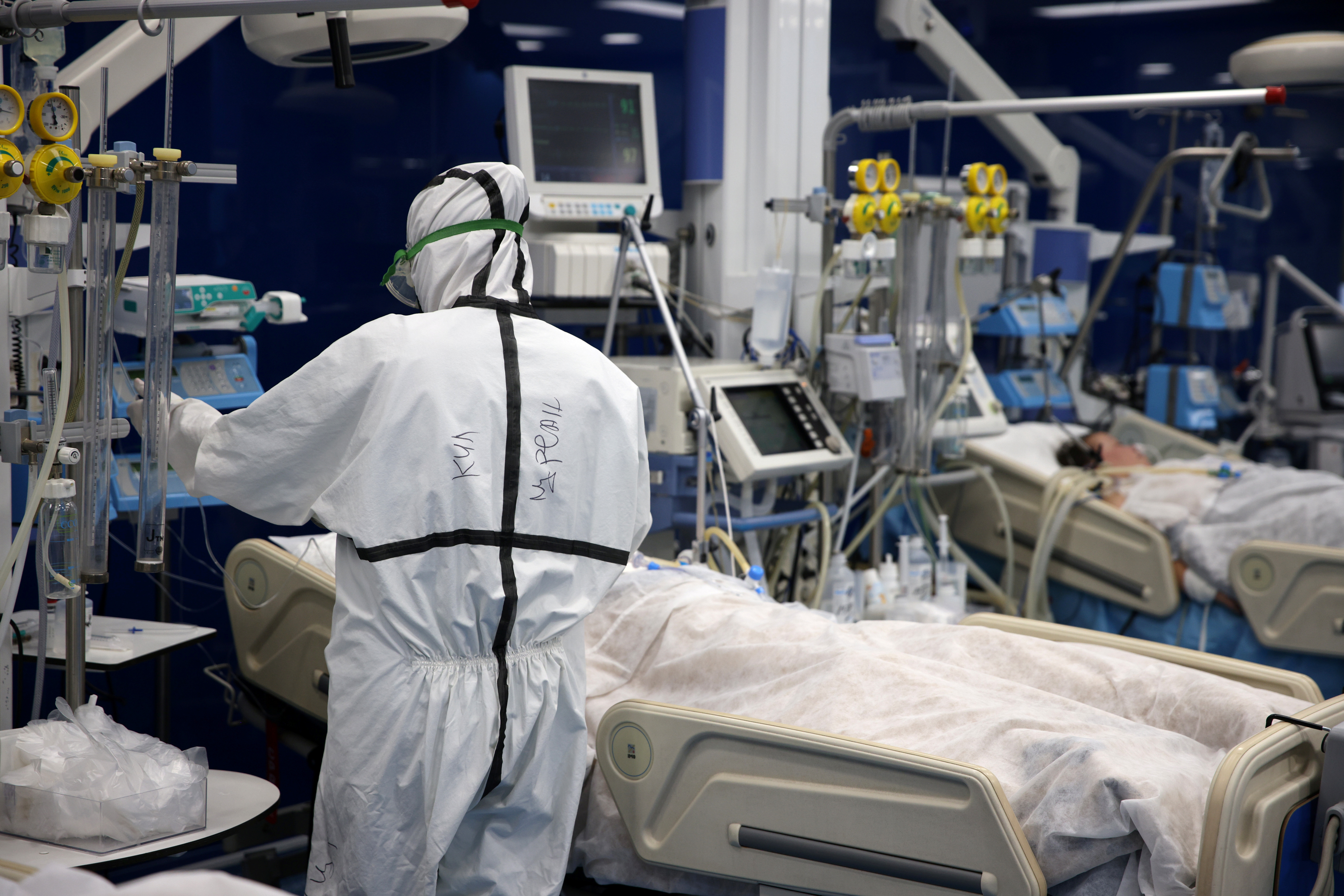 |
| A medic tends to coronavirus disease (COVID-19) patients at the intensive care unit (ICU) of Pirogov hospital in Sofia, Bulgaria, October 15, 2021. Photo: October 15, 2021. REUTERS/Stoyan Nenov |
On
the African continent, populations vulnerable to the SARS-CoV-2 virus
causing COVID in every country have little option over whether or not to
be inoculated against the novel coronavirus. They haven't the
opportunity, since vaccines of any type and origin are scarce, and where
vaccines are available they're short-dated and there is a serious lack
of syringes. The WHO calls this lack of equity. It is the wealthy
countries of the world that are swimming in vaccines.
And
there anti-vaxxers and vaccine-hesitant people in significant numbers
represent the only deterrence to having the majority of any population
inoculated against COVID. The promises made by advanced countries in the
West with ample access to medical equipment and vaccine doses to
provide the WHO vaccine-sharing program Covax with doses for the less
advanced countries of the world are not meeting their obligations. In
Europe there is no shortage of vaccines. The EU is acknowledged as
having a high rate of vaccine coverage altogether.
And
then, there is Eastern Europe, a dismal failure in vaccine uptake by
its populations. Unsurprisingly, as a result of resistance to vaccines,
the countries of Eastern Europe are facing a catastrophic rise of COVID
cases, hospitalizations and deaths. Exceptions to the widespread trend
of vaccine rejection are the Baltic nations, Poland, the Czech Republic,
Slovenia and Hungary. Public distrust is driving a low uptake of
vaccines in other Eastern European countries, however.
 |
| Medical workers carry a patient suspected of having coronavirus on a stretcher at a hospital in Kommunarka, outside Moscow, Russia, Monday, Oct. 11, 2021 AP Photo/Alexander Zemlianichenko |
There were 1,159 recorded COVID-related
deaths in Russia in 24 hours, last week, the largest daily death count
since the beginning of the pandemic. Roughly a third of the country's
146 million population has been fully vaccinated. In response, the
Kremlin ordered a nonworking period to last to November 7. In Hungary
private companies can require their employees to be vaccinated if they
want to retain their employment, and government employees are required
to be be vaccinated.
Poland
reported its highest number of daily infections at over 8,000 last
Thursday. A mere 15 percent of the adult population in Ukraine is fully
vaccinated, representing the second-lowest rate in Europe, following
Armenia's 7 percent. Teachers, government employees and other workers
are required to be fully vaccinated by November 8 in Ukraine to avoid
suspension in pay. People may not board planes, trains or long-distance
buses without proof of vaccination or a negative test.
A
black market in counterfeit documents has emerged with fake vaccination
certificates selling for $100 to $300. Police have opened 800 criminal
cases into workers at 15 hospitals in Ukraine being involved in
counterfeit certificates, with 100 mobile units deployed to track down
users, according to the Interior Minister. Last week, a former lawmaker
was among those arrested. In the western city of Chernivtsi, ten to 23
patients die daily of COVID, with those aged in their 30s and 40s
impacted.
Believing
the rumours that Western vaccines contain microchips to control people,
Lidia Buiko, 72, chose the Chinese Sinovac vaccine: "Priests have urged us to think twice about getting immunized -- it would be impossible to get rid of the chip",
she explained, waiting for her injection in a Kyiv clinic. It is
estimated that roughly half of Ukrainian medical workers express vaccine
reluctance. "The risks of misinformation to vaccination have never been higher; nor have the stakes", commented UNICEF representative in Ukraine Murat Sahin.
About
35 percent of vaccine-eligible adults in Romania are fully immunized
where tighter restrictions are in effect requiring vaccination
certificates for attending a gym, the movies or shopping malls. With a
10 p.m. curfew, shops close at 9 p.m., bars and nightclubs shuttered for
30 days, and masks are mandatory in public.
Bulgaria
has a quarter of its adult population fully vaccinated and reports
record numbers of infections and deaths. Official data identify Bulgaria
with the highest COVID-19 mortality rate in the 27-nation
European Union, with 94 percent of deaths representing the
unvaccinated.Authorities in Georgia launched a lottery of cash prizes to
entice the population to be vaccinated, where 33 percent of the
population has been fully vaccinated.
"[So many are] afraid of the vaccines because of the immense [amount of] fake information that has flooded social media and TV.""Every day we see people arriving with shortness of breath and most of them are feeling sorry for not being vaccinated."Dr.Dragos Zaharia, Marius Nasta Institute of Pneumology, Bucharest"[The government's information campaign] was not designed according to the peculiarities of our country.""The emphasis should have been done, for instance, on the Georgian Orthodox church, because we have many instances when priests are saying that vaccination is a sin."Dr.Bidzina Kulumbegov, Georgia
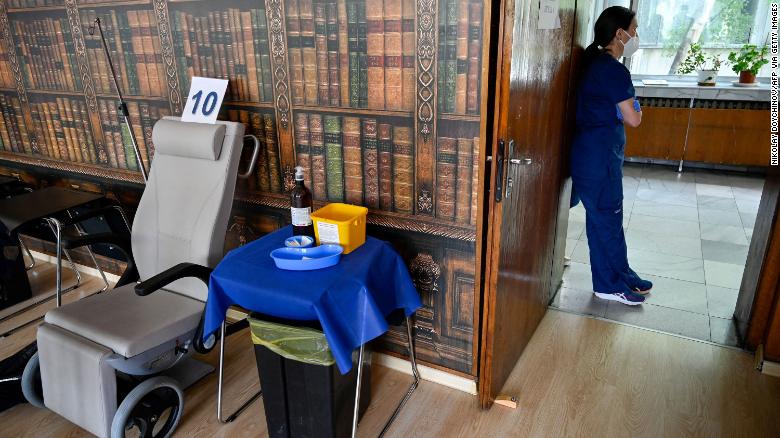 |
| A healthcare worker is waiting for patients at a Covid-19 vaccination centre at The Military Medical Academy in Sofia. |
Labels: COVID-19, Deaths, Eastern Europe, Low Vaccination Rates, Rising Cases
posted by Pieface @ Monday, November 01, 2021


